Monthly summary: Below are all known daily coalition military reports relating to the air war against Islamic State in Iraq and Syria for November 2014. We have also included relevant video and photo releases, as well as indicating where possible civilian or ‘friendly fire’ casualties may have occurred.
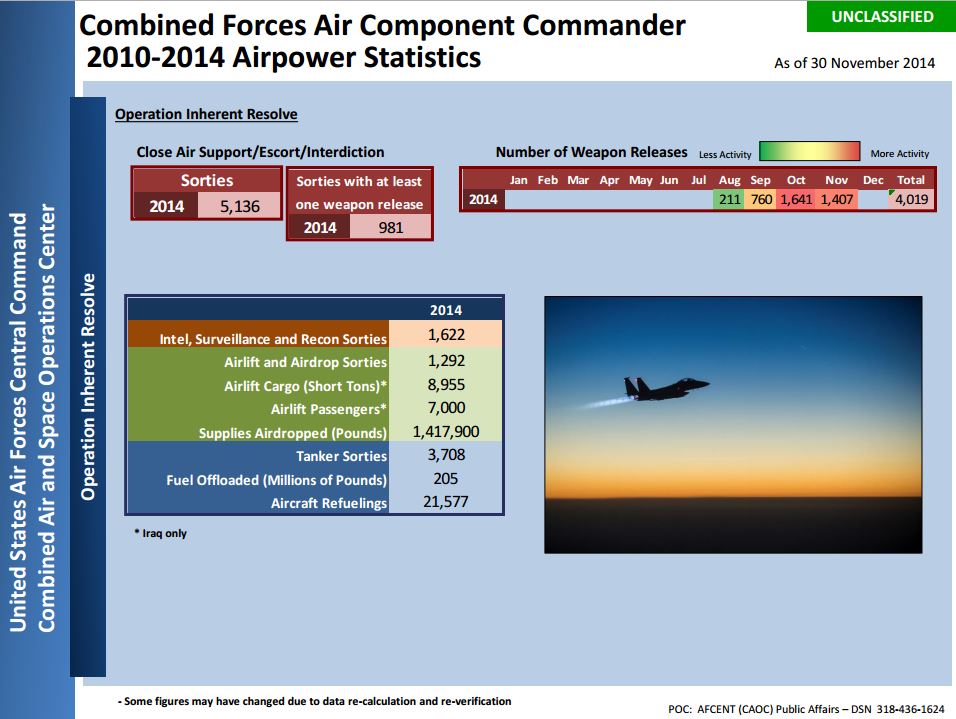
The coalition dropped 1,407 munitions on Iraq and Syria in 358 reported airstrikes. Canada became the final country to join the coalition in Iraq, as strikes continued to target Islamic State. Increasingly, airstrikes were focused on the cities and towns which ISIL was occupying – as well as infrastructure and military materiel.
More than 60 non-combatants were claimed killed in up to 18 incidents across Iraq and Syria, though in most cases any supportive evidence was poor. The coalition continued to deny it had killed any civilians.
NOVEMBER 1st/2nd 2014
Iraq 2 strikes (427-428)
Syria 7 strikes (335-341)
Confirmed actions: US
From CENTCOM:
‘November 2nd: U.S. military forces continued to attack ISIL terrorists in Syria Saturday and today using attack, fighter and bomber aircraft to conduct seven airstrikes. Separately, U.S. and partner nation military forces conducted two airstrikes in Iraq Saturday and today using fighter and remotely-piloted aircraft against ISIL terrorists.
In Syria, five airstrikes conducted near Kobani struck five small ISIL units and destroyed three ISIL vehicles.
Southeast of Dayr Az Zawr, Syria, two airstrikes destroyed an ISIL tank and two vehicle shelters.
In Iraq, one airstrike near Bayji struck a small ISIL unit.
Southeast of Fallujah, Iraq, coalition aircraft also struck a small ISIL unit’

Canadian CF-18 Hornets break away after refueling with a US tanker Nov 1st 2014 ( USAF/SSgt. Perry Aston)
NOVEMBER 2nd-3rd 2014
Iraq 9 strikes (429-437)
Syria 5 strikes (342-346)
Confirmed actions: US, Canada,
From CENTCOM:
‘November 3rd: U.S. and partner nation military forces continued to attack ISIL terrorists in Syria Sunday and today using fighter and bomber aircraft to conduct five airstrikes. Separately, U.S. and partner nation military forces conducted nine airstrikes in Iraq Sunday and today using fighter, bomber and remotely-piloted aircraft against ISIL terrorists.
In Syria, four airstrikes conducted near Kobani that struck an ISIL fighting position, a small ISIL unit and destroyed two buildings.
One airstrike near Dayr Az Zawr damaged an ISIL building.
In Iraq, two airstrikes near Bayji struck an ISIL fighting position, a small ISIL unit and destroyed an ISIL vehicle [British].
Near Fallujah, four airstrikes [1 Canada] struck a large ISIL unit and destroyed five ISIL bulldozers and one ISIL dump truck involved in creating obstructions and berms.
Three airstrikes near Ar Rutbah damaged one ISIL vehicle and destroyed four ISIL vehicles.’
From Canadian MoD:
[Canada becomes 8th member of international alliance to carry out airstrikes in Iraq.]
‘November 2nd 2014: The Honourable Rob Nicholson, P.C., Q.C., M.P. for Niagara Falls and Minister of National Defence, issued the following statement: “Today, Canada’s CF-18s conducted their first combat strike since joining the fight against ISIL on October 30. Coordinated with our coalition partners, two CF-18s attacked ISIL targets with GBU12 500 lb laser guided bombs in the vicinity of Fallujah, Iraq.
The approximately four hour mission included air-to-air refueling from Canada’s Polaris aircraft. All aircraft returned safely to their base.”‘
From Lt Gen Jon Vance, Commander, Canadian JOC:
‘On the 2nd of November, on Sunday, CF-18 Hornets conducted Canada’s first combat air strike on ISIL targets. The four targets were located near a dam west of Fallujah and consisted of heavy engineering equipment and vehicles. They were being used to divert water from the Euphrates River to create flooding and displace the population in Anbar province while also denying water to other populations downstream. By flooding certain areas, ISIL forced civilians and Iraqi security force members to use specific roads where they had placed improvised explosive devices, or IEDs. Additionally, the heavy engineering vehicles were being used to develop and enhance their defensive positions, which would have made future clearing operations for the Iraqi security forces more difficult.
You’ll see in the image behind me, ISIL was using the heavy engineering equipment to interfere with the flow of the dam. Our forces worked with the Combined Air Operations Centre, the CAOC, and coalition targeting assets during the approximate four-hour flight. Five-hundred pound laser-guided bombs destroyed and damaged the heavy engineering equipment and vehicles identified and removed them from further employment. The destruction of ISIL’s equipment in this case means that they will not be able to use the Euphrates River against the population in Anbar province. The attacks also assured the removal of heavy equipment necessary to develop those defensive positions I told you about.”‘
Briefing by Lt Gen Jon Vance, Nov 4th 2014.
From Netherlands MoD:
[Reports 16 new missions for its F-16 aircraft, during which bombs were dropped and the nose cannon fired.]
Nederlandse F-16’s voerden 16 missies uit boven Irak en bombardeerden doelen van terreurorganisatie ISIS. Ook namen de vliegtuigen doelen onder vuur met het boordkanon. Een overzicht van Defensie-operaties in de week van 27 oktober tot en met 2 november.
De jachtvliegtuigen schakelden tijdens deze missies verschillende doelen uit, waaronder materieelcomplexen, voertuigen en strijders van ISIS.’
Airwars Note: Between November 3rd and December 17th 2014, CENTCOM shifted from daily reporting to issuing reports every two days – and three days at weekends. Daily reporting then resumed under CJTF-OIR.
NOVEMBER 3rd-5th 2014
Iraq 10 strikes (438-447)
Syria 4 strikes (347-350)
Confirmed actions: US, Belgium, UK
3 to 15 civilians reported killed Nov 4th at Al Qaim, Iraq
From CENTCOM:
‘November 5th: U.S. military forces continued to attack ISIL terrorists in Syria Nov. 3-5 using attack and fighter aircraft to conduct four airstrikes. Separately, U.S. and partner nation military forces conducted ten airstrikes in Iraq Nov. 3-5 using fighter, attack and remotely-piloted aircraft against ISIL terrorists.
In Syria, three airstrikes conducted near Kobani struck a small ISIL unit, two ISIL fighting positions and an ISIL dump truck used to construct fighting positions.
One airstrike in Syria north of Sinjar destroyed an ISIL fighting position used to launch mortar attacks and struck a small ISIL unit manning the position.
In Iraq, an airstrike near Mosul destroyed ISIL-occupied buildings, to include one housing a generator used for oil production and another [Belgian] used to manufacture explosive devices such as IEDS and VBIEDs.
Three airstrikes near Bayji [1 UK] struck two small ISIL units, destroyed an ISIL vehicle, an ISIL-occupied bunker and an ISIL anti-aircraft artillery piece.
One airstrike near Fallujah struck a small ISIL unit and destroyed an ISIL vehicle.
Three airstrikes in the vicinity of Ramadi damaged an ISIL vehicle and destroyed an ISIL checkpoint.
Two airstrikes north of Sinjar, Iraq, [possibly strike below?] struck a small ISIL unit and destroyed an ISIL armored vehicle.’
From Belgian MoD:
[Belgium reports participation in a mass raid at Mosul where 2 of its F-16s joined six other colaition aircraft in targetign an ISIL ‘IED factory.]
‘In de nacht van 3 november vernietigden twee Belgische F-16’s en zes andere vliegtuigen een fabriek in het noorden van Irak, waar de terreurgroep Islamitische Staat (IS) geïmproviseerde springtuigen vervaardigde. Tijdens die opdracht hadden de Belgen de leiding over zes andere toestellen van de internationale coalitie.
Tijdens een persconferentie op vrijdag 7 november gaf de nieuwe commandant van de Luchtcomponent, generaal-majoor vlieger Frederik Vansina, meer uitleg over de opdracht. Uit inlichtingenrapporten verzameld door onbemande vliegtuigen van de coalitielanden bleek dat IS een verlaten Iraakse fabriek gebruikte voor de productie van geïmproviseerde springtuigen. “IS is een goed georganiseerde vijand”, zei generaal Vansina. “Het gebeurt zelden dat ze in grote getalen samenkomen. Hier was dat wel het geval, het was dan ook een kans om hen een zware slag toe te brengen.”
Het was de eerste keer dat het Belgische detachement tijdens operatie Desert Falcon de leiding neemt van een poule van internationale vliegtuigen. De F-16’s vertrokken vanuit Jordanië voor een missie van drie uur, waar ze met gps-gestuurde bommen de fabriek vernietigden. Daarbij viel geen nevenschade. De Belgische F-16’s zijn nu meer dan een maand actief binnen de internationale coalitie in de strijd tegen de Islamitische Staat. De regering verlengde de Belgische deelname aan die operatie eerder al tot het einde van het jaar.
From UK MoD:
‘November 4th 2014: Today has seen further action from Royal Air Force aircraft as they continue to assist the Iraqi Government in their fight against ISIL.
Two Tornado GR4s, flying in support of Iraqi army units in the area surrounding Bayji north of Baghdad, used a Brimstone precision guided missile to successfully destroy an ISIL armed pick-up truck.’
Nov 4th 2014 coalition strike against ‘ISIL bunker’ nr Bayji, Iraq.
NOVEMBER 5th-7th 2014
Iraq strikes 6 (448-453)
Syria 13 strikes (356-368)
Confirmed actions: US
3 civilians reported killed Nov 5th at Dayr ez Zawr, Syria
2 to 6 civilians confirmed killed Nov 5th at Harem, Syria
4 civilians reported killed Nov 5th at Al Qaim, Iraq
3 to 4 civilians reported killed Nov 6th at Mouka, Syria
From CENTCOM:
‘November 7th: U.S. and partner nation military forces continued to attack ISIL terrorists in Syria Nov. 5-7 using fighter, bomber and remotely piloted aircraft to conduct eight airstrikes. Separately, U.S. and partner nation military forces conducted six airstrikes in Iraq Nov. 5-7 using fighter, bomber and remotely-piloted aircraft against ISIL terrorists.
In Syria, seven airstrikes conducted near Kobani struck three small ISIL units, seven ISIL fighting positions and destroyed an ISIL artillery piece.
One airstrike near Tall Abyad destroyed an ISIL weapons stockpile.
In Iraq, an airstrike near Fallujah destroyed two ISIL bulldozers engaged in constructing obstructions.
One airstrike near Bayji struck a small ISIL unit and damaged an ISIL building.
Two airstrikes near Ramadi destroyed an ISIL vehicle.
One airstrike southeast of Fallujah struck a small ISIL unit and destroyed two ISIL vehicles.
One airstrike northwest of Haditha destroyed four ISIL vehicles.’
Additional CENTCOM release:
‘November 6th 2014: U.S. military forces conducted airstrikes last night against five Khorasan Group targets in the vicinity of Sarmada, Syria, using bomber, fighter and remotely piloted aircraft. All aircraft exited the strike areas safely. We are still assessing the outcome of the attack, but have initial indications that it resulted in the intended effects by striking terrorists and destroying or severely damaging several Khorasan Group vehicles and buildings assessed to be meeting and staging areas, IED-making facilities and training facilities. These strikes were undertaken only by U.S. assets.
The Khorasan Group is a term used to refer to a network of Nusrah Front and al-Qa’ida core extremists who share a history of training operatives, facilitating fighters and money, and planning attacks against U.S. and Western targets. These strikes were not in response to the Nusrah Front’s clashes with the Syrian moderate opposition, and they did not target the Nusrah Front as a whole. They were directed at the Khorasan Group whose focus is not on overthrowing the Asad regime or helping the Syrian people. These al-Qa’ida operatives are taking advantage of the Syrian conflict to advance attacks against Western interests.
This network was plotting to attack in Europe or the homeland, and we took decisive action to protect our interests and remove their capability to act. We will continue to take any action necessary to disrupt attack plotting against U.S. interests.’
From Danish MoD:
[Reports 14 new missions since October 27th, resulting in 2 bombs being dropped.]
Missionerne, som de danske fly har deltaget i, har været offensive. Det har i den forgangne periode udelukkende drejet sig om Close Air Support-missioner (CAS), hvor flyene er indsat som luftstøtte til styrker på landjorden. Luftstøtten kan bestå af flere forskellige opgaver, afhængig af hvad der er behov for.
I den seneste periode har de danske fly derfor – som en del af CAS-missionerne – udført en del opgaver inden for det, der kaldes NTISR (Non Traditional Intelligence and Surveillance Reconnaisance). Her overvåger flyene fx bygninger, personer eller køretøjer med det formål at bidrage til koalitionens samlede efterretningsbillede. Ligeledes overvåges også kamphandlinger, hvor flyene så samtidig er klar til at støtte med bomber, hvis det er nødvendigt.
I løbet af de seneste 14 missioner har de danske fly anvendt 2 bomber mod fjendtlige styrker og køretøjer.
Siden første mission den 16. oktober 2014, har det danske bidrag i alt fløjet 41 missioner og anvendt 39 bomber.’

Deputy PM Lodewijk Asscher and Defence Minister Jeanine Hennis-Plasschaert visit Dutch F-16s in the Middle East Nov 6th 2014 (Dutch MoD)
NOVEMBER 7th-10th 2015
Iraq 18 strikes (454-471)
Syria 23 strikes (364-386)
Confirmed strikes: US, UK
2 civilians reported killed Nov 7th at Al Zir, Syria
5 civilians reported killed Nov 7th at Dayr az Zawr, Syria
2 civilians reported killed Nov 7th at Salo, Syria
2 civilians reported killed Nov 8th at Khareeta, Syria
From CENTCOM:
‘November 10th 2014: U.S and partner nation military forces continued to attack ISIL terrorists in Syria Nov. 7-10 using bomber, fighter and remotely piloted aircraft to conduct twenty-three airstrikes. Separately, U.S. and partner nation military forces conducted eighteen airstrikes in Iraq Nov. 7-10 using attack, bomber, fighter and remotely piloted aircraft against ISIL terrorists.
In Syria, thirteen airstrikes conducted near Kobani struck an ISIL vehicle and five small ISIL units and destroyed an ISIL-occupied building used for ammunition stockpile, an ISIL command and control building, seven ISIL fighting positions while damaging two ISIL fighting positions.
Eight airstrikes southeast of Dayr Az Zawr damaged several structures of an ISIL oil collection facility which was used to trans-load oil for the black market.
Two airstrikes east of Dayr Az Zawr damaged an ISIL oil collection point.
In Iraq, seven airstrikes near Bayji [including by UK and Canada- see below] struck three small ISIL units and destroyed an ISIL sniper position and two ISIL vehicles, one which was used for construction.
Three airstrikes in Fallujah struck two small ISIL units, ISIL fighters who were emplacing an improvised explosive device (IED) on a road and destroyed an ISIL vehicle mounted with an anti-aircraft gun.
Three airstrikes near Mosul struck a small ISIL unit and destroyed an ISIL armed truck and a vehicle convoy consisting of ten ISIL armed trucks.
Two airstrikes near Al Qaim destroyed an ISIL armored vehicle and two ISIL checkpoints.
An airstrike 40 km southwest of Haditha destroyed two ISIL Humvees.
An airstrike near Ramadi struck a small ISIL unit.
An airstrike in Ar Rutbah destroyed an ISIL checkpoint.’
From UK MoD:
‘This weekend [November 8th-9th 2014] saw the first air strike by a Royal Air Force Reaper remotely piloted air system (RPAS) as British forces continue to assist the Iraqi Government in their fight against ISIL.
A series of coalition missions were conducted near Bayji, north of Baghdad, where ISIL terrorists were laying improvised explosive devices.
The Reaper RPAS, using procedures identical to those of manned aircraft, successfully attacked the terrorists using a Hellfire missile.
UK Reaper continued to provide intelligence, surveillance and reconnaissance assistance to coalition aircraft which enabled them to conduct further strikes.
In addition, on Sunday morning [November 9th], 2 RAF Tornado GR4s were tasked to investigate suspected ISIL activity near Al Anbar, west of Baghdad.
A single Brimstone missile was used to successfully destroy a shipping container used by the terrorists to store equipment to support extortion and control of the local population.’
From Netherlands MoD:
[Reports 30 new sorties which dropped over 20 bombs on ‘buildings, vehicles and terrorist positions’.]
‘Een overzicht van Defensie-operaties in de week van 3 tot en met 9 november 2014.
Nederlandse F-16’s bombardeerden gebouwen, voertuigen en gevechtsposities van terreurorganisatie ISIS. De toestellen vielen in bijna 30 vluchten meer dan 20 keer aan. Ze schakelden daarbij een onbekend aantal strijders uit.’

Canadian CF-18 in Kuwait ready for combat mission over Iraq, Nov 7th 2014 (Canadian Forces )
NOVEMBER 10th-12th 2014
Iraq 7 strikes (472-478)
Syria 16 strikes (387-402)
Confirmed actions: US, Canada
1 civilian claimed killed Nov 10th at Dayr az Zawr, Syria
1 to 3 civilians reported killed Nov 11th at Ar Raqqah, Syria
2 civilians reported killed Nov 11th at Manbij, Syria
1 civilian reported killed Nov 11th at al Shanan, Syria
From CENTCOM:
‘November 12th 2014: U.S. and partner nation military forces continued to attack ISIL terrorists in Syria Nov. 10-12 using bomber, fighter and remotely piloted aircraft to conduct sixteen airstrikes. Separately, U.S. and partner nation military forces conducted seven airstrikes in Iraq Nov. 10-12 using attack, fighter and remotely piloted aircraft against ISIL terrorists.
In Syria, ten airstrikes conducted near Kobani struck eight small ISIL units, damaged three ISIL fighting positions and destroyed an ISIL logistics facility.
There were two airstrikes south of Al-Haskah damaging a crude oil collection point operated by ISIL.
Three airstrikes northeast of Dayr Az Zawr damaged an ISIL crude oil collection facility.
Near Dayr Az Zawr, one airstrike struck a small ISIL unit and damaged an ISIL vehicle.
In Iraq, two airstrikes near Kirkuk struck a small ISIL unit and a large ISIL unit.
Five airstrikes near Bayji struck three small ISIL units, one large ISIL unit and destroyed two ISIL buildings, an ISIL sniper position, two ISIL vehicles, an ISIL mortar tube and an ISIL artillery piece [1 Canadian].’
From Canadian MoD
‘Briefing from Colonel Daniel Constable, Commander Joint Task Force: “On November 11th, CF-188s engaged ISIL along the northern ISIL supply line that I spoke to earlier, near the town of Baiji, some 200 kilometres northwest of Baghdad. As you can see in the video provided on the Canadian Armed Forces website, an ISIL artillery piece was destroyed using a laser-guided munition. Baiji is an area where the Iraqi security forces are battling ISIL.
This strike was part of a greater coalition effort and in this particular area the strike on the artillery piece was a continuation of other engagements against ISIL. This artillery piece was initially spotted in a tree line from where it had been firing at Iraqi forces.”’
Canadians target ‘ISIL artillery piece,’ Bayji, Iraq Nov 11th 2014.
NOVEMBER 12th-14th 2014
Iraq 16 strikes (479-494)
Syria 20 strikes (403-422)
Confirmed actions: US, UK, France, Belgium
7 civilians reported killed Nov 12th at Mosul, Iraq
3 civilians reported killed Nov 13th at Al Hassakah, Syria
From CENTCOM:
‘November 14th: U.S and partner nation military forces continued to attack ISIL terrorists in Syria Nov. 12-14 using bomber, fighter and remotely piloted aircraft to conduct 19 airstrikes against ISIL and one U.S. airstrike against a network of veteran al-Qa’ida operatives, sometimes called the “Khorasan Group.” Separately, U.S. and partner nation military forces conducted 16 airstrikes in Iraq Nov. 12-14 using attack, bomber, fighter, and remotely piloted aircraft against ISIL
terrorists.
In Syria, 17 airstrikes conducted near Kobani struck 10 ISIL units, destroyed ten fighting positions, an ISIL building, two ISIL vehicles, and an ISIL motorcycle.
An airstrike east of Ar Raqqah destroyed an ISIL training camp.
Another airstrike east of Dayr Az Zawr destroyed an ISIL oil collection point.
Finally, in northwest Syria west of Aleppo, a U.S. airstrike struck terrorists associated with a network of veteran Al Qaeda operatives, sometimes called the “Khorasan Group,” who are plotting external attacks against the United States and our allies.
In Iraq, [6] airstrikes south of Kirkuk struck four small ISIL units and an ISIL vehicle [including 3 by France].
Two airstrikes west of Kirkuk struck two small ISIL units, destroyed an ISIL heavy machine gun, an ISIL weapons bunker, and an ISIL vehicle [UK strikes].
One airstrike west of Taji destroyed three ISIL vehicles.
Two airstrikes near Ar Rutbah destroyed 13 ISIL vehicles and two ISIL excavators.
Three airstrikes near Bayji struck two small ISIL units and destroyed one ISIL vehicle.
An airstrike near Fallujah struck a large ISIL unit.
Finally, one airstrike east of Mosul, Iraq, destroyed one small ISIL unit.’
From UK MoD:
‘Last night [November 13th 2014] a Royal Air Force (RAF) Reaper remotely piloted air system was involved in a coalition air strike in the Kirkuk region. The Reaper had been tasked to conduct reconnaissance in an area where Iraqi forces had encountered ISIL fighters.
The operators were able to use the Reaper’s advanced systems to identify a number of ISIL positions, enabling another Coalition aircraft to attack a command post, bunker, observation post and two armed pick-up trucks. They then identified a further 3 positions, and, having carefully checked the area, conducted attacks using the Reaper’s own Hellfire missiles. Initial analysis indicates that the attacks were successful.’
Additional UK MoD report:
[The RAF later added two further strikes for the night of November 13th, though this copy is presently deleted.]
‘On Thursday evening, Kurdish peshmerga reported coming under fire from a dug-in machine-gun position. An RAF Reaper remotely piloted air system succeeded in locating the ISIL position, and attacked it with a Hellfire missile. The crew operating the Reaper then identified further ISIL positions, allowing another coalition aircraft to conduct an attack.
Before the end of its patrol, the Reaper crew used another Hellfire to engage an ISIL checkpoint set up to control a road.
Elsewhere in Iraq, another Reaper, investigating reported ISIL activity in response to advancing Iraqi forces, identified terrorists boarding a truck. Despite the vehicle moving off at high speed, the Reaper crew were able to hit it with a Hellfire.’
From French MoD:
[France reports 3 new airstrikes in the Kirkuk area, using GBU-12 munitions.]
‘Le 14 novembre 2014, la force Chammal a porté trois nouvelles frappes contre des positions de Daech depuis lesquelles ces terroristes menaient des actions offensives contre les forces de sécurité irakiennes dans le nord du pays.
Dans la matinée, alors qu’elle était en mission de reconnaissance armée, une patrouille de deux Rafale a été orientée par le centre opérationnel aérien (CAOC) sur une mission d’opportunité dans la région de Kirkouk, entre Bagdad et Mossoul. Il s’agissait de détruire des positions de combat depuis lesquelles des terroristes du groupe autoproclamé Daech ouvraient le feu sur les forces de sécurité irakiennes.
Au cours de cette mission, la patrouille a délivré plusieurs bombes guidées laser (GBU12) sur des positions de Daech. L’action des avions français a ainsi permis la destruction d’un bunker abritant des combattants terroristes, du matériel servant à la fortification de leur poste, ainsi qu’un second poste de combat.’
From Belgium MoD:
NOVEMBER 14th-17th 2014
Iraq 20 strikes (495-514)
Syria 11 strikes (423-433)
Confirmed actions: US,
From CENTCOM:
‘November 17th 2014: US military forces continued to attack ISIL terrorists in Syria Nov. 14-17 using fighter and bomber aircraft to conduct eleven airstrikes. Separately, U.S. and partner nation military forces conducted 20 airstrikes in Iraq Nov. 14-17 using attack, bomber, fighter and remotely piloted aircraft against ISIL terrorists.
In Syria, nine airstrikes near Kobani destroyed seven ISIL fighting positions, suppressed another ISIL fighting position, destroyed four ISIL staging areas, and struck one tactical ISIL unit.
Two airstrikes near Dayr Az Zawr struck an ISIL crude oil collection facility and destroyed one ISIL tank.
In Iraq, four airstrikes near Ar Rutbah [including 1 by UK] destroyed nine ISIL trucks, two ISIL excavators and one ISIL front-loader, and damaged one ISIL vehicle.
Three airstrikes near Fallujah destroyed two ISIL vehicles, one ISIL bulldozer and one ISIL front-loader.
One airstrike southwest of Mosul Dam [carried out by UK – see below] destroyed one ISIL bulldozer and struck one tactical ISIL unit.
Two airstrikes west of Mosul struck two ISIL tactical units and destroyed one ISIL vehicle and an ISIL fighting position.
Three airstrikes near Kirkuk struck one tactical ISIL unit, and damaged one ISIL tank and destroyed another.
One airstrike southwest of Al Qaim destroyed one ISIL vehicle.
One airstrike in Tel Afar struck one tactical ISIL unit.
Five airstrikes near Bayji struck two tactical ISIL units and one large ISIL unit and destroyed one ISIL tank, one ISIL vehicle, and four ISIL fighting positions.’
From UK MoD:
‘On Saturday night [November 15th 2014], Tornado GR4s conducted an armed reconnaissance patrol over western and northern Iraq, supported by a Voyager refuelling tanker. In the western desert, they were tasked to strike an ISIL communications vehicle, which coalition forces had previously identified. A single Brimstone missile was used to conduct an attack.
Later in the patrol, the Tornados were called north to the Mosul area to support Kurdish peshmerga who were under fire from ISIL heavy weapons. Paveway precision guided bombs were used to hit a mortar and firing positions, as well as a bulldozer which the terrorists were using to construct defences against the peshmerga’s advance.’
From Danish MoD:
[November 6th – November 17th summary: Denmark reports 20 new missions, in which 3 additional bombs were dropped. Overall it reports 61 missions which have dropped 42 bombs since October 16th.]
‘Der bliver til stadighed fløjet mange missioner. De danske fly er ofte indsat i overvågningsmissioner, hvor fokus er på indsamling af data – altså billeder taget med det fotoudstyr, som de danske F-16-kampfly har med på missionerne. Det er både flyets måludpegningsudstyr og en særlig “Reccepod”, som bruges. Flyene overvåger blandt andet bygninger, personer eller køretøjer med det formål at bidrage til koalitionens samlede efterretningsbillede. Flyene overvåger også kamphandlinger. Her er flyene samtidig klar til at støtte med bomber, når det er nødvendigt, hvilket også er sket i den forgangne periode.
Missionerne, som de danske fly har deltaget i, er stadig at betragte som offensive. Når der ikke er blevet fløjet overvågningsmissioner, har det været Close Air Support-missioner (CAS), hvor flyene er indsat som luftstøtte til styrker på landjorden. Luftstøtten kan bestå af flere forskellige opgaver, afhængig af hvad der er behov for.
I løbet af de seneste 20 missioner har de danske fly anvendt tre bomber mod fjendtlige styrker og køretøjer.
Fra første mission til den 17. november klokken 8.00 har det danske bidrag i alt fløjet 61 missioner og anvendt 42 bomber.’
From Netherlands MoD:
[Reports 10 new missions in Iraq which ‘destroyed multiple ISIS terror targets.]
‘Een overzicht van Defensie-operaties van 10 tot en met 16 november.
Nederlandse F-16’s van de Air Task Force Middle East vlogen meer dan 10 missies boven Irak. Ze vernietigden daarbij meerdere doelen van terreurorganisatie ISIS.’
RAF Tornados destroy ‘ISIL communications vehicle,’
Western Desert, Nov 15th 2014.
NOVEMBER 17th-19th 2014
Iraq 24 strikes (515-538)
Syria 7 strikes (434-440)
Confirmed actions: US, France, UK, Canada, Belgium
16 civilians reported killed Nov 17th at Qayyarah, Mosul, Iraq
From CENTCOM:
‘November 19th 2014: U.S. and partner nation military forces continued to attack ISIL terrorists in Syria Nov. 17-19 using fighter and bomber aircraft to conduct six airstrikes against ISIL and one U.S. airstrike against a network of veteran Al Qaeda operatives, sometimes called the “Khorasan Group.” Separately, U.S. and partner nation military forces conducted 24 airstrikes in Iraq Nov. 17-19 using attack, fighter, bomber and remotely piloted aircraft against ISIL terrorists.
In Syria, five airstrikes near Kobani destroyed one ISIL fighting position, an ISIL staging area, three ISIL occupied buildings, suppressed two ISIL fighting positions and struck two tactical and one large ISIL unit.
One airstrike southeast of Al-Hasakah damaged a crude oil collection point operated by ISIL.
Finally, in northwest Syria near Haram, a U.S. airstrike struck and destroyed a storage facility associated with a network of veteran Al Qaeda operatives, sometimes called the “Khorasan Group,” whose members are plotting external attacks against the United States and its allies.
In Iraq, thirteen airstrikes near Kirkuk destroyed two ISIL fighting positions [Canada], seven ISIL staging areas, one ISIL mortar position, an ISIL bulldozer and front-loader.
Seven airstrikes near Mosul struck five ISIL tactical units, damaged an IED factory [Canada] and destroyed an ISIL mortar position, three ISIL vehicles, an ISIL occupied building, an ISIL artillery piece and ISIL artillery mover.
Three airstrikes near Bayji struck three ISIL tactical units and destroyed an ISIL occupied building and an ISIL vehicle.
One airstrike near Fallujah struck an ISIL tactical unit.’
From French MoD:
[France reports a heavy early morning airstrke against ISIL defensive positions near Kirkuk, intended to allow Iraqi forces to advance.]
‘Dans la nuit du 18 au 19 novembre 2014, la force Chammal a contribué à un raid aérien effectué contre des positions de retranchement de l’organisation terroriste Daech, au sud de Mossoul, dans la région de Kirkouk, en Irak.
Le renseignement collecté par la coalition depuis le début de l’opération a permis de planifier une mission de bombardement contre un site défensif de l’organisation terroriste. Aux environs de 4h30 ce matin, heure de Paris, les deux Rafale français, armés chacun de quatre bombes AASM, ont ciblé un ensemble de tranchées utilisées par Daech pour tenir le siège de Kirkouk. Cette action a été complétée par des frappes simultanées de nos alliés, permettant de créer une brèche dans le système défensif des terroristes au niveau de la ligne de front entre les forces irakiennes et les combattants du groupe autoproclamé Daech.
C’est dans cette même zone que les avions français avaient appuyé les troupes irakiennes par des frappes d’opportunité réalisées le 14 novembre.
Les militaires de la force Chammal poursuivent quotidiennement leurs missions de reconnaissance armée et de renseignement, afin d’appuyer l’action des forces armées irakiennes au sol.’

French image of a strike against ‘Daesh defensive positions’ near Kirkuk, Iraq November 18th-19th 2014 (Ministère de la Défense )
From French MoD for 18 Nov:
[Reports that on 15 Nov an E-3F AWACS Air Force returned to France after three weeks engaged in Iraq.]
‘ Chammal : 10 000 mètres au-dessus de l’Irak, à bord de l’E-3F AWACS
Ajouter aux favoris
Partager
Mise à jour : 18/11/2014 14:31
Alors qu’il est rentré en France le 15 novembre, un E-3F AWACS de l’armée de l’Air a participé durant trois semaines au dispositif aérien de la coalition internationale engagée en Irak. L’équipage intégré à la force Chammal a effectué son premier vol opérationnel le 27 octobre. Au cours de ses missions, d’une durée moyenne de 9 heures au-dessus de l’Irak, l’E-3F AWACS a assuré la fonction C2 (command and control) des aéronefs de la coalition, en collaboration avec ses homologues des pays alliés.
Placé sous le contrôle opérationnel du général américain à la tête d’AFCENT, appuyé par l’amiral commandant la zone de l’océan Indien, l’E-3F français s’est intégré sans difficulté dans le dispositif aérien mis en place pour lutter contre Daech.
La mission principale de l’E-3F AWACS consistait à assurer le commandement et la conduite de l’ensemble des aéronefs de la coalition évoluant sur le théâtre. Parfaitement interopérable, il reliait ainsi les moyens aériens au centre de commandement d’Al Udeid au Qatar, permettant de réagir en quelques minutes en appui des forces armées irakiennes.
L’équipage de l’E-3F AWACS déployé se constituait :
Pour l’exécution de la mission :
1 chef de mission
4 personnels assurant le contrôle des moyens aériens
1 officier responsable des capteurs gérant 3 opérateurs pour l’établissement de la situation aérienne
2 opérateurs de guerre électronique
3 techniciens (radar, radio et calculateur) appuyés par 1 opérateur de communication
Pour la mise en œuvre de l’aéronef :
2 pilotes
1 navigateur
1 mécanicien
Pour la maintenance :
une équipe de plusieurs mécaniciens
L’E-3F AWACS a effectué 9 missions au cours de son détachement sur l’opération Chammal.
Les militaires de la force Chammal poursuivent quotidiennement leurs missions de reconnaissance armée et de renseignement, afin d’appuyer l’action des forces armées irakiennes au sol.
Lancée le 19 septembre 2014, l’opération Chammal vise, à la demande du gouvernement irakien et en coordination avec les alliés de la France présents dans la région, à assurer un soutien aérien aux forces armées irakiennes dans leur lutte contre le groupe terroriste autoproclamé Daech.’
From UK MoD:
‘19 November 2014 – RAF aircraft contributed to a major coalition air strike on an extensive ISIL complex of bunkers and tunnels. Aircraft from seven coalition nations conducted a comprehensive and closely coordinated attack on [the] complex early on Wednesday. RAF Tornado GR4 aircraft, carrying Paveway IV precision guided bombs, formed the UK element.
Separately, an RAF Reaper remotely piloted air system (RPAS) was tasked to investigate ISIL activity elsewhere in Iraq. The Reaper’s operators were able to locate a bulldozer which coalition forces confirmed was being used to prepare fighting positions to hold up Iraqi advances. A Hellfire missile was used to attack the bulldozer, which initial reports indicate was destroyed.’
From Canadian MoD:
‘On 17 November 2014, four CF-188 fighter jets, as part of a larger coalition operation, conducted airstrikes against ISIL positions in the vicinity of Mosul in northern Iraq. Our CC-150 Polaris conducted air-to-air refueling and delivered an estimated 28,000 pounds of fuel during this operation. This was Joint Task Force Iraq’s first participation in a deliberate strike. Our fighter aircraft destroyed an ISIL improvised explosive device – commonly referred to as IEDs – factory. The photo behind me shows the factory before it was hit. We know that ISIL is using improvised explosive device to indiscriminately maim or kill civilians and members of the Iraqi security forces. There were approximately 55 IED attacks across Iraq in September and 77 in October.
More recently, on 19 November, a series of coalition missions were conducted to the northwest of Kirkuq where ISIL was known to operate. Two Canadian CF-188 Hornet jets successfully conducted pre-planned strikes against ISIL fighting positions.’
From Belgium MoD:
NOVEMBER 19th-21st 2014
Iraq 23 strikes (539-562)
Syria 7 strikes (441-447)
Confirmed actions: US, UK
41 civilians alleged killed Nov 19th at Mosul, Iraq
From CENTCOM:
‘November 21st 2014: Military airstrikes continue against ISIL in Syria and Iraq. U.S. and partner nation military forces continued to attack ISIL terrorists in Syria Nov. 19-21 using fighter and bomber aircraft to conduct seven airstrikes.
Separately, U.S. and partner nation military forces conducted 23 airstrikes in Iraq Nov. 19-21 using fighter, attack, bomber and remotely-piloted aircraft against ISIL terrorists.
In Syria, six airstrikes near Kobani destroyed four ISIL staging areas, two ISIL-occupied buildings, two ISIL tactical units, and suppressed an ISIL fighting position.
Near Ar Raqqah, an airstrike damaged an ISIL barrack.
In Iraq, six airstrikes near Bayji destroyed three ISIL buildings, a bunker, two ISIL transport vehicles, five ISIL tactical units, an ISIL checkpoint and damaged another ISIL building.
Near Sinjar, four airstrikes destroyed two ISIL barracks, an ISIL bunker and storage facility, an ISIL guard post, at least eight ISIL armored vehicles and a truck in a vehicle storage yard, as well as two tactical ISIL units.
West of Kirkuk, three airstrikes destroyed five bunkers, two ISIL vehicles and an ISIL tactical unit.
Near al Asad, four airstrikes destroyed four ISIL vehicles, an ISIL building, and struck three ISIL tactical units.
Near Mosul, three airstrikes destroyed an ISIL guard post, an ISIL vehicle and two ISIL tactical units.
Near Ramadi, two airstrikes destroyed an ISIL vehicle and an ISIL tactical unit, while also damaging an ISIL armored vehicle and an ISIL-occupied building.
Finally, in Tal Afar, an airstrike damaged an ISIL-occupied airfield.’
From UK MoD:
‘November 21st 2014 – Royal Air Force (RAF) aircraft have conducted further operations in support of the Iraqi Government, helping their ground forces counter ISIL activity in the vicinity of the Bayji oil refinery.
The refinery, north of Baghdad, has been a focus of ISIL activity for several months. An Iraqi unit has mounted a continued defence, with air drops by the coalition keeping them supplied. Iraqi ground forces, supported by coalition aircraft, have been steadily clearing the route to the refinery, despite ISIL’s efforts to stop them.
Last night [November 20th], an RAF Tornado GR4 patrol flew in support of the Iraqi forces in the area, and was tasked to engage ISIL terrorists occupying three buildings within a compound. Each of these positions was struck with a Paveway IV precision guided bomb.
RAF Reaper remotely piloted aircraft were also in action over Iraq, carrying out armed reconnaissance missions. Three ISIL vehicles, in different locations, were positively identified by the crews operating the Reapers and were engaged with Hellfire missiles. Initial analysis indicates that these attacks were successful.’
Coalition strikes ISIL ammunition bunker, Bayji, Iraq Nov 19th 2014.
Coalition targets ‘ISIL bunker’ near Kirkuk, Iraq Nov 19th 2014.
Coalition targets alleged ISIL building Kirkuk, Iraq Nov 19th 2014.
An ‘ISIL tunnel’ is targeted near Kirkuk, Iraq Nov 19th 2014.
NOVEMBER 21st-24th 2014
Iraq 15 strikes (562-576)
Syria 9 strikes (448-456)
Confirmed actions: US
5 to 8 civilians reported killed Nov 22nd at Hit, Iraq
From CENTCOM:
‘November 24th 2014: U.S. and partner nation military forces continued to attack ISIL terrorists in Syria Nov. 21-24 using fighter and bomber aircraft to conduct nine airstrikes. Separately, U.S. and partner nation military forces conducted fifteen airstrikes in Iraq Nov. 21-24 using fighter, attack, bomber and remotely-piloted aircraft against ISIL terrorists.
In Syria, seven airstrikes near Kobani destroyed three ISIL fighting positions and two ISIL staging areas, damaged another ISIL staging area and suppressed four ISIL fighting positions.
Near Ar Raqqah, two airstrikes struck an ISIL headquarters building.
In Iraq, five airstrikes near Mosul destroyed an ISIL checkpoint, three ISIL HMMWVs, a large ISIL unit, two tactical ISIL units and a heavy weapon.
Near al-Asad, two airstrikes destroyed a mortar position, a ISIL artillery piece, an ISIL vehicle and a tactical ISIL unit and damaged an ISIL-occupied building and an ISIL vehicle.
Near Baghdad, two airstrikes destroyed an ISIL-occupied building, three ISIL vehicles, an ISIL HMMWV and two tactical ISIL units, one of which was emplacing IEDs.
Near Ramadi, two airstrikes destroyed two ISIL vehicles.
Near Tal Afar, two airstrikes suppressed a mortar position.
Near Fallujah, an airstrike struck an ISIL obstruction near Fallujah Dam.
Near Hit, an airstrike destroyed an ISIL vehicle.’
From Netherlands MoD:
[During 30 new missions, 20 bombs were dropped in Iraq.]
‘Een overzicht van Defensie-operaties van 17 tot en met 23 november 2014.
Midden-Oosten
Nederlandse F-16’s van de Air Task Force Middle East vlogen meer dan 30 missies boven Irak. Ze gooiden ruim 20 bommen op terreurorganisatie ISIS.
Een KDC-10-transportvliegtuig tankte 2 F-16’s bij op weg naar het Midden-Oosten. Daar losten de jachtvliegtuigen 2 toestellen af die voor onderhoud naar Nederland moesten. De KDC-10 voorzag het terugkerende duo eveneens van brandstof. Nederland levert 6 F16’s voor de internationale strijd tegen ISIS.’
NOVEMBER 24th-26th 2014
Iraq 7 strikes (577-583)
Syria 10 strikes (457-466)
Confirmed actions: US
1 civilian death falsely reported Nov 25th for Bansh, Syria
From CENTCOM:
‘November 26th: U.S. military forces continued to attack ISIL terrorists in Syria Nov. 24-26 using bomber and fighter aircraft to conduct ten airstrikes. Separately, U.S. and partner nation military forces conducted seven airstrikes in Iraq Nov. 24-26 using attack, fighter and remotely-piloted aircraft against ISIL terrorists.
In Syria, ten airstrikes near Kobani struck an ISIL fighting position, a large ISIL unit, two tactical ISIL units, and destroyed four ISIL staging areas and six ISIL fighting positions.
In Iraq, two airstrikes near Mosul destroyed an ISIL bulldozer, two ISIL vehicles, three ISIL-occupied buildings and an ISIL fighting position, and also struck a large ISIL unit.
Near Kirkuk, two airstrikes destroyed an ISIL tank, an ISIL HMMWV and an ISIL vehicle, as well as struck two ISIL units.
North of Sinjar, an airstrike destroyed an ISIL HMMWV and an ISIL vehicle. Northwest of Ramadi, an airstrike damaged an ISIL checkpoint.
Finally, west of Bayji, an airstrike destroyed one ISIL vehicle and damaged another.’
From Danish MoD:
[Reports 13 new missions since November 17th which dropped 18 mbombs, at Fallujah, Tikrit, Bayji, Mosul and Anbar.]
De danske fly har i den forløbne uge deltaget i missioner i områderne omkring Fallujah, Tikrit, Bayji, Mosul samt i Al-Anbar-regionen.
En af de missionstyper, som flyene har gennemført, er Air Interdiction. Her planlægges et specifikt angreb mod et på forhånd defineret mål udførligt og detaljeret hjemmefra, og flyene flyver direkte frem til målet, kaster bomber og flyver retur. Ved denne type missioner har de danske fly primært bombet bygninger.
Derudover har de danske fly i den forgangne periode fortsat gennemført en del Close Air Support-missioner (CAS), hvor flyene er indsat som luftstøtte til styrker på landjorden. Luftstøtten kan bestå af flere forskellige opgaver, afhængig af hvad der er behov for.
CAS-missioner udgør fortsat størstedelen af de 13 gennemførte missioner. Ved CAS-missionerne er der ikke nødvendigvis et på forhånd defineret mål; her bliver flyene indsat til fx at anvende våben, hvis det er nødvendigt.
På nogle af CAS-missionerne har flyene kastet bomber i forbindelse med kamphandlinger på jorden. Her har målene blandt andet været køretøjer og fjendtlige styrker.
På de missioner, hvor flyene ikke har anvendt våben, har de primært bidraget med overvågning og indhentning af efterretninger. På sådanne overvågningsmissioner er flyene dog altid klar til at anvende våben, hvis der er behov for det.
I løbet af de seneste 13 missioner har de danske fly kastet 18 bomber mod fjendtlige styrker, køretøjer og bygninger.
Siden første mission den 16. oktober 2014, har det danske bidrag i alt fløjet 74 missioner og anvendt 60 bomber.’
From French MoD for 26 Nov:
[Reports that on 21 November 2014, the maritime patrol aircraft Atlantique 2 (ATL2) of the Navy made its first flight SCAR-C (Coordination Strike and Reconnaissance – Coordinator) over Iraq.]
‘ Opération Chammal : L’ATL2 étend son champ d’action
Ajouter aux favoris
Partager
Mise à jour : 26/11/2014 15:52
Le 21 novembre 2014, l’avion de patrouille maritime Atlantique 2 (ATL2) de la Marine nationale a effectué son premier vol de SCAR-C (Strike Coordination and Reconnaissance – Coordinator) au-dessus de l’Irak.
Opération Chammal : L’ATL2 étend son champ d’action
L’ATL2, et son FAC-A (Forward Air Controller Airborne), a ainsi été désigné chef de mission d’un dispositif d’Air Interdiction composé de deux patrouilles de F16 américains et danois. Cette mission, qui a déjà prouvé son efficacité lors des opérations Harmattan et Serval, permet d’optimiser les capacités de l’avion et de son équipage dans la conduite des opérations de Dynamic Targeting contre le groupe terroriste Daech.
Lors de cette première sur le théâtre des opérations en Irak, le FAC(A) a coordonné l’action de l’Atlantique 2, des avions de chasse de la coalition et des JTAC (Joint Terminal Attack Controller) du CAOC (Combined Air and space Operation Center) au Qatar afin de détecter, d’identifier et de frapper d’éventuelles cibles d’opportunités.
En complément des missions d’ISR (Intelligence, surveillance and reconnaissance) réalisées depuis le début de l’opération Chammal, l’ATL2 a obtenu la responsabilité de la mission de SCAR-C et devrait régulièrement se voir confier ce type de mission par le CAOC.
Les militaires de la force Chammal poursuivent quotidiennement leurs missions de reconnaissance armée et de renseignement, afin d’appuyer l’action des forces armées irakiennes au sol.’
NOVEMBER 26th-28th 2014
Iraq 13 strikes (584-596)
Syria 2 strikes (467-468)
Confirmed actions: US, UK
From CENTCOM:
‘November 28th 2014 – U.S. military forces continued to attack ISIL terrorists in Syria Nov. 26-28 using bomber and remotely-piloted aircraft to conduct two airstrikes. Separately, U.S. and partner nation military forces conducted thirteen airstrikes in Iraq Nov. 26-28 using fighter, attack, and remotely-piloted aircraft against ISIL terrorists.
In Syria, an airstrike near Kobani struck an ISIL fighting position and an ISIL staging area.
Near Aleppo, an airstrike struck a tactical ISIL unit.
In Iraq, five airstrikes near Kirkuk destroyed five ISIL bunkers, four ISIL vehicles, a bulldozer and an ISIL fighting position and also struck a large ISIL unit and four tactical ISIL units.
Near Mosul, two airstrikes destroyed five ISIL vehicles and a heavy weapon, and also struck two ISIL units.
Near Ramadi, an airstrike struck a tactical ISIL unit.
Near Ar Rutbah, an airstrike destroyed seven ISIL vehicles.
Near Fallujah, an airstrike struck a tactical ISIL unit.
Near Al Qaim, two airstrikes destroyed a fighting position and an armored vehicle.
An airstrike in Bayji struck an ISIL tactical unit, an ISIL vehicle and an ISIL occupied building.’
From UK MoD:
‘November 27th 2014 – British forces have conducted further air missions to assist the Iraqi government’s military operations against the ISIL terrorist organisation.
Royal Air Force (RAF) Tornado GR4s, working in close conjunction with RAF Reaper aircraft, flew over northern Iraq in support of Kurdish peshmerga who have made several advances against ISIL in recent days.
The initial target for the Tornados was an ISIL fighting position, which was struck with Paveway IV guided bombs.
The GR4s then joined the Reaper in a combined attack on a group of 9 ISIL vehicles; a mixture of armoured personnel carriers and armed pick-up trucks.
The group was struck with a combination of Brimstone and Hellfire missiles, and Paveway IV bombs.
During the afternoon of 26 November, another RAF Reaper operating elsewhere in the country was able to assist Iraqi soldiers who were under fire from an ISIL position.’

A Mirage 2000D in Jordan, part of the French anti-ISIL campaign (Ministère de la Défense)
NOVEMBER 28th-DECEMBER 1st 2014
Iraq 28 strikes (597-624)
Syria 27 strikes (469-495)
Confirmed actions: US, France, UK, Canada
From CENTCOM:
‘December 1st 2014: U.S. military forces continued to attack ISIL terrorists in Syria Nov. 28-Dec. 1 using fighter, bomber and remotely-piloted aircraft to conduct 27 airstrikes. Separately, U.S. and partner nation military forces conducted 28 airstrikes in Iraq Nov. 28 – Dec. 1 using attack, fighter, and remotely-piloted aircraft against ISIL terrorists.
In Syria, 17 airstrikes near Kobani destroyed two ISIL-occupied buildings, three ISIL tanks, three ISIL fighting positions, an ISIL armored personnel carrier, three ISIL vehicles and two ISIL staging areas, and also struck seven tactical ISIL units. The airstrikes also targeted six ISIL fighting positions and damaged an ISIL-occupied building.
Near Ar Raqqah, nine airstrikes struck an ISIL electronic warfare garrison, an ISIL military garrison, an ISIL headquarters, an ISIL jamming system, an ISIL tank and 14 ISIL vehicles.
Near Aleppo, a U.S. airstrike struck a target associated with a network of veteran al Qa’ida operatives, sometimes called the “Khorasan Group.”
In Iraq, 13 airstrikes near Mosul destroyed four tactical ISIL units, two large ISIL units, two fighting positions, three armored vehicles, seven vehicles, two ISIL trucks and a bulldozer. Additionally, these airstrikes destroyed heavy weapons to include two heavy machine guns, a mortar position and an anti-aircraft artillery emplacement as well as an ISIL-occupied building and a tunnel entrance [includes Canada].
Near Sinjar, an airstrike destroyed two ISIL-occupied buildings [French].
Near Tal Afar, five airstrikes destroyed 19 ISIL vehicles, two ISIL bunkers, an ISIL compound and struck a tactical ISIL unit [British].
Near Hit, three airstrikes destroyed an ISIL checkpoint, an ISIL bunker, and an excavator and struck a tactical ISIL unit and also damaged another ISIL checkpoint [with Canada].
Near Tal Talab, two airstrikes destroyed three ISIL fighting positions and struck a tactical ISIL unit.
Near Tirkrit, two airstrikes destroyed three ISIL vehicles and struck two large ISIL units [British].
Near Kirkuk, an airstrike destroyed an ISIL vehicle.
Near Ramadi, an airstrike destroyed an ISIL vehicle and struck a tactical ISIL unit.’
From French MoD:
[France reports that it struck ‘a terrorist checkpoint southwest of Mount Sinjar, a besieged area that is regularly subjected to attacks by Daesh.]
‘Le lundi 1er décembre 2014, à 8h30 heure de Paris, une patrouille de reconnaissance armée de deux avions de chasse a bombardé une position du groupe terroriste autoproclamé Daesh.
Les équipages ont décollé dans la nuit afin d’assurer une mission planifiée d’appui aérien aux forces de sécurité irakiennes dans le nord de l’Irak. uelques heures auparavant, les moyens de la coalition avaient repéré un check-point terroriste au sud-ouest du Mont Sinjar, une zone en état de siège qui fait régulièrement l’objet d’assauts de la part des groupes de Daech.
Après avoir été orientés sur zone par le CAOC (Centre des opérations aériennes), les Rafaleéquipés de bombes guidées laser et de pod de désignation ont procédé à l’identification des objectifs et confirmé la présence d’un poste de contrôle aux mains de Daech.
Les équipages ont immédiatement neutralisé la menace. Les Rafale de la patrouille ont chacun délivré et guidé une bombe GBU12 afin de détruire les deux structures qui constituaient le check-point tenu par l’organisation terroriste.’
From UK MoD:
‘1st December 2014 – A Tornado GR4 patrol investigated a reported ISIL compound near Tal Afar in north-western Iraq and found a group of armoured personnel carriers. These were successfully attacked using Brimstone missiles.
A further pair of Tornado GR4s came to the support of Iraqi forces engaged in a major firefight with ISIL near Tikrit. Two terrorist positions were identified and the precision of the Brimstone missile system allowed both targets to be engaged without risk to friendly forces.
Meanwhile, an RAF Reaper remotely piloted aircraft on a separate patrol was able to attack 3 ISIL positions with Hellfire missiles.
Another Reaper conducted a reconnaissance patrol in northern Iraq. Two ISIL positions and a vehicle were located by the Reaper’s crew, allowing coalition fast jets to conduct strikes on each in turn. The Reaper then identified a further ISIL position and engaged it with 1 of its own Hellfire missiles.’
From Canadian MoD:
‘On 28 November 2014, coalition missions were conducted in support of Iraqi security forces ground operations in the vicinity of Hit, Anbar Province. Canadian CF-188 Hornets struck an ISIL position using precision-guided munitions.
On 30 November 2014, coalition missions were conducted in an ISIL-controlled area, south-south-east of Mosul, in support of Iraqi security forces ground operations in the area. Canadian CF-188 Hornets struck ISIL positions using precision-guided munitions. Striking ISIL fighting positions degrades ISIL fighting capabilities and supports the Iraqi security forces’ freedom of movement in the region.’
From Netherlands MoD:
[Reports that during 20 new missions, 18 bombs were dropped and the onboard cannon was additionally employed five times.]
For the week November 24th-30th 2014 [incorrect date given on press release]:
‘Nederlandse F-16’s van de Air Task Force Middle East vlogen meer dan 20 missies boven Irak. Ze wierpen 18 bommen af en zetten 5 keer het boordkanon in. De doelwitten: bunkers, gebouwen, stellingen, voertuigen en strijders van terreurorganisatie ISIS.’
Coalition strikes ‘ISIL electronic warfare garrison,’
Ar Raqqah Syria Nov 29th 2014.
ISIL tank destroyed by coalition, Ar Raqqah Syria Nov 29th 2014.
Coalition targets ‘ISIL truck’ Ar Raqqah, Syria Nov 29th 2014.
‘A group of ISIL vehicles’ targeted Ar Raqqah, Syria Nov 29th 2014.
Australian Ministry of Defence
Monthly data for November 2014
Aircraft |
Sorties |
Hours |
Munitions/Fuel (lbs) |
| E7 | 15 | 182 | N/A |
| KC-30 | 34 | 269 | 2,613,521 |
| F/A-18F | 62 | 489 | 49 |
US Air Force Central Command
Monthly Air Power Summary for November 2014