Source
Archive URL:
https://airwars.org/source/www-btselem-org/
Captured Post Date: 2025-08-25 00:00:00
Translated Author:
Author: B'Tselem
Translated Content:
Content:
A 39-year-old mother of six from the a-Shuja’iyah neighborhood in Gaza City, Aya spoke about the severe injury her seven-year-old daughter sustained in the bombing of an IDP shelter in Deir al-Balah on 27 July 2024Until the war, I lived with my husband, Jamal Fariz Husu, and our children, Yamen, 14, Yazan, 13, Muhammad, 12, Jamal, 10, Sila, 7, and Siwar, 3, in the a-Shuja’iyah neighborhood in Gaza City. Two weeks after the war began, when the Israeli military ordered us to evacuate from the northern Gaza Strip, I went south with the children. My husband stayed behind in Gaza City to care for his elderly parents, who could not relocate.At first, I stayed in a school in Deir al-Balah that served as an IDP shelter for about two months. Those were terrible days. I had to take care of everything on my own, since my husband wasn’t with me, and we lived in constant fear. Life in the school was very difficult. I didn’t have enough money to buy enough food or flour, and we lacked many things because we had fled our home with only light clothing.The toilets in the school were filthy, and we hardly received any food aid. All my children got hepatitis. My son Yazan and my youngest daughter, Siwar, got worse. I took them to the hospital and stayed with them for several days. All the hospital could give them were IV drips with saline and glucose. They had no other treatment to offer. The doctor asked me to feed them honey, jam, dates, and mineral water. My financial situation was bad, and I couldn’t buy honey or mineral water. Sometimes the aid packages included jam or sweet concentrate, and I used those to feed Yazan and Siwar. They drank regular water.
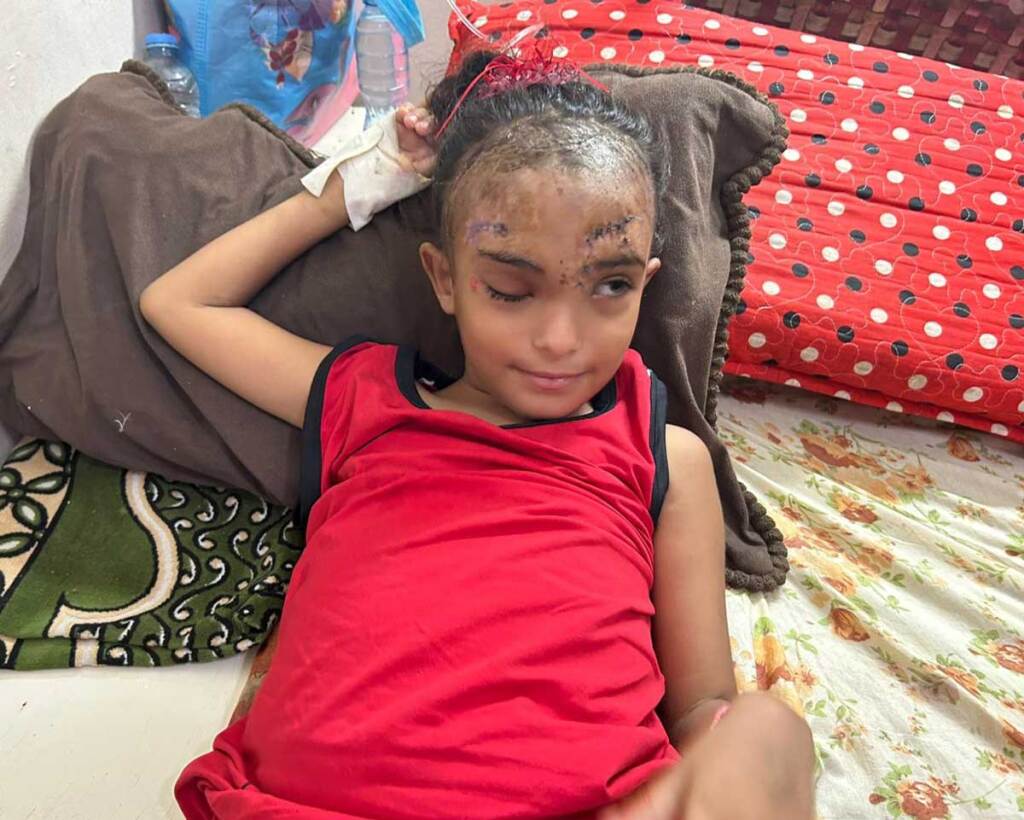
Sila Husu after her injury. Photo courtesy of the family
Around December 2023, I left that school after an Israeli drone flew over it and I feared it would be bombed. I moved with the children to the home of friends in Deir al-Balah, where we lived in one room for two months. There too, like in the IDP shelter in the school, we lived in constant fear, without electricity or water.When relatives of those friends came to stay there, we left and moved to another IDP shelter, in a-Sayedah Khadijah School in Deir al-Balah. We stayed there for about five months. It was already overcrowded with displaced people. The conditions were harsh: not enough toilets for so many people, and it was difficult to get water. I couldn’t give my children what they needed, like food and clothing, because I didn’t have money. I was constantly afraid of bombings there too, and being solely responsible for the children caused me a lot of grief. It was painful to see my sons without their father, and I often had trouble with other IDPs because my husband was not with me.On Saturday, 27 July 2024, I had my daughter Sila registered for classes in a tent near the shelter. She was ecstatic. She took her schoolbag, and went there with her friends. At around 11:00 A.M., the school we were staying in was bombed with several missiles. I began screaming and crying in fear for my children. Moments later, I saw Sila returning from the tent school to the shelter. She was sobbing and asking why they were bombing us. All my children screamed and cried. Around us were dead bodies, body parts, rubble and debris, and we heard the cries of IDPs from every direction.About an hour later, the Israeli military ordered us to evacuate the school. I took my children and fled. On the way out, we saw children’s bodies, body parts, and ambulances carrying the wounded. As we tried to escape, the school was bombed again, and Sila was hit in the head by shrapnel. Her head was covered in blood. I hugged her and screamed for help. My son Muhammad took off his shirt and tried to bandage Sila’s head to stop the bleeding. I shouted for an ambulance, but no one paid attention.A young man came, took Sila from me, and ran with her toward the hospital. The children and I ran after him, until he handed her to an ambulance that evacuated her to Shuhadaa al-Aqsa Hospital. When I arrived there, I found Sila in the ER, critically injured. Her skull was open, and she had a fracture in the bone above her right eye and a detached retina in that eye. She stayed like that for a whole day with only an IV, without any doctor examining her, because the hospital was overwhelmed with so many wounded and dead. Later, she had surgery to stop the bleeding and close the skull fracture, and a platinum plate was implanted in her forehead above her right eye.Sila is still at Shuhadaa al-Aqsa Hospital. Her wounds are infected, and the hospital doesn’t have the antibiotics she needs. Most of the other medicines she needs aren’t available either. She needs more head surgeries to prevent fluid from leaking through her nose or eye socket. The doctors say her condition is serious and complicated, and that she needs treatment outside Gaza, but there is almost no way to get out of Gaza today.I stay with Sila in the hospital, while my other children are in a tent with their aunt, my sister, in the town of a-Zawaydah in central Gaza. Sila can’t move to the tent, because it’s filthy and unbearably hot. She needs to continue treatment in the hospital; she needs fresh food and a clean environment. I try to stop her from looking at herself in pictures or in a mirror, because it affects her psychologically, especially when she sees old photos of herself. She asks when her hair will grow back, when she’ll be able to open her eye, when she’ll be pretty again.* Testimony given to B’Tselem field researcher Olfat al-Kurd on 25 August 2025
Sila Husu after her injury. Photo courtesy of the family
Around December 2023, I left that school after an Israeli drone flew over it and I feared it would be bombed. I moved with the children to the home of friends in Deir al-Balah, where we lived in one room for two months. There too, like in the IDP shelter in the school, we lived in constant fear, without electricity or water.When relatives of those friends came to stay there, we left and moved to another IDP shelter, in a-Sayedah Khadijah School in Deir al-Balah. We stayed there for about five months. It was already overcrowded with displaced people. The conditions were harsh: not enough toilets for so many people, and it was difficult to get water. I couldn’t give my children what they needed, like food and clothing, because I didn’t have money. I was constantly afraid of bombings there too, and being solely responsible for the children caused me a lot of grief. It was painful to see my sons without their father, and I often had trouble with other IDPs because my husband was not with me.On Saturday, 27 July 2024, I had my daughter Sila registered for classes in a tent near the shelter. She was ecstatic. She took her schoolbag, and went there with her friends. At around 11:00 A.M., the school we were staying in was bombed with several missiles. I began screaming and crying in fear for my children. Moments later, I saw Sila returning from the tent school to the shelter. She was sobbing and asking why they were bombing us. All my children screamed and cried. Around us were dead bodies, body parts, rubble and debris, and we heard the cries of IDPs from every direction.About an hour later, the Israeli military ordered us to evacuate the school. I took my children and fled. On the way out, we saw children’s bodies, body parts, and ambulances carrying the wounded. As we tried to escape, the school was bombed again, and Sila was hit in the head by shrapnel. Her head was covered in blood. I hugged her and screamed for help. My son Muhammad took off his shirt and tried to bandage Sila’s head to stop the bleeding. I shouted for an ambulance, but no one paid attention.A young man came, took Sila from me, and ran with her toward the hospital. The children and I ran after him, until he handed her to an ambulance that evacuated her to Shuhadaa al-Aqsa Hospital. When I arrived there, I found Sila in the ER, critically injured. Her skull was open, and she had a fracture in the bone above her right eye and a detached retina in that eye. She stayed like that for a whole day with only an IV, without any doctor examining her, because the hospital was overwhelmed with so many wounded and dead. Later, she had surgery to stop the bleeding and close the skull fracture, and a platinum plate was implanted in her forehead above her right eye.Sila is still at Shuhadaa al-Aqsa Hospital. Her wounds are infected, and the hospital doesn’t have the antibiotics she needs. Most of the other medicines she needs aren’t available either. She needs more head surgeries to prevent fluid from leaking through her nose or eye socket. The doctors say her condition is serious and complicated, and that she needs treatment outside Gaza, but there is almost no way to get out of Gaza today.I stay with Sila in the hospital, while my other children are in a tent with their aunt, my sister, in the town of a-Zawaydah in central Gaza. Sila can’t move to the tent, because it’s filthy and unbearably hot. She needs to continue treatment in the hospital; she needs fresh food and a clean environment. I try to stop her from looking at herself in pictures or in a mirror, because it affects her psychologically, especially when she sees old photos of herself. She asks when her hair will grow back, when she’ll be able to open her eye, when she’ll be pretty again.* Testimony given to B’Tselem field researcher Olfat al-Kurd on 25 August 2025
Images:
Additional Details
Captured Date
2025-09-22 12:00:24
Captured Post ID