
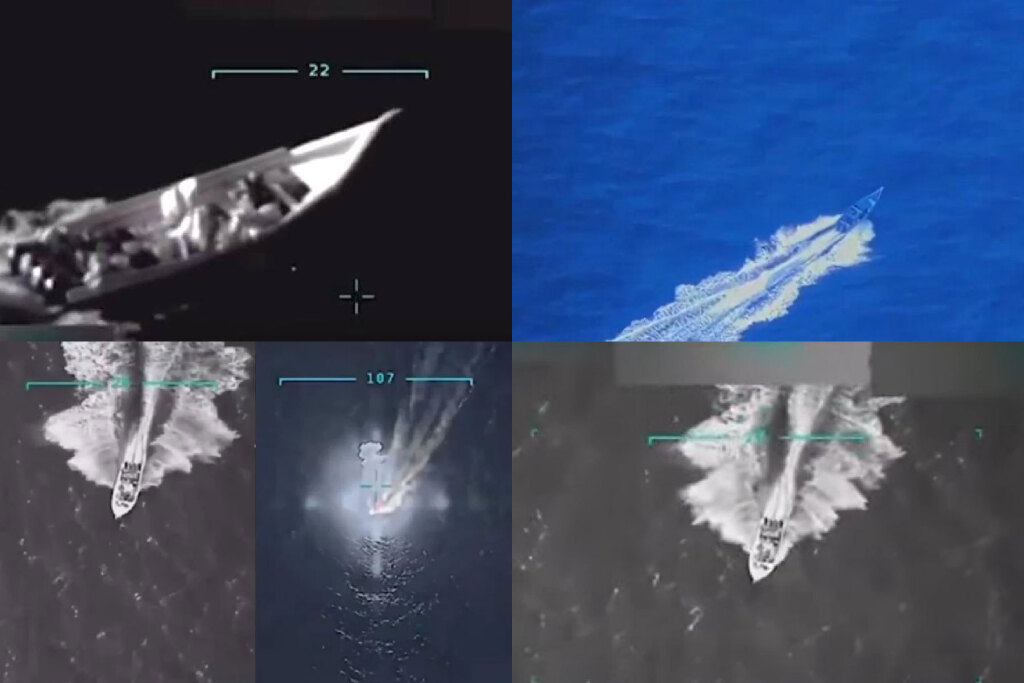
In September 2025, U.S. President Donald Trump launched a campaign of military strikes on supposed “narco-terrorists” in small boats, initially in the Caribbean Sea and later in the Pacific. Accusing those on the boats of smuggling drugs bound for the United States, the campaign marked a significant shift in U.S. policy – with the United Nations claiming the attacks violate international law.
In October 2025, Airwars released a new page tracking official statements of the strikes, and the first set of civilian harm incidents relating to each case. Given the highly complex information environment, with strikes conducted on small boats at sea in large expanses of the ocean, and with victims reported from multiple countries (including Venezuela, Ecuador, Colombia and Trinidad), Airwars has opted for a tracking approach as follows:
Organisations and media outlets publicly tracking this campaign adopt slightly different approaches, at times deviating when tracking those presumed dead, defining incidents and linking to geographic markers. Airwars is tracking methodologies across actors investigating these strikes to help inform our own methodology, which is evolving as we adapt to this highly dynamic context. If you have any questions about our numbers and why they may differ from others, drop us an email on info [at] airwars [dot] org.
Disclosed Strikes tracking fields
Incident definition (reflected in the headline number on our page as an aggregate)
Each incident in the ‘disclosed strike’ fields is defined as a strike or series of strikes on a singular target. In some instances, the reporting from official accounts aggregates multiple strikes in a single report. Where possible, Airwars teams have sought to separate out these reports to reflect multiple events. Where it has not been possible to do so, Airwars has published an aggregated strike report and indicated the number of events contained within the declared statement. The casualty recording team will endeavour to split these incidents as far as possible to ensure a more precise record when they publish the Researched Incidents.
Location description
This is an open text field describing the location as reported by official sources. Each strike report contains varying degrees of detail on the location. Until further investigation is conducted, Airwars will reflect the locations as described by official sources.
Deaths claimed (reflected in the headline number on our page as an aggregate)
A number of official U.S. strike statements reported that some individuals had survived. Given the nature of the strikes and the lack of clarity in reporting around rescue operations, in many cases it is unlikely that those who survived the initial strike were able to survive the effects of the attack. Initially, in order to most accurately reflect the overall death toll as reported by U.S. officials, Airwars’ tally of ‘U.S. declared deaths’ excluded these likely, but not confirmed, deaths. In February 2026, Airwars updated the overall death tolls on the website to now reflect ‘assumed deaths’, following statements made by SOUTHCOM to the Intercept (see below). These deaths are assumed most often once search and rescue missions have been called off, or after such time has passed that it is deemed highly unlikely that there are survivors (Airwars has adopted a +96 hour time period for this assumption). Once an incident has been more thoroughly researched and upgraded to a published assessment, additional details will be reflected in Airwars’ casualty ranges – as outlined below.
Researched Incidents tracking fields
All incidents will be researched in line with Airwars’ standard casualty recording methodology.
Incident definition
An incident is defined as the most precise delineator of an event based on the information available around casualties, time and geography. In some cases, this might mean grouping multiple strikes on multiple vessels on a given day into a single incident, where Airwars is only able to identify a total casualty toll. This ensures that casualties are not double counted during analysis. Where the number of fatalities, survivors, or survivors presumed dead can be delineated by geography and time, the incidents will be separated accordingly. In some cases, this means that Airwars’ overall incident numbers may differ to other trackers, where ‘incident’ may be defined by other factors (such as distinct vessels, for example). Airwars encourages all those engaging with the data to closely read the assessment description, which will provide as much detail as possible as to the parameters of a given incident.
Assumed deaths will be included in the upper casualty range for researched incidents, and are disaggregated as an additional line in the conflict page header for the ‘declared’ deaths. These would include the assumed deaths of those who were identified as surviving the initial strikes, but who were not rescued. In an Intercept interview in January 2026, SOUTHCOM public affairs chief stated that the cumulative death toll announced by the US as of January 7th 2026 included those for whom active searches had been suspended. This information has been included in respective incidents.
Airwars’ casualty recording approach and classification:
Civilian status
Airwars is not a legal organisation and does not conduct its own legal analysis of the military campaigns it monitors. Following ICRC guidelines, Airwars assessments assume civilian status unless otherwise specified.
There has been extensive discussion regarding the legal status of the U.S. strikes against so-called “narco-terrorists” in Latin America and the Caribbean Sea. Airwars relies on the positions outlined by the United Nations, and by international humanitarian law experts and human rights groups.
As of November 2025, the U.S. government had not offered a full legal justification for the strikes, though Trump has declared an official declaration of war unnecessary and claim the strikes are hitting “Designated Terrorist Organizations.” The United Nations has said “the use of lethal force in international waters without proper legal basis violates the international law of the sea and amounts to extrajudicial executions,” while also declaring the strikes “violate international human rights law.”
Regarding civilian status in particular, an analysis released on legal blog Just Security on September 17th 2025 outlined the legal position regarding the strikes.
The U.S. strikes in the Caribbean sea appear to violate both of these unalienable rights to life and fair trial. The United States is not party to any recognizable armed conflict in Latin America and the Caribbean. As such, international humanitarian law (IHL) does not apply. (And even if the United States was in an armed conflict in the Caribbean, the United States would be bound under IHL to distinguish between civilians and combatants, and the vessel’s occupants would be protected from attack unless and for such time as they take a direct part in hostilities, which all information indicates was not the case.).
Simply put, the accused drug traffickers are civilians, not lawful military objectives, and international human rights law, not the law of armed conflict, governs the administration’s use of force. The victims’ participation in drug smuggling and affiliation with any drug cartel remain disputed, but the facts of their activities or membership is immaterial to their rights to life and due process – under any of the plausible reported facts, there is no basis for concluding they could be deemed combatants or participants in hostilities. That means their alleged violations of law may only be handled through criminal proceedings, with protections of due process, fair trial, and right to counsel – not summary executions.
As the legal framework for these strikes may change based on processes within the United States branches of government and through international mechanisms, Airwars will endeavour to keep this section up to date to reflect this evolving context.
In each incident, in line with Airwars’ categorisation process, individuals reported killed or injured on the boats will fall into our ‘civilian status’ range – though we acknowledge given the analysis above that this dichotomy in this context is challenged by the fact that there cannot currently be combatant-civilian distinctions in this theatre.