Source
Archive URL:
https://airwars.org/source/www-amnesty-org-amnesty-international-report-2025-10-29-000000/
Captured Post Date: 2025-10-29 00:00:00
Translated Author:
Author: Amnesty International - Report
Translated Content:
Yemen: “It is a miracle we survived”: US air strike on civilians held in Sa’ada detention centre 5. MIGRANTS CAUGHT IN THE CROSSFIRE People have long taken the dangerous migration route known as the “Eastern Route” from the Horn of Africa, across the Gulf of Aden, into Yemen and then into Saudi Arabia. More than 90 percent of the migrants arriving on this route are Ethiopian.52 According to the International Organization for Migration (IOM), the majority of migrants on the Eastern Route rely on irregular routes or smugglers, placing them at an increased risk of human trafficking or drowning on unsafe boats. Since 2014, the IOM has documented 1,860 people dying or going missing along the route, including 480 migrants that drowned.53 Both the internationally recognized government of Yemen and the Huthi de facto authorities have detained migrants in poor conditions and subjected them to abuse. In a 2023 report, Human Rights Watch documented Huthi de facto authorities working with smugglers and extorting or transferring migrants to locations where they were abused and detained until they paid an “exit fee”.54 All 15 survivors of the Sa’ada migrant detention centre air strike interviewed by Amnesty International are Ethiopian migrants. Thirteen are from the Tigray region, while two are from the Oromiya region in Ethiopia. Fourteen arrived in Yemen between 2019 and 2025. One arrived in 2010. Out of the 15 survivors, 10 were detained by the Huthi de facto authorities on the basis of their irregular immigration status. Seven out of these 10 were detained while trying to cross the Yemeni border into Saudi Arabia or for being close to the border on suspicion that they would attempt to cross. Two migrants were held as suspects for allegedly being involved in a fight, three were detained for involvement in smuggling, and one was detained for the possession of a bottle of alcohol. Survivors told Amnesty International that they were held with at least 100 other migrant detainees in an overcrowded detention centre that had a hangar-like structure. They described it as an open space with no partitions. Satellite images reveal that the size of the centre was approximately 440sqm. Survivors, who had spent between three days and more than three years in the detention centre, said they were held indoors all the time. The UN Standard Minimum Rules for the Treatment of Prisoners (Nelson Mandela Rules) state that “all accommodation provided for the use of prisoners and in particular all sleeping accommodation shall meet all requirements of health, due regard being paid to climatic conditions and particularly to cubic content of air, minimum floor space, lighting, heating and ventilation.” 55 Under international law, everybody, regardless of their immigration status, has the right not to be arbitrarily detained or detained solely on immigration-related grounds without the opportunity to legally challenge their detention.56 Prolonged administrative detention without the possibility of review is considered arbitrary and is prohibited under international law.57 Amnesty International opposes the routine or automatic use of migration-related detention, as it considers this to be, by definition, arbitrary. Detention solely for migration-related purposes is only allowed in the most exceptional of circumstances, and there is a presumption against such detention. Migrants, refugees and asylum seekers, like anyone else, must benefit from a legal presumption of liberty. As a consequence, if these people are subject to any deprivation of liberty, this must be clearly prescribed by law, strictly justified by a legitimate purpose, necessary, proportionate and non-discriminatory. 6. SA’ADA MIGRANT DETENTION CENTRE AIR STRIKE Between 4:00 and 4:30 am local time on 28 April 2025, a US air strike hit a migrant detention centre within the Sa’ada prison compound in north-western Yemen. The US air strike killed and injured dozens of African migrants. Survivors interviewed by Amnesty International said they were among 100 to 120 other migrant detainees, mostly Ethiopian, who were held at the detention centre at the time of the attack. Survivors told Amnesty International that dozens of the migrant detainees were killed and injured in the strike. Survivors were able to identify by name and approximate age 16 of the people – all migrants, all men and most in their twenties – who had been killed. Soon after the strike on the migrant detention centre, Amnesty International was able to speak, on condition of anonymity, with three people working with African migrant and refugee communities in Yemen. Two of them visited the migrant detention centre and two nearby hospitals – the Republican Hospital and al Talh General Hospital in Sa’ada – and their morgues in the aftermath of the air strike. 58 Interview by voice call with Desta, 21 June 2025. 59 Interview by voice call with a witness on 5 May 2025. “I was buried under the rubble and after about one hour my brother came and pulled me out. He took me to the hospital. I was bleeding… I had a head injury and I lost sight in one eye… It is a miracle we survived and got out of that place.” Desta, 33-year-old survivor and former detainee at the Sa’ada migrant detention centre.58 “I saw 25 injured migrants in the Republican Hospital and nine in Al Talh General Hospital… They suffered from different fractures and bruises. Some were in critical condition and two had amputated legs… The morgue in the Republican Hospital was overwhelmed and there was no place left for tens of corpses that were still left outside the morgue for the second day.” Both of the witnesses that visited the hospitals said they saw evidence of a high number of casualties. They told Amnesty International they saw more than two dozen injured Ethiopian migrants and one injured Eritrean migrant at the hospitals. Injuries included severe amputations and fractures. They also said the hospitals’ morgues ran out of space to receive dead bodies and that air strike casualties had to be stacked outside.60 The International Committee of the Red Cross (ICRC), whose staff, along with the Yemen Red Crescent Society, were at the site in the immediate aftermath of the attack and helped evacuate the wounded and assist in the dignified management of the dead, also confirmed in a statement “a high number of casualties”.61 In addition to the three interviews conducted soon after the air strike, Amnesty International interviewed 15 survivors of the attack on the migrant detention centre in June 2025. Amnesty International also analysed satellite imagery and video footage, including scenes showing migrants’ bodies strewn across rubble and rescuers trying to pull badly wounded survivors from the debris. Amnesty International also analysed seven videos of the injured migrants while at hospitals privately shared by one witness. The Huthi authorities have claimed that more than 100 people were killed or wounded. Soon after the attack, the Huthi-run Ministry of Interior stated the detention centre was holding 115 African migrant detainees, of whom 68 were killed and 47 were injured.62 In their October 2025 response to Amnesty International, the Huthi Ministry of Justice and Human Rights updated their figures, stating that 117 African migrants were detained at the time of the attack. 63 Among the 117 migrant detainees, 61 were killed and 56 injured by the air strike on the migrant detention centre on 28 April 2025, the Huthi authorities said. 64 All 61 migrants that were killed were buried in Yemen. 65 The air strike on the migrant detention centre followed another air strike on a different building within the larger Sa’ada prison compound.66 In the immediate aftermath of the attack, the Huthis did not publish information on this building or on whether there were other casualties from the strike on it. However, in their October 2025 response, the Huthi Ministry of Justice and Human Rights stated that the other building was a prison administration building that contained all prison and migrant detainees’ documents. 67 They claimed that 15 prison staff members, all Yemeni, were injured as a result of the 28 April 2025 US air strikes.68 6.1 A WELL-KNOWN DETENTION FACILITY The USA should have known that the Sa’ada prison compound contained a detention facility, and that any attack on the migrant detention centre could result in significant civilian casualties, based on both open-source information and Amnesty International’s documentation of a previous air strike on a migrant detention facility within the same compound.69 The Sa’ada prison compound, which encompasses an approximately 21-hectare area, has been used for years by the Huthi de facto authorities to detain migrants. Satellite imagery reveals that the prison compound appears to be separated into three different internal areas, including the area where the migrant detention centre the US air strike hit in April 2025 was built. Each area has different levels of security features such as walls, gates, and guard towers. Survivors interviewed by Amnesty International said that they were held at the migrant detention centre for between three days and as long as three years and four months. In its public statement issued on 30 April 2025, the ICRC said: “For the past few years, ICRC delegates regularly visited detainees held in this facility as part of its ongoing work to ensure humane treatment and detention conditions.” 70 Amnesty International documented a 21 January 2022 Saudi-led coalition air strike on a building, also a detention centre, within the same Sa’ada prison compound. The Saudi-led coalition used a US-made precision guided munition and killed more than 90 detainees and injured dozens. 71 After the 2022 attack, the Saudi-led coalition issued a statement claiming that the air strike targeted a Huthi “Special Security Camp”.72 A week after the attack, the Office of the High Commissioner for Human Rights (OHCHR) stated: “During our recent visit, we saw no signs indicating that this site, formerly a barracks, continues to have a military function.” 73 Human Rights Watch reported that humanitarian workers had confirmed that the detention centre, which was formerly used as a military camp by the Huthi central security forces, had been transformed into a detention centre in 2020.74 The ICRC also issued a statement confirming the facility was a detention centre.75 Based on the information above, the migrant detention centre the USA struck on 28 April 2025 does not qualify as a military objective under international humanitarian law, particularly as it could not be said to “make an effective contribution to military action” based on its “nature, location, purpose or use”.76 In cases where it is unclear whether an object is used for military purposes, “it shall be presumed not to be so used”.77 Under international humanitarian law, attacking forces have an obligation to do everything feasible to verify whether their intended target is a military objective and, accordingly, if there is doubt in this respect, to refrain from launching an attack or to cancel or suspend an attack. 6.2 HUTHI PRISON GUARDS FIRED WARNING SHOTS Almost all survivors said that they were sleeping when, between 4:00 and 4:30 a.m., they heard one or two loud explosions nearby. It is most likely the survivors heard an air strike on another structure located 180 meters to the southwest of the building where the migrants were detained, which, according to satellite imagery, was also hit and destroyed on the same day. According to satellite imagery, since the Saudi-led coalition air strike in 2022, the Huthi de facto authorities have constructed additional buildings at the Sa’ada prison compound, including the other building that was struck on 28 April 2025 and completely destroyed, which the Huthis said was a prison administration building. 79 This briefing focuses on the subsequent strike on the migrant detention centre. Hearing the explosions, survivors said they woke up terrified and ran towards the gate of the detention centre where they were held. They screamed for help and pounded on the gate, asking the prison guards to let them out and seek shelter. Survivors told Amnesty International that, instead, the prison guards fired warning shots toward the detention centre where they were held. Mehret, 30, a survivor and former detainee at the migrant detention centre, woke up in shock after hearing a loud explosion. He told Amnesty International: “We all screamed for the guards to open the gate and let us out [after the explosion] but [instead] we heard gunfire shots by the guards as a warning. We lost hope. I went back to my sleeping area and laid down there…” 80 Hagos, 20, a survivor and former detainee, said that, along with the sound of the explosion, the detention centre shook, and some bricks fell from the walls. He added: “We all screamed and knocked at the doors but the guards fired gunshots at the ward and doors. They could have let us out and saved some of us. But sadly they did not and after 10 mins or so an air strike hit the ward.” 81 Under international human rights law, prison authorities must protect the right to life of detained persons. In case of an attack, this includes, as a minimum, providing immediate shelter and, if necessary, facilitating the evacuation of detainees. 82 The Huthi de facto authorities, which have human rights responsibilities, should conduct a prompt, thorough, independent, impartial, and transparent investigation into the failure to evacuate and provide shelter to the detained migrants and provide effective remedies and reparation to victims of violations of the right to life.83 In response to a question in Amnesty International’s letter on whether the Huthi de facto authorities had investigated the conduct of prison staff, the Huthis said that the conduct of prison guards was subject to investigation and that any guards found responsible for misconduct would be held accountable, but claimed that “there were no recorded instances in which prison guards prevented detainees from fleeing the targeted area or from seeking a safe location.” 84 Since 2015, Amnesty International, the UN and local and international human rights organizations have documented detention-related violations committed by all parties to the conflict in Yemen, including the Huthi de facto authorities. Perpetrators have rarely been seriously investigated or held accountable.85 6.3 THE STRIKE HITS THE MIGRANT DETENTION CENTRE A few minutes after the air strike on the other building within the Sa’ada prison compound, the USA hit the migrant detention centre. Survivors said they either fell unconscious or were buried under the rubble with severe injuries. Araya, 21, said he heard two explosions outside the detention centre and then the strike hit the detention centre: “I only remember that the place collapsed… and I was buried under the rubble. After that everything went blank for me.” 87 Satellite images show the destruction of the migrant detention centre after the US air strike. Photo analysis shows one crater and three walls that were blown down, indicating that at least one aircraft bomb was dropped on the building. Videos published by the Huthi-TV channel al-Masirah showed remnants of weapons allegedly used in the attack gathered and displayed on the ground at the Sa’ada prison compound.88 Amnesty International’s arms experts analysed the footage and identified fragments of at least two 250-pound precision-guided GBU-39 Small Diameter Bombs. The organization could not verify that the fragments definitively came from the migrant detention centre, but the damage caused to the facility is consistent with weapons of this size. US Central Command did not disclose information about the target of the attack. Shortly after the attack, a US defense official said they were assessing claims of civilian casualties and conducting a “battledamage assessment”.89 Amnesty International did not identify any military objective in the migrant detention centre. Survivors told Amnesty International that throughout their time in detention they were held with other migrant detainees. It was an open space, so they were able to see everyone who was in the building with them, and no Huthi fighters were posted inside the building or regularly resided there. Survivors said they were not allowed to leave the detention centre, but that they never heard military activity within the prison compound. On the rare occasions they were taken outside of the detention centre, survivors said they only saw prison guards. An attacking party must comply with international humanitarian law in relation to every attack, including when conducting a series of air strikes. Amongst other obligations, international humanitarian law requires an attacking party to distinguish between civilian objects and military objectives in respect of each and every attack. Based on the available evidence, the US air strike on the migrant detention centre amounts to an indiscriminate attack in violation of international humanitarian law, as it failed to be “directed at a specific military objective.” 90 In this respect, it does not seem the US complied with its obligation to do everything feasible to verify whether the object attacked was a military objective, particularly given that the Huthis use of the Sa’ada prison compound to detain migrants was widely known, including based on open-source information, and that the Huthis had used the specific building the US struck to detain migrants for an extended period of time.91 Given the attack killed and injured civilians, it should be investigated as a war crime. 6.4 SEVERE INJURIES, MAIMING AND TRAUMA “I am badly injured. I sustained shrapnel injuries to my spine. I can’t walk by myself. I have been sitting since the attack; I am being moved with the help of other people.” Sibhat, 22-year-old survivor and former detainee at the Sa’ada migrant detention centre.92 Out of the 15 survivors interviewed by Amnesty International, 14 sustained critical injuries, some with long lasting effects on their health. Most had shrapnel and debris fragments pierce their bodies, causing damage to tissues, bones, and vital organs. The injuries included fractures to legs and arms, nerve damage, and head, spine and chest trauma. Two of the 15 migrants had their legs amputated, one had his hand amputated, and one lost one of his eyes. All survivors expressed their shock and horror while sharing their testimonies. Desta, 33, suffered from a head injury and lost one of his eyes. He was so traumatized that he could not speak for 20 days. He said: “The attack was really terrible, it killed lots of people, it made us disabled and left others in shock and terror.” 93 Hamilan, 40, was the only one who did not suffer visible physical injuries, although he said that he fell unconscious after the air strike and only regained consciousness at the hospital. He described his severe distress. After the attack, he was socially withdrawn and unable to sleep without taking sleeping pills. Lacking financial resources, he needed other people to buy them for him.94 Hagos, 20, who was detained in the migrant detention centre just a week before the attack, lost his leg. He was experiencing severe pain. He said: “You just wish you were dead there. No one thinks that they got out of such a devastating situation… I am begging for some money from friends to get the treatment and pills.” 95 Fourteen survivors told Amnesty International that in the immediate aftermath of the air strike they were admitted to Republican Hospital or Al Talh General Hospital in Sa’ada. They stayed there between a few days and a month. Three said they had to pay for some medication, which was not available at the hospitals, to be bought from outside. Jirata, 29, had one leg amputated after the US air strike. He was detained for three years and four months in the migrant detention centre, after being arrested by the Huthi de facto authorities while attempting to cross the border to Saudi Arabia in 2021. After the air strike hit the detention centre, Jirata fell unconscious. He said: “The place collapsed and I was buried under the rubble. (…) I think people dragged me out and I then found myself at the hospital. I am badly injured, I lost one leg and my other leg is badly fractured… They have inserted metal rods in it.” 96 Abay, 31, was also severely injured by the US air strike. Arrested in January 2024 while attempting to cross the border to Saudi Arabia, he was detained by the Huthi de facto authorities for one year and six months in the migrant detention centre. TThe air strike buried him under the rubble – “The debris pressed against me”, he said – and now he has difficulty breathing and walking: “One leg was fractured and the other had shrapnel injuries (...) I have a fractured arm… and I have problems breathing and chest pain since Ihad a shrapnel injury to my heart. I had a shrapnel injury to my back and I still have metal pieces that haven’t gotten out yet.” 97 Five survivors told Amnesty International that, after receiving initial treatment at the hospital, they were detained again by the Huthi de facto authorities. The Huthis held them for between three days to three weeks and told them they were investigating and processing their release. During this time, the survivors said they were denied access to medical treatment. Mehret, who was detained again after the US air strike, said that he and his brother were not provided any medical care despite sustaining severe wounds: “They took me back to prison for additional investigation and I stayed there for three weeks without any medication. My brother joined two weeks later and his wounds formed infections and were infested by maggots in his head and eye. The guards were seeing all this. We pleaded for taking us back to hospital but no one listened. Then they released us after we signed papers and they took our fingerprints.” 98 The Huthi de facto authorities must ensure detainees receive health care, including access to needed medication. Detainees suffering from injuries or serious illnesses must be promptly transferred to hospitals or facilities that can provide appropriate medical care.99 6.5 SURVIVORS STRANDED AND ABANDONED At the time of the interviews, almost two months after the US air strike, 10 survivors told Amnesty International that they still required some form of medical treatment, including follow up surgeries and medication. They also said that, despite their dire economic situation, they were currently paying for this treatment themselves or with the support of family, also in dire economic straits, back home. Mehret and his brother Desta were still receiving medical treatment as outpatients in a private hospital in Sana’a at the time they spoke with Amnesty International. Mehret said: “Me and my brother are being treated together, our parents are sending us money despite their own poverty. They are selling their cows and oxen and borrowing money from others. We have paid 6000 Yemeni Riyals and the hospital told us that we still need 15000 Yemeni Riyal for all the procedures, especially for my brother’s case which is critical.” 101 Mehret and other survivors expressed feelings of fear and uncertainty given their precarious immigration status, which limits their access to essential services, including healthcare and housing, and puts them at risk of renewed detention. Fourteen of the survivors expressed their desire to return to Ethiopia, but many wanted to finish their medical treatment first. So they may recuperate, heal and complete any medical treatment necessary in Huthi-controlled territory without fear of further detention, the Huthi authorities should provide survivors with a temporary documentation that allows them residency status. The USA has an obligation to provide victims of violations of international humanitarian law, including their families, with access to effective remedies and full and adequate reparations. The USA should promptly make public its assessment into this strike, including any conclusions related to civilian casualties and efforts to respond to them.102
Content:
Yemen: “It is a miracle we survived”: US air strike on civilians held in Sa’ada detention centre
5. MIGRANTS CAUGHT IN THE CROSSFIRE
People have long taken the dangerous migration route known as the “Eastern Route” from the Horn of
Africa, across the Gulf of Aden, into Yemen and then into Saudi Arabia. More than 90 percent of the
migrants arriving on this route are Ethiopian.52
According to the International Organization for Migration (IOM), the majority of migrants on the Eastern
Route rely on irregular routes or smugglers, placing them at an increased risk of human trafficking or
drowning on unsafe boats. Since 2014, the IOM has documented 1,860 people dying or going missing
along the route, including 480 migrants that drowned.53
Both the internationally recognized government of Yemen and the Huthi de facto authorities have
detained migrants in poor conditions and subjected them to abuse. In a 2023 report, Human Rights
Watch documented Huthi de facto authorities working with smugglers and extorting or transferring
migrants to locations where they were abused and detained until they paid an “exit fee”.54
All 15 survivors of the Sa’ada migrant detention centre air strike interviewed by Amnesty International
are Ethiopian migrants. Thirteen are from the Tigray region, while two are from the Oromiya region in
Ethiopia. Fourteen arrived in Yemen between 2019 and 2025. One arrived in 2010.
Out of the 15 survivors, 10 were detained by the Huthi de facto authorities on the basis of their irregular
immigration status. Seven out of these 10 were detained while trying to cross the Yemeni border into
Saudi Arabia or for being close to the border on suspicion that they would attempt to cross. Two migrants
were held as suspects for allegedly being involved in a fight, three were detained for involvement in
smuggling, and one was detained for the possession of a bottle of alcohol.
Survivors told Amnesty International that they were held with at least 100 other migrant detainees in an
overcrowded detention centre that had a hangar-like structure. They described it as an open space with
no partitions. Satellite images reveal that the size of the centre was approximately 440sqm.
Survivors, who had spent between three days and more than three years in the detention centre, said
they were held indoors all the time.
The UN Standard Minimum Rules for the Treatment of Prisoners (Nelson Mandela Rules) state that “all
accommodation provided for the use of prisoners and in particular all sleeping accommodation shall
meet all requirements of health, due regard being paid to climatic conditions and particularly to cubic
content of air, minimum floor space, lighting, heating and ventilation.”55
Under international law, everybody, regardless of their immigration status, has the right not to be
arbitrarily detained or detained solely on immigration-related grounds without the opportunity to legally challenge their detention.56 Prolonged administrative detention without the possibility of review is
considered arbitrary and is prohibited under international law.57
Amnesty International opposes the routine or automatic use of migration-related detention, as it
considers this to be, by definition, arbitrary.
Detention solely for migration-related purposes is only allowed in the most exceptional of circumstances,
and there is a presumption against such detention. Migrants, refugees and asylum seekers, like anyone
else, must benefit from a legal presumption of liberty. As a consequence, if these people are subject to
any deprivation of liberty, this must be clearly prescribed by law, strictly justified by a legitimate purpose,
necessary, proportionate and non-discriminatory.
6. SA’ADA MIGRANT DETENTION CENTRE AIR STRIKE
Between 4:00 and 4:30 am local time on 28 April 2025, a US air strike hit a migrant detention centre
within the Sa’ada prison compound in north-western Yemen. The US air strike killed and injured dozens
of African migrants.
Survivors interviewed by Amnesty International said they were among 100 to 120 other migrant
detainees, mostly Ethiopian, who were held at the detention centre at the time of the attack.
Survivors told Amnesty International that dozens of the migrant detainees were killed and injured in the
strike. Survivors were able to identify by name and approximate age 16 of the people – all migrants, all
men and most in their twenties – who had been killed.
Soon after the strike on the migrant detention centre, Amnesty International was able to speak, on
condition of anonymity, with three people working with African migrant and refugee communities in
Yemen. Two of them visited the migrant detention centre and two nearby hospitals – the Republican
Hospital and al Talh General Hospital in Sa’ada – and their morgues in the aftermath of the air strike.
58 Interview by voice call with Desta, 21 June 2025.
59 Interview by voice call with a witness on 5 May 2025.
“I was buried under the rubble and after about one hour my
brother came and pulled me out. He took me to the hospital. I
was bleeding… I had a head injury and I lost sight in one eye…
It is a miracle we survived and got out of that place.”
Desta, 33-year-old survivor and former detainee at the Sa’ada migrant detention centre.58
“I saw 25 injured migrants in the Republican Hospital and nine in
Al Talh General Hospital… They suffered from different fractures
and bruises. Some were in critical condition and two had
amputated legs… The morgue in the Republican Hospital was
overwhelmed and there was no place left for tens of corpses that
were still left outside the morgue for the second day.”
Both of the witnesses that visited the hospitals said they saw evidence of a high number of casualties.
They told Amnesty International they saw more than two dozen injured Ethiopian migrants and one
injured Eritrean migrant at the hospitals. Injuries included severe amputations and fractures. They also
said the hospitals’ morgues ran out of space to receive dead bodies and that air strike casualties had to
be stacked outside.60
The International Committee of the Red Cross (ICRC), whose staff, along with the Yemen Red Crescent
Society, were at the site in the immediate aftermath of the attack and helped evacuate the wounded
and assist in the dignified management of the dead, also confirmed in a statement “a high number of
casualties”.61
In addition to the three interviews conducted soon after the air strike, Amnesty International interviewed
15 survivors of the attack on the migrant detention centre in June 2025. Amnesty International also
analysed satellite imagery and video footage, including scenes showing migrants’ bodies strewn across
rubble and rescuers trying to pull badly wounded survivors from the debris. Amnesty International also
analysed seven videos of the injured migrants while at hospitals privately shared by one witness.
The Huthi authorities have claimed that more than 100 people were killed or wounded. Soon after the
attack, the Huthi-run Ministry of Interior stated the detention centre was holding 115 African migrant
detainees, of whom 68 were killed and 47 were injured.62 In their October 2025 response to Amnesty
International, the Huthi Ministry of Justice and Human Rights updated their figures, stating that 117
African migrants were detained at the time of the attack.
63 Among the 117 migrant detainees, 61 were
killed and 56 injured by the air strike on the migrant detention centre on 28 April 2025, the Huthi
authorities said.
64 All 61 migrants that were killed were buried in Yemen.
65
The air strike on the migrant detention centre followed another air strike on a different building within
the larger Sa’ada prison compound.66 In the immediate aftermath of the attack, the Huthis did not
publish information on this building or on whether there were other casualties from the strike on it.
However, in their October 2025 response, the Huthi Ministry of Justice and Human Rights stated that
the other building was a prison administration building that contained all prison and migrant detainees’
documents.
67 They claimed that 15 prison staff members, all Yemeni, were injured as a result of the 28
April 2025 US air strikes.68
6.1 A WELL-KNOWN DETENTION FACILITY
The USA should have known that the Sa’ada prison compound contained a detention facility, and that
any attack on the migrant detention centre could result in significant civilian casualties, based on both
open-source information and Amnesty International’s documentation of a previous air strike on a
migrant detention facility within the same compound.69
The Sa’ada prison compound, which encompasses an approximately 21-hectare area, has been used
for years by the Huthi de facto authorities to detain migrants. Satellite imagery reveals that the prison
compound appears to be separated into three different internal areas, including the area where the
migrant detention centre the US air strike hit in April 2025 was built. Each area has different levels of
security features such as walls, gates, and guard towers.
Survivors interviewed by Amnesty International said that they were held at the migrant detention centre
for between three days and as long as three years and four months. In its public statement issued on
30 April 2025, the ICRC said: “For the past few years, ICRC delegates regularly visited detainees held
in this facility as part of its ongoing work to ensure humane treatment and detention conditions.”70
Amnesty International documented a 21 January 2022 Saudi-led coalition air strike on a building, also
a detention centre, within the same Sa’ada prison compound. The Saudi-led coalition used a US-made
precision guided munition and killed more than 90 detainees and injured dozens.
71
After the 2022 attack, the Saudi-led coalition issued a statement claiming that the air strike targeted a
Huthi “Special Security Camp”.72 A week after the attack, the Office of the High Commissioner for
Human Rights (OHCHR) stated: “During our recent visit, we saw no signs indicating that this site,
formerly a barracks, continues to have a military function.”73 Human Rights Watch reported that
humanitarian workers had confirmed that the detention centre, which was formerly used as a military
camp by the Huthi central security forces, had been transformed into a detention centre in 2020.74 The
ICRC also issued a statement confirming the facility was a detention centre.75
Based on the information above, the migrant detention centre the USA struck on 28 April 2025 does
not qualify as a military objective under international humanitarian law, particularly as it could not be
said to “make an effective contribution to military action” based on its “nature, location, purpose or
use”.76 In cases where it is unclear whether an object is used for military purposes, “it shall be presumed
not to be so used”.77 Under international humanitarian law, attacking forces have an obligation to do
everything feasible to verify whether their intended target is a military objective and, accordingly, if there
is doubt in this respect, to refrain from launching an attack or to cancel or suspend an attack.
6.2 HUTHI PRISON GUARDS FIRED WARNING SHOTS
Almost all survivors said that they were sleeping when, between 4:00 and 4:30 a.m., they heard one or
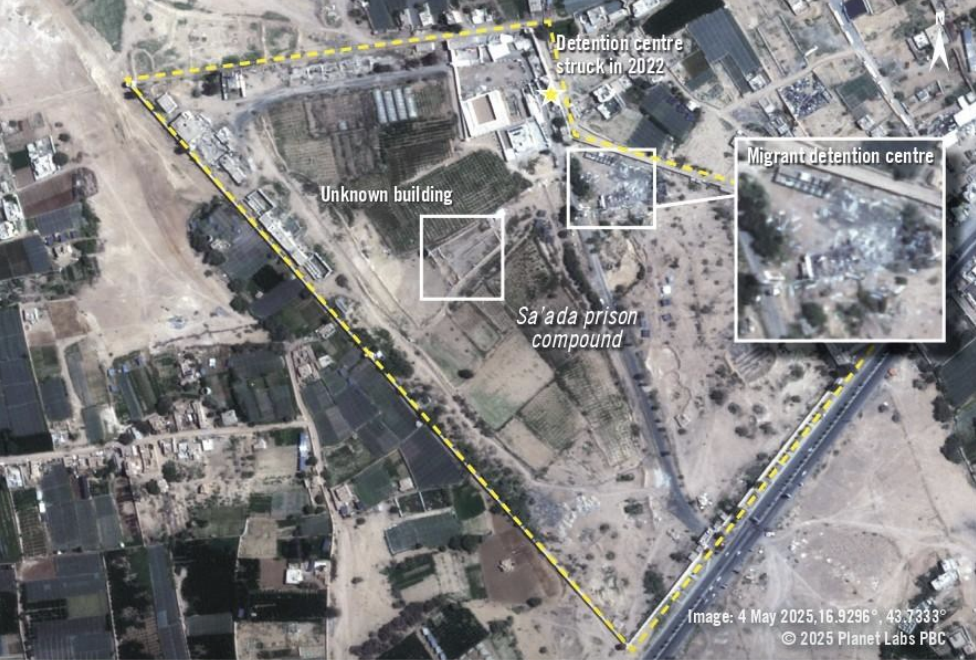
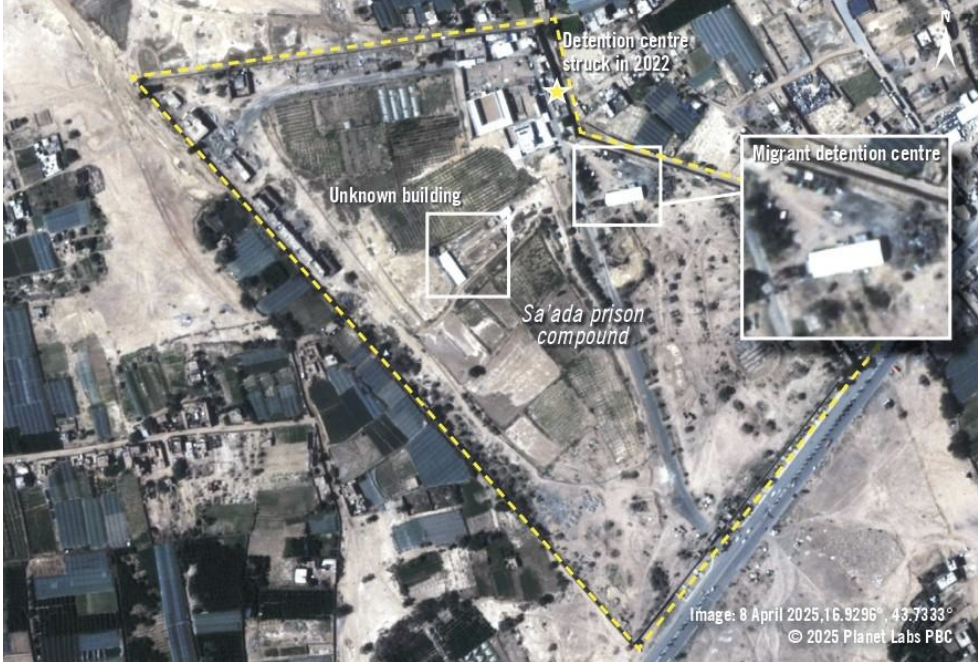
two loud explosions nearby. It is most likely the survivors heard an air strike on another structure located
180 meters to the southwest of the building where the migrants were detained, which, according to
satellite imagery, was also hit and destroyed on the same day.
According to satellite imagery, since the Saudi-led coalition air strike in 2022, the Huthi de facto
authorities have constructed additional buildings at the Sa’ada prison compound, including the other
building that was struck on 28 April 2025 and completely destroyed, which the Huthis said was a
prison administration building.
79 This briefing focuses on the subsequent strike on the migrant
detention centre.
Hearing the explosions, survivors said they woke up terrified and ran towards the gate of the detention
centre where they were held. They screamed for help and pounded on the gate, asking the prison
guards to let them out and seek shelter. Survivors told Amnesty International that, instead, the prison
guards fired warning shots toward the detention centre where they were held.
Mehret, 30, a survivor and former detainee at the migrant detention centre, woke up in shock after
hearing a loud explosion. He told Amnesty International:
“We all screamed for the guards to open the gate and let us out [after the explosion] but [instead] we heard gunfire
shots by the guards as a warning. We lost hope. I went back to my sleeping area and laid down there…”80
Hagos, 20, a survivor and former detainee, said that, along with the sound of the explosion, the detention
centre shook, and some bricks fell from the walls. He added:
“We all screamed and knocked at the doors but the guards fired gunshots at the ward and doors. They could have let
us out and saved some of us. But sadly they did not and after 10 mins or so an air strike hit the ward.”81
Under international human rights law, prison authorities must protect the right to life of detained
persons. In case of an attack, this includes, as a minimum, providing immediate shelter and, if necessary, facilitating the evacuation of detainees.
82 The Huthi de facto authorities, which have
human rights responsibilities, should conduct a prompt, thorough, independent, impartial, and
transparent investigation into the failure to evacuate and provide shelter to the detained migrants and
provide effective remedies and reparation to victims of violations of the right to life.83
In response to a question in Amnesty International’s letter on whether the Huthi de facto authorities
had investigated the conduct of prison staff, the Huthis said that the conduct of prison guards was
subject to investigation and that any guards found responsible for misconduct would be held
accountable, but claimed that “there were no recorded instances in which prison guards prevented
detainees from fleeing the targeted area or from seeking a safe location.”
84
Since 2015, Amnesty International, the UN and local and international human rights organizations
have documented detention-related violations committed by all parties to the conflict in Yemen,
including the Huthi de facto authorities. Perpetrators have rarely been seriously investigated or held
accountable.85
6.3 THE STRIKE HITS THE MIGRANT DETENTION CENTRE
A few minutes after the air strike on the other building within the Sa’ada prison compound, the USA hit
the migrant detention centre. Survivors said they either fell unconscious or were buried under the rubble
with severe injuries.
Araya, 21, said he heard two explosions outside the detention centre and then the strike hit the detention
centre: “I only remember that the place collapsed… and I was buried under the rubble. After that
everything went blank for me.”87
Satellite images show the destruction of the migrant detention centre after the US air strike. Photo
analysis shows one crater and three walls that were blown down, indicating that at least one aircraft
bomb was dropped on the building.
Videos published by the Huthi-TV channel al-Masirah showed remnants of weapons allegedly used in
the attack gathered and displayed on the ground at the Sa’ada prison compound.88 Amnesty
International’s arms experts analysed the footage and identified fragments of at least two 250-pound
precision-guided GBU-39 Small Diameter Bombs. The organization could not verify that the fragments
definitively came from the migrant detention centre, but the damage caused to the facility is
consistent with weapons of this size.
US Central Command did not disclose information about the target of the attack. Shortly after the attack,
a US defense official said they were assessing claims of civilian casualties and conducting a “battledamage assessment”.89
Amnesty International did not identify any military objective in the migrant detention centre.
Survivors told Amnesty International that throughout their time in detention they were held with other
migrant detainees. It was an open space, so they were able to see everyone who was in the building
with them, and no Huthi fighters were posted inside the building or regularly resided there.
Survivors said they were not allowed to leave the detention centre, but that they never heard military
activity within the prison compound. On the rare occasions they were taken outside of the detention
centre, survivors said they only saw prison guards.
An attacking party must comply with international humanitarian law in relation to every attack, including
when conducting a series of air strikes. Amongst other obligations, international humanitarian law
requires an attacking party to distinguish between civilian objects and military objectives in respect of
each and every attack.
Based on the available evidence, the US air strike on the migrant detention centre amounts to an
indiscriminate attack in violation of international humanitarian law, as it failed to be “directed at a
specific military objective.”90 In this respect, it does not seem the US complied with its obligation to do
everything feasible to verify whether the object attacked was a military objective, particularly given that
the Huthis use of the Sa’ada prison compound to detain migrants was widely known, including based
on open-source information, and that the Huthis had used the specific building the US struck to detain
migrants for an extended period of time.91 Given the attack killed and injured civilians, it should be
investigated as a war crime.
6.4 SEVERE INJURIES, MAIMING AND TRAUMA
“I am badly injured. I sustained shrapnel injuries to my spine. I
can’t walk by myself. I have been sitting since the attack; I am
being moved with the help of other people.”
Sibhat, 22-year-old survivor and former detainee at the Sa’ada migrant detention centre.92
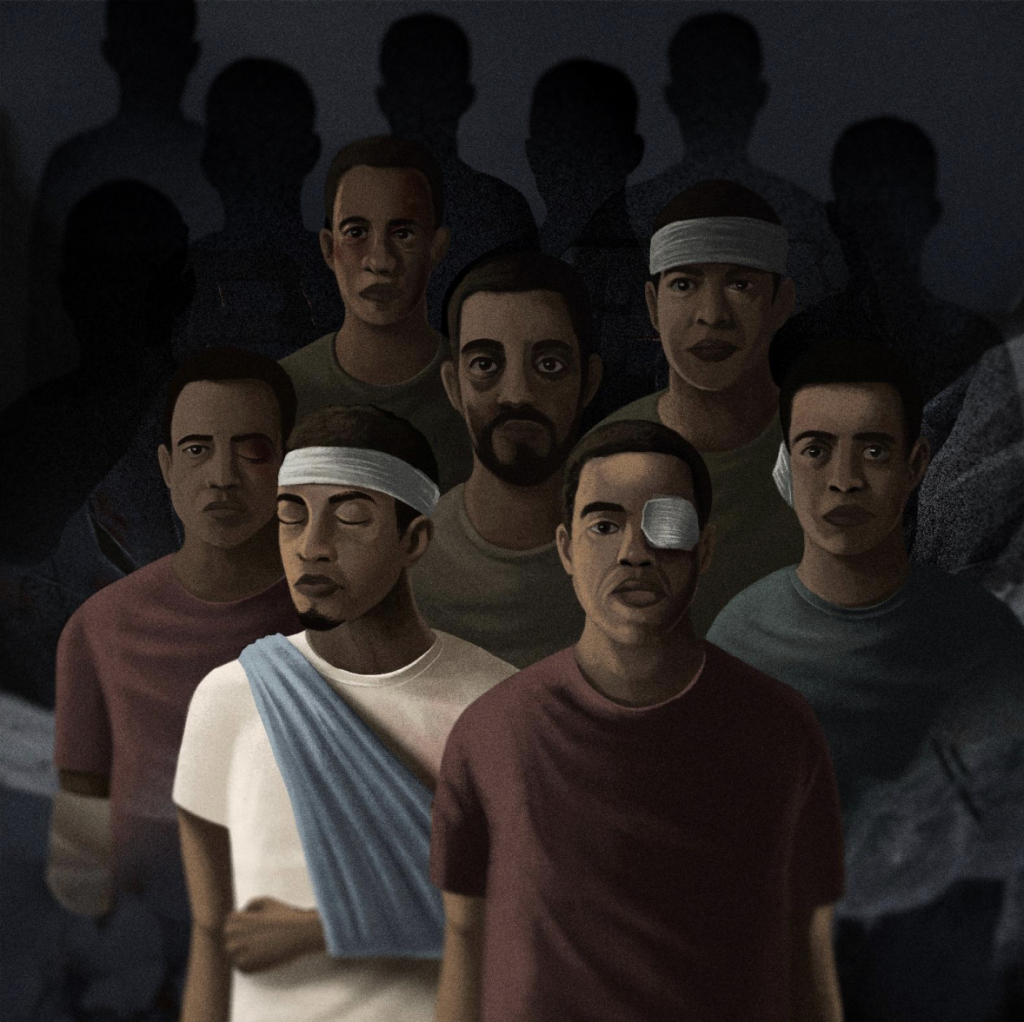
Out of the 15 survivors interviewed by Amnesty International, 14 sustained critical injuries, some with
long lasting effects on their health. Most had shrapnel and debris fragments pierce their bodies, causing
damage to tissues, bones, and vital organs. The injuries included fractures to legs and arms, nerve
damage, and head, spine and chest trauma. Two of the 15 migrants had their legs amputated, one had
his hand amputated, and one lost one of his eyes.
All survivors expressed their shock and horror while sharing their testimonies.
Desta, 33, suffered from a head injury and lost one of his eyes. He was so traumatized that he could
not speak for 20 days. He said: “The attack was really terrible, it killed lots of people, it made us disabled
and left others in shock and terror.”93
Hamilan, 40, was the only one who did not suffer visible physical injuries, although he said that he fell
unconscious after the air strike and only regained consciousness at the hospital. He described his severe
distress. After the attack, he was socially withdrawn and unable to sleep without taking sleeping pills.
Lacking financial resources, he needed other people to buy them for him.94
Hagos, 20, who was detained in the migrant detention centre just a week before the attack, lost his leg.
He was experiencing severe pain. He said:
“You just wish you were dead there. No one thinks that they got out of such a devastating situation… I am begging for
some money from friends to get the treatment and pills.”95
Fourteen survivors told Amnesty International that in the immediate aftermath of the air strike they were
admitted to Republican Hospital or Al Talh General Hospital in Sa’ada. They stayed there between a few
days and a month. Three said they had to pay for some medication, which was not available at the
hospitals, to be bought from outside.
Jirata, 29, had one leg amputated after the US air strike. He was detained for three years and four
months in the migrant detention centre, after being arrested by the Huthi de facto authorities while
attempting to cross the border to Saudi Arabia in 2021. After the air strike hit the detention centre, Jirata
fell unconscious. He said:
“The place collapsed and I was buried under the rubble. (…) I think people dragged me out and I then found myself at
the hospital. I am badly injured, I lost one leg and my other leg is badly fractured… They have inserted metal rods in
it.”96
Abay, 31, was also severely injured by the US air strike. Arrested in January 2024 while attempting to
cross the border to Saudi Arabia, he was detained by the Huthi de facto authorities for one year and six
months in the migrant detention centre. TThe air strike buried him under the rubble – “The debris
pressed against me”, he said – and now he has difficulty breathing and walking:
“One leg was fractured and the other had shrapnel injuries (...) I have a fractured arm… and I have problems breathing
and chest pain since Ihad a shrapnel injury to my heart. I had a shrapnel injury to my back and I still have metal pieces
that haven’t gotten out yet.”97
Five survivors told Amnesty International that, after receiving initial treatment at the hospital, they were
detained again by the Huthi de facto authorities. The Huthis held them for between three days to three
weeks and told them they were investigating and processing their release. During this time, the survivors
said they were denied access to medical treatment.
Mehret, who was detained again after the US air strike, said that he and his brother were not provided
any medical care despite sustaining severe wounds:
“They took me back to prison for additional investigation and I stayed there for three weeks without any medication.
My brother joined two weeks later and his wounds formed infections and were infested by maggots in his head and
eye. The guards were seeing all this. We pleaded for taking us back to hospital but no one listened. Then they released
us after we signed papers and they took our fingerprints.”98
The Huthi de facto authorities must ensure detainees receive health care, including access to needed
medication. Detainees suffering from injuries or serious illnesses must be promptly transferred to
hospitals or facilities that can provide appropriate medical care.99
6.5 SURVIVORS STRANDED AND ABANDONED
At the time of the interviews, almost two months after the US air strike, 10 survivors told Amnesty
International that they still required some form of medical treatment, including follow up surgeries and
medication. They also said that, despite their dire economic situation, they were currently paying for
this treatment themselves or with the support of family, also in dire economic straits, back home.
Mehret and his brother Desta were still receiving medical treatment as outpatients in a private hospital
in Sana’a at the time they spoke with Amnesty International. Mehret said:
“Me and my brother are being treated together, our parents are sending us money despite their own poverty. They are
selling their cows and oxen and borrowing money from others. We have paid 6000 Yemeni Riyals and the hospital told
us that we still need 15000 Yemeni Riyal for all the procedures, especially for my brother’s case which is critical.”101
Mehret and other survivors expressed feelings of fear and uncertainty given their precarious immigration
status, which limits their access to essential services, including healthcare and housing, and puts them at risk of renewed detention. Fourteen of the survivors expressed their desire to return to Ethiopia, but
many wanted to finish their medical treatment first.
So they may recuperate, heal and complete any medical treatment necessary in Huthi-controlled
territory without fear of further detention, the Huthi authorities should provide survivors with a temporary
documentation that allows them residency status.
The USA has an obligation to provide victims of violations of international humanitarian law, including
their families, with access to effective remedies and full and adequate reparations. The USA should
promptly make public its assessment into this strike, including any conclusions related to civilian
casualties and efforts to respond to them.
102
5. MIGRANTS CAUGHT IN THE CROSSFIRE
People have long taken the dangerous migration route known as the “Eastern Route” from the Horn of
Africa, across the Gulf of Aden, into Yemen and then into Saudi Arabia. More than 90 percent of the
migrants arriving on this route are Ethiopian.52
According to the International Organization for Migration (IOM), the majority of migrants on the Eastern
Route rely on irregular routes or smugglers, placing them at an increased risk of human trafficking or
drowning on unsafe boats. Since 2014, the IOM has documented 1,860 people dying or going missing
along the route, including 480 migrants that drowned.53
Both the internationally recognized government of Yemen and the Huthi de facto authorities have
detained migrants in poor conditions and subjected them to abuse. In a 2023 report, Human Rights
Watch documented Huthi de facto authorities working with smugglers and extorting or transferring
migrants to locations where they were abused and detained until they paid an “exit fee”.54
All 15 survivors of the Sa’ada migrant detention centre air strike interviewed by Amnesty International
are Ethiopian migrants. Thirteen are from the Tigray region, while two are from the Oromiya region in
Ethiopia. Fourteen arrived in Yemen between 2019 and 2025. One arrived in 2010.
Out of the 15 survivors, 10 were detained by the Huthi de facto authorities on the basis of their irregular
immigration status. Seven out of these 10 were detained while trying to cross the Yemeni border into
Saudi Arabia or for being close to the border on suspicion that they would attempt to cross. Two migrants
were held as suspects for allegedly being involved in a fight, three were detained for involvement in
smuggling, and one was detained for the possession of a bottle of alcohol.
Survivors told Amnesty International that they were held with at least 100 other migrant detainees in an
overcrowded detention centre that had a hangar-like structure. They described it as an open space with
no partitions. Satellite images reveal that the size of the centre was approximately 440sqm.
Survivors, who had spent between three days and more than three years in the detention centre, said
they were held indoors all the time.
The UN Standard Minimum Rules for the Treatment of Prisoners (Nelson Mandela Rules) state that “all
accommodation provided for the use of prisoners and in particular all sleeping accommodation shall
meet all requirements of health, due regard being paid to climatic conditions and particularly to cubic
content of air, minimum floor space, lighting, heating and ventilation.”55
Under international law, everybody, regardless of their immigration status, has the right not to be
arbitrarily detained or detained solely on immigration-related grounds without the opportunity to legally challenge their detention.56 Prolonged administrative detention without the possibility of review is
considered arbitrary and is prohibited under international law.57
Amnesty International opposes the routine or automatic use of migration-related detention, as it
considers this to be, by definition, arbitrary.
Detention solely for migration-related purposes is only allowed in the most exceptional of circumstances,
and there is a presumption against such detention. Migrants, refugees and asylum seekers, like anyone
else, must benefit from a legal presumption of liberty. As a consequence, if these people are subject to
any deprivation of liberty, this must be clearly prescribed by law, strictly justified by a legitimate purpose,
necessary, proportionate and non-discriminatory.
6. SA’ADA MIGRANT DETENTION CENTRE AIR STRIKE
Between 4:00 and 4:30 am local time on 28 April 2025, a US air strike hit a migrant detention centre
within the Sa’ada prison compound in north-western Yemen. The US air strike killed and injured dozens
of African migrants.
Survivors interviewed by Amnesty International said they were among 100 to 120 other migrant
detainees, mostly Ethiopian, who were held at the detention centre at the time of the attack.
Survivors told Amnesty International that dozens of the migrant detainees were killed and injured in the
strike. Survivors were able to identify by name and approximate age 16 of the people – all migrants, all
men and most in their twenties – who had been killed.
Soon after the strike on the migrant detention centre, Amnesty International was able to speak, on
condition of anonymity, with three people working with African migrant and refugee communities in
Yemen. Two of them visited the migrant detention centre and two nearby hospitals – the Republican
Hospital and al Talh General Hospital in Sa’ada – and their morgues in the aftermath of the air strike.
58 Interview by voice call with Desta, 21 June 2025.
59 Interview by voice call with a witness on 5 May 2025.
“I was buried under the rubble and after about one hour my
brother came and pulled me out. He took me to the hospital. I
was bleeding… I had a head injury and I lost sight in one eye…
It is a miracle we survived and got out of that place.”
Desta, 33-year-old survivor and former detainee at the Sa’ada migrant detention centre.58
“I saw 25 injured migrants in the Republican Hospital and nine in
Al Talh General Hospital… They suffered from different fractures
and bruises. Some were in critical condition and two had
amputated legs… The morgue in the Republican Hospital was
overwhelmed and there was no place left for tens of corpses that
were still left outside the morgue for the second day.”
Both of the witnesses that visited the hospitals said they saw evidence of a high number of casualties.
They told Amnesty International they saw more than two dozen injured Ethiopian migrants and one
injured Eritrean migrant at the hospitals. Injuries included severe amputations and fractures. They also
said the hospitals’ morgues ran out of space to receive dead bodies and that air strike casualties had to
be stacked outside.60
The International Committee of the Red Cross (ICRC), whose staff, along with the Yemen Red Crescent
Society, were at the site in the immediate aftermath of the attack and helped evacuate the wounded
and assist in the dignified management of the dead, also confirmed in a statement “a high number of
casualties”.61
In addition to the three interviews conducted soon after the air strike, Amnesty International interviewed
15 survivors of the attack on the migrant detention centre in June 2025. Amnesty International also
analysed satellite imagery and video footage, including scenes showing migrants’ bodies strewn across
rubble and rescuers trying to pull badly wounded survivors from the debris. Amnesty International also
analysed seven videos of the injured migrants while at hospitals privately shared by one witness.
The Huthi authorities have claimed that more than 100 people were killed or wounded. Soon after the
attack, the Huthi-run Ministry of Interior stated the detention centre was holding 115 African migrant
detainees, of whom 68 were killed and 47 were injured.62 In their October 2025 response to Amnesty
International, the Huthi Ministry of Justice and Human Rights updated their figures, stating that 117
African migrants were detained at the time of the attack.
63 Among the 117 migrant detainees, 61 were
killed and 56 injured by the air strike on the migrant detention centre on 28 April 2025, the Huthi
authorities said.
64 All 61 migrants that were killed were buried in Yemen.
65
The air strike on the migrant detention centre followed another air strike on a different building within
the larger Sa’ada prison compound.66 In the immediate aftermath of the attack, the Huthis did not
publish information on this building or on whether there were other casualties from the strike on it.
However, in their October 2025 response, the Huthi Ministry of Justice and Human Rights stated that
the other building was a prison administration building that contained all prison and migrant detainees’
documents.
67 They claimed that 15 prison staff members, all Yemeni, were injured as a result of the 28
April 2025 US air strikes.68
6.1 A WELL-KNOWN DETENTION FACILITY
The USA should have known that the Sa’ada prison compound contained a detention facility, and that
any attack on the migrant detention centre could result in significant civilian casualties, based on both
open-source information and Amnesty International’s documentation of a previous air strike on a
migrant detention facility within the same compound.69
The Sa’ada prison compound, which encompasses an approximately 21-hectare area, has been used
for years by the Huthi de facto authorities to detain migrants. Satellite imagery reveals that the prison
compound appears to be separated into three different internal areas, including the area where the
migrant detention centre the US air strike hit in April 2025 was built. Each area has different levels of
security features such as walls, gates, and guard towers.
Survivors interviewed by Amnesty International said that they were held at the migrant detention centre
for between three days and as long as three years and four months. In its public statement issued on
30 April 2025, the ICRC said: “For the past few years, ICRC delegates regularly visited detainees held
in this facility as part of its ongoing work to ensure humane treatment and detention conditions.”70
Amnesty International documented a 21 January 2022 Saudi-led coalition air strike on a building, also
a detention centre, within the same Sa’ada prison compound. The Saudi-led coalition used a US-made
precision guided munition and killed more than 90 detainees and injured dozens.
71
After the 2022 attack, the Saudi-led coalition issued a statement claiming that the air strike targeted a
Huthi “Special Security Camp”.72 A week after the attack, the Office of the High Commissioner for
Human Rights (OHCHR) stated: “During our recent visit, we saw no signs indicating that this site,
formerly a barracks, continues to have a military function.”73 Human Rights Watch reported that
humanitarian workers had confirmed that the detention centre, which was formerly used as a military
camp by the Huthi central security forces, had been transformed into a detention centre in 2020.74 The
ICRC also issued a statement confirming the facility was a detention centre.75
Based on the information above, the migrant detention centre the USA struck on 28 April 2025 does
not qualify as a military objective under international humanitarian law, particularly as it could not be
said to “make an effective contribution to military action” based on its “nature, location, purpose or
use”.76 In cases where it is unclear whether an object is used for military purposes, “it shall be presumed
not to be so used”.77 Under international humanitarian law, attacking forces have an obligation to do
everything feasible to verify whether their intended target is a military objective and, accordingly, if there
is doubt in this respect, to refrain from launching an attack or to cancel or suspend an attack.
6.2 HUTHI PRISON GUARDS FIRED WARNING SHOTS
Almost all survivors said that they were sleeping when, between 4:00 and 4:30 a.m., they heard one or
two loud explosions nearby. It is most likely the survivors heard an air strike on another structure located
180 meters to the southwest of the building where the migrants were detained, which, according to
satellite imagery, was also hit and destroyed on the same day.
According to satellite imagery, since the Saudi-led coalition air strike in 2022, the Huthi de facto
authorities have constructed additional buildings at the Sa’ada prison compound, including the other
building that was struck on 28 April 2025 and completely destroyed, which the Huthis said was a
prison administration building.
79 This briefing focuses on the subsequent strike on the migrant
detention centre.
Hearing the explosions, survivors said they woke up terrified and ran towards the gate of the detention
centre where they were held. They screamed for help and pounded on the gate, asking the prison
guards to let them out and seek shelter. Survivors told Amnesty International that, instead, the prison
guards fired warning shots toward the detention centre where they were held.
Mehret, 30, a survivor and former detainee at the migrant detention centre, woke up in shock after
hearing a loud explosion. He told Amnesty International:
“We all screamed for the guards to open the gate and let us out [after the explosion] but [instead] we heard gunfire
shots by the guards as a warning. We lost hope. I went back to my sleeping area and laid down there…”80
Hagos, 20, a survivor and former detainee, said that, along with the sound of the explosion, the detention
centre shook, and some bricks fell from the walls. He added:
“We all screamed and knocked at the doors but the guards fired gunshots at the ward and doors. They could have let
us out and saved some of us. But sadly they did not and after 10 mins or so an air strike hit the ward.”81
Under international human rights law, prison authorities must protect the right to life of detained
persons. In case of an attack, this includes, as a minimum, providing immediate shelter and, if necessary, facilitating the evacuation of detainees.
82 The Huthi de facto authorities, which have
human rights responsibilities, should conduct a prompt, thorough, independent, impartial, and
transparent investigation into the failure to evacuate and provide shelter to the detained migrants and
provide effective remedies and reparation to victims of violations of the right to life.83
In response to a question in Amnesty International’s letter on whether the Huthi de facto authorities
had investigated the conduct of prison staff, the Huthis said that the conduct of prison guards was
subject to investigation and that any guards found responsible for misconduct would be held
accountable, but claimed that “there were no recorded instances in which prison guards prevented
detainees from fleeing the targeted area or from seeking a safe location.”
84
Since 2015, Amnesty International, the UN and local and international human rights organizations
have documented detention-related violations committed by all parties to the conflict in Yemen,
including the Huthi de facto authorities. Perpetrators have rarely been seriously investigated or held
accountable.85
6.3 THE STRIKE HITS THE MIGRANT DETENTION CENTRE
A few minutes after the air strike on the other building within the Sa’ada prison compound, the USA hit
the migrant detention centre. Survivors said they either fell unconscious or were buried under the rubble
with severe injuries.
Araya, 21, said he heard two explosions outside the detention centre and then the strike hit the detention
centre: “I only remember that the place collapsed… and I was buried under the rubble. After that
everything went blank for me.”87
Satellite images show the destruction of the migrant detention centre after the US air strike. Photo
analysis shows one crater and three walls that were blown down, indicating that at least one aircraft
bomb was dropped on the building.
Videos published by the Huthi-TV channel al-Masirah showed remnants of weapons allegedly used in
the attack gathered and displayed on the ground at the Sa’ada prison compound.88 Amnesty
International’s arms experts analysed the footage and identified fragments of at least two 250-pound
precision-guided GBU-39 Small Diameter Bombs. The organization could not verify that the fragments
definitively came from the migrant detention centre, but the damage caused to the facility is
consistent with weapons of this size.
US Central Command did not disclose information about the target of the attack. Shortly after the attack,
a US defense official said they were assessing claims of civilian casualties and conducting a “battledamage assessment”.89
Amnesty International did not identify any military objective in the migrant detention centre.
Survivors told Amnesty International that throughout their time in detention they were held with other
migrant detainees. It was an open space, so they were able to see everyone who was in the building
with them, and no Huthi fighters were posted inside the building or regularly resided there.
Survivors said they were not allowed to leave the detention centre, but that they never heard military
activity within the prison compound. On the rare occasions they were taken outside of the detention
centre, survivors said they only saw prison guards.
An attacking party must comply with international humanitarian law in relation to every attack, including
when conducting a series of air strikes. Amongst other obligations, international humanitarian law
requires an attacking party to distinguish between civilian objects and military objectives in respect of
each and every attack.
Based on the available evidence, the US air strike on the migrant detention centre amounts to an
indiscriminate attack in violation of international humanitarian law, as it failed to be “directed at a
specific military objective.”90 In this respect, it does not seem the US complied with its obligation to do
everything feasible to verify whether the object attacked was a military objective, particularly given that
the Huthis use of the Sa’ada prison compound to detain migrants was widely known, including based
on open-source information, and that the Huthis had used the specific building the US struck to detain
migrants for an extended period of time.91 Given the attack killed and injured civilians, it should be
investigated as a war crime.
6.4 SEVERE INJURIES, MAIMING AND TRAUMA
“I am badly injured. I sustained shrapnel injuries to my spine. I
can’t walk by myself. I have been sitting since the attack; I am
being moved with the help of other people.”
Sibhat, 22-year-old survivor and former detainee at the Sa’ada migrant detention centre.92
Out of the 15 survivors interviewed by Amnesty International, 14 sustained critical injuries, some with
long lasting effects on their health. Most had shrapnel and debris fragments pierce their bodies, causing
damage to tissues, bones, and vital organs. The injuries included fractures to legs and arms, nerve
damage, and head, spine and chest trauma. Two of the 15 migrants had their legs amputated, one had
his hand amputated, and one lost one of his eyes.
All survivors expressed their shock and horror while sharing their testimonies.
Desta, 33, suffered from a head injury and lost one of his eyes. He was so traumatized that he could
not speak for 20 days. He said: “The attack was really terrible, it killed lots of people, it made us disabled
and left others in shock and terror.”93
Hamilan, 40, was the only one who did not suffer visible physical injuries, although he said that he fell
unconscious after the air strike and only regained consciousness at the hospital. He described his severe
distress. After the attack, he was socially withdrawn and unable to sleep without taking sleeping pills.
Lacking financial resources, he needed other people to buy them for him.94
Hagos, 20, who was detained in the migrant detention centre just a week before the attack, lost his leg.
He was experiencing severe pain. He said:
“You just wish you were dead there. No one thinks that they got out of such a devastating situation… I am begging for
some money from friends to get the treatment and pills.”95
Fourteen survivors told Amnesty International that in the immediate aftermath of the air strike they were
admitted to Republican Hospital or Al Talh General Hospital in Sa’ada. They stayed there between a few
days and a month. Three said they had to pay for some medication, which was not available at the
hospitals, to be bought from outside.
Jirata, 29, had one leg amputated after the US air strike. He was detained for three years and four
months in the migrant detention centre, after being arrested by the Huthi de facto authorities while
attempting to cross the border to Saudi Arabia in 2021. After the air strike hit the detention centre, Jirata
fell unconscious. He said:
“The place collapsed and I was buried under the rubble. (…) I think people dragged me out and I then found myself at
the hospital. I am badly injured, I lost one leg and my other leg is badly fractured… They have inserted metal rods in
it.”96
Abay, 31, was also severely injured by the US air strike. Arrested in January 2024 while attempting to
cross the border to Saudi Arabia, he was detained by the Huthi de facto authorities for one year and six
months in the migrant detention centre. TThe air strike buried him under the rubble – “The debris
pressed against me”, he said – and now he has difficulty breathing and walking:
“One leg was fractured and the other had shrapnel injuries (...) I have a fractured arm… and I have problems breathing
and chest pain since Ihad a shrapnel injury to my heart. I had a shrapnel injury to my back and I still have metal pieces
that haven’t gotten out yet.”97
Five survivors told Amnesty International that, after receiving initial treatment at the hospital, they were
detained again by the Huthi de facto authorities. The Huthis held them for between three days to three
weeks and told them they were investigating and processing their release. During this time, the survivors
said they were denied access to medical treatment.
Mehret, who was detained again after the US air strike, said that he and his brother were not provided
any medical care despite sustaining severe wounds:
“They took me back to prison for additional investigation and I stayed there for three weeks without any medication.
My brother joined two weeks later and his wounds formed infections and were infested by maggots in his head and
eye. The guards were seeing all this. We pleaded for taking us back to hospital but no one listened. Then they released
us after we signed papers and they took our fingerprints.”98
The Huthi de facto authorities must ensure detainees receive health care, including access to needed
medication. Detainees suffering from injuries or serious illnesses must be promptly transferred to
hospitals or facilities that can provide appropriate medical care.99
6.5 SURVIVORS STRANDED AND ABANDONED
At the time of the interviews, almost two months after the US air strike, 10 survivors told Amnesty
International that they still required some form of medical treatment, including follow up surgeries and
medication. They also said that, despite their dire economic situation, they were currently paying for
this treatment themselves or with the support of family, also in dire economic straits, back home.
Mehret and his brother Desta were still receiving medical treatment as outpatients in a private hospital
in Sana’a at the time they spoke with Amnesty International. Mehret said:
“Me and my brother are being treated together, our parents are sending us money despite their own poverty. They are
selling their cows and oxen and borrowing money from others. We have paid 6000 Yemeni Riyals and the hospital told
us that we still need 15000 Yemeni Riyal for all the procedures, especially for my brother’s case which is critical.”101
Mehret and other survivors expressed feelings of fear and uncertainty given their precarious immigration
status, which limits their access to essential services, including healthcare and housing, and puts them at risk of renewed detention. Fourteen of the survivors expressed their desire to return to Ethiopia, but
many wanted to finish their medical treatment first.
So they may recuperate, heal and complete any medical treatment necessary in Huthi-controlled
territory without fear of further detention, the Huthi authorities should provide survivors with a temporary
documentation that allows them residency status.
The USA has an obligation to provide victims of violations of international humanitarian law, including
their families, with access to effective remedies and full and adequate reparations. The USA should
promptly make public its assessment into this strike, including any conclusions related to civilian
casualties and efforts to respond to them.
102
Images:
Additional Details
Captured Date
2025-11-06 13:13:26
Captured Post ID