Incident Code
Incident Date
Location
Geolocation
Geolocation
Airwars Assessment
68 civilians detained in Sadaa’s Remand Detention Centre were killed and at least 47 injured by alleged US airstrikes on the morning of 28 April, 2025. The Centre primarily held migrants coming from African countries and was believed to be holding 115 people at the time of the strike. Yemen is a frequent route for African migrants hoping to reach the gulf states; such migrants, when intercepted by Houthis, are typically sent to detention camps.
An investigation published by Amnesty International on October 29, 2025 reported that survivors of the Remand strike were awakened by an explosion between 4 and 4:30 AM. The investigation attributed this explosion to a US airstrike on a different structure, also within the Sada’a prison compound. The strike on the Remand centre reportedly occurred “minutes later.”
@TvAlmasirah reported that 35 bodies had been recovered, though another 30 were still missing. Civil Defense crews later reported the deaths of 68, a death toll that was corroborated by Al Jazeera. Other sources reported that the injury toll could be as high as 65.
In speaking with Houthi officials, Amnesty International reported that – according to Houthi officials – “117 African migrants were detained at the time of the strike, of whom 61 were killed and 56 injured.”
@TvAlmasirah shared photographs of bodies – some severed – amid rubble in the nearly completely destroyed building. A video shared by the same source showed brutalised remains, blood dried to dirt; multiple bodies are visible. In the background, the videographer can be heard praying; his voice is soft – “God is sufficient for us, and He is the best disposer of affairs”. Balqees TV emphasised that those killed were not “fighters with weapons” but instead migrants looking for better lives. They ended up “dead or wounded” in a war they were “not part of.”
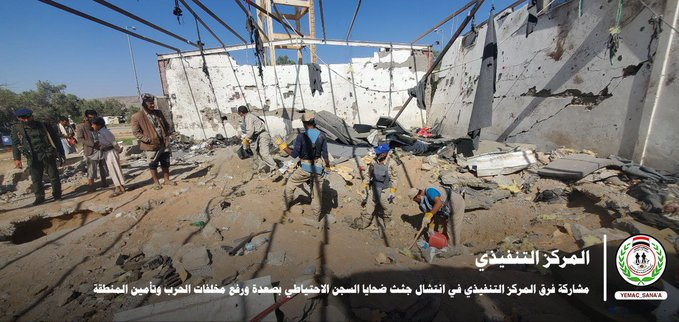
Facebook user Majd Al-Madani Saada included photographs of extraction efforts. Bodies collected by the Red Crescent were tagged with information cards then laid on the bodies. One man, laid on white plastic wrapping, has an information card proclaiming him a victim of the Detention Centre strike. In death, his identity has been lost: under “name” is recorded only “Anonymous”.
Rescue teams from both the Yemeni Red Crescent and Civil Defense sifted through rubble to extract the injured. The wounded were taken to the Republican Hospital; video shared by @TvAlmasirah shows numb faces, people shifting to accommodate injured limbs, a man holding his head, eyes closed. Most of the injuries were deemed critical. Especially severe cases were sent to hospitals in the Yemeni capital of Sanaa.
The Vice President of the Republican Hospital, Dr. Ali Al-Hamzi, met with “representatives of government agencies, humanitarian organizations, and African communities” following the strike where they “toured the hospital wards, where they were briefed on the health conditions of the African wounded [and heard] about the nature of their injuries and the care provided to them”.
Amnesty International spoke with “three individuals who work with African migrant and refugee communities in Yemen” and ICRC staff, including two of whom had visited the migrant detention center, two nearby hospitals, and their morgues and confirmed seeing “a high number of casualties” and said that all the migrants detainees held at the detention center were Ethiopian, with the exception of one Eritrean. According to one activist who visited the Republican hospital and al Talh General hospital in Sa’ada, 25 injured migrants were receiving treatment at the Republican hospital while nine were receiving treatment in al Talh General hospital: “They suffered from different fractures and bruises. Some were in critical condition and two had amputated legs… The morgue in the Republican hospital was overwhelmed and there was no place left for tens of corpses that were still left outside the morgue for the second day.”
Amnesty International spoke with another activist who spoke with dozens of the injured migrants: “They told me they were sleeping when they were hit with the first missile at around 4 a.m. in the morning (…) They said they woke up to find dismembered bodies around them. You could see the shock and horror on their faces. Some were still unable to speak because of the trauma.”
On October 29, 2025, Amnesty International published a report, “Yemen: “It is a miracle we survived”: US air strike on civilians held in Sa’ada detention centre.” In the report, Amnesty outlines their investigation into the US strike on the migrant detention centre. The report concludes that – per Amnesty’s investigation – the centre was not a military objective. Through interviews with survivors of the strike – all of whom were Ethiopian migrants – Amnesty reported that “the migrant detention centre was an open space, so [survivors] were able to see everyone who was present in the building, whom were all migrant detainees.”
Outlining the events of the strike, Amnesty reported that a second building in the Sada’a prison centre was hit minutes before the Remand facility. Reviewing satellite imagery, the Amnesty investigation found that a building “located about 180 meters from where the migrants were detained, was hit and destroyed the same day.” Amnesty submitted questions to the Houthis – the de-facto governing body in Sada’a – who reported that the other building struck was a “prison administration building.”
Following the sound of the explosion which woke many of the migrants up, survivors said that they ran towards the gate of the detention centre and “screamed for help and pounded on the gate, asking the prison guards to let them out to seek safety.” In response, the prison guards allegedly fired warning shots to keep the detainees inside the walls. “Minutes later, a second US airstrike hit the migrant detention centre.”
Responding to questions from Amnesty, Houthi officials claimed that “there were no recorded instances in which prison guards prevented detainees from fleeing the targeted area or from seeking a safe location.” Still, Amnesty reported that it wasn’t clear whether the officials had specifically investigated reports of detainees being unable to seek safety following the first reported US strike on a different building.
The report also notes that the migrant detention centre had long served as such. “The facility, part of the Sa’ada prison compound, had been used for years by the [Houthis] to detain migrants, and its civilian nature was widely known. It was visited by humanitarian organizations.”
In addition to having long-operated as a migrant detention center, Amnesty reported that on January 21, 2022, the Saudi-led coalition carried out an airstrike on another detention facility within the same prison compound in Sada’a. The a US-made precision guided munition was used in the 2022 attack, and ultimately killed more than 90 detainees and injured dozens others.
Given the history, Amnesty concludes that the US should have know that the centre was a civilian object “and that any aerial attack could result in significant death and injury to civilians.” Outlining the American military’s obligation to mitigate harm to civilians, the report details “Under international humanitarian law, attacking forces have an obligation to do everything feasible to verify whether their intended target is a military objective and, if there is doubt in this respect, to refrain from launching an attack or to cancel or suspend it. ”
The New York Times spoke with Fanta Ali Ahmed, a 32-year-old man who was injured in the bombing of the detention facility. Fanta is from the Tigray region of Ethiopia and was hoping to reach Saudi Arabia but instead was detained while passing through Yemen. When multiple bombs tore through the roof of the detention facility, Fanta initially thought he was the only one hurt but later realized that “The place and everyone in it were mangled,” himself sustaining two broken legs and a broken arm while 10 people close to him were killed.
In preparing their report, Amnesty International spoke with 15 survivors of the alleged US strike, reporting that “the air strike caused profound civilian harm with devastating, long-lasting consequences.” Of the 15 survivors interviewed, 14 sustained “critical injuries with lifelong impacts including lost limbs, serious nerve damage, as well as head, spine and chest trauma.” The report goes on to detail that “Two of the 15 migrants had their legs amputated, one had his hand amputated, and one lost an eye.”
Amnesty reportedly conducted interviews with survivors almost two months after the strike. At that time, 10 of the 15 survivors said they still required some form of medical treatment, “including follow up surgeries and medication.” Survivors also said that they were paying for their necessary treatment themselves.
Amnesty published excerpts from some of the survivor interviews, changing the names of those they spoke to for security reasons. 20-year-old “Hagos” survived the attack. He regained consciousness in a hospital the day after the attack. When he woke up, he found that he had lost his leg. Describing his pain, Hagos said “You just wish you were dead there… I am begging for some money from friends to get the treatment and pills.”
“Desta”, another survivor, suffered from a head injury and lost one of his eyes. “He was so traumatized that he could not speak for 20 days.” Speaking with Amnesty, Desta said “The attack was really terrible, it killed lots of people, it made us disabled and left others in shock and terror.”
Annedaa News reported that the Houthi Ministry of Interior claimed the detention centre “was under the supervision of the International Organization for Migration (IOM) and the Red Cross”. IOM specified that it “does not directly manage” the centre but was “closely monitoring the situation”. For their part, IOM expressed the organisation was “deeply saddened by the reports of the tragic loss of life in Sadaa, Yemen, where many migrants are believed to have been killed or injured”.
Almashhad News reported that the strike “targeted a center officially used as a correctional facility” but claimed that “field reports indicate that the Houthis have converted it into a security operations headquarters, keeping the migrants inside despite calls for their evacuation”. The people held inside were detained “for months in inhumane conditions, without being able to communicate with their families or international organizations”. According to Amnesty International, “The U.S. should have known Sa’ada prison was a detention facility, that has been used for years by the Huthis to detain migrants and that it was regularly visited by ICRC.”
The conclusion of Amnesty International’s investigation was such: ““The US must conduct a prompt, thorough, independent, impartial, and transparent investigation into the air strike on the Sa’ada migrant detention centre and make the results public. Survivors of this attack deserve nothing less than full justice. They must receive full, effective, and prompt reparations, including restitution, compensation, rehabilitation, satisfaction and guarantees of non-repetition, through an effective and accessible mechanism.”
Quoted by The Washington Post, US Central Command stated “We are currently conducting our battle-damage assessment and inquiry into those claims [of civilian harm]”.
All sources who named a belligerent identified the US military.
Assessment Updates
Key Information
Geolocation Notes
Reports of the incident mention the Remand Detention Center (السجن الاحتياطي) being struck in the city of Sadaa (صعدة). Analysing audio-visual material from sources, we have narrowed the location down to the following exact coordinates: 16.930440, 43.733538.
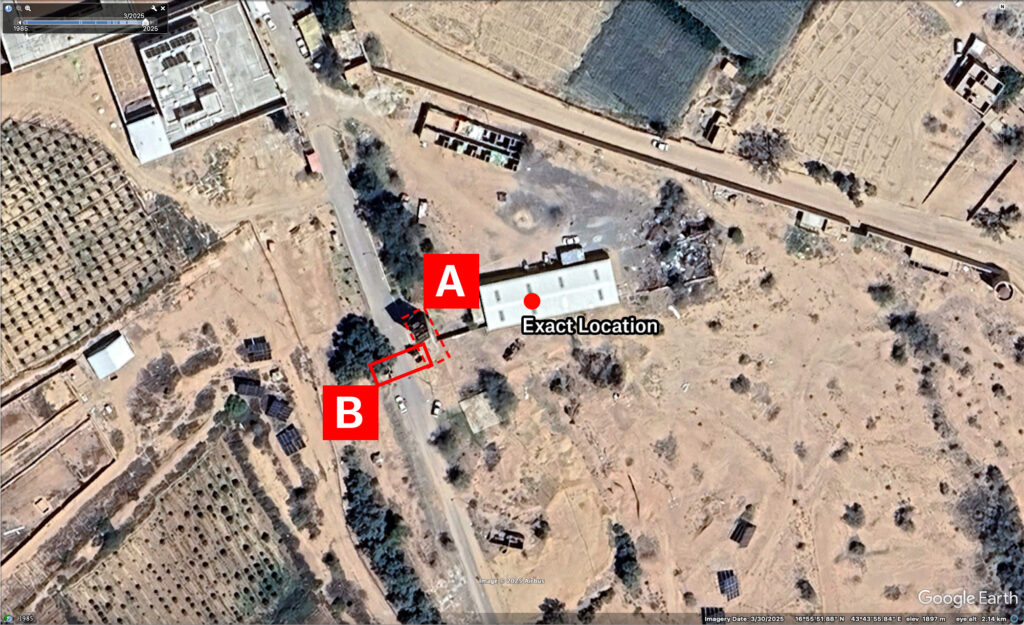
Imagery: Google Earth
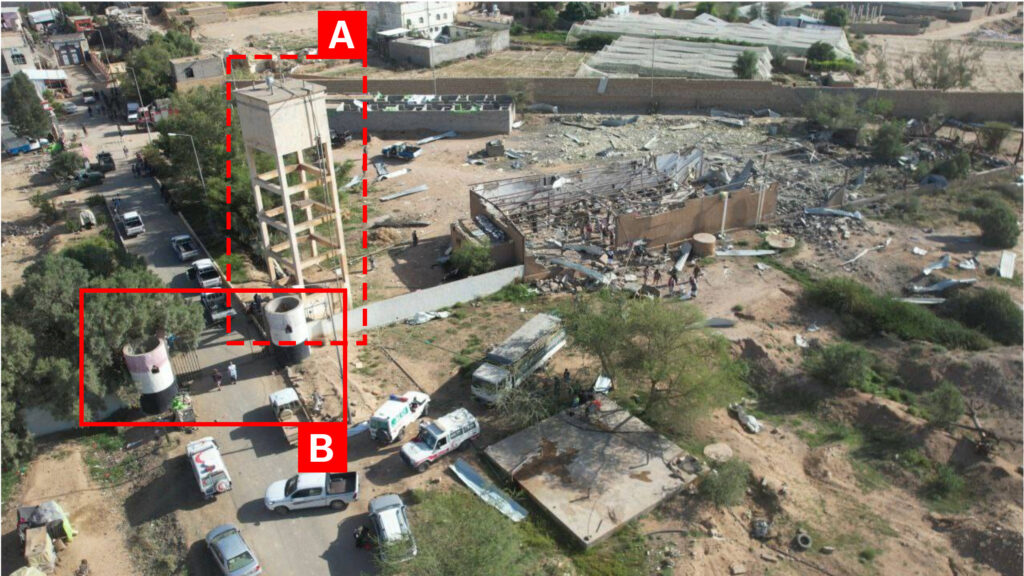
Imagery: Majd Al-Madani Saada
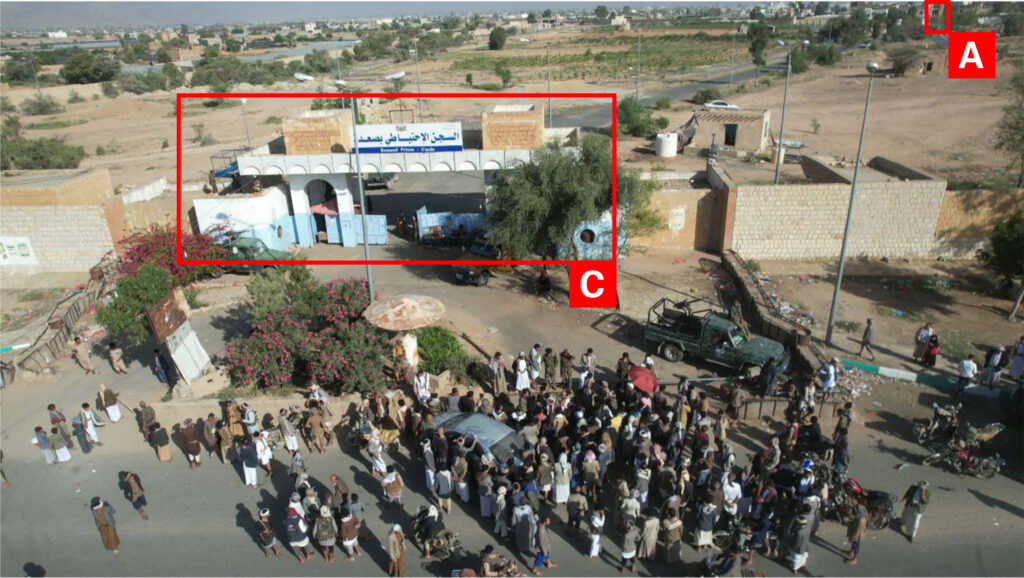
Imagery: Majd Al-Madani Saada
Munition
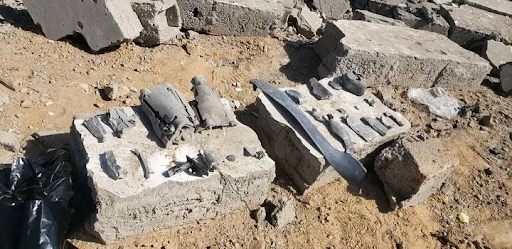
A remaining missile, according to @TvAlmasirah, did not explode on impact; the “relevant authorities are handling the object with extreme caution”. @TvAlmasirah further alleged that the “American GBU-39 JDAM” was used, a statement corroborated by Mine Action Yemen, who reported that their “Technical teams found remnants of an American GBU-39 JDAM bunker-buster bomb” and that the “effects and destruction found in the prison prove that this type of American weapon was used”. This information was corroborated by Amnesty International, which analyzed photos of remnants identified as “at least two 250-pount precision-guided GBU-39 Small Diameter Bombs” as well as the New York Times who referred to “multiple” US-made 250-pound bombs. Images of the munitions were shared by @almlsyyemen and have been identified in the Open Source Munition Portal.
Tentative Model