Source
Archive URL:
https://airwars.org/source/www-btselem-org-3/
Captured Post Date: 2025-08-20 00:00:00
Translated Author:
Author: B'Tselem
Translated Content:
Content:
A 32-year-old father of four from al-Bureij RC, Isma’il recounted the bombing of an IDP camp at a-Razi School in a-Nuseirat RC in which he was injured and his father and two of his brothers were killed, 16 July 2024:
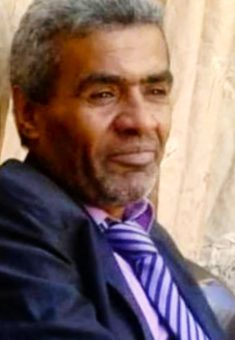
Isma’il’s father, Bassam al-Jarjawi, 57, who was killed in the bombing. Photo courtesy of the family
Before the war, I lived in al-Bureij Refugee Camp with my wife and our four children: Ghuna, 9, Bassam, 8, Lujin, 4.5, and Jud, 9 months. My parents and four of my brothers, Ahmad, 35, Khalil, 30, Yusef, 26, and Mahmoud, 23, lived with us in the apartment. My married brother, ‘Omar, 31, lived in a room on the roof with his wife and their three daughters, Watin, 4, Silya, 2, and Ibtesam, 1.On the third day of the war, our house, which had an asbestos roof, was badly damaged by a nearby airstrike. My brother Yusef suffered a moderate injury to his right leg, and my brother Mahmoud suffered a head wound that required stitches. My son Bassam’s right arm was broken.We had to leave home. We took a few mattresses and some kitchenware and moved to the Abu Hamisah School nearby. The women and girls stayed in one classroom, while we men lived in a tent in the schoolyard. There were thousands of IDPs there, and it was extremely crowded. We spent hours waiting in line for the toilets. Water was available only two hours a day, which was not enough to fill the tanks. We ate canned fava beans, hummus and processed cheese, and sometimes vegetables when they were available for a reasonable price. There was no cooking gas, so we cooked only with firewood.
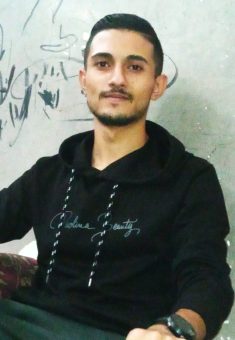
Isma’il’s brother, Mahmoud al-Jarjawi, 23, who was killed in the bombing. Photo courtesy of the family
We stayed at Abu Hamisah School for about two months, until the occupation forces raided al-Bureij Refugee Camp. My parents and brothers relocated to a-Razi School in the Nuseirat camp, while my wife, children and I moved to a school under construction in the town of a-Zawaydah. There was a severe water shortage there and no toilets, so we left after a week and joined my family in a-Razi School. After about a month, the Israeli military ordered everyone to evacuate the area. Most of the IDPs left, but we stayed, along with about 150 others. For 12 very difficult days, we never left the school because of the Israeli military’s presence. After it withdrew, thousands of IDPs returned to the school.On Tuesday, 16 July 2024, at around 2:00 P.M., I was in the schoolyard and my father, Bassam al-Jarjawi, 57, and my brothers ‘Omar and Mahmoud were in a tent in the yard. Suddenly, the military fired two missiles that hit the part of the yard with the tents, near the cafeteria. The yard was full of people at the time. Some of them were busy hanging up tarpaulins for shade. I was injured in the leg by shrapnel and fell. I saw rubble and thick dust everywhere, and body parts and wounded people lying on the ground.My cousins quickly took me in a car to al-Awda Hospital in a-Nuseirat. On the way, I told them my father and brothers must have been killed, because they were right where the missiles landed. From al-Awda, I was transferred to Shuhadaa al-Aqsa Hospital in Deir al-Balah, where I identified the bodies of my father and my brother ‘Omar. It took several hours to identify my brother Mahmoud, as only parts of his body were found in the schoolyard. After about an hour, I was transferred again, this time to an American field hospital on the beach near a-Zawaydah. The next day, I underwent surgery there and had a metal plate inserted in my left thigh. I was hospitalized for about two weeks.When I was discharged, I went back to the school that was bombed. We are still living there, my family, my mother, and my brothers. A week after ‘Omar was killed, his wife went back to her parents’ house with their daughters. Our home in the Bureij camp was hit about three times and completely destroyed. We don’t know where to go. We were driven from our homes under bombardment and took shelter in schools, thinking they would be safe. But apparently nowhere is safe and the military bombs indiscriminately, everywhere.* Testimony given to B’Tselem field researcher Khaled al-‘Azayzeh on 20 August 2024
Isma’il’s father, Bassam al-Jarjawi, 57, who was killed in the bombing. Photo courtesy of the family
Before the war, I lived in al-Bureij Refugee Camp with my wife and our four children: Ghuna, 9, Bassam, 8, Lujin, 4.5, and Jud, 9 months. My parents and four of my brothers, Ahmad, 35, Khalil, 30, Yusef, 26, and Mahmoud, 23, lived with us in the apartment. My married brother, ‘Omar, 31, lived in a room on the roof with his wife and their three daughters, Watin, 4, Silya, 2, and Ibtesam, 1.On the third day of the war, our house, which had an asbestos roof, was badly damaged by a nearby airstrike. My brother Yusef suffered a moderate injury to his right leg, and my brother Mahmoud suffered a head wound that required stitches. My son Bassam’s right arm was broken.We had to leave home. We took a few mattresses and some kitchenware and moved to the Abu Hamisah School nearby. The women and girls stayed in one classroom, while we men lived in a tent in the schoolyard. There were thousands of IDPs there, and it was extremely crowded. We spent hours waiting in line for the toilets. Water was available only two hours a day, which was not enough to fill the tanks. We ate canned fava beans, hummus and processed cheese, and sometimes vegetables when they were available for a reasonable price. There was no cooking gas, so we cooked only with firewood.
Isma’il’s brother, Mahmoud al-Jarjawi, 23, who was killed in the bombing. Photo courtesy of the family
We stayed at Abu Hamisah School for about two months, until the occupation forces raided al-Bureij Refugee Camp. My parents and brothers relocated to a-Razi School in the Nuseirat camp, while my wife, children and I moved to a school under construction in the town of a-Zawaydah. There was a severe water shortage there and no toilets, so we left after a week and joined my family in a-Razi School. After about a month, the Israeli military ordered everyone to evacuate the area. Most of the IDPs left, but we stayed, along with about 150 others. For 12 very difficult days, we never left the school because of the Israeli military’s presence. After it withdrew, thousands of IDPs returned to the school.On Tuesday, 16 July 2024, at around 2:00 P.M., I was in the schoolyard and my father, Bassam al-Jarjawi, 57, and my brothers ‘Omar and Mahmoud were in a tent in the yard. Suddenly, the military fired two missiles that hit the part of the yard with the tents, near the cafeteria. The yard was full of people at the time. Some of them were busy hanging up tarpaulins for shade. I was injured in the leg by shrapnel and fell. I saw rubble and thick dust everywhere, and body parts and wounded people lying on the ground.My cousins quickly took me in a car to al-Awda Hospital in a-Nuseirat. On the way, I told them my father and brothers must have been killed, because they were right where the missiles landed. From al-Awda, I was transferred to Shuhadaa al-Aqsa Hospital in Deir al-Balah, where I identified the bodies of my father and my brother ‘Omar. It took several hours to identify my brother Mahmoud, as only parts of his body were found in the schoolyard. After about an hour, I was transferred again, this time to an American field hospital on the beach near a-Zawaydah. The next day, I underwent surgery there and had a metal plate inserted in my left thigh. I was hospitalized for about two weeks.When I was discharged, I went back to the school that was bombed. We are still living there, my family, my mother, and my brothers. A week after ‘Omar was killed, his wife went back to her parents’ house with their daughters. Our home in the Bureij camp was hit about three times and completely destroyed. We don’t know where to go. We were driven from our homes under bombardment and took shelter in schools, thinking they would be safe. But apparently nowhere is safe and the military bombs indiscriminately, everywhere.* Testimony given to B’Tselem field researcher Khaled al-‘Azayzeh on 20 August 2024
Images:
Additional Details
Captured Date
2025-09-23 08:53:55
Captured Post ID