Source
Captured Post Date: 2026-01-09 20:57:51
Translated Author:
Author: CSIS
Translated Content:
Content:
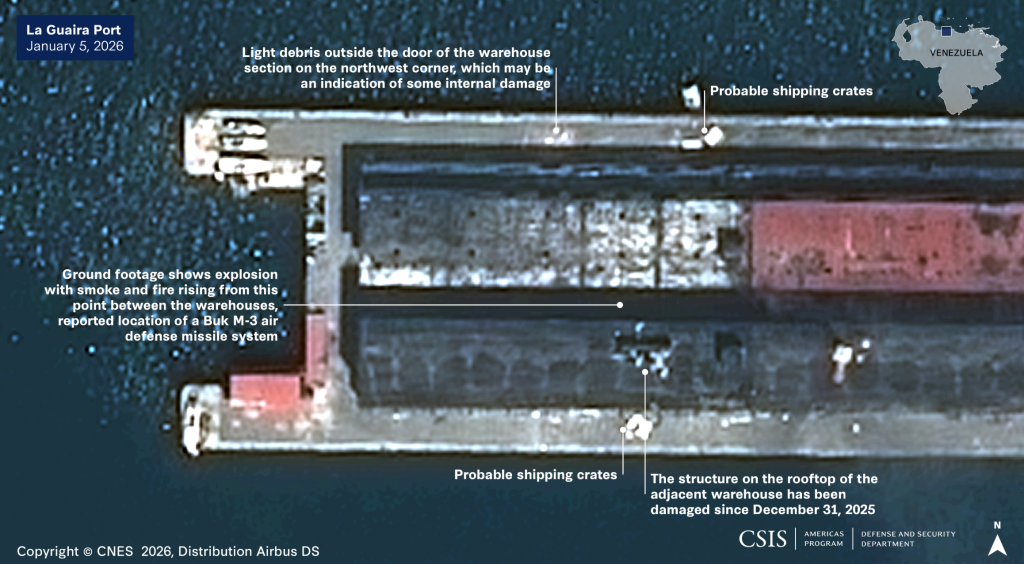
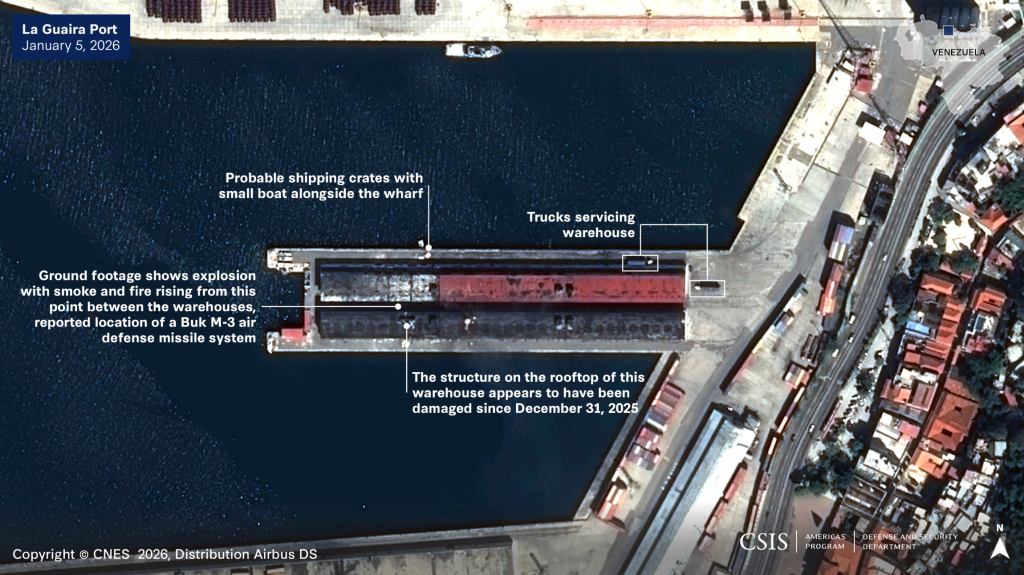
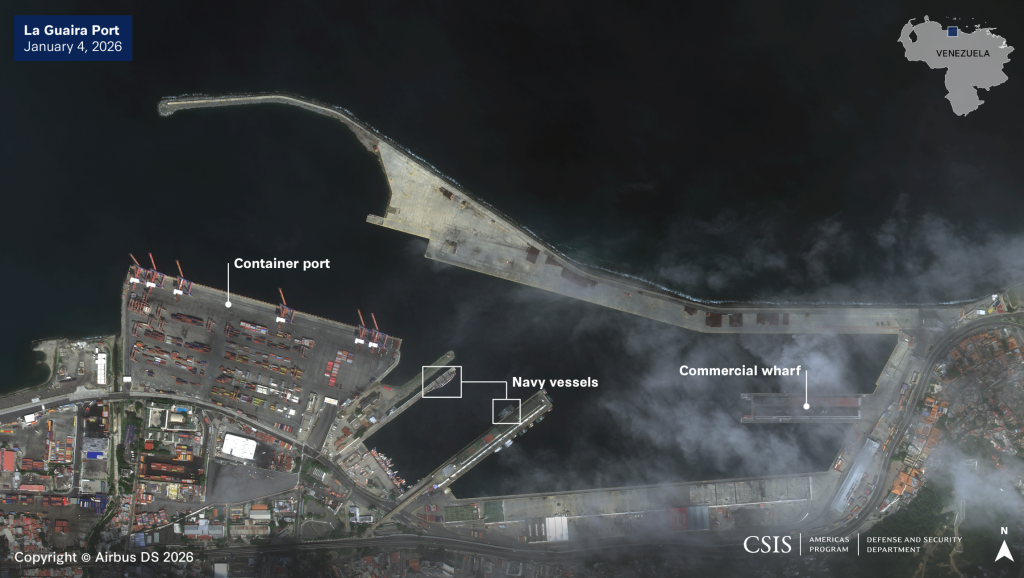
In the early morning hours of January 3, 2026, more than 200 U.S. special operations forces (SOF) surged through Caracas to capture Venezuelan dictator Nicolas Maduro and his wife, Cilia Flores, in Operation Absolute Resolve. Extensive intelligence collection—overhead and on the ground—built a “pattern of life” on Maduro and provided the foundation for a successful mission: Maduro and his wife were captured, and no U.S. personnel were killed. It was an extraordinary military and intelligence achievement.Using satellite imagery, combined with details that have emerged since the operation, CSIS was able to estimate the military activity and battle damage at four sites: the Fort Tiuna Military Complex, La Carlota Air Base, La Guaira Port, and El Higuerote Airport.The picture that emerges from these images is that of a military operation in furtherance of a law enforcement mission—an operation laser-focused on the capture of Maduro with minimal collateral damage. This was not a “shock and awe” campaign intended to bring the entire Venezuelan security apparatus to heel with overwhelming force, although that too would be within U.S. capabilities given the force posture in the southern Caribbean. It was thus unlike the U.S. air attacks against Iraq in 1991 and 2003, where the objective was to shut the country down via a broad set of attacks on electrical, communications, and transportation infrastructure, thus forcing capitulation. No such targets were struck here.In addition to these four sites, open-source reporting has confirmed that, at a minimum, additional strikes were carried out against communications infrastructure in El Volcán as well as air defenses in Catia del Mar and Fort Guaicaipuro. These more minor sites are not covered in this analysis.
U.S. forces focused on a limited number of sites, primarily the Fort Tiuna Military Complex where Maduro was known to have several bunkers. Air defense batteries and radars were also attacked to create a corridor for helicopters to enter Venezuelan territory and reach the target without interference. Many air defense sites remained untouched, however. U.S. military doctrine prescribes corridors: It was not necessary to take out the entire air defense system.Venezuela’s regular military forces and their headquarters were also not struck. While an air defense unit was hit in the Port of La Guaira, for example, nearby Venezuelan navy ships were not. None of the buildings at La Carlota Air Base, reported to be part of the Venezuelan air force headquarters, were struck. This narrow target set may reflect a sincere desire to reduce casualties—both military and civilian. Even striking buildings at night, when many are virtually deserted, produces some casualties. It may also reflect a deliberate signal to the Venezuelan armed forces and the remainder of Maduro’s inner circle of the limited U.S. objectives. The Trump administration could have already decided to work through the existing Venezuelan structure and, therefore, did not want to destabilize or decapitate the military because it would be needed to keep order.The inept force posture of the National Bolivarian Armed Forces of Venezuela (FANB) prior to January 3, 2026, facilitated the U.S. strikes. Air defenses were caught undisguised and out in the open, making them easy targets for U.S. attacks. It seems obvious in retrospect that these units should have been well camouflaged, possibly with decoys. However, units often fight as they train. If the training is undemanding—for example, taking place in the open, where it is easier to set up and conduct operations—units will do the same in wartime.Venezuelan command and control, heavily degraded by electronic warfare and possibly cyber, failed to react until it was too late, allowing the force to enter Caracas. In the words of General Dan Caine, they “maintained totally the element of surprise.” Even in the face of imminent U.S. attack, the FANB failed to prepare adequately for the task at hand. It seems likely that, had the United States opted for a larger-scale campaign as its opening maneuver, the FANB would have suffered much greater losses than those reported. Years of neglect, combined with endemic corruption, low morale, and cronyism, have eroded the FANB’s operational capabilities significantly.While U.S. strikes were limited, they still produced casualties. Current estimates report that approximately 75 people were killed, including 32 Cuban special forces who served as bodyguards for Maduro. Two civilian deaths have been identified, while residential buildings throughout Caracas were damaged. An investigation by Bellingcat found that one woman was killed when an AGM-88 anti-radiation missile detonated near an apartment block in Catia del Mar. Another civilian was reportedly killed when U.S. forces struck a communications array near El Volcán.Fort Tiuna Military ComplexThe sprawling military complex at Fort Tiuna constitutes the nerve center of the FANB. It is also reportedly where Maduro and his wife had taken up residence as the United States stepped up its military pressure against the regime. Accordingly, this site sustained the heaviest damage of the four locations reviewed by CSIS. However, the damage at Fort Tiuna is tightly focused, with no evidence of widespread strikes against barracks, training facilities, and administrative headquarters. This suggests a deliberate effort to isolate and neutralize those specific capabilities tied directly to rapid response and regime protection.A January 3, 2026, Vantor image of Fort Tiuna shows the damage concentrated in several discrete areas within the complex. The most heavily damaged site is a motor vehicle maintenance and storage facility that is likely supporting a mechanized unit. The damage shows widespread destruction without clearly defined impact craters, suggesting it was struck by rocket or missile systems rather than bombs. Several heavy equipment transporters (HETs) are visible within the compound, further indicating that the facility supported a high-readiness mechanized unit capable of rapid movement. Open-source reporting suggests the unit may have been the FANB’s 312th “Ayala” Armored Cavalry Battalion. U.S. operational planners did not want this mobile force, with its considerable firepower, to mount a counterattack against SOF operators on the ground. Although special operators are superbly trained, they are light infantry without heavy weapons. They could easily be overrun by determined mechanized forces.
U.S. forces focused on a limited number of sites, primarily the Fort Tiuna Military Complex where Maduro was known to have several bunkers. Air defense batteries and radars were also attacked to create a corridor for helicopters to enter Venezuelan territory and reach the target without interference. Many air defense sites remained untouched, however. U.S. military doctrine prescribes corridors: It was not necessary to take out the entire air defense system.Venezuela’s regular military forces and their headquarters were also not struck. While an air defense unit was hit in the Port of La Guaira, for example, nearby Venezuelan navy ships were not. None of the buildings at La Carlota Air Base, reported to be part of the Venezuelan air force headquarters, were struck. This narrow target set may reflect a sincere desire to reduce casualties—both military and civilian. Even striking buildings at night, when many are virtually deserted, produces some casualties. It may also reflect a deliberate signal to the Venezuelan armed forces and the remainder of Maduro’s inner circle of the limited U.S. objectives. The Trump administration could have already decided to work through the existing Venezuelan structure and, therefore, did not want to destabilize or decapitate the military because it would be needed to keep order.The inept force posture of the National Bolivarian Armed Forces of Venezuela (FANB) prior to January 3, 2026, facilitated the U.S. strikes. Air defenses were caught undisguised and out in the open, making them easy targets for U.S. attacks. It seems obvious in retrospect that these units should have been well camouflaged, possibly with decoys. However, units often fight as they train. If the training is undemanding—for example, taking place in the open, where it is easier to set up and conduct operations—units will do the same in wartime.Venezuelan command and control, heavily degraded by electronic warfare and possibly cyber, failed to react until it was too late, allowing the force to enter Caracas. In the words of General Dan Caine, they “maintained totally the element of surprise.” Even in the face of imminent U.S. attack, the FANB failed to prepare adequately for the task at hand. It seems likely that, had the United States opted for a larger-scale campaign as its opening maneuver, the FANB would have suffered much greater losses than those reported. Years of neglect, combined with endemic corruption, low morale, and cronyism, have eroded the FANB’s operational capabilities significantly.While U.S. strikes were limited, they still produced casualties. Current estimates report that approximately 75 people were killed, including 32 Cuban special forces who served as bodyguards for Maduro. Two civilian deaths have been identified, while residential buildings throughout Caracas were damaged. An investigation by Bellingcat found that one woman was killed when an AGM-88 anti-radiation missile detonated near an apartment block in Catia del Mar. Another civilian was reportedly killed when U.S. forces struck a communications array near El Volcán.Fort Tiuna Military ComplexThe sprawling military complex at Fort Tiuna constitutes the nerve center of the FANB. It is also reportedly where Maduro and his wife had taken up residence as the United States stepped up its military pressure against the regime. Accordingly, this site sustained the heaviest damage of the four locations reviewed by CSIS. However, the damage at Fort Tiuna is tightly focused, with no evidence of widespread strikes against barracks, training facilities, and administrative headquarters. This suggests a deliberate effort to isolate and neutralize those specific capabilities tied directly to rapid response and regime protection.A January 3, 2026, Vantor image of Fort Tiuna shows the damage concentrated in several discrete areas within the complex. The most heavily damaged site is a motor vehicle maintenance and storage facility that is likely supporting a mechanized unit. The damage shows widespread destruction without clearly defined impact craters, suggesting it was struck by rocket or missile systems rather than bombs. Several heavy equipment transporters (HETs) are visible within the compound, further indicating that the facility supported a high-readiness mechanized unit capable of rapid movement. Open-source reporting suggests the unit may have been the FANB’s 312th “Ayala” Armored Cavalry Battalion. U.S. operational planners did not want this mobile force, with its considerable firepower, to mount a counterattack against SOF operators on the ground. Although special operators are superbly trained, they are light infantry without heavy weapons. They could easily be overrun by determined mechanized forces.
Images:

Additional Details
Captured Date
2026-01-10 01:50:52
Captured Post ID