Source
Captured Post Date:
2026-06-05
Translated Author:
By Christian Montero
Author:
La Nación Por Christian Montero
Translated Content:
Victims of Alleged U.S. Military Attack on Boat in Costa Rica’s South Pacific Were Fishermen, OIJ Confirms
Christian Montero · June 5, 2026 · nacion.com
Split-screen view of a U.S. military video showing a boat suspected of drug trafficking in international waters with a weapon trained on it, moments before it was attacked.
U.S. President Donald Trump shared this image to refer to the alleged attack by U.S. forces on a suspected drug-trafficking boat in international waters, within the area of responsibility of U.S. Southern Command. (Screenshot/Screenshot)
Nearly three months after U.S. forces handed over two bodies and one survivor to the National Coast Guard following an incident in the waters of the South Pacific, the Judicial Investigation Agency (OIJ) confirmed the hypothesis that it was a shipwreck and ruled out the possibility of a military attack by the United States.
“Some international media outlets began reporting that it was allegedly an attack on a boat; we have not established that—we are treating it as a shipwreck caused by a fire on the boat,” Vladimir Muñoz, acting deputy director of the OIJ, told La Nación.
The official clarified that it was impossible to obtain further evidence because they did not have access to the boat on which two Ecuadorians and one Colombian were traveling. “We simply have the account of the people or the organization that located the bodies and the wreckage of what was a shipwreck; we have no further information on that,” he explained.
The incident occurred on March 19, but it wasn’t until the following day that U.S. Southern Command (Southcom) made it public on the social media platform X, describing a “lethal” attack on a low-profile vessel that, it said, “was traveling along known drug trafficking routes in the Eastern Pacific.” The U.S. Coast Guard transported the two bodies and the survivor and handed them over to Costa Rican authorities.
The OIJ in Golfito later confirmed that the two deceased were the Ecuadorians Pedro Ramón Holguín Holguín, 40, and Carlos Manuel Rodríguez Solórzano, 34. The survivor is the Colombian José David Torres Hurtado, who is 21 years old.
Fishing Trip
The survivor’s condition is one of the factors most complicating the investigation. Muñoz described his condition as “extremely critical”: he is sedated, undergoing various medical procedures, and unable to communicate. “He is likely already suffering from neurological damage that may even prevent him from ever speaking again,” the deputy director warned.
Torres Hurtado remains hospitalized in the Burn Unit at San Juan de Dios Hospital.
The Judicial Police contacted the families of those involved, particularly the sole survivor. According to Muñoz, the families reported that the three were fishermen and had set out on a fishing trip lasting approximately 20 days from which they never returned.
“The family has no information about any ties to drug trafficking or anything like that; rather, their only known occupation was fishing,” he said.
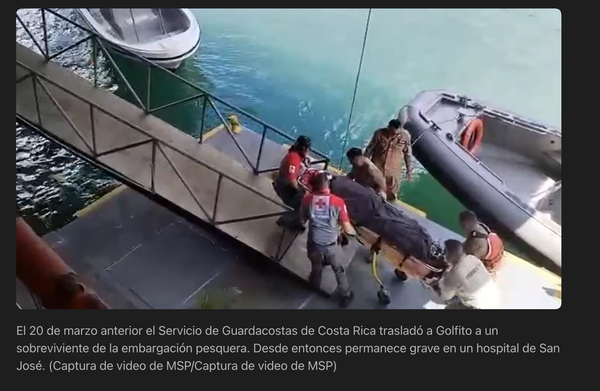
Costa Rica's Coast Guard Service transfers a survivor of a US attack on a small boat to Golfito.
On March 20, Costa Rica's Coast Guard Service transferred a survivor of the fishing vessel [incident] to Golfito. Since then he has remained in serious condition at a hospital in San José. (Video capture from MSP / Video capture from MSP)
Regarding the origin of the account that this incident was the result of a military attack, the police chief explained that it has only become known through media publications and social media.
"The information that starts on social media says that it was a boarding or an attack; we have not been able to establish that, we don't have reliable information on it, these were simply [unverified] accounts." What they have confirmed, he said, is that the three bodies showed signs of burns, consistent with a shipwreck.
Muñoz also highlighted the role of the police units involved in the rescue, stating that "if it had not been for the medical assistance they provided, the survivor would have died," he noted.
The OIJ [Judicial Investigation Agency] is awaiting the autopsy results of the two deceased in order to determine the cause and manner of death. The case remains under investigation.
Observations on the military attacks
When the case of this vessel carrying fishermen came to light, the United States had implemented a change in its counter-narcotics efforts, as Washington shifted from interdiction and capture operations to lethal military actions on the high seas, under the premise of being in an "armed conflict" against drug trafficking.
Those actions, at that time, already counted more than 140 dead in close to 40 attacks in the Caribbean and the Pacific.
However, according to international press reports, the United States has not presented conclusive evidence that the vessels attacked were in fact linked to drug trafficking, which has opened a debate over the legality of these actions.
For the OIJ, the case handled in Costa Rica does not fall within this strategy, because the injuries on the fishermen's bodies do not match a military attack.
"It is very unlikely that in an attack of this type, of this magnitude, with the equipment they have and use, other people would end up surviving," Vladimir Muñoz stated this past April.
Content:
Víctimas de supuesto ataque militar de EE. UU. a lancha en Pacífico sur de Costa Rica eran pescadores, confirma OIJ
Christian Montero · June 5, 2026 · nacion.com
Vista dividida de un video militar estadounidense que muestra una lancha sospechosa de narcotráfico en aguas internacionales bajo la mira de un arma, momentos antes de ser atacada.
El presidente de Estados Unidos, Donald Trump, mostró esta imagen para referirse al supuesto ataque de fuerzas de ese país, contra una presunta lancha del narcotráfico en aguas internacionales, en el área de responsabilidad del Comando Sur. (Captura de pantalla/Captura de pantalla)
Casi tres meses después de que fuerzas estadounidenses entregaran al Servicio Nacional de Guardacostas dos cuerpos y un sobreviviente de un evento en aguas del Pacífico sur, el Organismo de Investigación Judicial (OIJ), ratificó la hipótesis de que se trató de un naufragio y descarta la versión de un ataque militar de aquel país norteamericano.
“En algunos medios internacionales se empezó a publicar que fue supuestamente una lancha atacada; eso nosotros no lo hemos establecido, nosotros lo manejamos como un naufragio por un incendio que hubo en la lancha”, afirmó a La Nación, Vladimir Muñoz, subdirector interino del OIJ.
El jerarca aclaró que la obtención de más prueba resultó imposible al no haber tenido acceso a la lancha en la que viajaban dos ecuatorianos y un colombiano. “Simplemente tenemos una versión de las personas o la entidad que localizó los cuerpos y los restos de lo que fue un naufragio; no tenemos más información de eso”, explicó.
El hecho ocurrió el 19 de marzo, pero fue hasta un día después que el Comando Sur de Estados Unidos (Southcom), lo hizo público en la red social X, describiendo un ataque “letal” contra un buque de bajo perfil que, según indicó, “estaba transitando por rutas conocidas de narcotráfico en el Pacífico Oriental”. La Guardia Costera estadounidense trasladó a los dos cuerpos y al sobreviviente y los entregó a las autoridades costarricenses.
El OIJ de Golfito confirmó posteriormente que los dos fallecidos eran los ecuatorianos Pedro Ramón Holguín Holguín, de 40 años, y Carlos Manuel Rodríguez Solórzano, de 34 años. El sobreviviente es el colombiano José David Torres Hurtado, quien tiene 21 años.
Viaje de pesca
La situación del sobreviviente es uno de los elementos que más complica el avance de la investigación. Muñoz describió su condición como “sumamente delicada”: está sedado, con diversos procedimientos médicos y sin posibilidad de comunicarse. “Es una persona que ya probablemente tiene afectaciones neurológicas que comprometen, inclusive, que en algún momento pueda hablar”, advirtió el subdirector.
Torres Hurtado se mantiene internado en la Unidad de Quemados del Hospital San Juan de Dios.
La Policía Judicial estableció contacto con los familiares de los involucrados, en particular del único sobreviviente. Según Muñoz, las familias reportaron que los tres eran pescadores y que habían salido en un viaje de pesca de aproximadamente 20 días del que nunca regresaron.
“La familia no tiene información de vínculos relacionados con narcotráfico ni nada, sino que simplemente su actividad conocida era la de pescadores”, indicó.
El Servicio de Guardacostas de Costa Rica traslada a Golfito a un sobreviviente de un ataque de Estados Unidos a una lancha.
El 20 de marzo anterior el Servicio de Guardacostas de Costa Rica trasladó a Golfito a un sobreviviente de la embargación pesquera. Desde entonces permanece grave en un hospital de San José. (Captura de video de MSP/Captura de video de MSP)
Sobre el origen de la versión de que este hecho respondiera a un ataque militar, el jefe policial explicó que solo se ha conocido por publicaciones en medios y redes sociales.
“La información que empieza en redes habla de que fue un abordaje o un ataque; eso nosotros no lo hemos podido establecer, no tenemos información certera sobre eso, simplemente fueron versiones”. Lo que sí tienen acreditado, dijo, es que los tres cuerpos presentaban señales de quemadura, consistentes con un naufragio.
Muñoz también destacó el papel de lo cuerpos policiales involucrados en el rescate, al afirmar que “si no hubiera sido por la asistencia médica que le dieron, el sobreviviente hubiera muerto”, señaló.
El OIJ espera los resultados de las autopsias de los dos fallecidos para determinar la causa y la manera de la muerte. El caso permanece en investigación.
Observaciones a los ataques militares
Cuando trascendió el caso de esta embarcación con pescadores, Estados Unidos había implementado un cambio en la lucha antidrogas, pues Washington pasó de operaciones de interdicción y captura, a acciones militares letales en altamar, bajo la premisa de estar en un “conflicto armado” contra el narcotráfico.
Esas acciones, en aquella época, ya contabilizaba más de 140 muertos en cerca de 40 ataques en el Caribe y el Pacífico.
Sin embargo, según reportes de prensa internacional, Estados Unidos no ha presentado pruebas concluyentes de que las embarcaciones atacadas estuvieran efectivamente vinculadas al narcotráfico, lo que ha abierto un debate sobre la legalidad de estas acciones.
Para el OIJ, el caso atendido en Costa Rica no se enmarca dentro de esta estrategia, porque las lesiones en los cadáveres de los pescadores no coinciden con un ataque militar.
“Es muy poco probable que en un ataque de este tipo, de esta envergadura, con el equipo que ellos tienen y usan, resulten sobreviviendo otras personas”, afirmó en abril pasado Vladimir Muñoz.
Images: 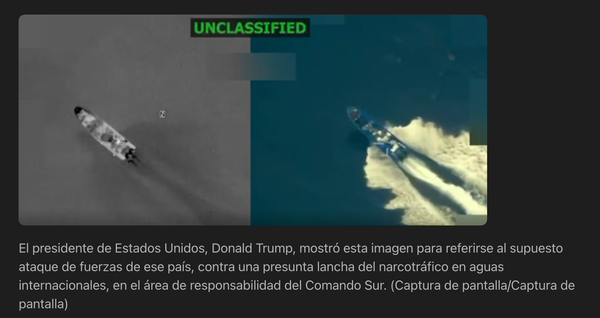
Additional Details
Captured Date
2026-06-21T00:12:24.000Z
Language
Spanish