
Incident Code
Incident Date
Location
Geolocation
Geolocation
Airwars Assessment
Shortly before 1 AM on September 10, 2024, at least 14 civilians, including seven children and two women, were killed in a series of declared Israeli airstrikes on tents housing displaced people in al-Mawasi, Khan Younis in the Gaza Strip. At least four civilians – including three children – were also injured. The Israeli military said the strikes targeted three senior Hamas militants, but did not state whether they were killed in the attack. The tents were reportedly near the Othman bin Affan Mosque behind the British Hospital, and the Israeli military’s statement referred to the location as being within the “Humanitarian Area”. Airwars identified a fatality, and then have been recorded as a militant affiliated with Hamas’ armed wing, Al-Qessam Brigades.
Five members of the Fujo family were killed, as were three members of the al-Shaer/Abu Asi family. Two other members of the family were injured. One member of the Muammar family was killed, and two of her daughters were injured. Fares al-Hayqi, a young boy, was also killed, as were 22-year-old Aseel Yasser al-Arja and 19-year-old Tariq Arafat al-Qadi. Though his name is unknown, the young son of Iyad Madi, a child, was also reportedly injured, and the husband of Manal al-Zaim was killed. 28-year-old Ahmed Ziad Hassouna Shamlakh was also reportedly killed, though sources were conflicted as to whether he was killed in this or a previous strike.
While Airwars researchers were able to find the names of 15 reported civilian victims, other reports put the death toll as high as 60. Partially explaining the discrepancy between the number of named victims and the total number of reported victims, social media users and news outlets alike reported on the difficulty of recovering bodies, as many were buried in the soft sand.
Reporting
Safa.ps was among the first to report on the strike, citing the Civil Defense in saying that “Israeli raids targeted a gathering of at least 10 tents in a populated area.” Minutes later, Safa.ps reported that “martyrs” were arriving at the Nasser Hospital after “the massacre of the displaced people’s tents in the al-Mawasi area.”
Another report from the Civil Defense said that “65 people were recovered”, adding that “recovery operations [were] ongoing”. Later, the Director General of the Government Media Office in Gaza reportedly informed Al Jazeera that “more than 40 martyrs and more than 60 wounded” had been recorded at the time. @PalinfoAr reported that “hundreds” were wounded. The Facebook account ‘Democratic Front for the Liberation of Palestine’ reported that in total, more than one hundred people were “martyred, wounded” or missing,
@ShehabAgency, reported by others like Euro-Mediterranean Human Rights Monitor, reported that more than forty people were killed and “dozens” others had disappeared inside the deep pits left by the strikes on the soft sand. Footage posted online showed a major chasm in the ground seemingly as a result of the strike.
Palestine TV reported that “five missiles were used in the attack, causing total destruction to the tents and digging holes nine meters deep in the ground, which increased the difficulty of rescue teams and medical crews in reaching the victims.”
While accounts began reporting on the number of killed and injured in the hour after the strike, reports were repeatedly accompanied by the line that “The search for missing persons and a large number of martyrs has not been identified.” Some sources specified that the sandy site of the strikes had resulted in many people being reported as missing, buried beneath the sand. While ambulance crews responded in the minutes right after the strikes, videos from ten plus hours after the strikes showed people digging through the sand with their hands and any tools they could find, continuing to look for those buried beneath the sand.
An article from the outlet Yeni Safak wrote that “Many have volunteered to help civil defense teams search for the missing under the sand, using their hands and simple tools to dig through the sand.”
Statement from the Israeli Military
The Israeli military declared that it conducted these strikes. Avichay Adraee, the military’s Arabic language spokesperson, posted to Facebook, writing “Overnight, based on military intelligence, the Israeli Air Force carried out a precise strike against a number of senior Hamas terrorists operating inside a command and control center integrated into a humanitarian zone in Khan Yunis.” The post said that Samer Ismail Khader Abu Daqqa, head of Hamas’s air unit in the Gaza Strip, as well as Osama Tabash, head of the surveillance and targeting department at Hamas’s military intelligence headquarters, and Ayman Mabhouh, another senior Hamas member, were targeted.
Avichay posted the announcement at 11:33 on September 10th, and referred to the strike as having occurred “last night”. Though these strikes in al-Mawasi were carried out at around 2 AM on September 10th, it seems that Avichay was in referring to those strikes.
Airwars was unable to find open source reports stating that Osama Tabash, Ayman al-Mabhouh, or Samer Ismael Abu Daqqa had died, and the IDF did not confirm if the men were killed after being targeted in the attack.
Airwars researchers found all three of the men’s names on the Palestinian Ministry of Health lists of all those reported killed in Gaza. The names of Abu Daqqa and Mabhouh first appeared on the eighth version of the MoH list, published on March 24th, 2025. Tabash’s name first appeared on the ninth list, published on June 23, 2025. All civilians killed in the strike who Airwars was able to match to an entry on the MoH lists first appeared on the seventh list, published on October 23, 2024. It is unclear if this discrepancy is because the alleged militants were killed in a later incident or just that their deaths were reported later than the civilian victims, as the MoH does not include details about when those listed were killed. It is not uncommon for those killed in Gaza to be listed by the MoH long after their death.
Referring to Osama Tabash, Ayman al-Mabhouh, and Samer Ismael Abu Daqqa, a Facebook account called ‘Gaza Video’ quoted an unspecified ‘security source’ which said “There is high intelligence confidence that the three were at the targeted site”, reiterating the notion that while the three men were supposedly the targets of the strike, it remains unclear whether they were killed or not. Airwars was also unable to independently find information online that linked the three men with Hamas.
As Airwars was unable to find non-belligerent, in this case the Israeli military, sources stating that the three men were killed in this incident, they are not recorded among those killed. Additionally, Airwars’ methodology is such that a statement from the belligerent military ascribing militant status to an individual does not translate to Airwars’ classification of an individual as a militant rather than civilian. This is to say that if Airwars were to find independent reports that the three men were killed in this incident, without those sources also saying that the men were affiliated with a militant organisation, they would be recorded as civilians.
Additionally, Airwars was also unable to determine through open source investigation if Hamas or any other militant group were present in the area prior or during the strike.
According to an article published by the Independent Arabic, Hamas’ spokesman, Osama Hamdan denied operating in the humanitarian zone in Al-Mawasi, stating “Israel’s claims about the presence of our operatives at the targeted site are a blatant lie. We have strict instructions to avoid the presence of our fighters among civilians.”
An article published in a Syrian news outlet, ‘Syrian Today’, quoted a Hamas response to the Israeli military’s statement regarding the attack on Al-Mawasi. Hamas representatives apparently referred to the Israeli military’s statement as a “blatant lie”. The statement went on to say “The resistance has repeatedly affirmed its denial of the presence of any of its members among civilian gatherings or the use of these areas for military purposes.”
Video – telling people to leave
A video shared to Facebook by a user named Khalf Kaeabinih al-iahtiatii appears to show a conversation, filmed unknowingly. The recording plays a conversation between a man and a woman. The audio, especially at the beginning, is not clear, but allegedly records a Hamas member asking a woman to evacuate the tent because of an important meeting of Hamas leaders.
The woman tells him that she has no place to go and that if they (Hamas members) come here, they will be a danger to the area and the Israeli military may bomb them for this reason. The male voice in the video responds, saying that if Israel bombs her, then God will have mercy on her. The woman responds and tells him that she has no place to go. He tells her to go to one of her relatives. She says that she has no relatives, so he tells her that she must go somewhere, but he needs the tent for this meeting.
Airwars was unable to verify the video, including if the man speaking in the video was in fact a member of Hamas, the claims included within or whether the video – recorded at night – was recorded at the site of the September 10 strike.
Scene of the strikes
A video shared by @ShehabAgency on Twitter/X at 9:30 AM, approximately hours after the strike, showed the scene left by the strikes. The video shows a large crater. As the background and surroundings are covered in tents and other temporary shelters, the metal skeletons of the tents are all that remain in the area around the shelter. East of the crater, it appears an area that was at one point at least four tents deep was burnt.
Another video re-shared by @ShehabAgency about 45 minutes later and narrated by the videographer, who, with a watermark with the name Haseeb Al-Wazeer, shows two large craters, tens of feet deep, right next to each other. “More than 40 martyrs in this area…no connection between them and anything, between them and fighting.”
A Facebook post shared by the Al Jazeera – Egypt account reported that “Three American-made bombs left three craters, some of which were about 10 meters deep”. Others, like a report from the Genocide in Gaza (gigaza) reported that “five missiles” struck the tents in Al-Mawasi. Another Facebook post, shared by user Mohammed Soliman said that “20 tents disappeared under the sand, along with everyone inside.” The exact munition type used remains unclear as none of the footage included identifiable remnants.
An article published by a Turkish outlet, Yenis Safak, described how human affects were strewn about in the aftermath of the strikes: “Children’s clothes and toys were scattered throughout the area, some burned, others stuck to charred trees.”
The outlet also spoke to a Rami Ahmed who was sleeping in a tent near the strikes the morning of the attacks. Rami reported “We were sleeping inside the tents, the silence of the night disturbed only by the buzzing drones we’re used to. Suddenly, we heard huge explosions, as if an earthquake had struck the area.”
Rami went on, saying “We ran out after the tents were blown away, and what we saw was beyond imagination. Dozens of tents had disappeared from the area, as if they had never existed, and bodies were scattered everywhere. The air was filled with smoke and the smell of burning, and there were deep holes beneath which we had no idea what had happened.”
Recovering bodies
In a video shared by @ShehabAgency to Twitter/X, the Spokesman for the Civil Defense described recovering people’s bodies after the strikes, saying “Their bodies evaporated and their organs were scattered.”
An article from the Independent Arabic wrote about the difficulties that many encountered in trying to identify the remains of their loved ones, as many of the victims were dismembered and/or buried deep in the sand. As such, many bodies were identified by specific physical marks, teeth, or small scraps of clothing.
The article also cited Civil Defense Spokesperson Mahmoud Basal in saying “The raids targeted a gathering of 200 tents inhabited by residents in an area the army claimed was a humanitarian area.” The article continued citing Basal, writing “About 40 tents were severely damaged as a result of the shelling, in which the army used more than four heavy concussion missiles, creating craters up to nine meters deep. This means that an entire displaced persons camp was buried under the sand as a result of the intense shelling.”
Basal went on to describe the difficulties that family members of those killed, like Ayman, faced in identifying their loved ones: “bodies were torn to pieces by the missiles, and the blast’s force disfigured the victims, making it impossible to identify them.”
Palestinian Health Ministry spokesman Khalil Al-Daqran was also cited, saying the “ambulance crews faced difficulties in retrieving the victims of the Al-Mawasi massacre, attributing this to the fact that the attack occurred in an area with dense sand, which made the rescue crews’ tasks difficult.”
Striking families
Talal Ibrahim, posting to Facebook, said that the strikes in Al-Mawasi struck tents on the land of the Al-Shaer family. Talal specified that “a number of displaced families” were sheltering on the land, including the Fujo, Madi, Ta’ima, and al-Shaer families. At the time of Talal’s post, ambulance crews were reportedly “still finding it difficult to retrieve the martyrs.” Members of the Muammar family were also killed and injured.
Al-Shaer/Abu Asi Family
Four members of the Abu Asi family were reportedly killed in the strikes on the tents: 5-year-old Salem Abdel Jabbar al-Shaer, 18-year-old Mahmoud Fawzy Mohammed al-Shaer, and 17-year-old Shaima’a Gabr Mohamed al-Shaer. According to some sources, Salem’s mother, Reham Zayed Abu Asi (al-Shaer), was also reportedly killed. However, others said that she was injured, and she provided an interview to news outlet Yenis Safak following the strike. As such, she has been recorded among those injured.
Additionally, 32-year-old Issam Fawzy Mohammed al-Shaer was reportedly injured, but it likely appears he ultimately succumbed to his wounds.
When Airwars first published this incident on September 29, 2025, no open sources were found to suggest that Issam Fawzy Mohammed al-Shaer was a militant. As such, Issam al-Shaer was recorded as a civilian. This was in line with Airwars’ methodology which is employed across all conflicts we document, and informed by international standards regarding the ‘presumption of civilian status‘. Specifically, as outlined by the International Committee of the Red Cross, civilian status is assumed until evidence is identified to the contrary.
On May 12, 2026, a Telegram account affiliated with Hamas’ armed wing, Al-Qessam Brigades, published a tribute to Issam al-Shaer, identifying him as a field commander. As such, Airwars updated Issam al-Shaer’s status from civilian to militant, and changed the minimum number of civilians reportedly killed in this incident from 15 to 14.
Facebook user Ahmad Alshaer posted to Facebook to remember his family members, writing that the “Al-Shaer family, both at home and abroad” mourned the losses. Ahmad closed the post, writing “We ask God Almighty to have mercy on him and to inspire his family and relatives with patience and solace.”
In an article published by the outlet Yenis Safak, Reham al-Shaer (Abu Asi), a surviving member of the Al-Shaer family who was injured in the attack was quoted saying “How could this place have turned into a graveyard like this?!” as she wiped away tears, reportedly pointing to the tent where she and her children had been taking shelter, “We left to live, but death has followed us even here”.
Some Facebook users, including Nedal Assi, A. Ahmed Abu Asi, and Ali Zaeed mourned the killing of Reham Zayed Mahmoud Abu Asi. However, as noted above, she gave interviews in the aftermath of the strike, and was referred to as injured.
Salem’s death was first reported by Safa.ps at around 2:27 AM, in a report which said “Salem Jaber al-Shaer was martyred in the shelling of the coastal Al-Mawasi area, west of Khan Yunis.”
Ali Zaeed prayed for Salem and Reham, posting on Facebook: “And those who, when disaster strikes them, say, “Indeed we belong to Allah, and indeed to Him we will return”.
Amal Hadad also prayed for Salem, and shared a picture of him on Facebook. In the picture, Salem, who appears to be a toddler, wears a black turtleneck under a red sweater and smiles at the camera.
Posting to Facebook, Belal Garghon and Abu Sulaiman remembered their cousins Mahmoud and Shaima’a. In Belal’s words: “My cousin #Mahmoud Fawzy, the poet, is a martyr. My cousin #Shaimaa Gabr, the poet, is a martyr.” Belal added a request for prayers for “A speedy recovery for Issam and the rest of the family.” However, Issam’s name was matched to an entry on the seventh Palestinian Ministry of Health list. For this reason, Issam has been recorded as killed, as it seems likely he succumbed to injuries from the strike. This will be updated should additional information become available.
Accompanying his post, Belal shared a photo of Mahmoud. In the photo, Mahmoud wears a blue suit, red tie, and white shirt, and smiles toward the camera, his left hand resting across his abdomen.
The deaths of 18-year-old Mahmoud and his sister 17-year-old Shaima’a were remembered by Facebook accounts associated with the ‘Democratic Front for the Liberation of Palestine’ (DFLP).
In one post, Mahmoud was remembered as someone who “persevered in his tireless work within the ranks of the Union and in student activities in the schools of Rafah Governorate, and was a courageous man in serving his people.”
A post shared by the Palestinian Democratic Youth Union / Central Page Facebook account also “mourned comrade Mahmoud al-Shaer”, and reiterated the sentiments regarding Mahmoud’s “tireless work” and courage.
Another post shared by the same account, cited The Union of Women’s Action Committees, affiliated with the Palestinian Movement in remembering Shaima’a. Writing that Shaima’a was “martyred in the horrific Al-Mawasi massacre in Khan Yunis Governorate, south of the Gaza Strip, which left more than 100 martyrs and wounded, and a large number missing,” and adding that she had been “displaced from Rafah Governorate”.
While the DFLP has a history of carrying out militant action, and members of the group are known to have fought alongside Palestinian militant groups since October 7, 2023, the DFLP also has an active political wing. Given the nature of the posts describing Mahmoud and Shaima’a, Airwars has assessed it as likely that they were involved in civilian activities rather than active within the militant wing of the group. As such, both Mahmoud and Shaima’a have been recorded as civilians. This will be updated should additional information become available.
Another post, shared by Alqotb al-Democrati (The Democratic Pole), a part of the Student Unity Bloc at Al-Najah University, also remembered Shaima’a. Airwars understands that this group is not believed to be associated with any militant activity.
Fujo Family
Five members of the Fujo family were also reportedly killed, including 30-year-old Ahmed Khaled Fujo, Ahmed’s wife 27-year-old Dua’a Antar Fujo, and three of Ahmed and Dua’a’s young children: 5-year-old Yousef Ahmed Fujo, 6-year-old Nada Ahmed Fujo, and Adam Ahmed Fujo.
Posting to Facebook, Ilia Maha described the scene in which the Civil Defense found the five family members who were killed together in their tent and buried under the dirt. “In a tent measuring 2 meters wide and 2 meters long, buried under the dirt, the Civil Defense found six mattresses, one next to the other…The entire family was buried under the dirt, suffocated to death beneath the sand, a scene that embodies the horror of the massacre.”
Echoing a sentiment shared by many other reports, the search for others in the sand was still ongoing, and of the bodies that had been found, many were charred and torn, and some “completely vaporised”.
Ilia also highlighted that those killed were killed in the humanitarian zone. “All the displaced people who were asked by the…army to evacuate their homes and head to this “humanitarian” area for their safety were buried. Despite complying with evacuation orders, they were buried alive beneath the sand.” Accompanying her text, Ilia shared a photo of one of the craters.
An image shared by Ahmed Saleh to Facebook showed Ahmed with two of his children, perhaps Yousef and Nada. In the photo, Ahmed sits behind a table and holds both smiling children in his arms. His face rests against Nada’s who appears to be laughing, and Yousef leans against Nada, his left arm in a little plaster cast.
Dua’as brother, Abed A Fujo, prayed for Ahmed, Dua’a, Nada, and Youssef, writing “With hearts that believe in God’s will and destiny, I received the news of the martyrdom of my sister, the joy of my heart, her husband, and their children in the Mawasi Khan Yunis massacre.” He added, “In this great tragedy, we say only what pleases our Lord. To God we belong and to Him we shall return.”
Muammar Family
Samar Muammar was injured and her young daughter, 3-year-old Eleen Muammar was killed. Samar’s 6-month-old daughter was also reportedly injured. Recounting the striket that killed Eleen, the girls’ father Raed said that his and Samar’s six-month-old daughter was pulled from the rubble and survived.
Videos of Eleen’s family carrying her tiny body, wailing and praying for her, were shared widely. In the videos, Eleen’s caramel shoulder-length hair flows out of her white shroud as family members cry and kiss her cheeks.
One of the videos was shared with the text “The child Eileen Muammar was killed by a fire belt launched by the occupation on the Al-Mawasi area, which was classified as safe, west of Khan Younis city.” ‘Fire belt’ is a term used in Gaza to describe many airstrikes, and the reference to the Al-Mawasi area in which Eleen and at least 14 others were killed is in reference to the Al-Mawasi having been at different points referred to as a ‘safe’ or ‘humanitarian’ zone.
Samar’s husband, Raed Muammar, was interviewed at Eleen’s funeral. In a video of the interview, posted by Wafa Agency on Facebook, Raed, holding the couple’s baby daughter, said:
“It was almost 1:00 in the morning, we were sleeping, there were violent Israeli raids in the place next to us, my daughter was martyred, my wife was injured, and this daughter of mine was injured, and the place was completely destroyed. I was there just moments ago, and all that is left are remains of the tents.”
Raed went on to describe how he and his family had come to the area for safety, as it had been declared a humanitarian zone: “We were in humanitarian areas that are supposed to be safe, yet these are the Israeli targets.”
Raed then described the moments after the strikes: “My daughter was buried under the sand, along with two girls and their mother. I was also buried under the sand. I came out from inside the sand looking for my wife and daughters. There were remains of the neighbors in my tent. I knew that they were the remains of the neighbors after I saw my family as complete corpses. One of the women was crying over her martyrs and saying that the father is in prison and the mother was martyred. Where will these ten people go now? The boys became orphans. Where should we go?
Raed finished the interview reiterating that despite following Israeli orders supposedly meant to keep them safe, they were struck: “They told us to go to Al-Mawasi, so we went there. We have been displaced many times.”
Civilians killed apart from their family
Remembered by his uncle, Shawqi Abu Adham, Tariq Arafat al-Qadi was among those killed. Posting to Facebook, Shaqi prayed for his nephew who had “been martyred”, and shared an image of Tariq. In the image, Tariq wears a grey-blue thawb, flashes a peace sign, and smiles toward the camera.
Facebook user Amal Hadad also posted to Facebook, praying for Tariq: “May God have mercy on him and on all the martyrs of Palestine.”
Aseel Yasser al-Arja, the daughter of Dr. Yasser al-Arja, was also killed. Aseel was remembered in a Facebook post shared by Jihad al-Shaer. In the post, Jihad prayed for Aseel and “the hearts of her family”. Another Facebook user, M. Munir Abu Ahmed, shared the same post.
A man by the name of Iyad Madi also survived the strike, as did his young son. However, Iyad’s son was injured. In a video interview with Palestine Online which was posted to Facebook, Iyad who was displaced from Rafah with his family, said “At 12 midnight, the aircraft came and bombed us like a volcano. We were buried here in this place, and we dug our children out of these places.”
Iyad went on to describe his son, who was injured: “My son, a child, was sleeping here, and we took him to the hospital in the ambulance.”
Describing people being buried under the rubble, Iyad said: “They told us to move here, and we moved here. I took my daughters out from under the rubble. I saw people flying. It was a situation that cannot be described, not even in action movies. I saw a severed head there near the palm tree, two severed legs there, and children under the sand. I tell you that my children were buried here in this place, and there was no civil defense equipment for rescue. We were working only with our hands.”
Speaking to the civilian nature of the area, Iyad said that whenever a family is displaced in an area, they try to learn about the people living in the area where they settle, so as to make sure that they’re in a civilian area and as such safe. “Anyone who is displaced from his home checks on those living nearby because he wants to protect his family and children. When we asked, we learned that everyone living around us are civilians, from the Madi family, the al-Shaer family, the Qashta family, and other civilian families who have nothing to do with this conflict.”
Fares al-Hayqi, a young boy, was also reportedly killed. In an article published by the Independent Arabic, Fares’ father, Raed al-Hayqi, recalled recovering parts of Fares’ body. Searching the site of the strikes for Fares’ remains, Raed was only able to find “parts of him”. “His legs were cut off, his stomach was open, and his intestines were out. His body was separated from his head. I thought that this was my son’s body because of what remained of his leg, as he had been injured in it previously. The scars from the injury were clear.”
Manal al-Zaim’s husband, whose name Airwars was unable to determine, was also killed. Speaking to Independent Arabic, Manal ran to the site of the strikes, looking for her husband. Manal was ultimately able to identify her husband based on a small piece of familiar floral fabric, from his shirt. “I found his charred body clinging to the remains of his clothes…this airstrike is strange. I have never seen charred bodies and bodies so disintegrated in my life. It seems that the intense heat emanating from the Israeli missiles has left us unable to identify the bodies.”
Another victim, 28-year-old Ahmed Ziad Hassouna Shamlakh, was listed among the dead in these strikes by the Genocide in Gaza project (gigaza.org). However Facebook user Amal Hadad also announced Ahmed’s death on September 10th, saying that he died from injuries that had resulted from a strike that had taken place before these Mawasi strikes. Aside from the Ministry of Heath, which first included Ahmed’s name on list seven, which related to the period between October 7, 2023 and October 7, 2024. As such, Airwars has included Ahmed’s death among the maximum number of those killed, but not the minimum. This will be updated should additional information become available.
Recovering family – Ayman
The Independent Arabic article goes on to recount the story of Ayman, whose brother was killed in the strike. Ayman describes looking into a nine-meter-deep crater, which he confirmed was exactly where his brother’s tent had stood. Ayman went on to describe descending into the crater, alongside rescue teams, to search for his brother. “There, [Ayman] found the bodies torn to pieces, scattered among the sand to the point that they were buried beneath the dirt.”
The article goes on to describe the difficulty that Ayaman and others faced in trying to find and identify the bodies of their loved ones.
During the search, Ayman found a severed head. He picked it up and looked at it. It was burned, disfigured, and featureless. His attention was immediately drawn to his teeth, where he found a golden tooth. He quickly embraced the head, kissed it, and cried, “My brother is dead.”
Recovering family – Randa
Per reporting from Independent Arabic, a woman named Randa rushed to the strike site, looking for her brother. She found a body with its stomach cut open, and despite wanting to look away, she looked at the victim’s face, and confirmed the body belonged to her brother. “His face was completely burned, but his beard hair caught my attention. My brother had a distinctive beard with an orange strand, and the rest of his hair was black.” She adds, “The head was scattered on the ground, and he had no features. What I saw on my brother’s body was terrifying. It’s something I can’t describe.”
Media coverage
An article published by the Euro-Mediterranean Human Rights Monitor said that the “massacre committed by the Israeli army against displaced persons in dilapidated tents in the area it declared a humanitarian zone in Mawasi Khan Yunis, south of the Gaza Strip, is further evidence that the international silence on the genocide committed against Palestinians for 11 months, and the failure to take appropriate stances regarding these mass killings, encourages Israel to commit further such crimes.”
The organisation went on to report that in investigating the September 10 strikes, it found that the Israeli military had “dropped three US-made MK-84 bombs”. Other sources, like @TRTArabi and Al Jazeera – Egypt, posting to Twitter/X and Facebook, highlighted that the strikes on the tents were committed by “American-made bombs”. There were no publicly available images of munition remnants that Airwars found to corroborate this claim.
Where possible, names have been matched with the Palestinian Ministry of Health (MoH) lists, which include national ID numbers. Airwars is matching individuals to the first list where their name appeared. The ages of additional victims have been found by cross-checking names against lists of fatalities shared online by Genocide in Gaza, which has a list of “martyrs” of Israeli forces.
Assessment Updates
Victims
Family members (4)
Family members (3)
Family members (5)
Individuals
Geolocation Notes
Reports of the incident mention a strike in the Al-Mawasi area (المواصي) to the southwest of Khan Younis (خان يونس). This incident was independently geolocated by Ben Tzion Macales (@BenTzionMacales). Satellite imagery shows the strike location at the following exact coordinates: 31.3463685, 34.2538416.
Geolocation Observation: Declared Humanitarian Zone
The coordinates provided by Airwars are inside the Humanitarian or Safe Zone established by the Israeli Military.
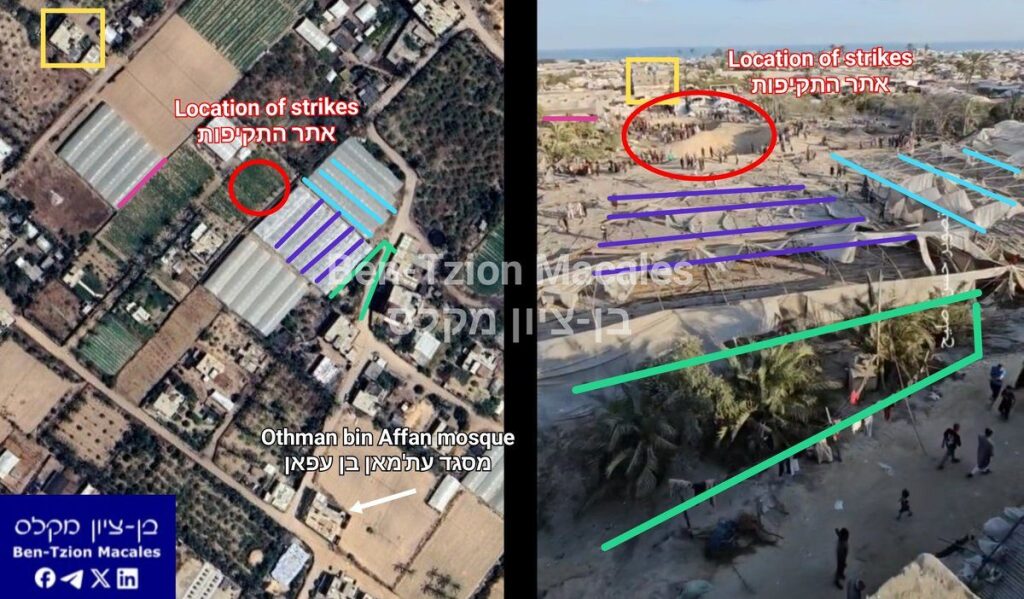
BenTzionMacales
Imagery: @BenTzionMacales