
Incident Code
Incident Date
Location
Geolocation
Geolocation
Airwars Assessment
Shortly after 7:15 a.m. on Sunday, December 3rd, 2023, a series of alleged Israeli airstrikes on the Hamouda family’s house in Beit Lahia killed at least 14 civilians, including two women and seven children, and injured eight others.
67-year-old Dr. Ahmed Atta Hamouda was killed alongside his sons, 36-year-old Atta Ahmed Hamouda and 27-year-old Dr. Muhammad Ahmed Hamouda. Atta Ahmed Hamouda’s six-year-old son, Ahmed Atta Hamouda, and two daughters, three-year-old Maria Atta Ahmed Hamouda and an infant Malak Atta Ahmed Hamouda, who was just eight months old, were also killed in the incident. Ahmed’s 62-year-old wife, Muna Hamouda, was injured.
Ahmed’s daughter-in-law, 31-year-old Lama Shawqi Hamouda, was killed alongside her five-year-old daughter, Reem Khaled Hamouda. Her husband and Ahmed’s son, 34-year-old Khaled Ahmed Hamouda, was reported injured. Khaled is a surgeon at the Indonesian Hospital and resident of Beit Lahiya.
Ahmed’s 71-year-old brother, Fawzy Atta Hamouda, was killed alongside his 50-year-old wife, Wafaa Hamouda. Other family members, including Ahmed’s cousin, 41-year-old Attia Osama Hamouda, and 15-year-old Saeed Mahmoud Hamouda, were also killed.
Ahmed’s two sisters, Mona and Mariam Hamouda, were injured, as was Mohammed Ousama Hamouda. 31-year-old woman Raneem Hamouda and her 12-year-old daughter Mona Hamouda were also injured. A woman, Shahd al-Barawi, was also injured. The extent of the injuries was not made public.
Among the victims killed were also the family’s neighbors – a 16-year-old girl, Shuruq (Jasser Fahmi) al-Barawi, and a 16-year-old boy, Hussam (Muhammad Ibrahim) Abu Rabi’.
Names within parentheses were found from the Ministry of Health list and the Shireen monitor website list rather than from local sources.
The surviving Khaled Hamouda told the field researcher Olfat al-Kurd from B’Tselem (The Israeli Information Center for Human Rights in the Occupied Territories) about the circumstances of the deadly attack that took the lives of his father, his wife Lama, their daughter Reem, and other family members. He said that on Sunday morning, at 7:15 a.m., he sat down to drink a cup of coffee with my wife and children and our neighbors, sisters Shuruq and Shahd al-Barawi, and shortly afterward the airstrikes happened:
“Then we heard an explosion. We all quickly went further into the apartment, into one of the rooms. A missile apparently hit our building, but we didn’t realize it. A few seconds later, another missile hit the building. I heard a muffled sound and stones, glass, and the walls fell upon us. Neighbors came to help us. They rescued us and sat us at the door of the home.
At that stage, I still didn’t know exactly who had been killed and injured in the bombing. But Shahd al-Barawi, who was right next to me, was injured by shrapnel to her head and body, so I took her on foot, a distance of about one kilometer, to the Khalifa School in Beit Lahiya. I thought I could call an ambulance from there. When I got there, the Red Crescent told me they couldn’t send an ambulance to the house because our area was classified as a red zone, to which they’re not permitted to go. They evacuated me and Shahd in an ambulance to the hospital named after Kamal Adwan, as I was also injured by some shrapnel on my body.
In the hospital, I learned that the two missiles were fired at my parents’ apartment, and while the neighbors attempted to rescue them, a third missile was fired at the building and killed my father, my wife Lama, my daughter Rim and our neighbors Shuruq al-Barawi, Sa’id Hamudah and Husam Abu Rabi’. Later, they brought the bodies to the hospital, and I went to identify my wife in the morgue. And then a nurse passed by me, dragging a stretcher with my daughter’s body. I was shocked, I couldn’t believe my eyes. I learned that Ahmad and Razan had survived and were okay.
My mother, Muna Hamudah, 62 years old, was injured, and my sister-in-law, Raneem Hamudah, 31 years old, my brother ‘Ata’s wife, and their 12-year-old daughter, Muna, were also injured. Both my mothers’ arms were broken, and Raneem had fractured ankles, wounds, bruises, and burns. I stayed at the Kamal Adwan Hospital, where my shrapnel wound was treated. My mother and the others wounded from the attack were transferred to Al-Awda Hospital in Jabalya. The remaining bodies of the deceased were left under the rubble as they couldn’t be retrieved.”
Family members and friends of the Hamouda family posted tributes to those killed and injured.
Maram Hijaz expressed his grief at the death of Muhammad Ahmed Hamouda who was a general practitioner at the Indonesian Hospital, in a post on Facebook, remembering him as a “great young man”. Maram praised Muhammad for his memorisation of the Quran, and wrote that “less than a year ago, he graduated from the Faculty of Medicine in Sudan with a very good grade.” Muhammad had returned to Gaza after eight years away “to embrace his family”. His dreams, Maram stressed, were focused on his family and career: “His dream was to complete an honours degree and specialise in cardiology, propose to the girl he wanted, get married, raise his family, and live.” Many users shared a photograph of Muhammad in his lab coat, with a stethoscope around his neck.
Facebook user Dooz also shared a tribute to Muhammad, writing, “I knew him in 2013, he was a fellow expatriate in Sudan…A young man with a laugh that made you want to get close to him and become his friend…He had a sweet and cheerful spirit, he made our repatriation easier, his family’s house was a guest house for young expatriates of our generation, he called his house the family house. He loved life.”
Maram Hijaz also remembered Muhammad’s nephew Ahmed, as a “happy and sweet boy” who was the “sweetheart of the whole family [and] the spoiled grandson.” He was “the first one to bear the name of his grandfather”. Facebook user Dr-elhassan Hammouda shared a photograph of Ahmed and a young girl, possibly Maria or Malik, both smiling at the camera. Accompanying this photograph were multiple family members – Ahmed, his sons, and grandson, Ahmed – at an event. Maram Hijaz posted another photograph from the same occasion, showing Muhammad and his nephew, Ahmed, in formal wear, both smiling at the camera.
Dr. Ahmed Atta Hamouda, the elder Ahmed, was a gynecology and obstetrics specialist. He studied at the College of Medicine at Alexandria University in Egypt. On September 17, 2024, the Gaza Ministry of Health published a non-exhaustive list of 986 medical professionals who had been killed in Gaza between October 7, 2023, and August 31, 2024. According to this list, Ahmed worked at the Ministry of Health as a primary care physician prior to his death.
Nader Salah shared a post about the Ahmed, writing that the two had come into contact when Ahmed, who was making the pilgrimage to Mecca, wrote to Nader on the Internet and so “opened a direct link between me and him and began praying for me and my wife to be blessed with children”. The generosity, Nader emphasised, was a family trait, as Ahmed’s son “also has a long history of providing assistance to poor and needy families, the last of which was the restoration of two houses in the city of Beit Lahia, as well as opening a project for a family that was living [in a rented accommodation] and many [other] charitable works.” Along with his commemoration, Nader shared a photo of Ahmed praying at Mecca.
The relative Khaled Jamil Hamouda remembered his “beloved uncle and support” Fawzy Atta Hamouda, and Fawzy’s wife, Wafaa, the “owner of the kind heart”. Like his brother Ahmed, Fawzy had also completed the Islamic pilgrimage to Mecca, and Khalid respectfully referred to him as a “Hajj”.
The surviving son of Ahmed Atta Hamouda, Khaled Hamouda, posted to Facebook an elegy for his daughter Reem. A vivid memory for Khaled was knocking on his daughter’s door and expectantly waiting for her answer. Reem, Khaled wrote, had recently turned five, and “had some difficulty with speaking and comprehension”. When Khaled would knock on her door, Reem would ask, “Who are you?” to which Khaled would reply, “I am Dad”. It was a ritual he would repeat daily, but of which he wrote, he never tired. These words were ones he was “happy to hear”. Khaled’s sense of loss was palpable: “If I knock on the door of heaven, hurry up, because my beloved, I cannot wait.”
On April 21st, Khaled shared a photo where he is seen carrying Reem in his arms; the two are smiling. Khaled wrote that without his daughter, “the whole world is insignificant.” Writing months after the strike, Khaled emphasised that “not a tear has dried” and that his heart had not “calmed down”. On August 19th, Khaled wrote that he awaited the day he could meet Reem “in a garden where there is no toil or suffering”.
On July 24th, 2024, Khaled shared another post for his father and uncle, admitting that he had “never cried for my father and uncle since their departure, despite the great status and love they hold in my heart and soul.” They had been sick “in the last years of their lives” and had been frequently brought to intensive care. Their conditions were severe enough that both men had been “transferred for treatment outside of Gaza many times”. After contracting COVID, a colleague told Khaled to pray for his father, as “No one survives with such results unless God wills it.” His father survived, Khaled wrote, because “he willed it”. Accompanying the post was a photo of his father and uncle standing together.
On August 23rd, 2024, Khaled shared a post for his brother, Atta Hamouda. Despite not being religious “in the traditional sense”, Khaled wrote of Atta, he was “a generous, pious, and honourable man who would only accept good, lawful food in his restaurant, and who was quick to respond to charity work and to help those in need with whatever goodness God bestowed upon us, whether money or fruit”. Atta was “affectionate, compassionate, and caring towards his children and our children.” Atta had dedicated himself to helping displaced relatives and friends secure housing “during the period of calm in late November”. Attached was a photograph of the two brothers. Facebook user Munther al-Bahri had similar memories of Atta, referring to him as a “brother” and “beloved”.
Facebook user Hadeel M Hamouda also mourned the destruction of the family home, “taking with it all the sweet memories”.
Posting to Facebook, Mohammed Magdey Hammouda also cited the destruction of the Hamouda family home. Sharing a picture of a residential street dusted with rubble and debris, Mohammed wrote: “Our home, our sweet memories, our beautiful moments and days were targeted.”
While no source directly named a belligerent, many sources mentioned that the Hamouda family had been “targeted”. In the context of this assessment, it is highly likely that these are references to Israeli targeting.
Where possible, names have been matched with the Palestinian Ministry of Health (MoH) lists, which include national ID numbers. Since October 26, 2023, the MoH has released six lists, along with an additional list of medical professionals, which was released on September 17, 2024. Airwars is matching individuals to the first list where their name appeared. In regard to this incident, names are matched to the sixth ‘Palestinian Ministry of Health List of Fatalities in Gaza’ list, which was released on September 16, 2024. Dr. Ahmed Atta Hamouda was also matched to the MoH list of medical professionals, which was released on September 17, 2024. With the exception of Reem Khaled Hamouda and Atta Ahmed Hamouda, all ages cited in this assessment were found in the MoH list.
Where sources identified the belligerent, all sources attributed the strike to the Israeli military.
Assessment Updates
Victims
Family members (20)
Individuals
Key Information
Geolocation Notes
Reports of the incident mention the Hamouda Medical Center (مركز حمودة الطبي) in Beit Lahia (بيت لاهيا). Analysing audio-visual material from sources, we have narrowed the location down to the following exact coordinates: 31.543541, 34.502726.
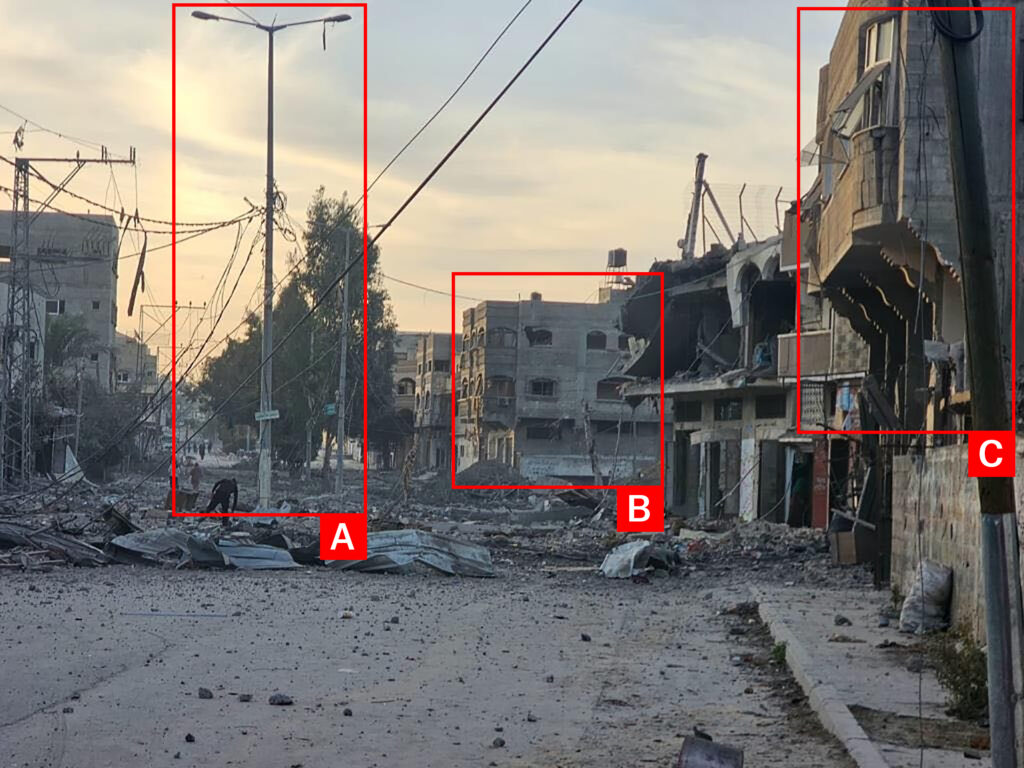
Imagery: Mohammed Magdey Hamouda