
Incident Code
Incident Code
Incident Date
Location
Geolocation
Geolocation
Airwars Assessment
In the evening on Monday, 05 May 2025, at least five civilians were killed, and between 21 and 42 civilians including at least one child were injured in a declared Israeli airstrike on the Bajel Cement Factory in the Hudaydah governorate, Yemen. Among the casualties were reportedly civilian employees of the Yemen General Corporation for Cement Industry & Marketing.
The Israeli Defense Forces (IDF) released a statement stating that they hit the “Bajil Concrete Plant, east of the city of al-Hudaydah” claiming that it had functioned as a “significant economic resource for the Houthis.” The IDF also alleged that the Plant had been used “for the construction of underground tunnels and terrorist infrastructure for the terrorist regime”, as justification for the strike.
At 06:44 PM on Monday, the Yemeni Ministry of Health posted that 21 civilians had been injured in the airstrike on the Bajel Cement Factory, “according to preliminary figures.” TV al-Masirah posted a photograph of a large explosive fire emerging from the Factory, adding that those reported killed “are civilian workers.”
Later that night at around 8 PM, TV al-Masirah updated the civilian casualty toll from the strikes as two killed and 42 wounded as of that time. Twitter/X user @faresalyamani alleged that the factory was supposed to have been evacuated two days prior for a week’s maintenance, and yet reports and witnesses testified that at the time of the strike over 5000 factory workers had been present, and demanded answers from Houthi and Israeli authorities.
Twitter/X user @bwmmdlsyd151004 posted a video showing the wounded from the strike being rushed into a hospital, including an elderly man, and a little child with a wounded leg. They also alleged that the strike hit the factory as well as “the homes of civilians adjacent to it in [Al-Hudaydah].”
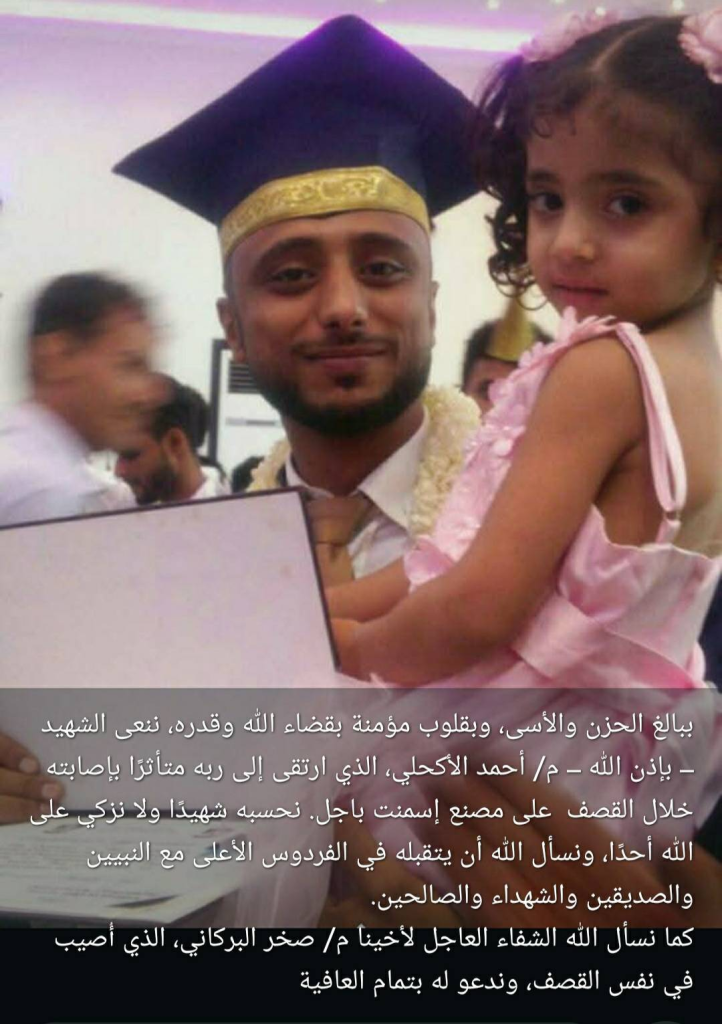
Users on social media posted the names and details of six men who had been killed, five of whom are indicated to have been civilians andthe identified civilian casualties, all of whom were reportedly employees of the Yemen General Corporation for Cement Industry & Marketing. The six who were identified as killed in the strike – Ahmed al-Akhaly, Mohammed Mohammed al-Dhiabi, Ali Hattali Saeed Rajih al-Bazihi, “Mujahid” Hassan al-Zifani, Abdullah Muhammad Ahmad Kahil, and Abkar Muhammad Omar Muhammad, as well as one of those injured – Sakhir al-Barkhani.
Facebook users Mohammed Radman Saruri posted at 02:46 AM on May 6, saying that “until now” two killed civilians had been found and identified – Ahmed Al-Akhaly, who was an engineer, and Mohammed al-Dhiabi. He also mourned the loss of the factory which was a “glorious statement…one of the achievements of…[the late] Ibrahim al-Hamdi” (former President of the Yemen Arab Republic).
Sami al-Akhali, cousin of Ahmed, expressed condolences and sympathy to his surviving family, saying he was “one of millions of Yemeni victims, and claimed that while the strike did not hit Houthi leaders, “what is certain is that we are paying the price.” He added that the death of his cousin came as a tragic shock to everyone, and that he “was known for his energy, vitality, and intelligence.” Zyaid al-Sharjaby grieved the loss of their brother Ahmed, and posted a picture of him at his graduation ceremony: a smart, smiling young man dressed in his graduation gown and hat, holding presumably his little sister or niece in his arms. They also noted that another engineer, Sakhir al-Barkhani had been injured in the strike, and prayed for his recovery.
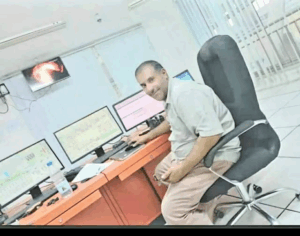
Ammar Al-Maghrabi posted an image of a smiling, cheerful middle-aged man at a desk in an office, captioned “Martyr of Bajel Cement Factory/ Brother Mujahid Hassan Al-Zifani/ May God have mercy on him and forgive him.” As multiple sources refer to Hassan as a mujahid but do not provide further details, Hassan’s civilian status has been classified as contested.
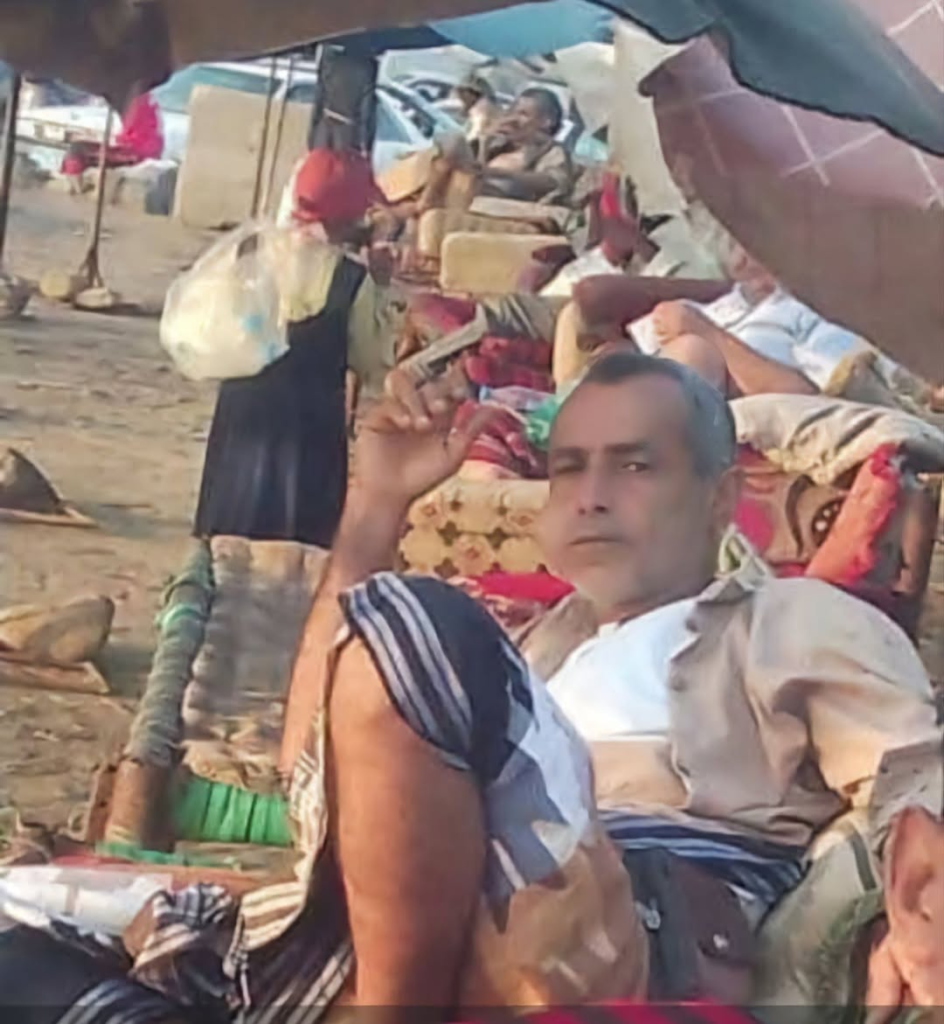
Twitter/X user @musaaaldhiyabi posted “My cousin, Mohammed Dhiabi, was martyred” in the strike, sharing an image of him – a smiling middle aged man with a thin mustache.
Hashed Sinan al-Barh informed of the death of their father, Ali Hattali Saeed Rajih Al-Bazihi, who was on duty at the factory mill at the time of the strike, and was transferred to work at the Bajel factory after shutdown of the Al-Barh cement factory. Condolences were expressed to his surviving family, grandchildren, and members of his village al-Safiya al-Barh.
Musa al-Dhiabi and Yasser Hadidi posted images of all six identified civilian employees of the Yemen General Corporation for Cement Industry & Marketing that were killed in the strikes, including Abdullah Muhammad Ahmed Kahil, and Abkar Muhammad Omar Muhammad. Yasser added that they “have attained dignity, honor, and martyrdom”, and that they “were not a military target or a war base” but that they were attacked without differentiating “between a worker, a child, an elderly person, or a woman.“
Al-Thawrah news and @alsyasiah shared images of the governor of Hudeydah visiting those grievously wounded at the hospital. Hassan Qaheshil posted images of the wounded, including that of an elderly man, as well as images of the burning factory, wishing condolences to the families of his colleagues that were killed, and recovery to his colleagues that were wounded.
Several others shared footage of the destruction and mourned the loss of the factory as a loss to their nation and livelihood.
Ahmed al-Wasli called the destruction seen in the aftermath “no less horrific than what is happening in Gaza”, with workers laying bloodied beneath rubble, and the factory decimated. Noting that this had been the first cement factory in Yemen, established by Ibrahim al-Hamdi, he called it the destruction of a property of a nation. He added that “Workers and engineers have fallen as victims, helpless and powerless, except that they are serving their homeland and struggling for a decent living.”
Facebook user Adul Latif al-Zaylai shared a video of the burning factory seen from a distance, voices can be heard crying in shock in the background. He captioned it “God is sufficient for me, and He is the best Disposer of affairs. The screams of women and children.”
Twitter/X user @Abdhuzaid1 posted that the Bajel Cement Factory was among “one of the largest and oldest factories in Yemen and the Middle East”, and along with Arab TV shared a video recorded by a driving passerby of a catastrophic fire with enormous plumes of smoke billowing from the site of the strike, nothing of the factory can be seen amidst the conflagration.
Alsabei Omar posted that following this and other Israeli strikes in the region, Yemen “has lost approximately $20 billion in infrastructure and economic value”, and that “all the infrastructure destroyed in Yemen belongs to the people and was owned by the people….What was built over fifty years was destroyed in 24 hours.” Yemen American Network mourned the loss of the factory as a “national tragedy that transcends the limits of devastation” and that “words fail to describe the magnitude of the loss Yemen suffered today.” They called the factory “one of the greatest industrial and economic symbols” and said that “it was not just a building; it was a story of struggle for thousands of workers and a symbol of hope and self-reliance.” A collage posted by them showed the large, impressive factory before the strike, and the smouldering remains in the aftermath.
Ahmed al-Sarouri stated that the destruction of the factory was the destruction of what remained of their hope, and that “It is a pain beyond pain as we watch our country being destroyed stone by stone.”
A heartfelt and tragic tribute to the factory was penned by Taha Hussein al-Sayes: “The Bajel Cement Factory was more than just a building emitting dust and the sounds of machinery. It was the beating heart of a greater nation. We were raised in its glow, sheltered in its shade, and drank from its water tanks as a father drinks the sweat of his brow to water his children. It was our home and our refuge, and its men were our fathers before they were workers. I spent my childhood next to the factory, inhaling its dust-filled air as if it were a daily incense purifying our memories. Its electricity lit our homes for free, as if the factory were giving us its spirit, not its energy. Today, as I watched it burn behind my phone screen, I imagined my own heart was burning. What kind of tragedy is this that makes us see our dreams shattered in an instant? What kind of sadness is this that made my small homeland collapse before my eyes, without my being able to save it? Hopes that had returned after years of absence were shattered, and with them fell innocent lives, their only sin being that they had been there, silently guarding hope. Weak workers, children, and women all rushed under the blazing daylight like fragments of a dream suddenly shattered. Tears flowed, blood gushed, and ashes mingled with hope.”
They added that a relative had narrowly escaped death, and their colleague had miraculously survived. They mourned Mohammed Dhiabi, saying that his father-in-law Ahmed Khamjan, a lawyer, had been searching for him before they found out about his death.
They went on to say “I remember the fathers of my colleagues who would pass by us every morning with tired eyes and bodies exhausted by work, yet they would greet us as if distributing the blessings of life./ Where are they now? Where is the factory that was once alive, just like us?/ I don’t know how to apologize to this silent giant. How can we atone for our failure? What words can restore its prestige, its radiance, and its history? / It is not just a factory… / It is the story of a homeland that was burned while it was still dreaming.”
Assessment Updates
Victims
Individuals

Key Information
Geolocation Notes
Reports of the incident mention the Bajel Cement Factory (مصنع اسمنت باجل), for which the generic coordinates are: 15.032523, 43.258633. Due to limited satellite imagery and information available to Airwars, we were unable to verify the location further.