Source
Archive URL:
https://airwars.org/source/thenational-shorthandstories-com-nada-atallah-maucourant-nada-homsi/
Captured Post Date:
Author: Nada Atallah Maucourant, Nada Homsi
Translated Content:
Content:
From his hospital bed, Gabi Zalghout, a paramedic with the IHA, told The National how a routine mission in Mayafadoun, an area in the southern district of Nabatieh, turned into a massacre of his colleagues. He recalled escaping half-conscious, his legs bleeding heavily, in a damaged ambulance filled with wounded paramedics – all while still under Israeli fire.
“Geneva Conventions? All talk. It doesn’t apply here,” Mr Zalghout said. He spoke with an eerie calm only a day after the incident. The attack in Mayfadoun was not Mr Zalghout’s first close call, nor the first time he had lost colleagues.
Based on the accounts of Mr Zalghout and two other survivors, The National was able to reconstruct how Israel killed four paramedics in a series of targeted strikes in Mayfadoun on April 15.
Around 12.30pm, three ambulances from the Islamic Risala Scout Association, a Lebanese youth and volunteer organisation affiliated with the Hezbollah-allied Amal Movement, and IHA were sent to retrieve a body after a previous strike. Mr Zalghout said when they arrived to bag the body, he and his colleagues were hit by a missile, sending them flying. “It landed right between us,” he said.
About five minutes later, as other rescuers on the ground gathered to help the wounded, a second strike hit, “directly on us”, Mr Zalghout recounted. With his legs injured and crawling on the ground, he began to look for survivors: “Anyone who might still be alive or breathing.”
“I found an ambulance that was damaged but still running,” he told The National from his hospital bed. He loaded four of his wounded colleagues into it – one of whom would later die of his injuries inside the ambulance – but was forced to leave two colleagues, already dead, behind.
After driving around 100 metres, he was met by a third rescue crew from the Nabatieh Ambulance Service. Mr Zalghout opened the ambulance door, fell out and lost consciousness. From there, the Nabatieh Service took over rescue duties.
The following scene was captured on the paramedics’ body cameras as they began transferring victims from the damaged ambulance into two newly arrived vehicles.
Among the first responders sent to rescue Mr Zalghout and the others was Mahdi Salloum, a paramedic with Nabatieh Ambulance Association. He recalled opening the back of the damaged ambulance that Mr Zalghout had driven. “We saw bodies severely injured, some of them missing legs. It was horrible,” he said.
“It took less than five minutes,” Mr Salloum explained as he showed the bodycam footage to The National. “We had two vehicles on site. The video clearly shows that the vehicles were completely free of any military equipment, contrary to what Israel claims.”
Seconds later, as they were finishing transferring the wounded, a third missile struck near the second ambulance, killing a fourth paramedic, the driver, Mahdi Abou Zeid. Mr Salloum, with wounded paramedics loaded into his vehicle, was forced to drive away.
The footage clearly shows the impact, with injured paramedics inside the ambulance screaming as it is hit.
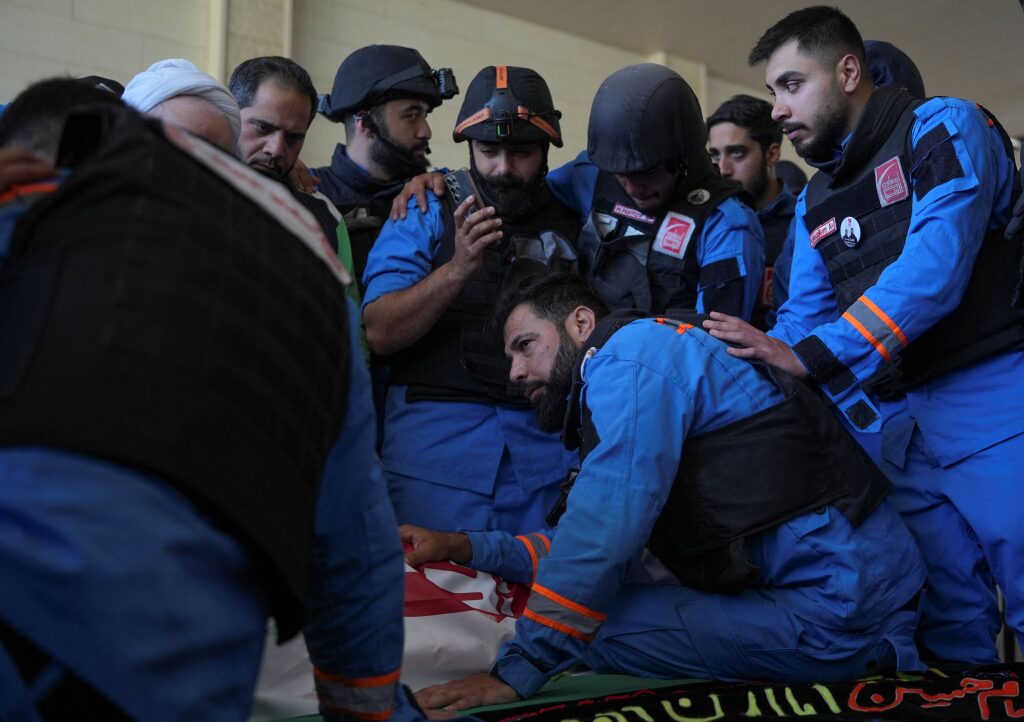
In total, four paramedics were killed in the quadruple-tap attack: Mahdi Abu Zeid, Fadl Sarhan, Ali Sabra and Said Haribi.
In the bodycam footage of the Mayfadoun attack, the ambulances are clearly marked, as are the paramedics, who were in full uniform.
The Israeli army said the Mayfadoun quadruple-tap attack targeted “Hezbollah terrorist infrastructure, and not an ambulance or rescue team”. But it did not respond when asked to clarify why the strikes appeared to have followed the paramedics and ambulances after they had departed the initial strike location. Nor did the army specify what infrastructure was targeted following the initial strike, after Mr Zalghout had driven away.
Human rights lawyers who reviewed the footage said there was no evidence of fighting around the ambulances at the time of the strikes.
“It is not one incidental strike. That’s basically a deliberate pattern,” said Mr Houry of the Arab Reform Initiative.
Rescuers told The National that drones were in the air above them throughout the entire ordeal.
“Israel has basically eyes in the skies; they know these are ambulances,” Mr Houry said. “If you want to attack a first responder, the burden is on [them] to show they were engaged in military activity – and they haven’t done that.”
The National pressed the Israeli army on all four cases presented in this report; no evidence was provided to substantiate its claims for any of them.
Israel has repeatedly accused Hezbollah members of using ambulances for military purposes. In its crosshairs is the IHA, a civilian emergency service affiliated with Hezbollah. The IHA has suffered the most from Israeli attacks. Under international law, paramedics are protected, regardless of their political affiliations.
“There hasn’t been a single incident where Israel has released footage showing that weapons were being transported in these ambulances,” Mr Houry said.
“Geneva Conventions? All talk. It doesn’t apply here,” Mr Zalghout said. He spoke with an eerie calm only a day after the incident. The attack in Mayfadoun was not Mr Zalghout’s first close call, nor the first time he had lost colleagues.
Based on the accounts of Mr Zalghout and two other survivors, The National was able to reconstruct how Israel killed four paramedics in a series of targeted strikes in Mayfadoun on April 15.
Around 12.30pm, three ambulances from the Islamic Risala Scout Association, a Lebanese youth and volunteer organisation affiliated with the Hezbollah-allied Amal Movement, and IHA were sent to retrieve a body after a previous strike. Mr Zalghout said when they arrived to bag the body, he and his colleagues were hit by a missile, sending them flying. “It landed right between us,” he said.
About five minutes later, as other rescuers on the ground gathered to help the wounded, a second strike hit, “directly on us”, Mr Zalghout recounted. With his legs injured and crawling on the ground, he began to look for survivors: “Anyone who might still be alive or breathing.”
“I found an ambulance that was damaged but still running,” he told The National from his hospital bed. He loaded four of his wounded colleagues into it – one of whom would later die of his injuries inside the ambulance – but was forced to leave two colleagues, already dead, behind.
After driving around 100 metres, he was met by a third rescue crew from the Nabatieh Ambulance Service. Mr Zalghout opened the ambulance door, fell out and lost consciousness. From there, the Nabatieh Service took over rescue duties.
The following scene was captured on the paramedics’ body cameras as they began transferring victims from the damaged ambulance into two newly arrived vehicles.
Among the first responders sent to rescue Mr Zalghout and the others was Mahdi Salloum, a paramedic with Nabatieh Ambulance Association. He recalled opening the back of the damaged ambulance that Mr Zalghout had driven. “We saw bodies severely injured, some of them missing legs. It was horrible,” he said.
“It took less than five minutes,” Mr Salloum explained as he showed the bodycam footage to The National. “We had two vehicles on site. The video clearly shows that the vehicles were completely free of any military equipment, contrary to what Israel claims.”
Seconds later, as they were finishing transferring the wounded, a third missile struck near the second ambulance, killing a fourth paramedic, the driver, Mahdi Abou Zeid. Mr Salloum, with wounded paramedics loaded into his vehicle, was forced to drive away.
The footage clearly shows the impact, with injured paramedics inside the ambulance screaming as it is hit.
In total, four paramedics were killed in the quadruple-tap attack: Mahdi Abu Zeid, Fadl Sarhan, Ali Sabra and Said Haribi.
In the bodycam footage of the Mayfadoun attack, the ambulances are clearly marked, as are the paramedics, who were in full uniform.
The Israeli army said the Mayfadoun quadruple-tap attack targeted “Hezbollah terrorist infrastructure, and not an ambulance or rescue team”. But it did not respond when asked to clarify why the strikes appeared to have followed the paramedics and ambulances after they had departed the initial strike location. Nor did the army specify what infrastructure was targeted following the initial strike, after Mr Zalghout had driven away.
Human rights lawyers who reviewed the footage said there was no evidence of fighting around the ambulances at the time of the strikes.
“It is not one incidental strike. That’s basically a deliberate pattern,” said Mr Houry of the Arab Reform Initiative.
Rescuers told The National that drones were in the air above them throughout the entire ordeal.
“Israel has basically eyes in the skies; they know these are ambulances,” Mr Houry said. “If you want to attack a first responder, the burden is on [them] to show they were engaged in military activity – and they haven’t done that.”
The National pressed the Israeli army on all four cases presented in this report; no evidence was provided to substantiate its claims for any of them.
Israel has repeatedly accused Hezbollah members of using ambulances for military purposes. In its crosshairs is the IHA, a civilian emergency service affiliated with Hezbollah. The IHA has suffered the most from Israeli attacks. Under international law, paramedics are protected, regardless of their political affiliations.
“There hasn’t been a single incident where Israel has released footage showing that weapons were being transported in these ambulances,” Mr Houry said.
Images:
Additional Details
Captured Date
2026-06-18 12:07:24
Captured Post ID