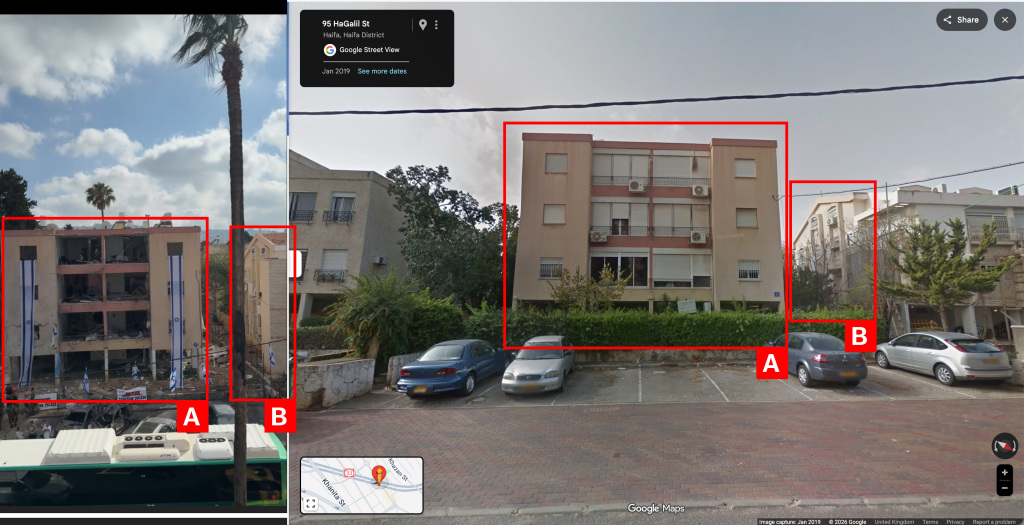
On June 17, Former Israeli prime minister Naftali Bennett visited Haifa to see missile impact sites and meet with community members. Speaking with Eli, a rescue worker with the IDF, Eli stated that seven people had been injured, all of whom were not in shelters.
The interview posted on Twitter/X did not mention who was responsible for the missile strikes. Long War Journal published a summary of all of the alleged Iranian strikes against Israel. The Journal reported: “At 8:38 am, Iran launched 20 missiles targeting the Haifa District’s Hadera and Haifa Subdistricts”.
No additional details were available as to the attack and the resulting civilian harm. Therefore, this incident has been graded as a “single source claim” and “weak”.
Weak
Single source claim, though sometimes featuring significant information.
Causes of Death / Injury
Heavy weapons and explosive munitions
Civilians reported injured
7
Geolocation Notes
Reports of the incident mention Haifa (חיפה, حيفا). Analysing audio-visual material from sources, we have narrowed the location down to the neighbourhood of Neve Sha’anan. The exact coordinates for this incident are: 32.788375, 35.019511.
EXPLAINERUsing open-source intelligence and visual evidence, Al Jazeera’s Sanad unit has mapped key Iranian strikes on Israel from Saturday to Monday.Sirens have continued to sound in cities across Israel as Iranian missiles strike for a sixth consecutive day in response to Israeli attacks on Iran’s nuclear, military and other sites since Friday.
On Wednesday morning, an Iranian missile sparked a fire in central Israel that appeared to have engulfed several cars. Iran’s Fars News Agency says one of the targets was the Meron airbase, which is in northern Israel.
Israeli attacks across Iran have killed at least 240 people since Friday while Iranian attacks have killed at least 24 people in Israel.
Military censorship during war
Israeli media have reported on some strikes across the country that have resulted in varying levels of damage and casualties. However, due to military censorship enforced during wartime, reports on attacks involving sensitive or strategic targets are often restricted or withheld from the public.
Using open source intelligence, including publicly circulated images and videos on social media, Israeli media platforms as well as visual identification of destroyed locations in Israeli cities, Al Jazeera’s fact-checking unit, Sanad, has mapped some of the most significant Iranian attacks on Israel from Saturday to Monday.
These sites are shown on the map below:
(Al Jazeera)
Sensitive locations targeted
On Saturday, missiles landed just 300 metres (984ft) from the Israeli Ministry of Defence headquarters (the Kirya) in Tel Aviv.Sign up for Al JazeeraBreaking News AlertGet real-time breaking news alerts and stay up-to-date with the most important headlines from around the globe.
This location, often called “Israel’s Pentagon”, is one of the most sensitive and heavily fortified government complexes in Israel, housing key military and intelligence offices.
Another strike hit the Weizmann Institute of Science, one of Israel’s leading research centres, located in Rehovot, south of Tel Aviv. The institute is reported to have collaborated with the Israeli military, making it a significant target.
Tel Aviv metropolitan area
Several areas across the Tel Aviv metropolitan area have also come under fire.
In Ramat Gan, a city adjacent to Tel Aviv, missiles struck several towers and residential complexes, causing significant damage and forcing evacuations. Local authorities reported that nine buildings were destroyed.
Residences were damaged in a missile attack from Iran in Ramat Gan on June 14, 2025 [Yair Palti/Reuters]
The nearby city of Petah Tikva, to the east, was also hit by missile strikes that damaged both residential and commercial areas while in Bnei Brak, a religious school was destroyed.
Ultra-Orthodox Jewish men inspect the damage at the site of an Iranian missile strike in Bnei Brak, east of Tel Aviv, on June 16, 2025 [John Wessels/AFP]
South of Tel Aviv, Bat Yam experienced the highest levels of destruction and casualties in Israel with nine confirmed deaths and about 200 people injured, according to emergency services. In Rishon LeZion, multiple homes were destroyed, adding to the widespread damage across the region.
Israeli first responders work in a residential area hit by a missile fired from Iran in Bat Yam on June 15, 2025 [Ariel Schalit/AP Photo]
Haifa refinery
In northern Israel, Iranian missiles struck Haifa’s Bazan petrochemical complex, the country’s largest oil refinery, forcing a shutdown of operations.
Haifa suffered a second missile strike, which hit several residential buildings in the Neve Sha’anan neighbourhood.
Smoke billows up from an Iranian missile attack on an oil refinery in Haifa on June 16, 2025 [Ariel Schalit/AP Photo]
Tamra
In Tamra, a predominantly Palestinian town of 35,000 people in northern Israel, an Iranian missile killed four women from the same family. Like many Palestinian towns in Israel, Tamra lacks adequate bomb shelters.
Damaged cars lie amid the rubble of a damaged building in Tamra after an overnight missile attack from Iran on June 15, 2025 [Ahmad Gharabli/AFP]
Major Eli with a clear statement from the point of impact of the missile in Haifa: 0 casualties among dozens who were in the shelters or shelters. 7 casualties who were not inside. *By the way, Major Eli is an ultra-Orthodox who was happy to serve his people in the IDF, so many will!
Content
רס״ן אלי עם קביעה ברורה מנקודת פגיעת הטיל בחיפה:
0 נפגעים מקרב עשרות ששהו בממ״דים או מקלטים.
7 נפגעים שלא היו בפנים.
*אגב, רס״ן אלי הוא חרדי ששמח לשרת את עמו בצה״ל, כן ירבו!
Media from naftalibennett (2)
This media contains graphic content. Click to unblur.
Tel Aviv, Israel – For the fourth night in a row, missiles have hit Israeli cities. Iran’s retaliatory strikes, triggered by Israeli attacks, saw people sheltering in stairwells and bomb shelters as the scale of the damage and Iranian rockets managing to penetrate one of the world’s most sophisticated defence systems have left many reeling.On Friday, Israel began its assault on Iran, targeting military and nuclear facilities and killing high-profile security, intelligence and military commanders as well as scientists. Israel’s attacks, which have also targeted residential areas, have killed more than 224 people and wounded at least 1,481, according to Iranian authorities. The government said most of those killed and wounded have been civilians.In response, Iran has fired barrages of missiles towards Tel Aviv and other Israeli cities.Hundreds of Iranian missiles have been launched since Friday, and Israel’s air defence systems, though robust, have been unable to stop all of them. While the number of missiles fired by Iran appears to have gone down on a night-by-night basis, the scale of the attacks continues to be unprecedented for Israelis.Central Tel Aviv, Haifa, the scientific hub of Rehovot and homes have been struck. At least 24 people in Israel have been killed in the strikes and hundreds wounded.The Weizmann Institute of Science in Rehovot, a source of national pride and a cornerstone of Israeli military research, was among the hardest hit. Its laboratories were torn open, glass panes shattered, and cables and rebar left dangling.“This isn’t just damage to buildings,” said Jenia Kerimov, 34, a biology PhD candidate who lives nearby. “It’s years of research, equipment we can’t easily replace, data that might be lost forever.”She had been in a bomb shelter a block away when the institute was struck. “We’re supposed to be helping protect the country. But now even our work, our home, feels exposed.”Shelters across the country are packed. In older neighbourhoods without bunkers, residents crowd into communal safe rooms. In Tel Aviv and West Jerusalem, stairwells have become makeshift bedrooms. The Israeli military’s Home Front Command has evacuated hundreds of people to hotels after buildings that were hit were deemed uninhabitable.Video Duration 2 minutes 29 seconds 2:29 Now PlayingVideo Duration 02 minutes 29 seconds 02:29 Israel-Iran conflict: Air raid sirens sound in Tel Aviv after Iranian missile attacks on Tuesday NextVideo Duration 24 minutes 39 seconds 24:39 Inside India’s expulsion of Bengali Muslims Video Duration 24 minutes 40 seconds 24:40 The War on Truth Video Duration 16 minutes 22 seconds 16:22 Who gets to have nukes? | Start Here Video Duration 02 minutes 22 seconds 02:22 Sanctioned Israeli settler under probe after activist shot dead in occupied West Bank‘No shelter in our building’Yacov Shemesh, a retired social worker in West Jerusalem, said his wife has been sleeping on the stairs in their apartment block since the attacks began.Sign up for Al JazeeraBreaking News AlertGet real-time breaking news alerts and stay up-to-date with the most important headlines from around the globe.“There’s no shelter in our building,” the 74-year-old explained. “I went to the roof Sunday night to see what was happening. I saw a flash in the sky and then a boom. But I couldn’t find anything in the news. Maybe they [the state] don’t want us to know how close it came.”The barrage has triggered panic in a society long shaped by conflict – but where, until now, the destruction and wars were inflicted elsewhere – in Gaza, Jenin or southern Lebanon. Now, many Israelis are being confronted with destruction in their home cities for the first time.In Tel Aviv, long lines snaked through the aisles of a grocery store. Despite being crowded, the atmosphere was hushed as customers tapped their phones, their faces drawn tight.Gil Simchon, 38, a farmer from near the Ramat David Airbase, east of Haifa, stacked bottles of water in his arms.“It’s one thing to hear for decades about the Iranian threat,” he said, “but another to see it with your own eyes – to see high rises in Tel Aviv hit.”On Monday night, he used a bomb shelter for the first time in his life.Even the Kirya, Israel’s military headquarters in Tel Aviv, was struck although damage was limited. Iran’s ability to hit such a fortified and symbolically vital target has deeply rattled a population raised on the reliability of its multilayered defence architecture.While much of Israel is covered by the Iron Dome, David’s Sling and Arrow defence systems, officials admit these were not designed for a saturation attack involving ballistic missiles with heavy warheads. “These aren’t homemade rockets from Gaza,” one analyst said on Israeli television. “These are battlefield weapons.”On Saturday night, the streets of West Jerusalem were quiet. One of the few lit spaces was a gym. Its owner gestured to the staircase descending underground. “We’re protected,” he said. Then with a smile, he added, “Gymgoers are crazy. If you’re working out at night, the gym had better be open.”Outside, the night air buzzed with tension. A neon sign flared against the darkness. A small group gathered, eyes fixed on the sky. Moments earlier, streaks of light had passed overhead.“They’re headed somewhere else – Haifa, I think,” a young man muttered. Minutes later, sirens wailed. Video soon appeared online showing flames erupting from a gas installation near Haifa.Initially, social media was flooded with footage of missile impacts – some from residential balconies, others from dashcams. By the third night, multiple reports were published of people being arrested for documenting the attacks while Israeli officials warned foreign media against breaking a ban on broadcasting such content, describing it as a security offence.Meanwhile, fears of power outages are growing. In Tel Aviv, drivers queued at petrol stations, anxious to keep their tanks full. A father strapped his children into the back seat before speeding away. His eyes flicked to the clouds, then the rear-view mirror.Israeli police inspect a damaged apartment near the site where an Iranian missile destroyed a three-storey building in the city of Tamra, killing four women, according to rescue workers and medics [Ahmad Gharabli/AFP]‘Protecting ourselves and making it worse’For some Israelis abroad, a feeling of helplessness has deepened. Eran, 37, who lives and works in New York, spoke to his elderly parents near the city of Beit Shemesh. “They’ve gone to shelters before, but this time, the fear was different,” he tells Al Jazeera. “The shelter was full. When they returned home, they found pieces of interceptor debris in the yard.”Eran, a former conscientious objector who refused Israel’s mandatory military draft – for which he spent time in jail – and asked to use a pseudonym for fear of state reprisal upon his return to Israel, has long been critical of Israeli policies. Now watching his family in danger, he feels more certain than ever.“Israel claims to act for all Jews,” he said. “But its crimes in Gaza and elsewhere just bring danger to families like mine. Even in New York, it impacts me.”For others, the picture is murkier.“I don’t know any more where the line is between protecting ourselves and making it worse,” Gil said. “You grow up believing we’re defending something. But now, the missiles, the shelters, the fear – it feels like a cycle we can’t see out of.”The Israeli government, meanwhile, has struck a belligerent tone, promising to make Tehran “pay a heavy price”. But in the shelters, tension is mixed with exhaustion and a growing recognition that something fundamental has changed.“It’s like the feeling of a meat lover after they visit a meat-packing factory,” Gil said quietly. “You grow up on it, you believe in it – but when you see how it’s made, it makes you uneasy.”This piece was published in collaboration with Egab.
Bennett with Fleishman
Watch: Bennett met Itamar Fleishman who told what saved his life
Former Prime Minister Naftali Bennett arrived at noon (Tuesday) in the Nosh neighborhood, at the scene of the missile fall the day before yesterday, where he met Itamar Fleishman, who told him about going down to the shelter and the decision that saved his life.
21 Sivan 5775
23:19
Former Prime Minister Naftali Bennett arrived at noon (Tuesday) in the Nosh neighborhood, at the scene of the missile fall the day before yesterday, where he met Itamar Fleishman, who told him about going down to the shelter and the decision that saved his life.
Bennett visited not only the scene of the fall but also the municipality's emergency management center, and met with volunteers, including ultra-Orthodox volunteers. He toured the shelters and spoke with residents.
Content
בנט עם פליישמן
צפו: בנט פגש את איתמר פליישמן שסיפר מה הציל את חייו
ראש הממשלה לשעבר נפתלי בנט, הגיע בצהרים (שלישי) לשכונת נו"ש, אל זירת נפילת הטיל שלשום, שם הוא פגש באיתמר פליישמן, שסיפר לו לגבי הירידה למקלט וההחלטה שהצילה את חייו.
Attack #6 – Missile Attack: At 8:38 am, Iran launched 20 missiles targeting the Haifa District’s Hadera and Haifa Subdistricts, the Tel Aviv District, the Central District’s HaSharon, Petah Tikva, Rishon LeZion, and Ramla Subdistricts, and the Southern District’s Beersheba Subdistrict. Two missile impacts and eight related incidents were reported, mostly involving fires from missile debris in open areas across HaSharon and Gush Dan. In Gush Dan/Tel Aviv, five people suffered shock, and a bus station was hit, damaging or destroying several buses. In HaSharon, a house was damaged by interception shrapnel.
Media from Sources (4)
This media contains graphic content. Click to unblur.