
Incident Code
Incident Code
Incident Date
Location
Geolocation
Geolocation
Airwars Assessment
Around midnight on Saturday, the 14th June 2025, 13 people, including six women and three children, were killed and at least one man was injured in an attack allegedly carried out by the Israeli military on several residential buildings in the Narmak Sixth Square in the Narmak neighbourhood of Tehran, Iran. Reports stated that the attack caused the death of the Sadati family, made up of seven people, including children aged four to ten, as well as the Soltani family, who were a family of three. A young photography student, along with her father, and a renowned female painter, were also killed.
According to the websites Partokavir and Tirdadname, nuclear scientist Dr. Seyef Mustafa Sadati Armaki was killed alongside his wife, a religious teacher, Fahimeh Moghimi, and three of their children: a 15-year-old daughter, Reyhaneh Sadat Sadati Armaki, a Quran memoriser; a youngest daughter, Fatemeh ُSadat Sadati Armaki, who was eight or 10 years old, according to different sources, and was “very dependent on her mother”; and a four- or five-year-old son, Seyed Ali Sadati Armaki. Seyef’s mother-in-law, Rebabeh Azizi, and his father-in-law, Hamid Moghim, were also killed in the strike.
Seyef Sadati was a resident of the village of Aramak (Ermak), Kashan. He was a prominent professor at Shahid Beheshti University of Tehran and a nuclear scientist, holding a PhD in nuclear physics. He was raised in a religious and culturally-rooted family, and his own family, according to Tirdadname, was “cohesive, religious, and simple-minded.” His eldest daughter, Reyhaneh, was an intelligent girl who studied at the school for gifted children. She was reportedly a firm believer in her hijab and even “gave up on school field trips so as not to be forced to put away her veil.” The youngest son, Ali, loved General Soleimani and walked around the house and behaved like him, which is why they called him “General Soleimani” of the house.
An article by Tasnim News recounted correspondent Zeinab Omidi’s visit to the destroyed Sadati house. She attested to the destruction left behind and is quoted as saying “It still smells of blood here” and “Around me, I see broken playing equipment, the Quran, and a book of prayers and supplications that, despite the terrible explosion, have remained largely intact.” She highlighed seeing decorations for what seemed to be an Eid al-Ghadir celebration. According to Zeinab’s account, during the lunch for the celebration, the children of Seyef Mustafa jokingly said, “You’re going to be a martyr too.” He smiled, and as he was leaving, he told his wife that it was better not to come to our house tonight, saying “Either stay here or go to your parents’ house.” As Zeinab continued to observe, she noticed that the only clock in all the rubble and destruction has “stopped at midnight on June 14.”
28 to 35-year-old stewardess of Mahan Air, Mehrnoush Haji Soltani, was also killed in the strike, along with her mother, Nahid Mohammad Rahimi, and her father, a driver, Mohammad Haji Soltani. The family reportedly died due to the destruction of their house caused by the blast wave. In a video report filmed by Mashregh News, two surviving family members of the Soltani family told their story of the incident, and multiple images of their parents and sister are shown. The end of the video shows the victim’s tombs.
According to Zeinab Omidi, Sara Jawdat, a 20- or 22-year-old photography student, was also killed in the same building along with her father, Darioush Joudat, while Sara’s brother was injured. Zeinab wrote that the first thing she saw upon entering the building was Sara’s school records.
There are two contradicting accounts of where Sara and her father were staying when the alleged airstrike that caused their deaths occurred. According the to the Hammihan Newspaper’s interview with the with Amir Abedi, a professor at Pars University of Art and Architecture, his art student, Sara Joudat, and her father were walking on the street outside of their home in Narmak, Tehran, when the airstrike occurred on a nearby building.
In a separate account, Sara’s brother and son of the deceased, Darioush Jodat, who was injured in the strike, told the Iranian Students News Agency (ISNA) that he was sleeping at the time of the attack, while Sara and his father, Darioush, were watching television. He recalled: “It was 12 o’clock at night, we were gathered together, I was eating dinner, and I passed out without realizing it. I came to my senses while the war tore our family apart… My family was watching television when this happened, and they attained the status of martyrdom.”
Sara Joudat was a photography student at Pars University of Art and Architecture and a cafe employee. Amir Abedi, a professor at Pars University of Art and Architecture, told the student newspaper Hammihan, “Sara was my student for one semester. She was 22 years old and an art student; she took photography classes with me. The university is affiliated with the Ministry of Science and is on Amirabad Street. She had 12 classes with me, and when another of my students told me about her death, a young woman, it was very sad for me, and I am sorry for that.”
Some accounts, including the website Havash, claimed that Sara was 20 years old. Sara’s sister, speaking to ISNA, also said that her sister was 20 at the time of her death.
A customer at the cafe where she worked told the Iran Times, “Every time I went to the cafe, Sara would greet us with a smile and cheerfulness. She was a calm and composed girl. It’s hard to believe that she is no longer alive.”
On Twitter/X, user IranUnderFire posted an image of the late Sara, who was young and full of life, with long black hair. She was gently smiling in the picture, tilting her head to her shoulder.
Darioush Joudat, Sara’s father, was a retired bank employee. @iraninsa posted his image on her Instagram account. Darioush was a middle-aged man with dark hair, a moustache, and wore glasses.
On Twitter/X, user @ZeinabHeidari2 posted an image of the two coffins alongside each other, wrapped in Iranian flags. She commented, “This is the saddest and strangest father-daughter photo.”
A 57-year-old Iranian painter, Mansoureh Alikhani, was also killed in the Israeli strike on her home in Tehran’s Narmak neighborhood, as reported by @DropSiteNews on Twitter/X and the IranWire website. According to the Al-Akhbar website, Mansoureh Alikhani, a leading student of renowned artist Kazem Chalipa (b. 1957), was known for her unique style blending Iranian authenticity with modern aesthetics. A graduate of Al-Zahra University and Soore University, she taught at Kashan University and the Soore Higher Institute, and served as director of the Art Skills Center at Soore. Her work spanned local and international exhibitions, illustrated art books, aesthetic theory, and festival juries — including the Alif wa Bismillah Festival.
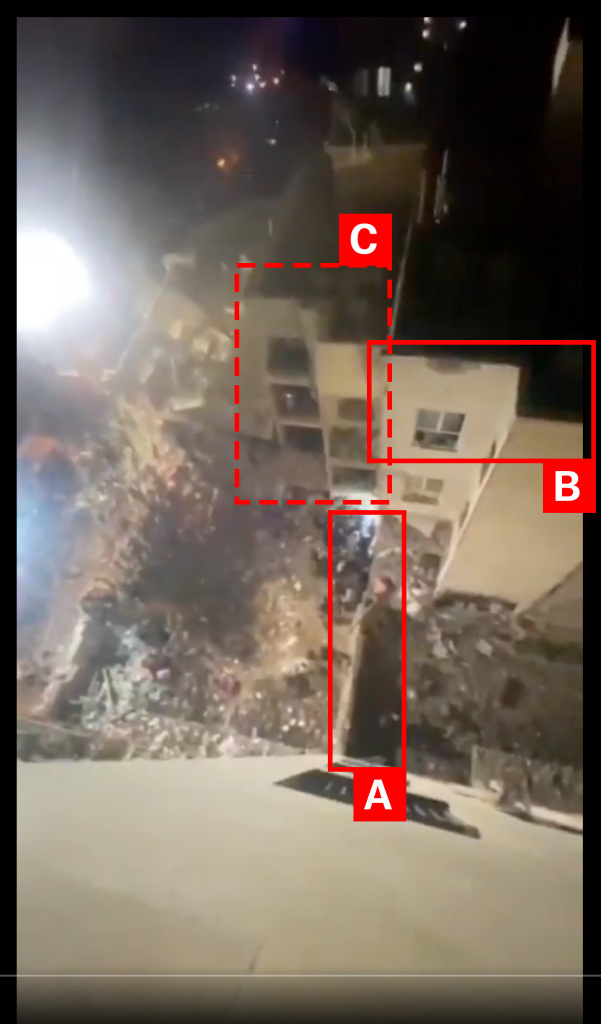
The images shared by donya-e-eqtesad show the devastating aftermath of the attack, with buildings destroyed and whole apartments burnt.
Where sources identified the belligerent, all sources attributed the strike to the Israeli military.
Although the Israeli Defence Forces admitted the assassination of nine leading nuclear scientists of Iran, the name of Seyef Sadati Armaki was not on that list. Hence, Airwars has graded the strike status of the incident as “likely” and the civilian harm status as “fair” until further information comes to light.
Victims
Family members (7)
Family members (3)
Family members (3)
Family members (1)
Geolocation Notes
Reports of the incident mention 6th square (میدان ۶) in the Narmak neighbourhood (نارمک) in Tehran (تِهران). Analysing audio-visual material from sources, we have narrowed the location down to the following exact coordinates: 35.731776, 51.504208.
Imagery: IranNewsAgency0