
Incident Code
Incident Date
Location
Geolocation
Geolocation
Airwars Assessment
At least two people were killed and one person injured as a result of an alleged Israeli airstrike on a vehicle in Lebanon’s Khardali area on October 2, 2025.
Engineers Ahmad Hasan Saad and Mostafa Hussein Rezek were both reported killed; the identity of the injured person is unknown. Both men had links to the Jihad al-Binaa Foundation, a reconstruction organisation run by Hezbollah. Though sanctioned by the United States for ties to Hezbollah, the organisation itself carries out civilian activities, mainly related to the repair and reconstruction of civilian infrastructure damaged by Israeli military actions in recent years. As both Ahmad and Mostafa are understood by Airwars to hold civil roles in this organisation, they have been recorded as civilians in this assessment. This will be updated should additional information become available. Airwars did not find any reports among open sources that linked the injured person to Hezbollah or another group.
Both Ahmad and Mostafa were from the town of Kfar Rumman, and were “on a mission to inspect the damage” in a neighbouring town, according to the Bint Jbeil Facebook page. The Union of Municipalities of Eastern Baalbek corroborated that both men were “killed while performing their professional and national duty in the Khardali area” and had been en route on the Jarmaq-Khardali road to “conduct damage assessments and evaluate infrastructure and buildings.” Certain users remarked on the timing of the strike, writing that Ahmad and Mostafa had been killed on “Lebanese Engineer and Architect Day.”
Facebook user K Zalzaleh wrote “Paper and pen now terrify them… Assessing the damage has become an act of terrorism… Reconstruction has become a violation..” Attached to the image, K Zalzaleh shared a screenshot of a Twitter/X post which reshared the strike footage, originally shared by the Israeli Air Force (IAF) Telegram account. The strike footage, shared by the IAF account on October 2, shows grey-scale footage of a small car, likely a sedan, driving down a road, before it’s struck and turns into a ball of fire. Images shared by Facebook user bintjbeil and the news outlet, Al-Nahar Al-Arabi, show the car post-strike. In the images, only the mangled metal remains of the car are left. All of the glass has been blown out and any non-metal material burnt away. In images shared by Al-Nahar Al-Arabi, members of the Lebanese Armed Forces are present at the site of the strike, inspecting the car’s remains.
The news outlet ‘Janoubia’ shared a number of images, including one in which two Islamic Health Authority civil defense members push a stretcher. A dark body-sized bag lies on the stretcher, suggesting that the individual being moved was deceased.
A collaged image shared by Yajnoub 2 website to Facebook shows Ahmad holding a surveying tool, common among those in the engineering field. The image seems to be taken from Ahmad’s personal Instagram account, in which his bio is ‘Surveying Engineer’. The account appears to be devoted to his work, showing him at different surveying sites and with different computer planning and surveying programs. One of his photos from August 16, 2025 shows him in a red ‘Ya Hussein’ headband. The phrase refers to Imam Hussein, the grandson of the Prophet Muhammad, and is commonly invoked among Muslims, in particular Shia’a. The location of the post is tagged as ‘كربلاء المقدسة’ or ‘Holy Karbala’, a city in Iraq considered sacred among Shia’a Muslims and a popular pilgrimage destination. Ahmad also has a story on his Instagram page called ‘عاشوراء’ (‘Ashura’), a day of remembrance for many Muslims. Given the dates within the story, it seems that the images which circulated of Ahmad in the ‘Ya Hussein’ headband may have been taken during a 2025 pilgrimage to the Iraqi city of Karbala for Ashura.
Mostafa’s personal Facebook account also includes a photo of him wearing a red headband, along with a stylised photo of a red flag with the text ‘Ya Hussein’ written in Arabic. The post in which Mostafa wears the headband is dated to January 21, 2021 and is likely the original image which was later reshared by other users. Another post, shared on July 16, 2017, shows a younger Mostafa in a white polo shirt. The image appears to be a selfie and juxtaposed over the photograph is a crest which features a cedar tree floating above a pair of crossed swords – the emblem affiliated with the Lebanese Armed Forces.
While it does not appear that either man had taken part in armed conflict, their deaths were mourned by those who appeared to be either sympathetic to or members of Hezbollah. Ahmad and Mostafa’s connection to the group appears to stem from their affiliation with the Jihad al-Binaa Foundation, as outlined above, this is an infrastructure development fund affiliated with Hezbollah. Among the foundation’s objectives is “repairing the damage caused by Zionist aggression.”
Indeed, Al Manar News reported that “Hezbollah and the residents of the southern town of Kfar Rumman mourned the martyrs, engineers Ahmad Hassan Saad and Mostafa Hussein Rezek,” and that a funeral procession saw “their comrades [take] an oath of allegiance and loyalty to the resistance path.” Commemorative posters, which Hezbollah often releases after members are killed, were published after their deaths: images of both men can be seen superimposed on backgrounds emblazoned with the Hezbollah logo. In these posters, both Saad and Rezek’s names follow the title ‘المهندس’ – ‘the engineer’. Though not a rule, individuals associated with Hezbollah’s military wing are usually given the honorific ‘المجاهد’ at death, rather than ‘الشهيد’ – ‘the martyr’ or ‘المهندس’.
Both Ahmad and Mostafa are also pictured with red headbands emblazoned with the phrase “Labbayk ya Hussain,” a phrase commonly invoked within Shia communities and translating to “We are here for you, Oh Hussain.” The slogan refers to Imam Hussein, the grandson of the Prophet Muhammad. While the phrase has been incorporated into Hezbollah messaging, it is not exclusive to the group.
A post shared by the Facebook account associated with Janoub Media said that Member of Parliament, Dr. Hussein Hajj Hassan, “a member of the Loyalty to the Resistance Bloc,” (a member of Hezbollah’s parliamentary bloc in the Lebanese Parliament) made a speech “at the memorial ceremony for the martyred engineers Ahmed Saad and Mostafa Rezek, organized by Hezbollah in the town of Kfar Rumman.” Images from the memorial ceremony showed that many members of the Islamic Health Authority – the civil defense group that is affiliated with Hezbollah and responsible for providing emergency aid to communities in Hezbollah stronghold areas, particularly in southern Lebanon – were in attendance.
While Hezbollah operates an active militant wing, their political presence is also deeply enmeshed within the state, providing social and organisational services, particularly in Shia’a majority areas in southern Lebanon. As such, like those affiliated with the Jihad al-Bina’a Foundation, members of the Islamic Health Authority are not considered militants given their affiliation with Hezbollah.
Another Facebook post, shared by Ahmad Zreik, shared images from “a massive and solemn [funeral] procession” for Ahmad and Mostafa, where “Hezbollah and the people of the South bid farewell to the martyrs, engineers Ahmad Hassan Saad and Mostafa Hussein Rezek.” The post concluded with the line “Ahmad Saad and Mostafa Rezek were laid to rest alongside those who preceded them on the path of jihad, sacrifice, and martyrdom.” In this incident, given that the work that the reconstruction efforts pursued by Jihad al-Binaa Foundation is considered as a form of ‘jihad’ on the Foundation’s website, Airwars is not taking this invocation of ‘jihad’ to necessarily denote militant activity. This will be updated should additional information become available.
The Israel Defense Forces admitted responsibility for the strike in a post their Telegram account, writing that they had “struck and eliminated two Hezbollah terrorists in Kfar Reman, southern Lebanon.” According to the IDF, Ahmad and Mostafa “held role[s] of engineering operatives in the organization, and took part in the reestablishment of Hezbollah’s terrorist infrastructure in the residential areas of Mount Dov and Khiam.”
The official Telegram account of the Israeli Air Force (IAF), too, announced the strike. The IAF post, published in Hebrew, also referred to two Hezbollah “terrorists,” noting that they “served as engineering operatives in the organisation and were engaged in the reconstruction of Hezbollah’s terror infrastructure.” Additionally, both posts cited the individuals’ reconstruction efforts as the reason for the attack, noting that such efforts “constituted a violation of the understandings between Israel and Lebanon.” Based on these two posts from the Israeli military, this incident’s strike status has been recorded as ‘declared’ and civilian harm status as ‘confirmed’. This will be updated should additional information become available.
Assessment Updates
Victims
Individuals
Key Information
Geolocation Notes
Reports of the incident mention a residential building being struck on the Jarmaq-Khardali road (طريق الجرمق الخردلي). Analysing audio-visual material from sources, we have narrowed the location down to the following exact coordinates: 33.379371, 35.529768.
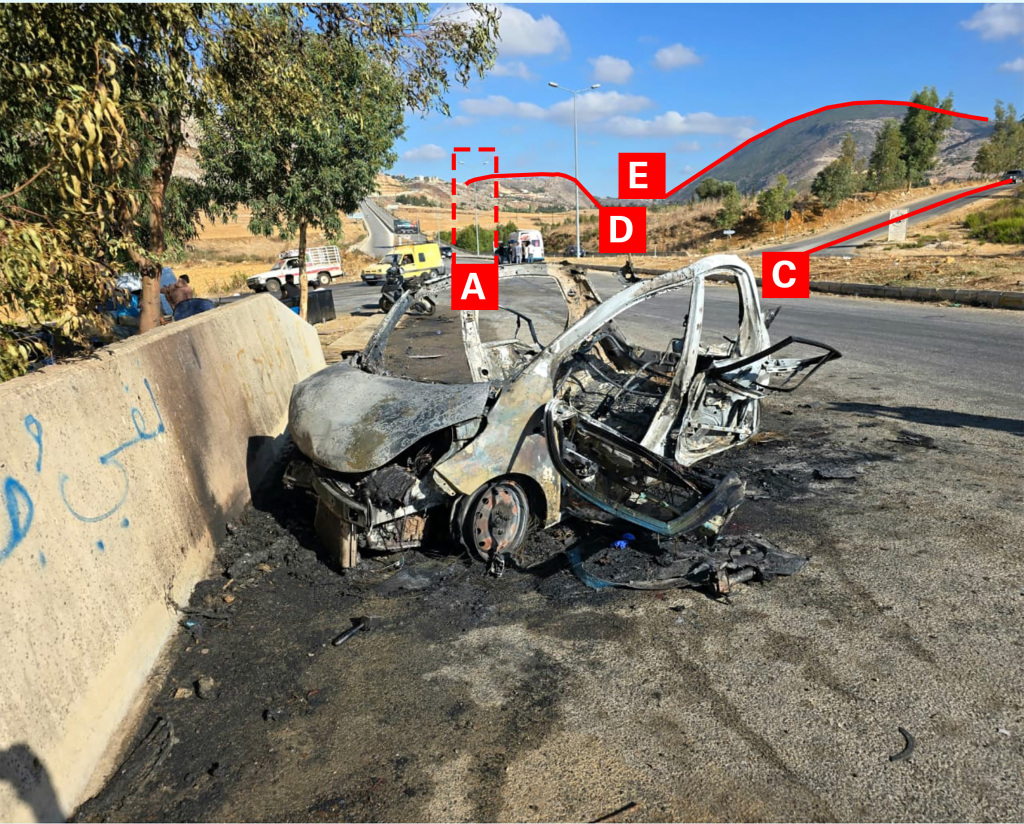
Imagery: النهار العربي
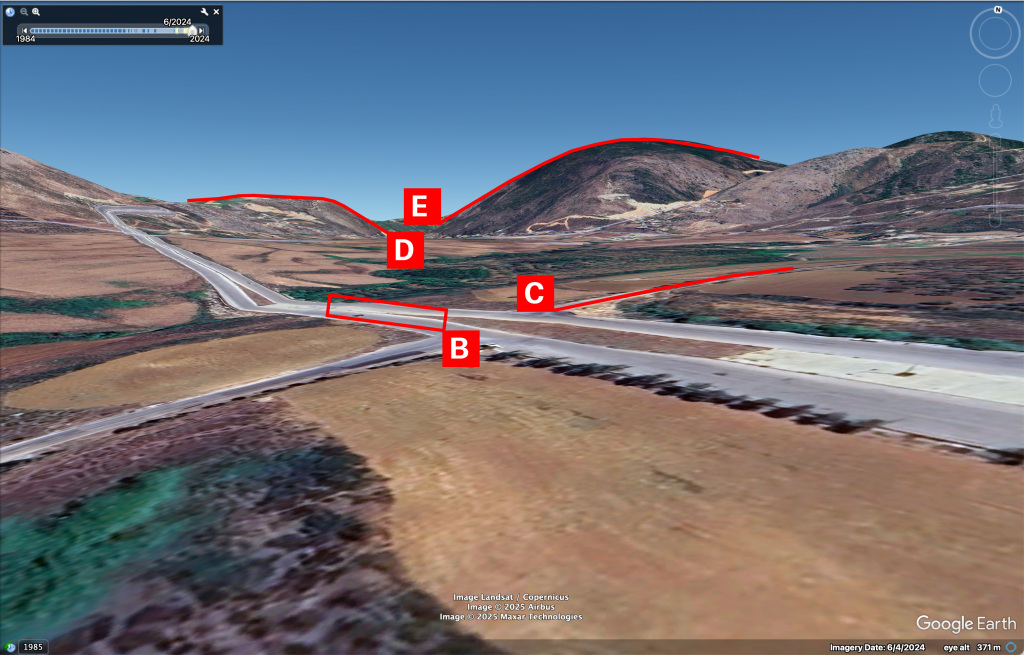
Imagery: Google Earth
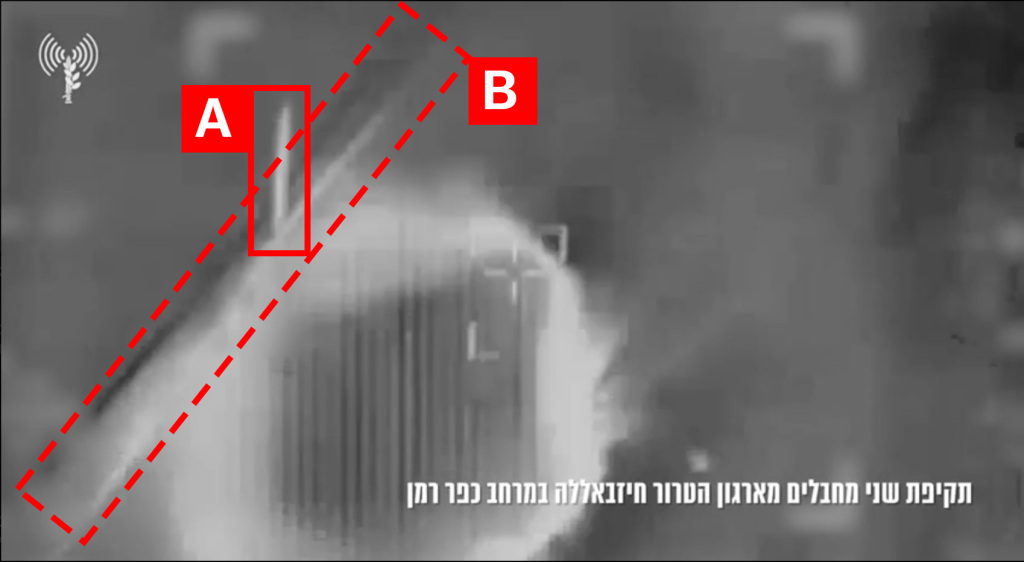
Imagery: חיל-האוויר