
Incident Code
Incident Date
Location
Airwars Assessment
During the evening of Monday, 11th November 2024, 12 civilians – including at least seven women, three children, and two men – were reportedly killed and up to seven more injured in an alleged Israeli airstrike on a home in a residential neighbourhood of the coastal town of Al-Saksakieh, located south of Sidon in the South Lebanon governorate.
Whilst sources such as journalist Fouad Khreiss initially reported that seven had been killed, the number of people named to have been killed in the strike later rose to 12.
Meanwhile, according to Lebanese news network An-Nahar, the Lebanese Civil Defense claimed to have recovered five wounded people during rescue operations, whilst the Lebanese Ministry of Health placed the number of wounded at seven.
Those identified to have been killed included Amin Ahmed Shomer, and his wife Sakina Ahmed Faqih, alongside their two daughters, Laila Amin Shomer and Zainab Amin Shomer. Amin was a cousin of a journalist of the same name (Amin Shomer al-Mukhtar) whose daughter Hiba was also killed in the strike.
Also killed in the alleged Israeli strike were Zahra Ahmed Faqih. Zainab Mohammed Siblini was also reported killed, as was her son, Mahdi Mohammed Abbas.
Mohammed Ahmed Mahmoud Siblini, possibly a correspondent at Al-Manar News Network, was killed alongside his wife Hiba Amin Shomer – the other Amin Shomer’s daughter – and their daughter, Zahraa Mohammed Ahmed Siblini. On September 12 at 6:57 PM local time, Facebook account ‘South 24 Site’ wrote that “Ahmed Mahmoud Siblini and his daughter Zahraa” had been found, noting that rescue teams continued to search for three other bodies. Airwars is taking the reference to “Ahmed Mahmoud” as “Mohammed Ahmed Mahmoud.”
11-year-old girl Maryam Mohammed Mahmoud Kotrani was also killed in the incident, as was Alia Ahmad Faqih, who was an adult woman, the wife of Ali Mahmoud Musa (Al-Marj).
Numerous people posted photos on Facebook in tribute of those killed, with several individuals further expressing their grief.
Sakina, whose body was found the day following the strike, was lauded as a “Hajja”, indicating she had completed the Islamic pilgrimage to Mecca, an undertaking highly valued by her community.
Facebook user “Men Who Will Not Die/Al-Saksakiya” mourned the death of Mohammed Ahmed Mahmoud Siblini and added his image, showing a young man dressed in a black shirt and wearing a black sash with gold lettering. The sash reads ‘خادم الإمام حسين’ or ‘Servant of Imam Hussein’. Imam Hussein is a large figure in for Shia’a muslims and indicates that Mohammed was likely Shia’a.
Twitter/X user @hussenfakih grieved what he considered the “enemy’s target bank”, specifically mentioning Zahraa Siblini. In a photograph included, Zahraa – a young girl – is dressed in a child’s abaya.
Fatima Fadel mourned Zainab Amin Shomer, including a photograph of Zainab in a black abaya. With her death, Fatima wrote, Zainab “broke [her] heart”.
Meanwhile, Rayane Faris Badran wrote, “I mourn the martyred child, the happy moon of our family, Mahdi [Mohammed] Abbas”, accompanying the post with a picture of the young boy smiling on a scooter.
Several sources expressed their sympathy for correspondent Amin Shomer al-Mukhtar, whose only daughter was Hiba Amin Shomer, the “most precious thing he had”. Marvelling at Amin’s calmness and faith as he searched for his family’s remains, the Facebook page for Saida TV asked that Amin “tell us and guide us to this blessing of patience that God has surrounded you with and bestowed upon you”. Powered by a “steadfastness [from his] faith”, Amin had searched for his family, sifting through rubble and crushed cement: “You, Hajj Amin, the searcher among the rubble, you sift through the dirt, you kneel down, your hands holding a pickaxe, a shovel and a hoe, searching for the body of your daughter, your only child who has not been found, you search for anything of her, her scent, her clothes, her remains, for anything, anything of her. You move between the stones, your eyes looking right and left, up and down, hoping to catch a glimpse of something that will point you to your only child, “Heba,” your daughter. You race the heavy drilling equipment that was brought in, and run after the rescue workers. They even follow you from one destroyed floor to another that has become remains”.
“How weak” the onlookers felt, in the face of Amin’s fortitude, “this mountain that did not bow to the horror of that massacre”. For he had “remained steadfast and did not rest, and did not close [his] eyes for a single moment since last night until today, searching for his daughter Heba… for anything from her. He searche[d] for her, tears washing his face, and in his heart [were] a thousand regrets and anguish…and a deep, silent, suppressed sadness that [had] only overflowed a little…waiting for the moment to meet the most precious creature God has created…waiting with bated breath to embrace her, to hold her, for his hands to touch any part of her for the last time”.
Attached to the memorial was a photograph of Amin crouched in the blown-out wall of a building.
Another mourner, Mohammed Zaatari, also remarked on Amin’s “patience, determination and endurance” while he “watched the teeth of the excavator lifting the rubble in search of his daughter under the rubble” and how he understood the loss by framing it in faith, in a “certainty that God Almighty chose those he loved from the martyrs”.
Amin Shomer himself delivered a video report for Al-Manar (a Hezbollah-affiliated news network) from the site of the incident. In the report posted on Facebook by Hussein al-Sayed, he paid tribute to his family members. The report also contained footage of people searching the rubble of the destroyed home, as well as mourners praying and a funeral procession for those killed. Whilst the bodies of those killed appear to be shrouded in Hezbollah flags, there is no explicit indication in any available source of militant activities.
Similarly, two images of Zahraa and Heba Sibling showed both in a headband adorned with Arabic script, likely an excerpt from the Quran. While members of groups like Hezbollah’s militant wing are known to wear headbands with the writing from Quranic versus, there is nothing to suggest that this headband, and therefore Zahraa or Heba, were affiliated with a militant group. This is further cemented by the gender of both, and Zahraa’s young age.
Bint Jbeil, amongst others, included photo collages of the deceased. Mahdi Mohammed Abbas, a young boy, can be seen in a military-style uniform, waving what appears to be a Hezbollah flag. Because of his age – under 10 – he has also been recorded as a civilian. All will be updated should additional information become available.
An earlier video posted by the news network Al-Arabiya Lebanon showed people, including Civil Defense workers, searching for survivors among the rubble of the completely destroyed building in the aftermath of the strike.
Where sources identified the belligerent, all sources attributed the strike to Israeli forces.
Victims
Family members (4)
Family members (2)
Family members (3)
Individuals
Key Information
Geolocation Notes
Reports of the incident mention a residential building being struck in the town of Al-Saksakiya (سكسكية) in the Sidon District (قضاء صيدا). Analysing audio-visual material from sources, we have narrowed the location down to the following exact coordinates: 33.436044, 35.284980.
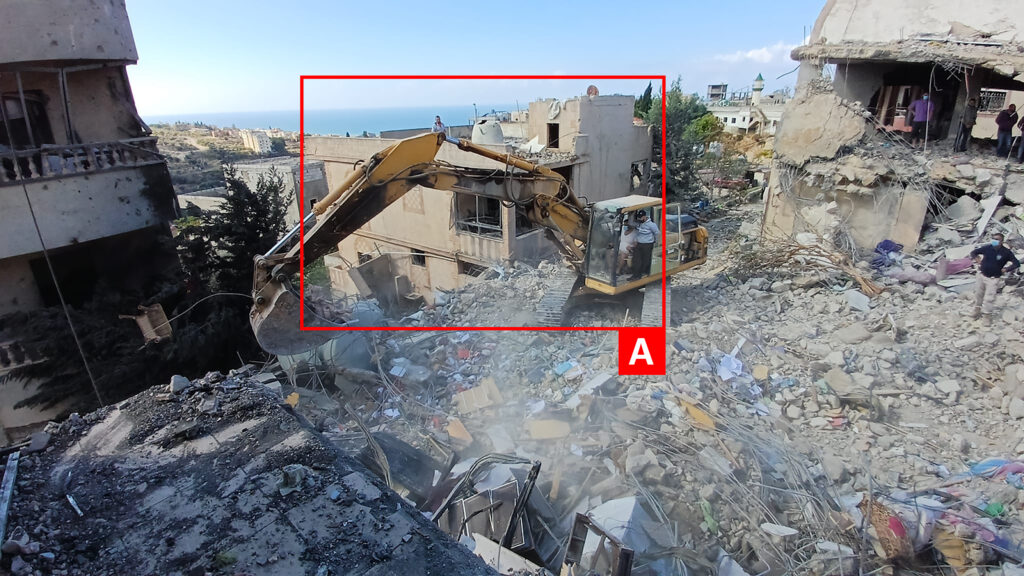
Imagery: Mohammed Zaatari
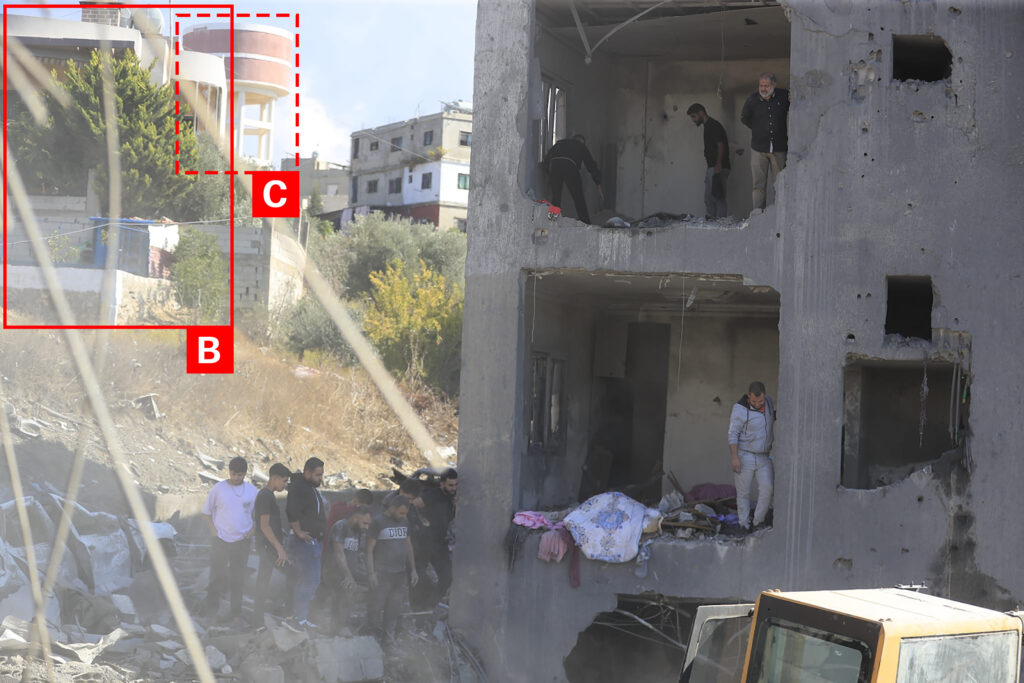
Imagery: Mohammed Zaatari