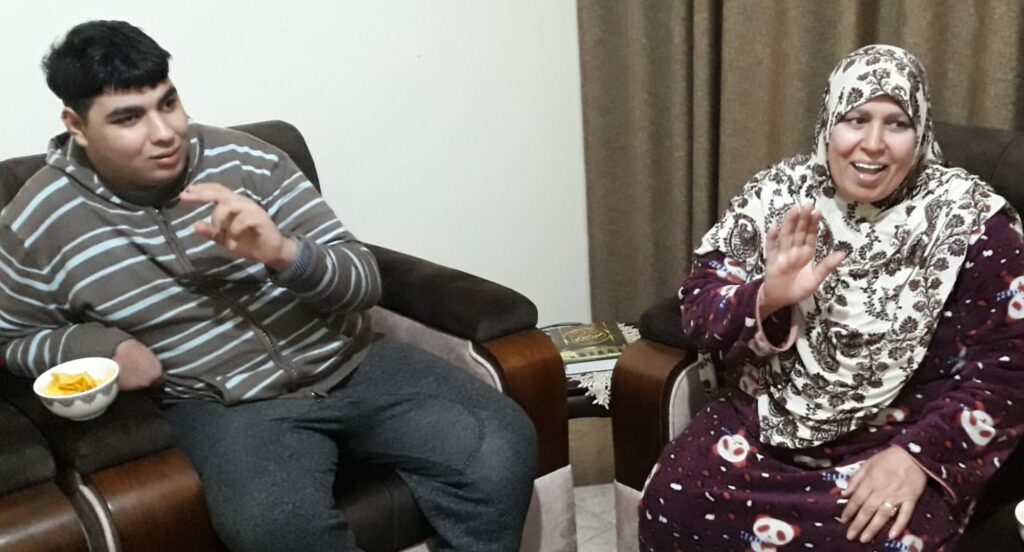
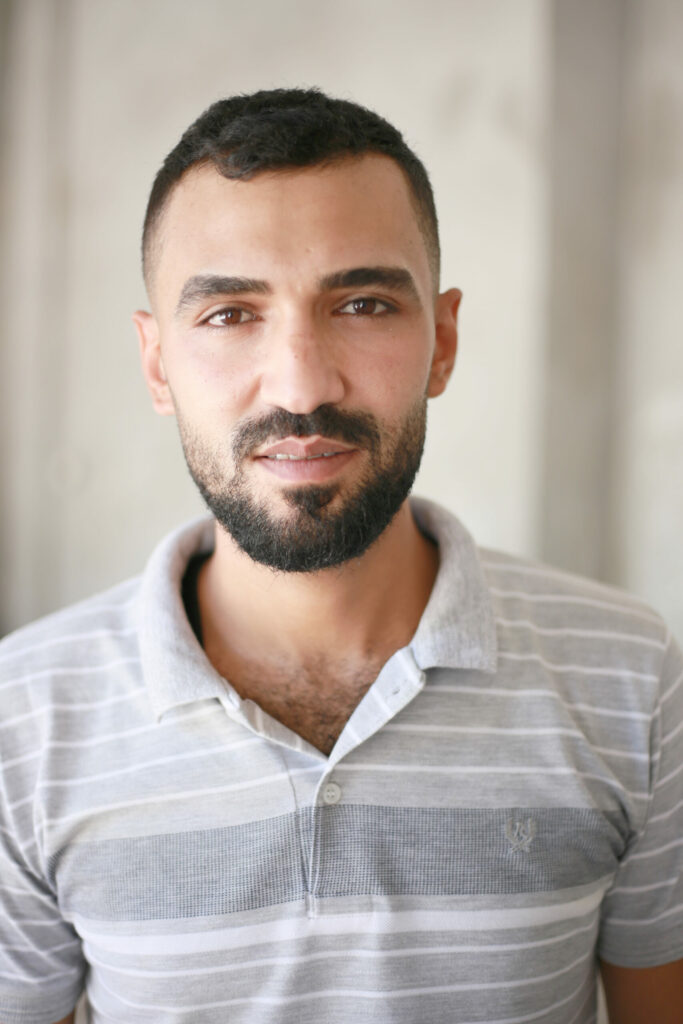
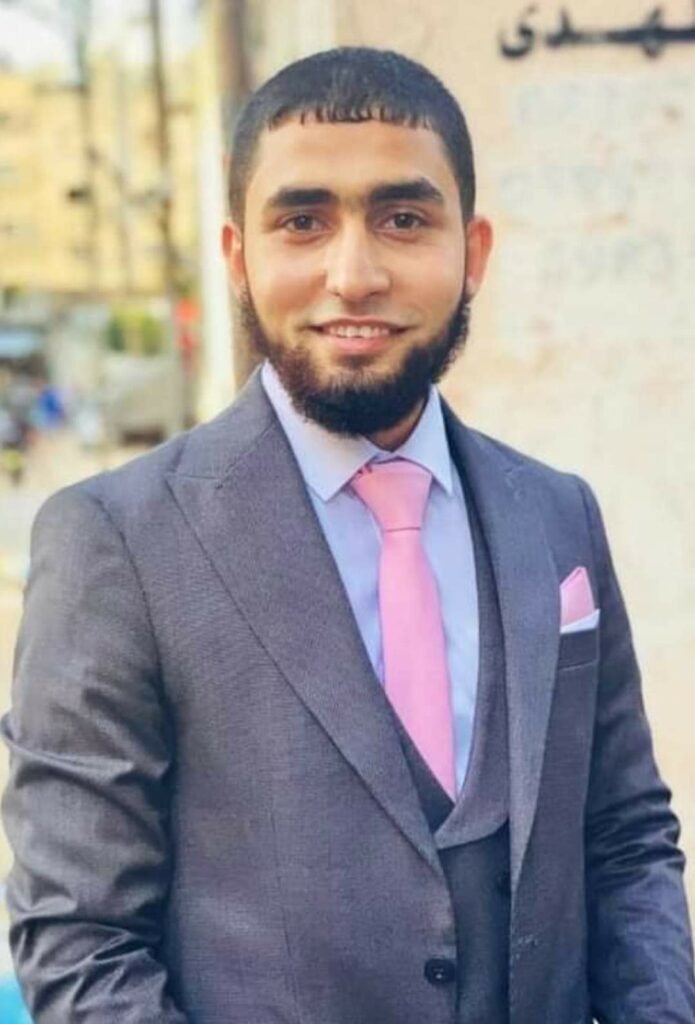
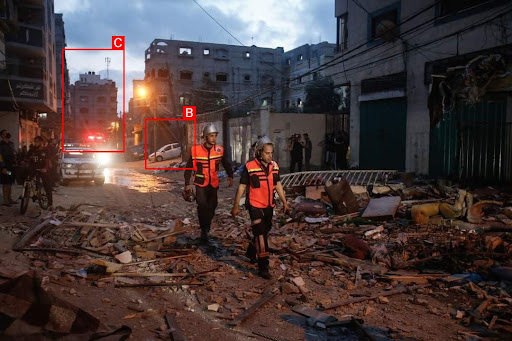
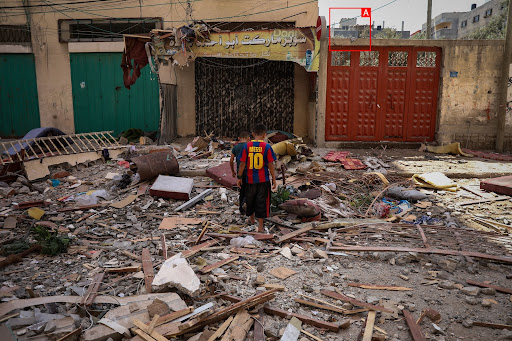
A woman and her disabled son were killed in an alleged Israeli airstrike on their building in Gaza’s al Shati refugee camp. They were identified as Amira Abdel Fattah Subuh and Abdul-Rahman Yusef Ali Subuh.
The airstrike hit the Taiba building, where they lived, in the early hours of the morning on May 11th, 2021. Early reporting indicated the death of one woman, but further reporting identified a second death – the woman’s son who Al Haq said had cerebral palsy. The Associated Press reported that another man was also killed in the airstrike, citing health officials, but no additional information was provided.
Al Haq found two people had been injured in the incident, with them both in a medium to critical condition. According to Palestinian Centre for Human Rights they had been in a nearby house when the strike occurred. @ahmed_rade_2017 shared a photo of a man identified as Ahmed Alsyed, saying he had been seriously injured in the airstrike on the Taiba building. Other sources reported up to four injuries.
The Israeli Defence Force said it had targeted a senior official of the armed wing of Hamas in the attack, according to Haaretz. A similar statement from the Israeli military was reported by Euro-Mediterranean Human Rights Monitor – the home of a battalion commander had allegedly been targeted. But field investigations by the organisation reportedly found no-one had been in the apartment hit at the time. It instead resulted in the collapse of the ceiling of the apartment underneath which lead to the fatalities. Airwars acquired the official statement from the IDF referring to “A Hamas battalion commander was also targeted” but this statement doesn’t specifically reference the location of the commander.
The building targeted consisted of 13 apartments over seven floors. Al Mezan Centre for Human Rights reported that the top floor was hit with three missiles, while he Palestinian Centre for Human Rights said it was hit with two.
A neighbour, Saleh al-Khaldi, recounted the events of the morning to Middle East Eye.“We were at the mosque doing the al-Fajr [dawn] prayers when a massive explosion rocked the neighbourhood. I ran out to the street to find out that [Israeli warplanes] had targeted a building belonging to the Nasman family, which had apartments that were rented to other families,” he said. “I helped pull out a number of injured residents, as well as two martyred people; a woman and her son who were peacefully sleeping in their home.”
One of Subuh’s surviving children told the Palestinian Ma’an news agency, “I bid farewell to the most precious person in my heart, my mother, and I ask God to have mercy on her.”
B’Tselem collected testimonies from two of Amira’s sons, who are also Abdul-Rahman’s brothers:
Mu’az Subuh, 29, told B’Tselem that “On Monday, 10 May 2021, I went to my mother’s with my wife and daughter for Iftar dinner. We stayed with them until 1:30 A.M. I had a feeling the situation was going to escalate, so I suggested they move in with us. It’s really close, less than a kilometer away, but I thought it would better for them to stay at my place, mainly because my brother, ‘Abd a-Rahman, has cerebral palsy. But my mother refused. We went back home…In the morning, I prayed the dawn prayers and went to my mother’s house. I got to their street around 4:30 A.M. When I was about 50 meters away from the building, I heard a very loud explosion. There were clouds of smoke and dust, and I heard people shouting. The building my mother and brothers lived in had been bombed. I tried to get into the building, but people there stopped me because they were afraid of another strike. They suggested I wait for the ambulance and the Civil Defense crew. They tried to reassure me and told me they’d seen my brother ‘Ali at the mosque and had prayed with him. I felt on the verge of a nervous breakdown. I was sure my family was dead. I saw the sixth and seventh floors had been completely demolished. They looked like one floor. I lost all hope that anyone in my family would make it out alive. Some neighbors went up to the apartment and came back down and told me my brothers Baraa and ‘Ali and ‘Ali’s wife Nasmah were alive. As for my mother and my brother ‘Abd a-Rahman, they said, “We didn’t find them. We’re looking for them, but it looks very bad.” Then they told me my mother was injured and on the way to hospital, and that I should go there. When I arrived, I discovered she’d been killed. I hugged her, kissed her body, and screamed and shouted, “I told you to come to our house! Why didn’t you listen to me?!” Then they put my mother in the morgue.”
Baraa Subuh, 27, told B’Tselem that “On Tuesday, 11 May 2021, at 2:00 A.M., I came home and found my mother and my brother ‘Abd a-Rahman awake. My mother was reading the Quran. I sat down with her, ‘Abd a-Rahman and my sister-in-law Nasmah for the meal before the fast. Then I went back to the living room. At around 4:30 A.M., my brother ‘Ali went to the mosque to pray and my mother told me to go to bed. We went to our bedrooms but a few minutes later, before I’d fallen asleep, the house suddenly collapsed on top of me. The wardrobe fell on me, too, and the wall behind me fell out to the road. There was a lot of dust and I had trouble breathing. There was no power and the house was pitch black. I managed to pull myself out from under the debris and went to the room where my mother and ‘Abd a-Rahman sleep. It was in ruins. I called out but couldn’t see anyone. I started removing the debris to get them out. It was only then that I realized Israeli airplanes had bombed the house while we were in it. There was no warning before they fired. The solar boilers on the roof were leaking into our apartment. I started running around the house looking for ‘Abd a-Rahman and the rest of the family. I found my sister-in-law Nasmah and told her to go down to the ground floor. I also found my brother ‘Ali, who was looking for my mother and ‘Abd a-Rahman. In the end, we found mother’s body under the rubble. I started removing the debris that was covering her. Meanwhile, an ambulance and Civil Defense crews arrived, so I put her on a stretcher and told ‘Ali to go with her. I stayed home to look for ‘Abd a-Rahman with the Civil Defense crew and people from the neighborhood. Suddenly, I felt weak and short of breath. I was given first aid and taken to a-Shifaa Hospital. ‘Abd a-Rahman was under the rubble for an hour and a half before we found him. The paramedics brought him to the hospital. Because of the amount of rubble, I didn’t believe he’d survive and when we found him, he was lifeless. When I saw that my brother ‘Abd a-Rahman was dead, I felt great sorrow. I also saw my mother lying lifeless and felt she was sending a message that she wanted to die along with ‘Abd a-Rahman, because he was disabled and we have no father, so there would be no one to care for him without her. ‘Abd a-Rahman was very attached to her.”
Most sources reported that Abdul-Rahman Yusef Ali Subuh was 19 years old, although a single source recorded him as 13-years-old. His mother, Amira, was aged between 57 and 61.
The majority of sources attributed the strikes to Israel. B’Tselem pointed out that “A Hamas military wing operative lived on the seventh floor. He was not home at the time. It is not known whether that was the reason for the strike.” Mu’az and Baraa Subuh, relatives of the victims, said that there was no warning before the strike.
Victims
Family members
(3)
Amira Abdel Fattah Subuhأميرة عبد الفتاح سوبا
59 years oldfemalekilled
Abdul-Rahman Yusef Ali Subuhعبد الرحمن يوسف علي صبح
Fair
Reported by two or more credible sources, with likely or confirmed near actions by a belligerent.
Causes of Death / Injury
Heavy weapons and explosive munitions
Civilians reported killed
2–3
(1 Woman, 1–2 Men)
Civilians reported injured
2–4
(1 Man)
Geolocation Notes
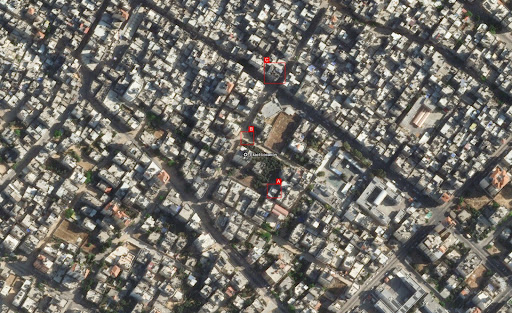
Reports of the incident mention an apartment being struck in the Taiba Building (عمارة طيبة) in the Al Shati Camp (مخيّم الشاطئ). Analyzing visual material from sources, we have narrowed down the location to these exact coordinates: 31.528774, 34.446597.
Several people were killed during Israeli bombing in the early hours of Tuesday, taking the total deaths resulting from the raids on Gaza since Monday to 26, including nine children, Gaza's health ministry has said.
Those killed included a Palestinian woman whose home was targeted in the besieged coastal enclave.
The woman was killed in the Al-Shati refugee camp in the northern Gaza Strip. Her children were also wounded in the attack, but their condition was reported to be stable.
Explained: Why did Israel bomb Gaza?
Read More »
At least 122 people have been wounded in the air strikes, some of them are in critical condition.
In a statement on Tuesday, Jason Lee, Save the Children’s country director in the occupied Palestinian territory, said: “There is no possible justification for children being killed or injured.
New MEE newsletter: Jerusalem Dispatch
Sign up to get the latest insights and analysis on
Israel-Palestine, alongside Turkey Unpacked and other MEE newsletters
"We condemn and demand an immediate stop to the indiscriminate targeting and killing of civilians, including children.
"This is a grave violation of children’s rights and perpetrators must be held to account for their actions and brought to justice."
Ahmed Aboul Gheit, the secretary-general of the Arab League, described the air strikes as "indiscriminate and irresponsible".
He said that Israel was responsible for a "dangerous escalation" in Jerusalem, and called on the international community to act immediately to stop the violence.
Meanwhile, the military wing of Hamas movement, the de facto ruler of Gaza, said it carried out rocket attacks on Ashkelon, located 13km north of Gaza, in retaliation for the night raid that killed the Palestinian woman.
Israel had announced on Monday the launch of a new operation on the Gaza Strip following rockets fired by Palestinian militant groups on Israel in protest against the storming of al-Aqsa Mosque.
Tensions continued to escalate on Monday as Palestinians continue to protest the forced evictions set to take place in East Jerusalem's Sheikh Jarrah neighbourhood.
On 2 May, Israel's Supreme Court ordered that 40 residents of Sheikh Jarrah, including 10 children, be removed from their homes, which would subsequently be given to Israeli settlers. The order sparked massive protests in East Jerusalem, which have spread across cities in Israel and the occupied Palestinian territories.
Israeli forces have been particularly brutal in their attacks on protests near al-Aqsa Mosque, the third holiest site for Muslims. Israeli forces stormed the mosque complex again on Monday morning, injuring hundreds of Palestinians.
'They were playing': Gaza mourns children killed in Israeli air strikes
Read More »
The Gaza-based Hamas movement launched several homemade rockets into Israel following the raid, with its military wing, al-Qassam Brigades, immediately taking responsibility for the attacks, warning they came in response to Israel's actions in Jerusalem.
The rockets that Hamas fired injured a 49-year-old man, who was described as "in a moderate condition" after being injured by shards of glass. No other injuries were reported from the Hamas rockets.
Earlier on Monday, the movement had given Israel a 6pm deadline to withdraw from al-Aqsa Mosque and Sheikh Jarrah and to release all detainees arrested during the recent crackdown on protests. Israeli forces did leave the mosque for a few hours, but just after sundown, there were reports they had again stormed the holy site.
Meanwhile, a Palestinian man was killed in the Israeli city of Lod after he was shot dead late on Monday evening as protests continued inside Israel in solidarity with al-Aqsa and Gaza.
In footage widely shared online, the man was seen laying on the ground with many people crowded around him calling for medical attention.
The Palestinian news website Arab48 cited local sources as saying the protester was shot dead by an Israeli settler, while the Israeli newspaper Haaretz said the cause of death was not yet confirmed. Israeli police confirmed the fatality without further explanation.
Arab 48 website identified the victim as Moussa Hassona. It cited a member of the Popular Committee in Lod, Tayseer Shaban, as saying that Israeli settlers fired indiscriminately on crowds of Palestinian demonstrators. He said the protesters "erupted peacefully in support of al-Aqsa, and were surprised by the bullets of the occupation and its settlers.
Arabs in Israel held massive demonstrations in support of Jerusalem and the Al-Aqsa Mosque on Monday, while Israeli police arrested dozens of protesters, and wounded many others as they tried to disperse the protests with rubber-coated metal bullets and tear gas canisters.
The mass protests erupted in Nazareth, Shfaram, Umm al-Fahm, Ain Mahal, Tamra, Baqa al-Gharbia, Jaffa, Lod, Ramla and Jaljuliya to protest the storming of the al-Aqsa Mosque and the attack on worshipers and protesters in the Sheikh Jarrah neighborhood and Bab al-Amud Square.
At least 46 Palestinians have so far been arrested in the protests, according to Israeli police.
'Palestinians deserve protection'
Within hours of Hamas' missile strikes, Israel responded with air strikes, claiming it had killed three Hamas fighters. Palestinians have denied the strikes were targeted, however, as they caused widespread damage.
'My children were martyred. I cannot find any justification for targeting where children usually play'
- Youssef al-Masri, father of air strike victim
Among those killed were two brothers from the al-Masri family, Ibrahim, 11, and seven-year-old Marwan, from Beit Hanoun in the northern Gaza Strip.
"The children were playing with their cousins in front of the house when a man on a motorcycle passed by, and the occupation targeted him twice," Youssef al-Masri, the children's father, told Middle East Eye.
"My children were martyred. I cannot find any justification whatsoever for targeting someone passing through overcrowded civilian neighbourhoods where dozens of children usually play," he continued.
Following the strike, Israeli Defence Minister Benny Gantz declared the area within 80km of the Gaza Strip under military control for the following 48 hours.
The Palestinian health ministry said it had put its hospitals, ambulances and emergency services on high alert.
The international community, including leaders in the US and UK, have been largely silent over Israel's air strikes on the Gaza Strip, instead focusing condemnation against Hamas' rockets and calling for calm "on both sides".
US Department of State spokesperson Ned Price said the Biden Administration is 'concerned' about the escalating violence at al-Aqsa Mosque and in Gaza and urges 'calm' from both sides.
UK Foreign Secretary Dominic Raab said on Monday that the United Kingdom condemned the firing of rockets at Jerusalem and locations within Israel.
"The ongoing violence in Jerusalem and Gaza must stop. We need an immediate de-escalation on all sides, and an end to targeting of civilian populations", Raab said on Twitter.
US House Representative Ilhan Omar, however, quickly labelled Israel's strikes "an act of terrorism", saying it would be "unconscionable to not condemn" them.
"Palestinians deserve protection. Unlike Israel, missile defense programs, such as Iron Dome, don't exist to protect Palestinian civilians," she said in a post to Twitter.
Saudi Arabia and Egypt, who have recently signed normalisation agreements with Israel, issued statements condemning that al-Aqsa attack "in the strongest terms."
“We express our condemnation in the strongest terms for the blatant attacks carried out by the Israeli occupation forces, against the sanctity of the al-Aqsa Mosque, and the safety and security of worshipers,” the ministry of foreign affairs said in a Twitter statement.
It urged the international community to hold Israel accountable for its violations of Palestinian rights, and expressed solidarity with Palestinians.
Egypt's ministry of foreign affairs also issued a statement expressing its condemnation of the Israeli forces' repeated storming of al-Aqsa Mosque compound and the assault on Palestinian worshipers.
The statement urged Israel to "assume its responsibility regarding these rapid and dangerous developments," which could lead to further tension and escalation.
Meanwhile, the Grand Imam of Al-Azhar Dr. Ahmed Al-Tayeb condemned the world’s “shameful silence towards the brutal Zionist terrorism and its shameful violations of the right of al-Aqsa Mosque, our brothers and our sanctities in Arab Palestine.”
In Turkey, thousands took part in demonstrations in Istanbul and Ankara in defiance of a Covid-19 curfew to protest against Israel's raids on Al-Aqsa Mosque and deadly air strikes in Gaza.
President Recep Tayyib Erdogan, according to a statement from his office, told King Abdullah of Jordan that the "inhumane" attacks against Palestinians were aimed at all Muslims, adding that Turkey and Jordan needed to work together to stop them.
In Jordan, thousands protested near Israel's embassy in Amman on Monday, calling on their government to cancel its peace treaty with Israel in the face of attacks on al-Aqsa mosque and Gaza.
How Israeli raid on al-Aqsa Mosque could constitute a war crime
Read More »
Riot police blocked roads leading to the fortified embassy complex to keep back demonstrators who gathered around the Kaloti mosque in the capital near the Israeli mission.
Jordan, which established diplomatic relations with Israel in 1994, summoned the Israeli charge d'affaires in Amman on Sunday to voice the kingdom's condemnation over Israeli "attacks on worshippers" around the al-Aqsa compound.
Javad Zarif, Iran's foreign minister, condemned the storming of al-Aqsa Mosque in a statement on Twitter.
“It wasn't enough for the Israeli regime to steal people’s land & homes; Create an Apartheid regime; refuse to vaccinate civilians under illegal occupation,” he said.
“It had to shoot innocent worshippers inside Islam's 3rd Holiest Mosque upon Islam's Holiest Eid,” he added.
Israeli nationalists march
Meanwhile, hundreds of nationalist Israeli youth gathered at the Western Wall to mark "Jerusalem Day", the anniversary of Israel's victory in the 1967 war.
Crowds under the protection of Israeli police made their way into the plaza after a march through parts of Jerusalem's Old City. The celebrations were seen as highly provocative, given recent events.
While the nationalist march was originally scheduled to start at Damascus Gate, the main entrance to the Old City's Muslim quarter where Palestinians had gathered in demonstrations, police redirected the marchers to the Jaffa Gate to avoid further confrontations.
Israeli Prime Minister Benjamin Netanyahu convened a meeting with his security cabinet ahead of the march, with Israeli journalist Barak Ravid reporting that it was the prime minister, not the police chiefs, who altered the nationalist march's route.
Ravid reported that US National Security Adviser Jake Sullivan suggested the route change during a phone call with his Israeli counterpart on Sunday.
'Nefarious occupation' in Sheikh Jarrah
With recent tensions beginning in Sheikh Jarrah, the issue of the forced eviction notices remains a central focus of unrest. While the order has been postponed, Israeli authorities have continuously put off attempts to reschedule a hearing in case.
Two far-right Israeli Knesset members belonging to the Religious Zionism political alliance showed up in the East Jerusalem neighbourhood on Monday morning, as did several members from the Joint List, a party representing Palestinian citizens of Israel.
Al-Aqsa and Sheikh Jarrah: How is the world reacting to the situation in Jerusalem?
Read More »
Ayman Odeh, one of the Joint List members in attendance, was quoted by Israel's Haaretz newspaper as saying that "everything that's happening [in Sheikh Jarrah] is part of the nefarious occupation".
"There is a nation of people here that deserve self-determination – the establishment of a Palestinian state alongside Israel," he said.
According to Mohammed al-Kurd, a Palestinian belonging to a family threatened with eviction, no Palestinians were allowed in the part of Sheikh Jarrah threatened with evictions on Monday - not even journalists.
Protests in Sheikh Jarrah and around greater Jerusalem are expected to continue throughout the week. As Wednesday marks the Islamic Eid celebration - the end of Ramadan's month of fasting - tens of thousands of worshippers are expected to flock to al-Aqsa Mosque, increasing the potential for violence in Israel's ongoing crackdown at the holy site.
Content
Several people were killed during Israeli bombing in the early hours of Tuesday, taking the total deaths resulting from the raids on Gaza since Monday to 26, including nine children, Gaza's health ministry has said.
Those killed included a Palestinian woman whose home was targeted in the besieged coastal enclave.
The woman was killed in the Al-Shati refugee camp in the northern Gaza Strip. Her children were also wounded in the attack, but their condition was reported to be stable.
Explained: Why did Israel bomb Gaza?
Read More »
At least 122 people have been wounded in the air strikes, some of them are in critical condition.
In a statement on Tuesday, Jason Lee, Save the Children’s country director in the occupied Palestinian territory, said: “There is no possible justification for children being killed or injured.
New MEE newsletter: Jerusalem Dispatch
Sign up to get the latest insights and analysis on
Israel-Palestine, alongside Turkey Unpacked and other MEE newsletters
"We condemn and demand an immediate stop to the indiscriminate targeting and killing of civilians, including children.
"This is a grave violation of children’s rights and perpetrators must be held to account for their actions and brought to justice."
Ahmed Aboul Gheit, the secretary-general of the Arab League, described the air strikes as "indiscriminate and irresponsible".
He said that Israel was responsible for a "dangerous escalation" in Jerusalem, and called on the international community to act immediately to stop the violence.
Meanwhile, the military wing of Hamas movement, the de facto ruler of Gaza, said it carried out rocket attacks on Ashkelon, located 13km north of Gaza, in retaliation for the night raid that killed the Palestinian woman.
Israel had announced on Monday the launch of a new operation on the Gaza Strip following rockets fired by Palestinian militant groups on Israel in protest against the storming of al-Aqsa Mosque.
Tensions continued to escalate on Monday as Palestinians continue to protest the forced evictions set to take place in East Jerusalem's Sheikh Jarrah neighbourhood.
On 2 May, Israel's Supreme Court ordered that 40 residents of Sheikh Jarrah, including 10 children, be removed from their homes, which would subsequently be given to Israeli settlers. The order sparked massive protests in East Jerusalem, which have spread across cities in Israel and the occupied Palestinian territories.
Israeli forces have been particularly brutal in their attacks on protests near al-Aqsa Mosque, the third holiest site for Muslims. Israeli forces stormed the mosque complex again on Monday morning, injuring hundreds of Palestinians.
'They were playing': Gaza mourns children killed in Israeli air strikes
Read More »
The Gaza-based Hamas movement launched several homemade rockets into Israel following the raid, with its military wing, al-Qassam Brigades, immediately taking responsibility for the attacks, warning they came in response to Israel's actions in Jerusalem.
The rockets that Hamas fired injured a 49-year-old man, who was described as "in a moderate condition" after being injured by shards of glass. No other injuries were reported from the Hamas rockets.
Earlier on Monday, the movement had given Israel a 6pm deadline to withdraw from al-Aqsa Mosque and Sheikh Jarrah and to release all detainees arrested during the recent crackdown on protests. Israeli forces did leave the mosque for a few hours, but just after sundown, there were reports they had again stormed the holy site.
Meanwhile, a Palestinian man was killed in the Israeli city of Lod after he was shot dead late on Monday evening as protests continued inside Israel in solidarity with al-Aqsa and Gaza.
In footage widely shared online, the man was seen laying on the ground with many people crowded around him calling for medical attention.
The Palestinian news website Arab48 cited local sources as saying the protester was shot dead by an Israeli settler, while the Israeli newspaper Haaretz said the cause of death was not yet confirmed. Israeli police confirmed the fatality without further explanation.
Arab 48 website identified the victim as Moussa Hassona. It cited a member of the Popular Committee in Lod, Tayseer Shaban, as saying that Israeli settlers fired indiscriminately on crowds of Palestinian demonstrators. He said the protesters "erupted peacefully in support of al-Aqsa, and were surprised by the bullets of the occupation and its settlers.
Arabs in Israel held massive demonstrations in support of Jerusalem and the Al-Aqsa Mosque on Monday, while Israeli police arrested dozens of protesters, and wounded many others as they tried to disperse the protests with rubber-coated metal bullets and tear gas canisters.
The mass protests erupted in Nazareth, Shfaram, Umm al-Fahm, Ain Mahal, Tamra, Baqa al-Gharbia, Jaffa, Lod, Ramla and Jaljuliya to protest the storming of the al-Aqsa Mosque and the attack on worshipers and protesters in the Sheikh Jarrah neighborhood and Bab al-Amud Square.
At least 46 Palestinians have so far been arrested in the protests, according to Israeli police.
'Palestinians deserve protection'
Within hours of Hamas' missile strikes, Israel responded with air strikes, claiming it had killed three Hamas fighters. Palestinians have denied the strikes were targeted, however, as they caused widespread damage.
'My children were martyred. I cannot find any justification for targeting where children usually play'
- Youssef al-Masri, father of air strike victim
Among those killed were two brothers from the al-Masri family, Ibrahim, 11, and seven-year-old Marwan, from Beit Hanoun in the northern Gaza Strip.
"The children were playing with their cousins in front of the house when a man on a motorcycle passed by, and the occupation targeted him twice," Youssef al-Masri, the children's father, told Middle East Eye.
"My children were martyred. I cannot find any justification whatsoever for targeting someone passing through overcrowded civilian neighbourhoods where dozens of children usually play," he continued.
Following the strike, Israeli Defence Minister Benny Gantz declared the area within 80km of the Gaza Strip under military control for the following 48 hours.
The Palestinian health ministry said it had put its hospitals, ambulances and emergency services on high alert.
The international community, including leaders in the US and UK, have been largely silent over Israel's air strikes on the Gaza Strip, instead focusing condemnation against Hamas' rockets and calling for calm "on both sides".
US Department of State spokesperson Ned Price said the Biden Administration is 'concerned' about the escalating violence at al-Aqsa Mosque and in Gaza and urges 'calm' from both sides.
UK Foreign Secretary Dominic Raab said on Monday that the United Kingdom condemned the firing of rockets at Jerusalem and locations within Israel.
"The ongoing violence in Jerusalem and Gaza must stop. We need an immediate de-escalation on all sides, and an end to targeting of civilian populations", Raab said on Twitter.
US House Representative Ilhan Omar, however, quickly labelled Israel's strikes "an act of terrorism", saying it would be "unconscionable to not condemn" them.
"Palestinians deserve protection. Unlike Israel, missile defense programs, such as Iron Dome, don't exist to protect Palestinian civilians," she said in a post to Twitter.
Saudi Arabia and Egypt, who have recently signed normalisation agreements with Israel, issued statements condemning that al-Aqsa attack "in the strongest terms."
“We express our condemnation in the strongest terms for the blatant attacks carried out by the Israeli occupation forces, against the sanctity of the al-Aqsa Mosque, and the safety and security of worshipers,” the ministry of foreign affairs said in a Twitter statement.
It urged the international community to hold Israel accountable for its violations of Palestinian rights, and expressed solidarity with Palestinians.
Egypt's ministry of foreign affairs also issued a statement expressing its condemnation of the Israeli forces' repeated storming of al-Aqsa Mosque compound and the assault on Palestinian worshipers.
The statement urged Israel to "assume its responsibility regarding these rapid and dangerous developments," which could lead to further tension and escalation.
Meanwhile, the Grand Imam of Al-Azhar Dr. Ahmed Al-Tayeb condemned the world’s “shameful silence towards the brutal Zionist terrorism and its shameful violations of the right of al-Aqsa Mosque, our brothers and our sanctities in Arab Palestine.”
In Turkey, thousands took part in demonstrations in Istanbul and Ankara in defiance of a Covid-19 curfew to protest against Israel's raids on Al-Aqsa Mosque and deadly air strikes in Gaza.
President Recep Tayyib Erdogan, according to a statement from his office, told King Abdullah of Jordan that the "inhumane" attacks against Palestinians were aimed at all Muslims, adding that Turkey and Jordan needed to work together to stop them.
In Jordan, thousands protested near Israel's embassy in Amman on Monday, calling on their government to cancel its peace treaty with Israel in the face of attacks on al-Aqsa mosque and Gaza.
How Israeli raid on al-Aqsa Mosque could constitute a war crime
Read More »
Riot police blocked roads leading to the fortified embassy complex to keep back demonstrators who gathered around the Kaloti mosque in the capital near the Israeli mission.
Jordan, which established diplomatic relations with Israel in 1994, summoned the Israeli charge d'affaires in Amman on Sunday to voice the kingdom's condemnation over Israeli "attacks on worshippers" around the al-Aqsa compound.
Javad Zarif, Iran's foreign minister, condemned the storming of al-Aqsa Mosque in a statement on Twitter.
“It wasn't enough for the Israeli regime to steal people’s land & homes; Create an Apartheid regime; refuse to vaccinate civilians under illegal occupation,” he said.
“It had to shoot innocent worshippers inside Islam's 3rd Holiest Mosque upon Islam's Holiest Eid,” he added.
Israeli nationalists march
Meanwhile, hundreds of nationalist Israeli youth gathered at the Western Wall to mark "Jerusalem Day", the anniversary of Israel's victory in the 1967 war.
Crowds under the protection of Israeli police made their way into the plaza after a march through parts of Jerusalem's Old City. The celebrations were seen as highly provocative, given recent events.
While the nationalist march was originally scheduled to start at Damascus Gate, the main entrance to the Old City's Muslim quarter where Palestinians had gathered in demonstrations, police redirected the marchers to the Jaffa Gate to avoid further confrontations.
Israeli Prime Minister Benjamin Netanyahu convened a meeting with his security cabinet ahead of the march, with Israeli journalist Barak Ravid reporting that it was the prime minister, not the police chiefs, who altered the nationalist march's route.
Ravid reported that US National Security Adviser Jake Sullivan suggested the route change during a phone call with his Israeli counterpart on Sunday.
'Nefarious occupation' in Sheikh Jarrah
With recent tensions beginning in Sheikh Jarrah, the issue of the forced eviction notices remains a central focus of unrest. While the order has been postponed, Israeli authorities have continuously put off attempts to reschedule a hearing in case.
Two far-right Israeli Knesset members belonging to the Religious Zionism political alliance showed up in the East Jerusalem neighbourhood on Monday morning, as did several members from the Joint List, a party representing Palestinian citizens of Israel.
Al-Aqsa and Sheikh Jarrah: How is the world reacting to the situation in Jerusalem?
Read More »
Ayman Odeh, one of the Joint List members in attendance, was quoted by Israel's Haaretz newspaper as saying that "everything that's happening [in Sheikh Jarrah] is part of the nefarious occupation".
"There is a nation of people here that deserve self-determination – the establishment of a Palestinian state alongside Israel," he said.
According to Mohammed al-Kurd, a Palestinian belonging to a family threatened with eviction, no Palestinians were allowed in the part of Sheikh Jarrah threatened with evictions on Monday - not even journalists.
Protests in Sheikh Jarrah and around greater Jerusalem are expected to continue throughout the week. As Wednesday marks the Islamic Eid celebration - the end of Ramadan's month of fasting - tens of thousands of worshippers are expected to flock to al-Aqsa Mosque, increasing the potential for violence in Israel's ongoing crackdown at the holy site.
Media from By MEE staff (5)
This media contains potentially graphic content. Click to unblur.
JERUSALEM (AP) — Palestinian militants launched dozens of rockets from Gaza and Israel unleashed new air strikes against them early Tuesday, in an escalation triggered by soaring tensions in Jerusalem and days of clashes at an iconic mosque in the holy city.Twenty-four people, including nine children, were killed in Gaza overnight, most of them in Israeli strikes. More than 700 Palestinians were hurt in clashes with Israeli security forces in Jerusalem and across the West Bank in 24 hours, including nearly 500 who were treated at hospitals. The Israeli military said six Israeli civilians were hurt by rocket fire Tuesday morning.This round of violence, like previous ones, was fueled by conflicting claims over Jerusalem, home to major holy sites of Islam, Judaism and Christianity. The rival national and religious narratives of Israelis and Palestinians are rooted in the city, making it the emotional core of their long conflict.
In recent weeks, tension has been soaring in Jerusalem, marked by clashes between Palestinian protesters and Israeli police in the walled Old City, located in east Jerusalem which Israel captured and annexed in the 1967 war.
One of the flashpoints in the Old City has been the Al-Aqsa Mosque compound, the third holiest site of Islam and the holiest site of Judaism. Another driver of Palestinian anger has been the threatened eviction of Palestinian families from homes in an east Jerusalem neighborhood by Israeli settlers.
Monday was a long day of anger and deadly violence, laying bare Jerusalem’s deep divisions, even as Israel tried to celebrate its capture of the city’s eastern sector and its sensitive holy sites more than half a century ago. With dozens of rockets flying into Israel throughout the night, Prime Minister Benjamin Netanyahu met with top security officials and warned that the fighting could drag on, despite calls for calm from the U.S., Europe and elsewhere.
Hamas, the militant group ruling the Gaza Strip, fired dozens of rockets Monday evening, setting off air raid sirens as far as Jerusalem. The barrage came after Hamas had given Israel a deadline to withdraw forces from the Al-Aqsa compound. By Tuesday morning, Hamas and other Gaza militants had fired more than 200 rockets. That included a barrage of six rockets that targeted Jerusalem, some 100 kilometers (60 miles) away. It set off air raid sirens throughout Jerusalem, and explosions could be heard in what was believed to be the first time the city had been targeted since a 2014 war.There appeared to be some first signs of de-escalation in Jerusalem early Tuesday. Palestinian worshippers performed the dawn prayer at the mosque without confrontations as Israel apparently limited the presence of its police officers around the compound. Amateur videos showed dozens of faithful marching to the mosque and chanting “we sacrifice our blood, soul for Al-Aqsa.”In Gaza, an Israeli drone strike killed a man in the southern Gaza town of Khan Younis early Tuesday, according to local media reports. In another strike, a woman and two men were killed when a missile struck the upper floors of an apartment building in the Shati refugee camp on the edge of Gaza City, according to Gaza Health Ministry and rescue services.
Hamas’ armed wing said it intensified the rocket barrages following the airstrike on the house.The Israeli military said it had carried out dozens of airstrikes across Gaza overnight, targeting what it said were Hamas military installations and operatives. It said a Hamas tunnel, rocket launchers and at least eight militants had been hit.Dozens of rockets were intercepted by Israel’s Iron Dome defense system. But one landed near a home on the outskirts of Jerusalem, causing light damage to the structure and sparking a brush fire nearby. In southern Israel, an Israeli man was lightly wounded after a missile struck a vehicle.Prime Minister Benjamin Netanyahu said that “terrorist organizations in Gaza have crossed a red line and attacked us with missiles in the outskirts of Jerusalem.”
He said fighting could continue for some time and that “”whoever attacks us will pay a heavy price,” he said, warning that the fighting could “continue for some time.”Gaza health officials gave no further breakdowns on the casualties. At least 15 of the 22 deaths in Gaza were attributed to the airstrikes. Seven of the deaths were members of a single family, including three children, who died in a mysterious explosion in the northern Gaza town of Beit Hanoun. It was not clear if the blast was caused by an Israeli airstrike or errant rocket. More than 100 Gazans were wounded in the airstrikes, the Health Ministry said.In a statement issued early Tuesday, Hamas leader Ismail Haniyeh said the rocket attacks would continue until Israel stops “all scenes of terrorism and aggression in Jerusalem and Al-Aqsa mosque.”
Tensions at the site, known to Muslims as the Noble Sanctuary and to Jews as the Temple Mount, have triggered repeated bouts of violence in the past.In Monday’s unrest, Israeli police fired tear gas, stun grenades and rubber bullets in clashes with stone-throwing Palestinians at the compound.More than a dozen tear gas canisters and stun grenades landed in the mosque as police and protesters faced off inside the walled compound that surrounds it, said an Associated Press photographer at the scene. Smoke rose in front of the mosque and the golden-domed shrine on the site, and rocks littered the nearby plaza. Inside one area of the compound, shoes and debris lay scattered over ornate carpets.Over 600 Palestinians were hurt in Jerusalem alone, including more than 400 who required care at hospitals and clinics, according to the Palestinian Red Crescent.Palestinians and police reported renewed clashes late Monday. Israeli police also reported unrest in northern Israel, where Arab protesters burned tires and threw stones and fireworks at security forces. Police said 46 people were arrested.Monday’s confrontations came after weeks of almost nightly clashes between Palestinians and Israeli police in the Old City of Jerusalem during the Muslim holy month of Ramadan. The month tends to be a time of heightened religious sensitivities.Most recently, the tensions have been fueled by the planned eviction of dozens of Palestinians from the Sheikh Jarrah neighborhood of east Jerusalem, where Israeli settlers have waged a lengthy legal battle to take over properties.Israel’s Supreme Court postponed a key ruling Monday in the case, citing the “circumstances.”In Washington, State Department spokesman Ned Price condemned “in the strongest terms” the rocket fire on Israel and called on all sides to calm the situation.“More broadly, we’re deeply concerned about the situation in Israel, the West Bank and the Gaza Strip, including violent confrontations in Jerusalem,” he said. He said the U.S. would remain “fully engaged” and praised steps by Israel to cool things down, including the court delay in the eviction case.In an apparent attempt to avoid further confrontation, Israeli authorities changed the planned route of a march by thousands of flag-waving nationalist Jews through the Muslim Quarter of the Old City to mark Jerusalem Day.The annual festival is meant to celebrate Israel’s capture of east Jerusalem in the 1967 Mideast war. But it is widely seen as a provocation because the route goes through the heart of Palestinian areas. Israel also captured the West Bank and Gaza in 1967. It later annexed east Jerusalem and considers the entire city its capital. The Palestinians seek all three areas for a future state, with east Jerusalem as their capital.Meanwhile, the United Nations, Egypt and Qatar, which frequently mediate between Israel and Hamas, were all trying to halt the fighting, a diplomatic official confirmed. He spoke on condition of anonymity because he was not authorized to discuss the issue with the media.The tensions in Jerusalem have threatened to reverberate throughout the region and come at a crucial point in Israel’s political crisis. Netanyahu failed to form a governing coalition last week, and his opponents are now working to build an alternate government.
Geneva – Israel’s escalation of violence and widespread bombardment, including civilian objects without respecting the principle of proportionality, in the Gaza Strip is utterly appalling, Euro-Mediterranean Human Rights Monitor said today in a statement.
Since the Israeli Army launched its military operation “Guardian of the Walls”, fears have significantly risen regarding Israel’s intent to not only continue their attacks but to further escalate and expand its target range, according to the recommendations of the Israeli Chief of the General Staff, General Aviv Kochavi.
Israeli warplanes have been bombing dozens of sites in the Gaza Strip since Monday evening after Palestinian armed factions fired several rockets at Israel and the occupied territories. This came as a response to the Israeli forces' attacks on Palestinians in Jerusalem, especially those praying in the Al-Aqsa Mosque and the Sheikh Jarrah neighbourhood.
However, the Israeli forces expanded their response to include targeting dozens of civilian objects, women and children and bombing densely populated gatherings, which according to the Rome Statute, is a war crime.
Israel has been targeting civilian objects in the Gaza Strip in a manner that exceeds military necessities. In one of the targeted houses, an elderly woman Amira Abdel Fattah Subuh, 58, was killed. Her son, Abd al-Rahman Yusef Subuh, 19, a disabled young man who suffers from cerebral palsy since birth, was also killed.
Later, the Israeli army announced that it had targeted the home of a battalion commander. But field investigations confirm that no one was in the targeted flat during the bombing. The bombing caused the ceiling of the lower apartment to fall, which killed the two citizens and wounded some others.
This incident is an example of Israel’s bombing policy that does not consider the principle of proportionality. Israel targets civilian objects deliberately to inflict damage upon victims and leave them with material losses as a form of revenge and collective punishment, prohibited by the rules of international humanitarian law.
Israel might return to this policy of deliberately targeting civilian homes, which has happened in previous attacks, where hundreds of homes were destroyed, including entire residential towers, many of them targeted during the presence of the civilian population in them.
Israel expanded its bombardment range today and targeted economic facilities such as an ice cream factory in the east of Gaza and educational institutions such as the Al-Salah school in Deir Al-Balah in the central Gaza Strip.
According to the Palestinian Ministry of Health, up until the statement was published, the airstrikes had killed 26 Palestinians, including nine children, and injured 122 others.
This attack requires urgent action from the international community to bind Israel to the rules of international humanitarian law. At the same time, the International Criminal Court should include these violations in its investigation of possible crimes in the Palestinian territories.
Article 25 of the Hague Regulations concerning the Laws and Customs of War on Land says: “The attack or bombardment, by whatever means, of towns, villages, dwellings, or buildings which are undefended is prohibited. Article 53 of the Fourth Geneva Convention stipulates that “Any destruction by the Occupying Power of real or personal property […] is prohibited, except where such destruction is rendered absolutely necessary by military operations”.
Destruction of property for no clear military justifications is a grave breach of Article 147 of the Fourth Geneva Convention and a war crime under the Statute of the International Criminal Court Article 8 (2) (b) (2).
Anas Aljarjawi, Euro-Med Monitor’s Chief Operations Officer, said that “even if there was a military necessity, it is the responsibility of the occupying power to comply with the other provisions stipulated by international humanitarian law”.
“International humanitarian law provides for the prohibition of property damage as a 'preventive measure' – that is, in cases where the danger has not yet been verified. It also prohibits the destruction of property in order to achieve deterrence, spread terror among civilians, or take revenge”.
“Israel's targeted demolition of civilian homes is merely a form of collective punishment for residents in the Gaza Strip. Itis a violation of international humanitarian law, especially Article 33 of the Fourth Geneva Convention, which states that “Collective penalties and likewise all measures of intimidation or terrorism is prohibited. Pillage is prohibited. Reprisals against protected persons and their property is prohibited’.”
Palestinian militants say they fired 130 missiles at the Israeli city of Tel Aviv after an Israeli air strike felled a tower block in the Gaza Strip. The 13-storey building was attacked an hour and a half after residents and local people were warned to evacuate, Reuters news agency reports.Israel's military says it is targeting militants in Gaza in response to earlier rocket attacks.At least 31 people have died in some of the worst violence in years.The international community has urged both sides to end the escalation, which follows days of unrest in Jerusalem. Militants had already fired hundreds of rockets towards Jerusalem and other areas. Three people have been killed in Israeli areas while at least 28 Palestinians have been killed by Israeli air strikes.Israeli Prime Minister Benjamin Netanyahu said earlier that the main militant group, Hamas, had "crossed a red line" by firing rockets towards Jerusalem for the first time in years. Hamas, which controls Gaza, says it has been acting to defend Jerusalem's al-Aqsa mosque from Israeli "aggression and terrorism" after the site, which is holy to Muslims and Jews, saw clashes between Israeli police and Palestinians on Monday that left hundreds injured. The past few days have seen the worst violence in Jerusalem since 2017. It followed mounting Palestinian anger over the threatened eviction of families from their homes in occupied East Jerusalem by Jewish settlers. Tension had already been stoked by a month of altercations between protesters and police in the predominantly Arab part of the city.What do we know of the latest fighting?Hamas said it had launched rockets at Tel Aviv and its suburbs in response to "the enemy's targeting of residential towers". Video footage from the city shows rockets streaking through the night sky, some exploding as they are hit by Israeli interceptor missiles.A 50-year-old woman was killed by a rocket in Rishon LeZion, near Tel Aviv, Israeli official said. In the Tel Aviv suburb of Holon, a rocket hit a bus just after it had been evacuated. A girl of five and two women, one 50 and one 30, were injured.In Tel Aviv itself, pedestrians ran for shelter and diners streamed out of restaurants while others flattened themselves on pavements as the sirens sounded, according to Reuters. Ben Gurion Airport briefly halted flights and an energy pipeline between the cities of Eilat and Ashkelon was hit.The rockets were launched after the destruction of the Hanadi Tower in Gaza, which houses an office used by the political leadership of Hamas.Hours after the collapse, there were still no reports of casualties.There are reports that a second high-rise building was also destroyed by the Israelis after a warning to evacuate. Israeli Defence Minister Benny Gantz said the Israeli strikes were "just the beginning"."Terror organisations have been hit hard and will continue to be hit because of their decision to hit Israel," he said. "We'll return peace and quiet, for the long term."Hamas leader Ismail Haniyeh said the group was "ready" if Israel chose to escalate."If [Israel] wants to escalate, we are ready for it, and if it wants to stop, we're also ready," he said in a televised address. "There is a new balance of force."The UN Security Council will meet privately on Wednesday to discuss the conflict, diplomats said.The open wound of an unresolved conflictThe fundamental reason for the renewed violence does not change. It is the open wound of the unresolved conflict between Jews and Arabs that has blighted and ended Palestinian and Israeli lives for generations. This latest episode has happened because of tension in Jerusalem, the sharpest part of the conflict. The holy sites in the Old City are national as well as religious symbols. Crises affecting them have often ignited violence. The triggers for what has happened this time include heavy-handed Israeli policing of Palestinians during Ramadan and controversial efforts in the Israeli courts to evict Palestinians from their homes.But other events could have had the same effect. This was a crisis waiting to happen, in a conflict that, once again, has been left to fester. Leaders on both sides have concentrated on safeguarding their own positions. The biggest challenge, of making peace, has not been addressed seriously for years. Earlier on Tuesday, two women, one in her 60s and the other in her 80s, were killed in a rocket attack on the southern Israeli city of Ashkelon, with one other person seriously injured, medics say.Hamas said it had fired 137 rockets at Ashkelon and nearby Ashdod in the space of five minutes, and warned it had "many surprises" prepared if the fighting continued.At least 95 people received treatment in Israeli hospitals as a result of the attacks.The Israeli military said earlier that 90% of rockets had been intercepted by its Iron Dome missile defence system.Among the "terror targets" in Gaza it said it had struck were two attack tunnels being dug under the border with Israel.Among those killed by Israeli air strikes was the head of the Islamic Jihad group's special rocket unit, Samah Abed al-Mamlouk, and the commander of a Hamas anti-tank missile unit is also said to have been killed. The Hamas-run health ministry in Gaza reported that at least 28 Palestinians, including 10 children, had been killed in Israeli strikes and more than 150 others had been injured.Victims included a 59-year-old woman and her disabled son and seven members of one family, including three children, in Beit Hanoun. What has caused the violence?The fighting between Israel and Hamas was triggered by days of escalating clashes between Palestinians and Israeli police at a holy hilltop compound in East Jerusalem. The site is revered by both Muslims, who call it the Haram al-Sharif (Noble Sanctuary), and Jews, for whom it is known as the Temple Mount. Hamas demanded Israel remove police from there and the nearby predominantly Arab district of Sheikh Jarrah, where Palestinian families face eviction by Jewish settlers. The fate of Jerusalem, with its deep religious and national significance to both sides, lies at the heart of the decades-old Israel-Palestinian conflict. Israel in effect annexed East Jerusalem in 1980 and considers the entire city its capital, though this is not recognised by the vast majority of other countries. Palestinians claim the eastern half of Jerusalem as the capital of a hoped-for state of their own.
Media from BBC News (9)
This media contains potentially graphic content. Click to unblur.
GAZA CITY, Gaza Strip: Israel unleashed new airstrikes on Gaza early Tuesday, hitting a pair of high-rise buildings believed to be housing militants, as Hamas and other armed groups bombarded southern Israel with hundreds of rockets. The escalation was sparked by weeks of tensions in contested Jerusalem.
Since sundown Monday, 26 Palestinians — including nine children and a woman— were killed in Gaza, most by airstrikes, Gaza health officials said. The Israeli military said at least 16 of the dead were militants. During the same period, Gaza militants fired hundreds of rockets toward Israel, killing two Israeli civilians and wounding 10 others.
In a further sign of rising tensions, Israel signaled it is widening its military campaign. The military said it is sending troop reinforcements to the Gaza border and the defense minister ordered the mobilization of 5,000 reserve soldiers.
But, in a potentially positive sign, officials said Egypt was working on brokering a cease-fire.
The barrage of rockets and airstrikes was preceded by hours of clashes between Palestinians and Israeli security forces, including dramatic confrontations at Jerusalem’s Al-Aqsa Mosque compound, a sacred site to both Jews and Muslims. The current violence, like previous rounds, including the last intifada, or uprising, has been fueled by conflicting claims over Jerusalem, which is at the emotional core of the long conflict.
In a sign of widening unrest, hundreds of residents of Arab communities across Israel staged overnight demonstrations — denouncing the recent actions of Israeli security forces against Palestinians. It was one of the largest protests by Palestinian citizens in Israel in recent years.
Militants launch rockets from Gaza towards Israel (AFP Video)
Israel and Hamas, an Islamic militant group that seeks Israel’s destruction, have fought three wars and numerous skirmishes since Hamas seized control of Gaza in 2007. Recent rounds of fighting have usually ended after a few days, often helped by behind-the-scenes mediation by Qatar, Egypt and others.
An Egyptian official confirmed that the country was trying to broker a truce. But the official, speaking on condition of anonymity because he was discussing sensitive diplomacy, said Israeli actions in Jerusalem had complicated those efforts. A Palestinian security official, also speaking on condition of anonymity, confirmed the cease-fire efforts.
Israeli Prime Minister Benjamin Netanyahu, meanwhile, has warned that fighting could “continue for some time.” Lt. Col. Jonathan Conricus, an Israeli military spokesman, told reporters Tuesday that the military was in “the early stages” of strikes against Gaza targets that it had planned well in advance.
Israel carried out dozens of airstrikes, including two that targeted high-rise buildings where militants were believed to be hiding.
At midday, an airstrike hit an apartment building in central Gaza City. Local media said an unknown number of militants had been killed. But the force of the blast sent terrified residents, including women and children who were barefoot, running into the streets.
An earlier airstrike struck a high-rise elsewhere in Gaza City as people were conducting dawn prayers, residents said. Health officials said two men and a woman were killed. The woman’s 19-year-old disabled son was among the dead, residents said.
Ashraf Al-Kidra, spokesman for the Gaza Health Ministry, said a total of 26 people, including nine children and the woman, were killed and 122 people were wounded. He said Israel’s “relentless assault” was overwhelming the health care system, which has been struggling with a COVID-19 outbreak.
The escalation comes at a time of political limbo in Israel.
Netanyahu has been acting as a caretaker prime minister since an inconclusive parliamentary election in March. He tried and failed to form a coalition government with his hard-line and ultra-Orthodox allies, and the task was handed to his political rivals last week.
Israelis run for cover as air raid sirens sound. (AFP Video)
One of those rivals is Israel’s defense minister, who is overseeing the Gaza campaign. It was not clear whether the toxic political atmosphere is spilling over into military decision-making, though the rival camps have unanimously expressed support for striking Hamas hard.
The support of an Arab-backed party with Islamist roots is key for the anti-Netanyahu bloc’s efforts. But the current tensions might deter the party’s leader, Mansour Abbas, from joining a coalition for now. The sides have three more weeks to reach a deal.
The current round of violence in Jerusalem coincided with the start of the Muslim fasting month of Ramadan in mid-April.
Critics say heavy-handed police measures helped stoke nightly unrest, including a decision to temporarily seal off a popular gathering spot where Palestinian residents would meet after evening prayers. Another flashpoint was the Jerusalem neighborhood of Sheikh Jarrah, where dozens of Palestinians are under treat of eviction by Jewish settlers.
Over the weekend, confrontations erupted at the Al-Aqsa Mosque compound, which is the third holiest site of Islam and the holiest site in Judaism.
Over several days, Israel police fired tear gas, stun grenades and rubber bullets at Palestinians in the compound who hurled stones and chairs. At times, police fired stun grenades into the carpeted mosque.
On Monday evening, Hamas began firing rockets from Gaza, setting off air raid sirens as far as Jerusalem. From there on, the escalation was rapid.
Conricus, the army spokesman, said Gaza militants fired more than 250 rockets at Israel, with about one-third falling short and landing in Gaza.
The army said that a rocket landed a direct hit on a seven-story apartment block in the coastal Israeli city of Ashkelon. Israeli paramedic service Magen David Adom said it treated six people injured in the rocket strike. Two were hospitalized in moderate condition.
Later, a second building in the city of Ashdod was hit, lightly wounding four people, Israeli police said.
Conricus said the military hit 130 targets in Gaza, including two tunnels militants were digging under the border with Israel. He said Israel’s new system of concrete barriers and electronic sensors, intended to thwart tunnel digging, has proven effective.
He did not address Gaza Health Ministry reports about the dead children.
In Gaza, most of the deaths were attributed to airstrikes. However, seven of the deaths were members of a single family, including three children, who died in an explosion in the northern Gaza town of Beit Hanoun. It was not clear if the blast was caused by an Israeli airstrike or errant rocket.
Dozens of mourners took part in the funeral of Hussein Hamad, an 11-year-old boy who was among the dead.
More than 100 Gazans were wounded in the airstrikes, the Health Ministry said.
Israel struck scores of Gaza homes in its 2014 war with Hamas, arguing it was aiming at militants, but also killing many civilians. The practice drew broad international condemnation at the time.
Israel’s tactics in Jerusalem have drawn angry reactions from the Muslim world.
Regional power house Saudi Arabia on Monday condemned in the strongest terms what it said were attacks by Israeli forces against the sanctity of Al-Aqsa and the safety of its worshippers. The Saudi Foreign Ministry called Tuesday on the international community to hold Israeli forces responsible for any escalation.
The Israeli air force renewed its bombardment of the Gaza Strip on Tuesday, killing at least 25 Palestinians, including nine children, and injuring 115 others, according to the Palestinian Ministry of Health.
Among those killed were Amira Subuh, a 57-year-old woman, and her 19-year-old son, Abdulrahman, who suffered from a brain injury.
One of Subuh’s neighbours recounted the attack to Middle East Eye.
“We were at the mosque doing the al-Fajr [dawn] prayers when a massive explosion rocked the neighbourhood. I ran out to the street to find out that [Israeli warplanes] had targeted a building belonging to the Nasman family, which had apartments that were rented to other families,” said Saleh al-Khaldi.
'They did not do anything. The occupation assassinated their dreams'
- Saleh al-Khaldi, neighbour of family killed in Gaza attack
“The house was on fire and dust and ruins were everywhere in the street. I rushed to help the building’s residents. Children and women were all screaming and everyone was running not realising what just happened.”
New MEE newsletter: Jerusalem Dispatch
Sign up to get the latest insights and analysis on
Israel-Palestine, alongside Turkey Unpacked and other MEE newsletters
“I helped pull out a number of injured residents, as well as two martyred people; a woman and her son who were peacefully sleeping in their home,” he said, referring to Subuh, who lived alone with her son in a small apartment in the al-Shati refugee camp of the north-western Gaza City.
“They did not do anything. The occupation assassinated their dreams.”
The renewed violence has prompted Amnesty International to condemn Israel’s "disproportionate and unlawful” use of force in Jerusalem and the Gaza Strip, calling for an end to arms sales to Israel.
“Israel must not be allowed to continue its rampage against Palestinians who are simply defending their right to exist and protesting against their forced displacement,” said Saleh Hijazi, deputy director for the Middle East and North Africa at the London-based human rights group.
“Mere expressions of concerns about Israel’s utter disregard for its obligations under international law are not sufficient. There must be clear and strong denunciations of the flagrant violations,” he added in a statement released on Monday.
A whole new ‘level of crime’
Khaldi recalled Israel’s military offensive on the besieged enclave seven years ago, where their neighbourhood in the al-Shati camp had witnessed similar attacks.
“We experienced the same shock in the summer of 2014, where the neighbourhood, including homes and mosques, was destroyed. This brought back a nightmare that we have not yet got over.”
But to MEE photographer Mohammed al-Hajjar, who has covered numerous rounds of escalation between the two sides, the latest attacks seemed more violent than Israel’s Operation Protective Edge in 2014.
“The occupation has never reached this level of crime at the beginning of escalations like it is doing now… While the Israeli occupation remains under pressure in the absence of a new government, Palestinians in their homes in Gaza will pay the price during this round,” he said.
One consequence was the immediate cancellation of many traditional activities associated with Ramadan, the holiest month in the Islamic calendar.
Shops in Gaza shut their doors as the attacks escalated, while Muslims around the world prepared for the Eid al-Fitr celebration, which marks the end of Ramadan.
“This morning, my five-year-old son asked me multiple times: Dad, is the Eid coming?” Hajjar told MEE.
‘Maximum' collateral damage
On Monday, Israel announced the launch of a new military operation on the Gaza Strip, after a week of violent Israeli crackdowns on Palestinian protesters in Jerusalem.
In response to rockets fired by Palestinian groups on Israel, the Israeli authorities closed the fishing zone and the pedestrian Erez crossing to the blockaded Gaza Strip.
The move drew criticism from the Palestinian Ministry of Health in Gaza.
“The closure of the Beit Hanoun [Erez] crossing in all directions will have serious repercussions on the health of patients who have [scheduled] treatment referrals to hospitals in the West Bank, Jerusalem and the occupied territory,” the ministry spokesman, Ashraf al-Qedra, said in a statement on Tuesday.
In the east of Gaza, Israeli aircraft targeted a number of buildings overnight, including an ice factory.
Explained: Why did Israel bomb Gaza?
Read More »
“They [Israelis] targeted the [ice] factory, but our shop located just next to it was also destroyed,” Khaled al-Saloul, owner of an auto parts shop told MEE.
“The occupation could have targeted the factory without destroying the buildings adjacent to it, as was the case in the past, but they deliberately did this to cause the maximum damage to everyone.
“This store was all we had. It had provided income for more than four families… How can the world wait for us to make peace with this criminal occupation?” he asked.
The explosions in the factory attack could be heard far and wide across Gaza.
“I was sleeping in my four-year-old son’s bedroom because he is afraid to stay alone during offensives. A few minutes after we finally fell asleep, following intensive shelling near our home, we woke up terrified to the sound of explosions,” Salma Mohammed, a resident of central Gaza City, told MEE.
“I thought a building in my neighbourhood was targeted, before turning on the radio and finding out it was a bombardment of an ice factory in the east of Gaza. Due to the intensive shelling everywhere, the water tank on the roof of our home even exploded,” she said.
“Israel says it is targeting the resistance in Gaza, but all I can see is the bombardment of civilian homes and neighbourhoods.”
Media from By Maha Hussaini in Gaza Strip (2)
This media contains potentially graphic content. Click to unblur.
By Palestine Chronicle Staff
As Israel continued to bombard the besieged Gaza Strip, Palestinians rushed to bury some of their dead on Tuesday.
Palestine Chronicle photojournalist Fawzi Mahmoud took part in the funeral processions of a Palestinian mother, Amira Subuh, 57, and her son, 17-year-old Abdulrahman, in the Shati refugee camp in Gaza.
One of Subuh’s surviving children told the Palestinian Ma’an news agency, “I bid farewell to the most precious person in my heart, my mother, and I ask God to have mercy on her.”
Thousands more rushed to bury their dead family members and neighbors in Beit Hanoun, Khan Younes, and elsewhere.
As of Tuesday evening, 28 Palestinians were killed in Gaza and 152 were wounded. Among the dead, are a woman and 10 children, Palestinian Health Ministry sources reported.
(The Palestine Chronicle)
Media from admin (11)
This media contains potentially graphic content. Click to unblur.
“The sounds of screaming children were louder than the missiles.”
The al-Sobh family in Gaza recall the moment an Israeli airstrike destroyed their family home and killed two family members - an elderly mother and her 17-year-old disabled son.
Media from MiddleEastEye (1)
This media contains potentially graphic content. Click to unblur.
Share to FacebookShare to XArticle printing is available to subscribers onlyPrint in a simple, ad-free formatSubscribeComments: Zen reading is available to subscribers onlyAd-free and in a comfortable reading formatSubscribeSince the start of the escalation in Gaza, 13 children and teenagers have been killed, including a 2-year-old, according to the Al-Mezan Center for Human Rights and the Gaza Health Ministry. Six of the minors were killed in a single attack. Your 50% discount expires soonFinal hoursSUBSCRIBECancel anytimeAlready signed up? Log inContinue reading this article for freeRegister with your email addressWe will send you a daily email with articles you actually want to read.
By signing up, you agree to Haaretz's terms and conditionsClick the alert icon to follow topics:You Might Also LikeYou Might Also LikePurestep / Revealed: Why 1 in 3 seniors fall every winterUndoPaperela / Rumors About Laura's Partner Have Been ConfirmedUndoletstalkhealth / Dementia Has Been Linked To a Common Habit. Do You Do It?UndoFolkaly / She Was Everyone's Dream Girl In 90's, This Is Her RecentlyUndoVoViral / Ben Shephard Confirmed The Rumors About His Relationship That We Knew All Along!UndoWowGadgetsGo / Here Are 21 of The Coolest Gifts for This 2025UndoCommentsYour Perspective Belongs HereWant to reply? Subscribe to join the conversationEnter the commenter display nameIn the NewsAG Says She Can't Oppose Petitions for Ben-Gvir's Ouster Due to His Police InterveningA Weekly Pilgrimage of Israeli Sadness and Fury Comes to an EndState Comptroller: Israel Fails to Protect Vital Facilities From Missiles After Oct. 7Ben-Gvir Is Making the Israel Police Into an Organization Filled With CriminalsNovelists in Arab Countries Recall Jews Who Were Once There, and Then DisappearedRemembering and rebuilding two years laterICYMIAnalysisAnalysisIsrael's Right Wing Bet the Country's Future on U.S. Christian Nationalists. It BackfiredHe Takes Killer Dogs, and Teaches Them to Love AgainWhy Did So Many Jews Vote for Mamdani?At a Secret Harvard Site, a Massive Archive of Israeliana Is Kept – in Case Israel FallsNew Documentary Asks: Was Israel Behind the 1951 Baghdad Synagogue Bombing?Losing the Republican Base, Israel Pours Millions to Target Evangelicals and Churchgoers
Al-Haq Field Updates (8 -11 May 2021)[1] Since 8 May 2021 Al-Haq has documented widespread and systematic attacks on the Palestinian civilian population, as Israeli Occupying Forces have escalated attacks across the Occupied Palestinian Territory (OPT), targeting civilians, including journalists and paramedics in Jerusalem, and civilians in the Gaza Strip, Nablus, Qalqilya, Ramallah, Salfit, Jenin, Tulkarm, Jericho, Tubas, Bethlehem, and Hebron, in acts amounting to war crimes and crimes against humanity. Between Monday 10 May 2021 and on Friday May 14 2021 at 9:30 am, the Ministry of Health in the Gaza Strip documented the killing of 119 Palestinians, including 19 women and 31 children and one person with disabilities, and the injury of 830 Palestinians in the Gaza Strip. Between 11-12 May, Al-Haq documented the killing of a further four Palestinians by the IOF, including one minor, in the West Bank. Israeli Occupying Forces Attack Civilian Ramadan Worshippers in Jerusalem As the holy month of Ramadan drew to a close in the Old City of occupied East Jerusalem, the capital of Palestine, heavily militarised Israeli forces attacked civilian Palestinian worshippers, including the elderly, with wastewater, tear gas cannisters, and sound bombs. Between 7 – 12 May, 2021, the Palestine Red Crescent, recorded 923 injuries in Jerusalem, of which 45 were wounded from hits, falls, and burns, 97 from tear gas inhalation, and 781 from rubber bullets. On 8 May 2021 at around 4:00 pm the IOF erected checkpoints at the western entrance to Jerusalem, near the town of Abu Ghosh, to prevent buses of Palestinian worshippers from Palestinian towns colonised in 1948, from arriving to pray in the Al-Aqsa Mosque. Between 10:00 pm and midnight, the IOF targeted worshipers leaving the Al-Aqsa Mosque at Bab Al-Asbat with wastewater, tear gas, and sound bombs. That evening the Palestinian Red Crescent issued a statement documenting some 90 injuries, 8 of whom were taken to hospital. Most of the injured were directly shot by rubber bullets and sound bombs. Attacks continued the following morning, when the IOF fired sound bombs, tear gas and rubber bullets at the worshipers to empty the Al-Aqsa Mosque. The attacks continued throughout the day until approximately 6:15 pm when the occupation forces withdrew from the courtyards of Al-Aqsa Mosque. As the worshipers were leaving, some young men were arrested. The Palestinian Red Crescent announced that 10 worshipers were injured. One man sustained injuries from a rubber bullet to the mouth, five suffered rubber bullet wounds to the head, and four had injuries to the hands and feet, requiring field treatment. As the IOF stoked tensions across Jerusalem, Al-Haq documented settler attacks in Issawiya, northeast of Jerusalem on 9 May. Settlers hurled stones at Palestinian cars, under the watch and protection of the IOF. Again in Shufat on 10 May, settlers threw stones at Palestinians in concert with IOF forces who targeted Palestinians with rubber coated bullets. The Palestinian Red Crescent announced the injury of 19 people throughout the day, 5 injured were taken to hospital, including a paramedic who was wounded by rubber bullets. On 8 May and again on 10 May, the IOF launched attacks on Palestinians gathering in Sheikh Jarrah to protest the evictions of some 500 Palestinians from 28 families and their forced displacement from Sheikh Jarrah. Between 8:30 pm and midnight on 10 May, the IOF prevented activists from entering the Sheikh Jarrah neighbourhood, attacking them with wastewater, sound bombs, and rubber bullets. The following night at 9:30 pm, the IOF again attackedsolidarity activists in the Sheikh Jarrah neighbourhood, beating them and using cavalry teams for crowd dispersal. On 10 May, the IOF started attacked worshippers arriving at Al-Aqsa mosque, firing tear gas, sound bombs, and rubber bullets. The IOF threw sound and gas bombs inside the Dome of the Rock Mosque and the Al-Qibli prayer hall, despite the congregation of worshipers inside. The IOF prevented ambulance crews from entering the courtyards of Al-Aqsa Mosque and providing aid. The occupation forces arrested some worshippers as they were leaving the mosque. At about 9:00 am, the IOF forced journalists who were covering the events to leave Al-Aqsa mosque. A number of journalists were injured in the ensuing IOF attacks, including Assaid Amarna, Abu Armila Brigade, Fatima al-Bakri, and Maysa Abu Ghazaleh. IOF attacks on Al-Aqsa Mosque continued until about 12:30 pm after the withdrawal of the IOF from the mosque's courtyards. The IOF stormed the roof of the Al-Qibli Mosque, broke the windows, and fired tear gas and sound bombs at those inside the mosque. The IOF attacks resulted in 278 injuries, including 205 who were transferred to Al-Maqasid, French, Al-Mutlaq, and Hilal field hospital, including 5 serious injuries. Dr. Samia Al-Kurd, working at Al-Maqasid Hospital, confirmed that 180 cases had arrived at Al-Maqasid Hospital, whereupon five cases were admitted to operating rooms and 18 cases to the intensive care unit. At Bab al-Amoud, the IOF used sound bombs to disperse the people, and a unit of the occupation forces in civilian clothes arrested a young man at the steps of the Bab al-Amoud Gate. The IOF then returned to suppress the residents of the Bab al-Amoud area using stun grenades, wastewater, and a cavalry squad. At around 8:00 pm, at Bab al-Silsah (one of the gates of the Al-Aqsa Mosque), a group of IOF climbed onto the roof of the gate and targeted youths and worshippers. After 11:30 pm, the IOF fired heavy sound bombs forcing the worshipers out through the gate. The IOF then fired sound bombs at worshippers who had collected at the side of the gate, leading to the injury of five worshippers. Israeli Military Offensive on the Gaza Strip In the Gaza Strip, Al-Haq documentation from 10-11 May highlighted a coordinated barrage of some 18 separate IOF ariel bombardments across the Gaza Strip, with unnecessary, excessive and disproportionately high civilian casualties, in addition to the targeting of residential and commercial buildings. Throughout this two-day period, Al-Haq documented the killing of 25 Palestinians including, nine children, the youngest of whom was only two years old. At around 6:10 pm on 10 May 2021, the IOF engaged in a bombing campaign sweeping the northern Gaza Strip. In Jabalia Al-Balad an IOF reconnaissance plane launched one missile, targeting and killing, Saber Ibrahim Mahmoud Suleiman, 38, and his son Muhammad Suleiman, 15 as they worked their agricultural lands in the Jabal Al-Kashef area, east of Izbt Abd Rabbo. They were taken to the Indonesian Hospital in Jabalia, and were found to have had fatal shrapnel wounds. At the same time, in Al-Masryeen Street east of the town of Beit Hanoun in the northern Gaza Strip Gaza, a missile targeted a gathering of civilians, most of them from the Al-Masry family. They had gathered on a dirt street located in front of their homes at Al-Basha House in the Al-Dahra area, where they had been collecting straw and wheat. The missile killed eight civilians, including six children, with five of the deceased from one family. Al-Haq documented 18 civilians including a woman and 10 children who were also injured in the same incident, along with damage to three residential houses. The deceased include: Ibrahim Youssef Atallah Al-Masry, 11 Marwan Masry 6, Ahmed Muhammad Atallah Al-Masry, 20 Rahaf Masry, 10 Yazan Sultan Muhammad Al-Masry, 2 Hussein Munir Hussein Hamad, 11 Muhammad Ali Muhammad Naseer, 24 Ibrahim Abdullah Muhammad Hassanein, 16 Meanwhile in in the northern Gaza Strip at 6:10 pm, an Israeli reconnaissance plane targeted activist, Muhammad Abdullah Zaidan Fayyad, 26, while he was in the middle of the Salah neighbourhood in the Bora Beit Hanoun area. He died on the spot, and his body was transported in pieces to Beit Hanoun Governmental Hospital, in the northern Gaza Strip. On 10 May, at 10:15 pm, an Israeli reconnaissance aircraft, launched a missile targeting a group of Palestinian resistance members while they were on open land in Al-Manara neighborhood. As a result of the bombing, 3 members of the group were wounded, including Salim Muhammad Salim Al-Farra, 38 who later died from his injuries. Throughout the night Israeli war planes targeted and attacked a number of military sites including, the training site of Abu Qadus and a military site at Sudania. The IOF also targeted the Quraish training site with two missiles in south west Gaza City, and bombed a "former" administration site causing damage to the site. On 11 May, at 4:00 am, in the northern Gaza Strip, Israeli warplanes targeted four lathe missiles at a factory belonging to one of the Palestinian factions located in the Abu Al-Khair industrial area near the Al-Qurum roundabout in Jabalia. This caused the complete destruction of factories and damage to five other industrial facilities. At the same time, at Al-Shati refugee camp, west of Gaza City, three Israeli missiles hit the Taiba residential building, consisting of seven stories, which is built on an area of about 300 square meters, and contains 13 apartments. The attack killed Amira Abdel-Fattah Abdel-Rahman Subuh, 58 and her son Abdul-Rahman Yusef Ali Subuh, 19, a person with disabilities who had suffered from cerebral palsy since birth. Al-Haq documented additional injuries to two persons who are described as being in medium and critical condition. The bombing also caused material damage to a number of neighbouring civilian homes. On 11 May 2021, Israeli warplanes targeted a residential apartment located on the second floor of the 14-storey Unknown Soldier Tower. The bombing caused the death of three Palestinians and moderate injury to 7 civilians in addition to material damage to a number of civilian homes and nearby shops and moderate injury to seven civilians. The three deceased were members of the Al-Quds Brigades: Sameh Fahim Hashem Al-Mamlouk, 34 Kamel Tayseer Salman Quraiqaa, 28 Muhammad Yahya "Muhammad Shaker" Abu Al-Atta, 36 On 11 May 2021, at 3:30 am, IOF warplanes launched two missiles bombing neighbourhood houses and factories in Tel Al-Hawa neighborhood, west of Gaza City. At 4:55 am, IOF warplanes launched two missiles bombing neighbourhood houses and factories. In addition, IOF warplanes targeted and bombed the resistance, located in the Tel Al-Hawa neighborhood. Thirty minutes later, IOF warplanes bombed the Galilee Ice Cream Factory owned by Khalil Habib, which led to the complete destruction of the factory, at Street 10 near Kuwait Junction, southeast of Gaza City. Incursions, Raids, Arrests and Demonstrations across the West Bank Across the West Bank, in Nablus and Qalqilya the IOF unleashed widespread, unnecessary and disproportionate force against civilians assembling to protest the attacks on Al-Aqsa mosque and the bombing of the Gaza Strip. In 13 separate incidents across Nablus the IOF fired live and rubber coated metal bullets, sound bombs, and tear gas canisters at the demonstrators, causing numerous injuries due to tear gas inhalation. At Laban Huwara checkpoint in the village of Beita, after clashes erupted with the IOF, 93 Palestinians were injured from tear gas inhalation and 13 injured from rubber bullets,. On 11 May 2021, at Hawara checkpoint, south of Nablus, Muhammad Ali Abdel Qader Amer, 18, from the village of Kafr Qalil, was wounded with a live bullet in the right leg by the Israeli occupation forces. At 6:30 pm the same evening, Mustafa Asim Abd Al-Fattah Mansour, 13 years old, was wounded after he was run over by a military jeep, at the entrance to Azzun town, east of Qalqilya. On 11 May 2021, at 6:39 pm, the IOF shot two Palestinian men near Za'tara checkpoint. The two men were residents of al-Luban al-Sharqiya, and were on the staff of the PA’s General Intelligence. According to eyewitnesses, around 15 occupation soldiers sprayed bullets on a Palestinian car that was passing through the checkpoint, killing Ahmed Abdel Fattah Daraghmeh, 38. The same day, in Sinjil, north of Ramallah, dozens of settlers, under the protection of the IOF, attacked, a number of Palestinian homes belonging to the Khalil, Asfour, and Ghafri, families located near the bypass road. The IOF fired sound bombs and tear gas at the Palestinians, causing a number of them to suffocate from tear gas inhalation. Al-Haq documented four IOF incidents in Tubas and Jericho, where the IOF targeted protestors with tear gas and sound bombs. At 5:30 am in Tubas, on 12 May 2012, IOF soldiers ran over two young men - Suleiman Mahmoud Suleiman Faqha and Hatem Ahmed Abdullah Faqha with military jeeps. The two injured have been transferred to Tubas Turkish Governmental Hospital, with one in a critical condition and admitted to intensive care. On 12 May 2021, at 5:30 am, Israeli military jeeps stormed the town of Aqaba, where IOF soldiers shot directly at and killed Rashid Muhammad Rashid Abu Ara, 16 without any confrontations. Later, the IOF raided and arrested Sheikh Mustafa Muhammad Saeed Abu Ara, 60, near the scene of the killing. In Jenin and Tulkarm the IOF conducted a series of house raids, carried out night arrests, and also targeted and attacked protestors. In the village of Zbuba, located near Salem camp, west of Jenin, some Palestinian boys were suffocated as a result of tear gas inhalation, which the soldiers fired towards the boys and men. On 11 May at 10:30 pm, IOF soldiers clashed with Palestinians near one of the openings created in the Annexation Wall at the western side of the village of Zita, north of Tulkarm. Four young men were injured by live bullets in the lower extremities of their bodies. The wounded were transferred to the Tulkarm Governmental Hospital and later described as "stable". In Bethlehem, the IOF targeted Palestinians in six separate clashes over a two-day period, firing tear gas cannisters and rubber bullets. On 11 May, in Bab Zuqaq, Bethlehem, five youths suffered from tear gas inhalation, and were treated on the ground. At the same time in Husan, west of Bethlehem, after IOF soldiers fired tear gas canisters, two men were wounded and were treated in the field. The following day on 12 May, three young men in the Al-Qadam area, were wounded and transported to Beit Jala Governmental Hospital to receive treatment, following an eruption of clashes in the area between the occupation soldiers who fired bullets at youths who had been throwing stones. IOF house raids and attacks on demonstrators continued in Hebron. On 12 May 2021, the IOF entered Al-Fawwar camp from the south side "Al-Hadab" and from the eastern side “Al-Rihiya”. Young men from the camp threw stones. The IOF responded firing various types of ammunition, shooting and wounding two, and killing Hassan Attia Al-Titi, 26 after shooting him in the chest with a bullet. His body was transferred to the Hebron Governmental Hospital. He was a member of the National Security Forces. Conclusion As the Occupying Power, Israel is obliged to ensure public order and civil life in the occupied territory.[ 2] Instead, it directs and implements repeated and sustained racist violence against all Palestinians. Israel is obliged to respect, protect, and fulfil Palestinian human rights under international law. Instead, its policies and practices, over decades, and now accelerating in scope and scale, are subjecting Palestinians to brutality and dispossession. Across Palestine, Israeli forces are engaged in blatant and repeated violations of the basic right to life of Palestinians. Israel’s unnecessary, disproportionate, and excessive use of force in Jerusalem, Bethlehem, Hebron, Tulkarm, Tubas, Jericho and Ramallah, and the use by the IOF of live fire, rubber coated metal bullets, sound bombs and tear gas to disperse, target and attack unarmed civilian worshippers and protestors demonstrates that Israel has acted in breach of basic principles of law, and is committing acts amounting to grave breaches of the Geneva Conventions, by wilfully causing great suffering or serious injury to body or health, acts which are prosecutable as war crimes.[ 3] Israel’s campaign of bombardment of the Gaza Strip, targeting and killing Palestinian civilian agricultural works, and families, in addition to the targeting of civilian infrastructure violates and disregards basic IHL rules on the principle of distinction.[ 4] The bombardment of residential areas, killing 119 and causing injury to 830 Palestinians in the Gaza Strip, is indicative of unlawful and excessive methods of warfare. Unlawful indiscriminate attacks include “an attack which is expected to cause incidental loss of civilian life, injury to civilians, damage to civilian objects…which would be excessive in relation to the concrete and direct military advantage anticipated”.[ 5] The attack on the seven story Taiba residential building, causing two civilian deaths, can be considered indiscriminate and a violation of international humanitarian law. Al-Haq calls on the international community to intervene immediately to bring to an end Israel’s widespread and systematic attacks on the civilian Palestinian population and inhumane acts of apartheid, including the quashing of Palestinian freedom of assembly, and military acts of aggression in the Gaza Strip, in violation of the Charter of the United Nations. It is time for the international community to address the root causes of occupation and apartheid, to work collectively to end Israeli impunity for international crimes, and to work to ensure the realisation by the Palestinian people as a whole of their collective right of self-determination, including the right of return of Palestinian refugees and exiles to their homeland. It is time to end the blockade, end the occupation, and to restore the full rights of the Palestinian people as a whole. [1] The following report is a non-exhaustive list of incidents which took place between 8-11 May 2021. Full list of incidents is on file with Al-Haq. [2] Article 43, Hague Regulations (1907) [3] Article 147, Fourth Geneva Convention (1949) [4] Article 48, Additional Protocol 1 (1977).[5] Article 51(5)(b), Additional Protocol 1 (1977).
Content
Al-Haq Field Updates (8 -11 May 2021)[1]
Since 8 May 2021 Al-Haq has documented widespread and systematic attacks on the Palestinian civilian population, as Israeli Occupying Forces have escalated attacks across the Occupied Palestinian Territory (OPT), targeting civilians, including journalists and paramedics in Jerusalem, and civilians in the Gaza Strip, Nablus, Qalqilya, Ramallah, Salfit, Jenin, Tulkarm, Jericho, Tubas, Bethlehem, and Hebron, in acts amounting to war crimes and crimes against humanity. Between Monday 10 May 2021 and on Friday May 14 2021 at 9:30 am, the Ministry of Health in the Gaza Strip documented the killing of 119 Palestinians, including 19 women and 31 children and one person with disabilities, and the injury of 830 Palestinians in the Gaza Strip. Between 11-12 May, Al-Haq documented the killing of a further four Palestinians by the IOF, including one minor, in the West Bank.
Israeli Occupying Forces Attack Civilian Ramadan Worshippers in Jerusalem
As the holy month of Ramadan drew to a close in the Old City of occupied East Jerusalem, the capital of Palestine, heavily militarised Israeli forces attacked civilian Palestinian worshippers, including the elderly, with wastewater, tear gas cannisters, and sound bombs. Between 7 – 12 May, 2021, the Palestine Red Crescent, recorded 923 injuries in Jerusalem, of which 45 were wounded from hits, falls, and burns, 97 from tear gas inhalation, and 781 from rubber bullets.
On 8 May 2021 at around 4:00 pm the IOF erected checkpoints at the western entrance to Jerusalem, near the town of Abu Ghosh, to prevent buses of Palestinian worshippers from Palestinian towns colonised in 1948, from arriving to pray in the Al-Aqsa Mosque. Between 10:00 pm and midnight, the IOF targeted worshipers leaving the Al-Aqsa Mosque at Bab Al-Asbat with wastewater, tear gas, and sound bombs. That evening the Palestinian Red Crescent issued a statement documenting some 90 injuries, 8 of whom were taken to hospital. Most of the injured were directly shot by rubber bullets and sound bombs.
Attacks continued the following morning, when the IOF fired sound bombs, tear gas and rubber bullets at the worshipers to empty the Al-Aqsa Mosque. The attacks continued throughout the day until approximately 6:15 pm when the occupation forces withdrew from the courtyards of Al-Aqsa Mosque. As the worshipers were leaving, some young men were arrested. The Palestinian Red Crescent announced that 10 worshipers were injured. One man sustained injuries from a rubber bullet to the mouth, five suffered rubber bullet wounds to the head, and four had injuries to the hands and feet, requiring field treatment.
As the IOF stoked tensions across Jerusalem, Al-Haq documented settler attacks in Issawiya, northeast of Jerusalem on 9 May. Settlers hurled stones at Palestinian cars, under the watch and protection of the IOF. Again in Shufat on 10 May, settlers threw stones at Palestinians in concert with IOF forces who targeted Palestinians with rubber coated bullets. The Palestinian Red Crescent announced the injury of 19 people throughout the day, 5 injured were taken to hospital, including a paramedic who was wounded by rubber bullets.
On 8 May and again on 10 May, the IOF launched attacks on Palestinians gathering in Sheikh Jarrah to protest the evictions of some 500 Palestinians from 28 families and their forced displacement from Sheikh Jarrah. Between 8:30 pm and midnight on 10 May, the IOF prevented activists from entering the Sheikh Jarrah neighbourhood, attacking them with wastewater, sound bombs, and rubber bullets. The following night at 9:30 pm, the IOF again attackedsolidarity activists in the Sheikh Jarrah neighbourhood, beating them and using cavalry teams for crowd dispersal.
On 10 May, the IOF started attacked worshippers arriving at Al-Aqsa mosque, firing tear gas, sound bombs, and rubber bullets. The IOF threw sound and gas bombs inside the Dome of the Rock Mosque and the Al-Qibli prayer hall, despite the congregation of worshipers inside. The IOF prevented ambulance crews from entering the courtyards of Al-Aqsa Mosque and providing aid. The occupation forces arrested some worshippers as they were leaving the mosque. At about 9:00 am, the IOF forced journalists who were covering the events to leave Al-Aqsa mosque. A number of journalists were injured in the ensuing IOF attacks, including Assaid Amarna, Abu Armila Brigade, Fatima al-Bakri, and Maysa Abu Ghazaleh.
IOF attacks on Al-Aqsa Mosque continued until about 12:30 pm after the withdrawal of the IOF from the mosque's courtyards. The IOF stormed the roof of the Al-Qibli Mosque, broke the windows, and fired tear gas and sound bombs at those inside the mosque. The IOF attacks resulted in 278 injuries, including 205 who were transferred to Al-Maqasid, French, Al-Mutlaq, and Hilal field hospital, including 5 serious injuries. Dr. Samia Al-Kurd, working at Al-Maqasid Hospital, confirmed that 180 cases had arrived at Al-Maqasid Hospital, whereupon five cases were admitted to operating rooms and 18 cases to the intensive care unit.
At Bab al-Amoud, the IOF used sound bombs to disperse the people, and a unit of the occupation forces in civilian clothes arrested a young man at the steps of the Bab al-Amoud Gate. The IOF then returned to suppress the residents of the Bab al-Amoud area using stun grenades, wastewater, and a cavalry squad.
At around 8:00 pm, at Bab al-Silsah (one of the gates of the Al-Aqsa Mosque), a group of IOF climbed onto the roof of the gate and targeted youths and worshippers. After 11:30 pm, the IOF fired heavy sound bombs forcing the worshipers out through the gate. The IOF then fired sound bombs at worshippers who had collected at the side of the gate, leading to the injury of five worshippers.
Israeli Military Offensive on the Gaza Strip
In the Gaza Strip, Al-Haq documentation from 10-11 May highlighted a coordinated barrage of some 18 separate IOF ariel bombardments across the Gaza Strip, with unnecessary, excessive and disproportionately high civilian casualties, in addition to the targeting of residential and commercial buildings. Throughout this two-day period, Al-Haq documented the killing of 25 Palestinians including, nine children, the youngest of whom was only two years old.
At around 6:10 pm on 10 May 2021, the IOF engaged in a bombing campaign sweeping the northern Gaza Strip. In Jabalia Al-Balad an IOF reconnaissance plane launched one missile, targeting and killing, Saber Ibrahim Mahmoud Suleiman, 38, and his son Muhammad Suleiman, 15 as they worked their agricultural lands in the Jabal Al-Kashef area, east of Izbt Abd Rabbo. They were taken to the Indonesian Hospital in Jabalia, and were found to have had fatal shrapnel wounds.
At the same time, in Al-Masryeen Street east of the town of Beit Hanoun in the northern Gaza Strip Gaza, a missile targeted a gathering of civilians, most of them from the Al-Masry family. They had gathered on a dirt street located in front of their homes at Al-Basha House in the Al-Dahra area, where they had been collecting straw and wheat. The missile killed eight civilians, including six children, with five of the deceased from one family. Al-Haq documented 18 civilians including a woman and 10 children who were also injured in the same incident, along with damage to three residential houses. The deceased include:
Ibrahim Youssef Atallah Al-Masry, 11
Marwan Masry 6,
Ahmed Muhammad Atallah Al-Masry, 20
Rahaf Masry, 10
Yazan Sultan Muhammad Al-Masry, 2
Hussein Munir Hussein Hamad, 11
Muhammad Ali Muhammad Naseer, 24
Ibrahim Abdullah Muhammad Hassanein, 16
Meanwhile in in the northern Gaza Strip at 6:10 pm, an Israeli reconnaissance plane targeted activist, Muhammad Abdullah Zaidan Fayyad, 26, while he was in the middle of the Salah neighbourhood in the Bora Beit Hanoun area. He died on the spot, and his body was transported in pieces to Beit Hanoun Governmental Hospital, in the northern Gaza Strip.
On 10 May, at 10:15 pm, an Israeli reconnaissance aircraft, launched a missile targeting a group of Palestinian resistance members while they were on open land in Al-Manara neighborhood. As a result of the bombing, 3 members of the group were wounded, including Salim Muhammad Salim Al-Farra, 38 who later died from his injuries.
Throughout the night Israeli war planes targeted and attacked a number of military sites including, the training site of Abu Qadus and a military site at Sudania. The IOF also targeted the Quraish training site with two missiles in south west Gaza City, and bombed a "former" administration site causing damage to the site. On 11 May, at 4:00 am, in the northern Gaza Strip, Israeli warplanes targeted four lathe missiles at a factory belonging to one of the Palestinian factions located in the Abu Al-Khair industrial area near the Al-Qurum roundabout in Jabalia. This caused the complete destruction of factories and damage to five other industrial facilities.
At the same time, at Al-Shati refugee camp, west of Gaza City, three Israeli missiles hit the Taiba residential building, consisting of seven stories, which is built on an area of about 300 square meters, and contains 13 apartments. The attack killed Amira Abdel-Fattah Abdel-Rahman Subuh, 58 and her son Abdul-Rahman Yusef Ali Subuh, 19, a person with disabilities who had suffered from cerebral palsy since birth. Al-Haq documented additional injuries to two persons who are described as being in medium and critical condition. The bombing also caused material damage to a number of neighbouring civilian homes.
On 11 May 2021, Israeli warplanes targeted a residential apartment located on the second floor of the 14-storey Unknown Soldier Tower. The bombing caused the death of three Palestinians and moderate injury to 7 civilians in addition to material damage to a number of civilian homes and nearby shops and moderate injury to seven civilians. The three deceased were members of the Al-Quds Brigades:
Sameh Fahim Hashem Al-Mamlouk, 34
Kamel Tayseer Salman Quraiqaa, 28
Muhammad Yahya "Muhammad Shaker" Abu Al-Atta, 36
On 11 May 2021, at 3:30 am, IOF warplanes launched two missiles bombing neighbourhood houses and factories in Tel Al-Hawa neighborhood, west of Gaza City. At 4:55 am, IOF warplanes launched two missiles bombing neighbourhood houses and factories. In addition, IOF warplanes targeted and bombed the resistance, located in the Tel Al-Hawa neighborhood. Thirty minutes later, IOF warplanes bombed the Galilee Ice Cream Factory owned by Khalil Habib, which led to the complete destruction of the factory, at Street 10 near Kuwait Junction, southeast of Gaza City.
Incursions, Raids, Arrests and Demonstrations across the West Bank
Across the West Bank, in Nablus and Qalqilya the IOF unleashed widespread, unnecessary and disproportionate force against civilians assembling to protest the attacks on Al-Aqsa mosque and the bombing of the Gaza Strip. In 13 separate incidents across Nablus the IOF fired live and rubber coated metal bullets, sound bombs, and tear gas canisters at the demonstrators, causing numerous injuries due to tear gas inhalation. At Laban Huwara checkpoint in the village of Beita, after clashes erupted with the IOF, 93 Palestinians were injured from tear gas inhalation and 13 injured from rubber bullets,.
On 11 May 2021, at Hawara checkpoint, south of Nablus, Muhammad Ali Abdel Qader Amer, 18, from the village of Kafr Qalil, was wounded with a live bullet in the right leg by the Israeli occupation forces. At 6:30 pm the same evening, Mustafa Asim Abd Al-Fattah Mansour, 13 years old, was wounded after he was run over by a military jeep, at the entrance to Azzun town, east of Qalqilya.
On 11 May 2021, at 6:39 pm, the IOF shot two Palestinian men near Za'tara checkpoint. The two men were residents of al-Luban al-Sharqiya, and were on the staff of the PA’s General Intelligence. According to eyewitnesses, around 15 occupation soldiers sprayed bullets on a Palestinian car that was passing through the checkpoint, killing Ahmed Abdel Fattah Daraghmeh, 38.
The same day, in Sinjil, north of Ramallah, dozens of settlers, under the protection of the IOF, attacked, a number of Palestinian homes belonging to the Khalil, Asfour, and Ghafri, families located near the bypass road. The IOF fired sound bombs and tear gas at the Palestinians, causing a number of them to suffocate from tear gas inhalation.
Al-Haq documented four IOF incidents in Tubas and Jericho, where the IOF targeted protestors with tear gas and sound bombs. At 5:30 am in Tubas, on 12 May 2012, IOF soldiers ran over two young men - Suleiman Mahmoud Suleiman Faqha and Hatem Ahmed Abdullah Faqha with military jeeps. The two injured have been transferred to Tubas Turkish Governmental Hospital, with one in a critical condition and admitted to intensive care.
On 12 May 2021, at 5:30 am, Israeli military jeeps stormed the town of Aqaba, where IOF soldiers shot directly at and killed Rashid Muhammad Rashid Abu Ara, 16 without any confrontations. Later, the IOF raided and arrested Sheikh Mustafa Muhammad Saeed Abu Ara, 60, near the scene of the killing.
In Jenin and Tulkarm the IOF conducted a series of house raids, carried out night arrests, and also targeted and attacked protestors. In the village of Zbuba, located near Salem camp, west of Jenin, some Palestinian boys were suffocated as a result of tear gas inhalation, which the soldiers fired towards the boys and men. On 11 May at 10:30 pm, IOF soldiers clashed with Palestinians near one of the openings created in the Annexation Wall at the western side of the village of Zita, north of Tulkarm. Four young men were injured by live bullets in the lower extremities of their bodies. The wounded were transferred to the Tulkarm Governmental Hospital and later described as "stable".
In Bethlehem, the IOF targeted Palestinians in six separate clashes over a two-day period, firing tear gas cannisters and rubber bullets. On 11 May, in Bab Zuqaq, Bethlehem, five youths suffered from tear gas inhalation, and were treated on the ground. At the same time in Husan, west of Bethlehem, after IOF soldiers fired tear gas canisters, two men were wounded and were treated in the field. The following day on 12 May, three young men in the Al-Qadam area, were wounded and transported to Beit Jala Governmental Hospital to receive treatment, following an eruption of clashes in the area between the occupation soldiers who fired bullets at youths who had been throwing stones.
IOF house raids and attacks on demonstrators continued in Hebron. On 12 May 2021, the IOF entered Al-Fawwar camp from the south side "Al-Hadab" and from the eastern side “Al-Rihiya”. Young men from the camp threw stones. The IOF responded firing various types of ammunition, shooting and wounding two, and killing Hassan Attia Al-Titi, 26 after shooting him in the chest with a bullet. His body was transferred to the Hebron Governmental Hospital. He was a member of the National Security Forces.
Conclusion
As the Occupying Power, Israel is obliged to ensure public order and civil life in the occupied territory.[2] Instead, it directs and implements repeated and sustained racist violence against all Palestinians. Israel is obliged to respect, protect, and fulfil Palestinian human rights under international law. Instead, its policies and practices, over decades, and now accelerating in scope and scale, are subjecting Palestinians to brutality and dispossession. Across Palestine, Israeli forces are engaged in blatant and repeated violations of the basic right to life of Palestinians.
Israel’s unnecessary, disproportionate, and excessive use of force in Jerusalem, Bethlehem, Hebron, Tulkarm, Tubas, Jericho and Ramallah, and the use by the IOF of live fire, rubber coated metal bullets, sound bombs and tear gas to disperse, target and attack unarmed civilian worshippers and protestors demonstrates that Israel has acted in breach of basic principles of law, and is committing acts amounting to grave breaches of the Geneva Conventions, by wilfully causing great suffering or serious injury to body or health, acts which are prosecutable as war crimes.[3]
Israel’s campaign of bombardment of the Gaza Strip, targeting and killing Palestinian civilian agricultural works, and families, in addition to the targeting of civilian infrastructure violates and disregards basic IHL rules on the principle of distinction.[4] The bombardment of residential areas, killing 119 and causing injury to 830 Palestinians in the Gaza Strip, is indicative of unlawful and excessive methods of warfare. Unlawful indiscriminate attacks include “an attack which is expected to cause incidental loss of civilian life, injury to civilians, damage to civilian objects…which would be excessive in relation to the concrete and direct military advantage anticipated”.[5] The attack on the seven story Taiba residential building, causing two civilian deaths, can be considered indiscriminate and a violation of international humanitarian law.
Al-Haq calls on the international community to intervene immediately to bring to an end Israel’s widespread and systematic attacks on the civilian Palestinian population and inhumane acts of apartheid, including the quashing of Palestinian freedom of assembly, and military acts of aggression in the Gaza Strip, in violation of the Charter of the United Nations. It is time for the international community to address the root causes of occupation and apartheid, to work collectively to end Israeli impunity for international crimes, and to work to ensure the realisation by the Palestinian people as a whole of their collective right of self-determination, including the right of return of Palestinian refugees and exiles to their homeland. It is time to end the blockade, end the occupation, and to restore the full rights of the Palestinian people as a whole.
[1] The following report is a non-exhaustive list of incidents which took place between 8-11 May 2021. Full list of incidents is on file with Al-Haq.
[2] Article 43, Hague Regulations (1907)
[3] Article 147, Fourth Geneva Convention (1949)
[4] Article 48, Additional Protocol 1 (1977).
[5] Article 51(5)(b), Additional Protocol 1 (1977).
Media from Source (1)
This media contains potentially graphic content. Click to unblur.
Geneva – The Israeli Army has killed and maimed many Palestinians in the deliberate targeting of unprotected homes with families inside in inhumane military operations, Euro-Mediterranean Human Rights Monitor said.
Since the beginning of the current Israeli bombing blitz, the Israeli forces targeted 27 families: sixteen homes of families were bombed and destroyed with families being inside; two civil gatherings of family members were targeted; a man and his wife were stuck inside their car, and a man and his son were targeted in agricultural land.
So far, the reported incidents have left 78 Palestinians killed, including 30 children and 22 women.
The victims include husbands and wives, mothers and siblings. Three mothers were also reportedly killed along with their three or four children.
The death toll is expected to rise as many victims are still buried under the ruins due to the difficulties faced by the rescue teams.
One of the most horrific crimes was on Sunday, March 16, at 1:00 p.m., when the Israeli warplanes fired about 50 missiles at buildings, residential homes, and roads in the Al-Rimal neighborhood, west of Gaza City. The raids targeted a residential building belonging to Abu Al-Awf family, another for the Al-Kulak family, and the Ministry of Labor headquarters. The missiles killed 42 civilians, including 10 children and 16 women, while 50 others were wounded, including eight children, and 15 women.
This horrific attack came a day after Israeli warplanes committed a massacre by targeting Alaa Muhammad Abdel-Al Abu Hatab's home in Shati refugee camp, northwest of Gaza City, with at least six rockets.
The home was completely destroyed without prior notice. Abu Hatab's family was killed including his wife, their four children, his sister, and her three children who fled their home due to the heavy bombing in east Gaza. Another child remains missing, only a five-month-old infant has survived the deadly attack.
According to the Palestinian Ministry of Health, since last Monday, 10 May, 192 people have been killed, including 58 children and 34 women, while 1,235 have been wounded. The number is expected to increase as search and rescue operations continue.
The attack was not an isolated incident but another example of Israeli’s systematic policy that we have witnessed over the past six days.
In 2014, Euro-Med Monitor documented 144 incidents where at least two or more of the same family were killed. The victims' number reached 750 at that time.
The reported attacks are part of hundreds of Israeli air raids that destroyed 719 residential units and partially destroyed at least 4,000 homes and facilities in the 2014 attack.
The chart below includes a list of the victims killed between Monday, May 10, 2021, to Sunday, May 16, 2021 (19:00).
Victims
Details
Date
Region
1
Saber Ibrahim Mahmoud Suleiman, 38, and his son Muhammad, 15
Agricultural land bombing
10 May
Jabalia
2
Amira Abd al-Fattah Abd al-Rahman Subuh, 58, and her son, Abd al-Rahman Yusef Ali Subuh, 19
Home bombing
11 May
Gaza
3
Iyad Fathi Fayeq Shrair, 45, his wife Layali Taha Abbas Shrair, 41, and their daughter Linah, 16
Home bombing
11 May
Gaza
4
Munther Abdul Karim Muhammad Baraka, 21, and his brother Manar, 18, were killed
A farm bombing
11 May
Dair Al Balah
5
Nader Muhammad al-Ghazali, 47, and his nephew, Abd al-Salam Mahmoud Nabih al-Ghazali, 28
Car bombing
11 May
Gaza
6
Rima Saad Kamel Saad “Al-Telbani”, 31, and her son, Zaid Muhammad Oudeh Al-Telbani, five years old
A home bombing
12 May
Gaza
7
Saeed Hashem Saeed Al-Hattu, 67, and his wife Maysoon Zaki Hashem Al-Hatu, 55
His two sons Muhammad and Yara were injured.
Car targeting
12 May
Gaza
8
Miami Abdullah Musa Arafa, 49, and her daughter Hadeel Khaled Mahmoud Arafa, 28
Her father was wounded.
Home bombing
12 May
Khan Younes
9
Abd al-Rahim Muhammad Abdullah al-Madhoun, 62, and his wife Halima Ali Muhammad al-Madhoun, 65
Seven citizens are still missing and 33 citizens were injured.
Home bombing
13 May
North of Gaza
10
Ra'fat Muhammad Ismail Ata al-Tanani, 39; his wife, Rawya Fathi Hassan al-Tanani, 36; and their children, Ismail, seven years old, Adham, four years old, Amir, six years old, and Muhammad, three years old
Home bombing
13 May
North of Gaza
11
Manar Khader Ahmad Issa (Salama), 39, and her daughter, Lina Muhammad Mahmoud Issa, 13
Home bombing
13 May
Al-Bureij camp
12
Hoor Moamen Jamal Al-Zamili, three years old, and her mother Kholoud Fouad Farhan Al-Zamili, 27, who was six-month-pregnant
Home bombing
13 May
Rafah
13
Siham Yusef Muhammad al-Rantisi, 66, her grandson Ibrahim Muhammad Ibrahim al-Rantisi,2, her son Raed Ibrahim Khamis al-Rantisi, 29, and his wife Shaima Diab Muhammad al-Rantisi, 21
15 civilians were wounded.
Home bombing
13 May
Rafah
14
Lamia Hassan Muhammad Al-Attar, 27, and her three children, Islam Muhammad Mahmoud Al-Attar, 8, Amira, seven years old, and Muhammad Zain Al-Dinwho is eight-month-old.
Home bombing
14 May
North Gaza
15
Fayza Ahmed Muhammad Salama, 45
Her husband and son were injured.
Home bombing
14 May
North Gaza
16
Ahmed Hatem Mahmoud Al-Mansi, 34, and his brother Yusef, 22
Home bombing
14 May
North Gaza
17
Yasmin Muhammad Khamis Abu Hatab, 31, and four of her children: Yusef, 11, Maryam, eight years old, Bilal, nine years old, and Yamen, six years old.
The children's aunt Maha Muhammad Abdel-Al Abu Hatab (Al-Hadidi), 35, and three of her children: Osama, six years old, Abdel-Rahman and Suhaib, both 13, and Muhammad Subhi al-Hadidi. Her 11-year-old child, Yahya, is still missing under the rubble.
Their 5-month-old baby brother has survived the attack.
Others from the second family are still under the rubble.
Home bombing
15 May
Gaza
18
Ayman Tawfiq Ismail Abu Al-Auf, 50, a doctor, and his two children: Tawfiq, 17, and Tala, 13.
Home bombing
16 May
Gaza
19
Abeer Nimer Ali Ashkuntna, 30, and three of her children: Yahya, 5, Dana, 9, and Zain, 2. In addition to Riad Hassan Ashkuntna.
Home bombing
16 May
Gaza
20
Reem Khalil Ahmad Abu Al-Auf, 41, and her cousin, Rawan Alaa Sobhi Abu Al-Auf, 19.
Home bombing
16 May
Gaza
21
Fawaz Amin Muhammad al-Qulaq, 63, and four of his children, including two women: Abdul Hamid, 23, Reham, 33, Bahaa, 49, Sameh, 28, and his wife, Ayat Ibrahim Khalil al-Qulq, 19, and their child, Qusay, 6 months.
Home bombing
16 May
Gaza
22
Amal Jamil Salama Al-Qalaq, 42, and three of her sons: Taher, 24, Ahmed, 16, and Hanaa, 15, Shukri Amin Al-Qalaq.
Home bombing
16 May
Gaza
23
Muhammad Mu'in Muhammad al-Qulaq, 42, his brother Izzat, 44, and his two children: Zaid, 8, and Adam, 3.
Home bombing
16 May
Gaza
24
Raja Sobhi Abu Al-Auf (Al-Afranji) and her four children, Dima, Yazan, Amir, Mira, and Rami Al-Franji.
Home bombing
16 May
Gaza
25
Doaa Omar Abdullah Al-Qulaq, 39, and her elderly relative, Saadia Yusef Daher al-Qulaq, 84.
Home bombing
16 May
Gaza
Israel continues its systematic policy, which targets residential buildings and densely populated neighborhoods. The Israeli government disregards the international humanitarian laws and takes advantage of the international community's failure to hold it accountable for its violations.
Article 25 of the 1899 Hague Regulations provides: “The attack or bombardment of towns, villages, habitations or buildings which are not defended, is prohibited.”
Article 53 of the Fourth Geneva Convention also states that "Any destruction by the Occupying Power of real or personal property belonging individually or collectively to private persons, or to the State, or to other public authorities, or to social or cooperative organizations, is prohibited, except where such destruction is rendered absolutely necessary by military operations."
According to Article 147 of the Fourth Geneva Convention, the unjustified destruction of properties is considered a grave breach of the Convention. It is also considered a war crime according to Article 8 (2) (b) of the International Criminal Court (ICC)
The international community's silence and the European Union’s negative position towards the ICC's investigation into the war crimes carried out in the occupied territories gave Israel the green light to continue with its escalated violations against Palestinians.
All acting powers should work to end Israeli’s aggressive offensive on the people of Gaza and act immediately to stop the military operations that are claiming more civilian lives every hour.
The ICC should monitor the ongoing Israeli violations in the Gaza Strip, including them in their recent investigations into Israel’s previous violations, and hold Israeli leaders and soldiers accountable.