Incident Code

IRIS250614b

Location

Tamra, Northern District, Israel
טַמְרָה, طمرة

Geolocation

32.857975, 35.188817
Accuracy: Exact location (via Airwars)

Airwars Assessment

Last Updated: May 7, 2026

Four members of the Khateeb family, including a child, were killed in alleged Iranian strikes on their family home in Tamra, Lower Galilee, Israel during the night of 14 June, 2025. 45-year-old Manar Khateeb was killed with her two daughters, 20-year-old Shada Khateeb and 13-year-old Hala Khateeb. Her sister-in-law, 41-year-old Manal Khateeb, was also killed. Up to 40 injures were also recorded. The home was reportedly directly hit by a missile weighing 880 pounds.

Multiple family members expressed extreme pain at their loss. Kasem Abu al-Hija, Manar’s father, was quoted by the BBC: “I am so angry.” Seeing videos of celebrations of ultranationalist communities cheering strikes on Tamra, an Arab-majority town, had been devastating, Kasem shared. As voices are heard singing “May your village burn,” Kasem could think only of those lost: “They sang about what happened to my family.”

Raja Khateeb, Manar’s husband and Shada and Hala’s father, was not at home when the missile hit. Rushing back immediately, he found his daughter Razan, safe, but unable to reach her mother and sisters who had been on an upper floor. Razan had been in a safe room on the ground floor; the others had been unable to reach it as “the missile fell so quickly.” Shahda had not been living with the family and came to stay with the family when the war started; for this, Raja was devastated. “I’m sorry that a few days ago when there were sirens, her mother called and said ‘Shada, come to us, stay with us.’ She has an apartment in Haifa, she came here to her death. What can I say? It’s from God; it’s all written. I hope the four will meet in paradise.”

The Guardian specified that the family had other safe rooms, and that Manar and her daughters had gone to one on an upper level, to no avail: “the reinforced concrete did not protect them.” The floor underneath fell, crushing Manal, who had been in the safe room on the floor below. Tamra has no public bomb shelters, despite having a population of 38,000.

Raja had tried to reach his family, but “couldn’t: the house was destroyed, and I realized they couldn’t be saved.” They had just returned from a vacation in Italy; Raja wished “the flight had been delayed by a day and canceled.” His wife, Manar, had been his “whole world.” A teacher, Manar was “loved by her students.” Shada had dreamed of following in her father’s footsteps, hoping to become a lawyer, “maybe even a judge.” Hala, only 13, “didn’t even have time to dream.” Such a loss was incomprehensible: “I wouldn’t wish this even on my worst enemy.”

Ihab, Raja’s brother and Manal’s husband, remembered her as a “professional and honest educator, and everyone loved her. I always heard positive and joyful comments about her.” She had called him only 15 minutes before her death, Ihab remembered, telling him “something was about to happen.” With her death, he had “lost an amazing wife who was everything to [him…]It’s hard to put into words the love I had for my dear wife. She will always remain in my heart.” The couple have a son, studying medicine in Romania. Raja told Haaretz that the family was waiting for him to return so they could bury her.

The evening of the strike, Razan had gone with her sisters to buy cookies. She said Shada had then returned home to listen to music and watch videos on their phones. On hearing the alarms, the two had initially dismissed them. After a louder explosion, Razan had decided to go to the safe room. The subsequent blast had been blinding: “I couldn’t see anything. I asked Allah, please don’t take my life.”

As a whole, the family emphasised their need for peace. Ihab stated, “I demand that the war stop so we can continue living in peace without risking our lives. We don’t want to lose more people.” Raja felt the same: “We want peace. We want to live.”

Friends and colleagues also spoke to the loss. Facebook user Fateen Mulla “woke up to great sorrow and an unbearable loss” on hearing the news. She extended “deepest condolences” to a “dear friend,” and surviving family member, Raga Khatib, an attorney, for the loss. Abeer Baker, Shada’s teacher at the University of Haifa’s College of Law, remembered her as “a beloved, radiant, and promising student.” She had just sent her resume to the Adalah Legal Center, hoping to volunteer with them.

Abeer also spoke to what he saw as a larger culture of apathy, nodding to the ultranationalist community that Kasem had also mentioned. “One missile destroyed Shada’s dream and cut a thread from all of our souls. We will not be silent, and we will not stop fighting to bring to justice every filthy fascist who rejoiced over your death, over your family’s grief, and over our pain.” The effort to prosecute people who cheered the strikes on Tamra was “part of Shada’s path, of the project she didn’t get to complete.” Shada would stand as a memory: “Your name and voice will remain in my memory — and the memory of all of us — as a radiant symbol, a torch of wisdom that dreamed of becoming a voice against injustice, despite all the hardships.”

Layan Diab, Shada and Hala’s cousin, was shocked: “It’s a deep loss. It hurts my soul. We lost our entire family. Four people here. I can’t fathom it. I don’t understand. It’s unbelievable.” Constant sirens, warning of impending strikes, did not help her forget: “Every time we hear the sirens, people start to scream and remember.”

Other friends were similarly shocked. Mohamed Osman, a 16-year-old neighbour, remembered Shada as intensely dedicated: “She studied her entire life. She wanted to be the best. Her father is a lawyer, and she wanted to be like him. All of those dreams, just disappeared.” The entire family, Mohamed thought, had been very special: “They were the best picture of a happy family.” But seeing their bodies had been shocking, replacing former memories: “When I imagine them, I imagine the pieces of them that I saw.”

The BBC reported that rescuers found their bodies only by “following trails of blood.” Adnan, a paramedic quoted by YNet News, remembered that he was “pulled out a woman in her 20s who was unconscious” – likely Shada – but “had to soon declare her dead.” Other people had emerged, disorientated, from nearby buildings, “some suffering injuries.” Kheir Abu-Elhija, a first responder who spoke to the Guardian, said that he had worked as a nurse for 20 years and had “never seen anything like it.”

Where sources named a belligerent, all pointed to the Iranian military.

Victims

Family members (4)

Manar Khateeb מנאר ח'טיב, منار خطيب
45 years old female killed
Shada Khateeb שאדה ח'טיב, شذى خطيب
20 years old female killed
Hala Khateeb האלה ח'טיב, هالة خطيب
13 years old female killed
Manal Khateeb מנאל ח'טיב, منال خطيب
41 years old female killed

Key Information

Geolocation Notes

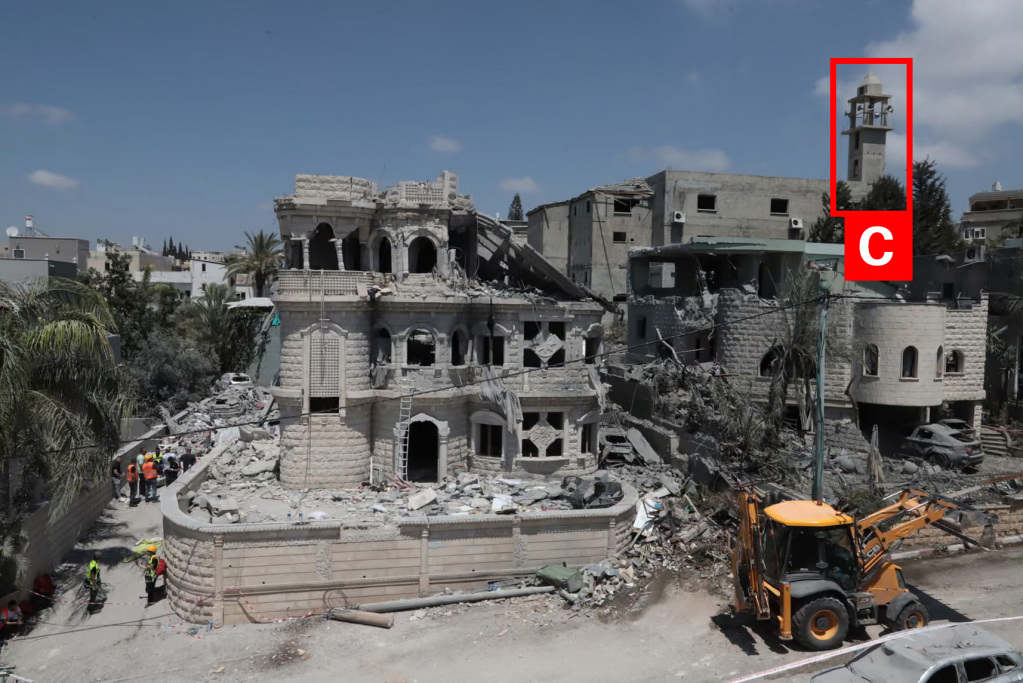
Reports of the incident mention a residential building in Tamra (טַמְרָה, طمرة). Analysing audio-visual material from sources, we have narrowed the location down to the following exact coordinates: 32.857975, 35.188817.
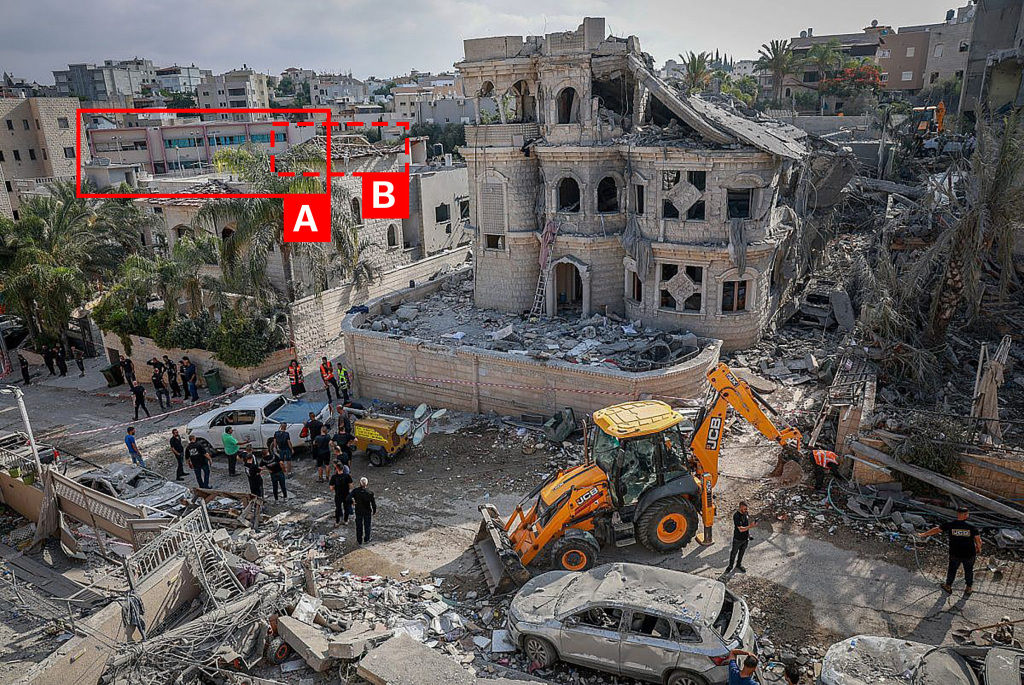
{"type":"FeatureCollection","features":[{"type":"Feature","properties":{"label":"Exact Location","label-type":"black-white"},"geometry":{"coordinates":[35.188817,32.857975],"type":"Point"}},{"type":"Feature","properties":{"label":"A","label-type":"white-red","stroke":"#ff0000","stroke-width":1,"stroke-opacity":1,"fill-opacity":0},"geometry":{"coordinates":[[[35.18868397040751,32.85918357953494],[35.18868397040751,32.8589818265051],[35.18913904833735,32.8589818265051],[35.18913904833735,32.85918357953494],[35.18868397040751,32.85918357953494]]],"type":"Polygon"}},{"type":"Feature","properties":{"label":"C","label-type":"white-red","stroke":"#ff0000","stroke-width":1,"stroke-opacity":1,"fill-opacity":0},"geometry":{"coordinates":[[[35.189244609023746,32.85778281912806],[35.189244609023746,32.857664495989226],[35.189345737452584,32.857664495989226],[35.189345737452584,32.85778281912806],[35.189244609023746,32.85778281912806]]],"type":"Polygon"}},{"type":"Feature","properties":{"label":"B","label-type":"white-red","stroke":"#ff0000","stroke-width":1,"stroke-opacity":1,"fill-opacity":0},"geometry":{"coordinates":[[[35.18865259969212,32.85813901279617],[35.18865259969212,32.85805861408038],[35.188761018464874,32.85805861408038],[35.188761018464874,32.85813901279617],[35.18865259969212,32.85813901279617]]],"type":"Polygon"}}]}

Imagery: @martoiu

Imagery: The Guardian

Military Statements

Iranian Military Assessment
Suspected belligerent
Iranian Military
Iranian Military position on incident
Not yet assessed

Sources (24)

askherb1
14 Jun 2025

English

View

Source ID

200040

Archive URL

Archive

Source URL

View

Date

14 Jun 2025

Source Author

askherb1

Languages

English

Content

At least two people have died in #Israel following #Iran’s retaliatory strikes. A woman in her 60s was found unconscious, and a 45-year-old man was pronounced dead after evacuation. 21 others were injured in the Coastal Plains region per MDA. #SpreadLoveWithEst Tel Aviv #إسرائيل

Media from askherb1 (2)

elikowaz
14 Jun 2025

English

View

Source ID

179394

Archive URL

Archive

Source URL

View

Date

14 Jun 2025

Source Author

elikowaz

Languages

English

Content

Medics are responding to reports of injuries in Tamra.
elikowaz
14 Jun 2025

English

View

Source ID

179391

Archive URL

Archive

Source URL

View

Date

14 Jun 2025

Source Author

elikowaz

Languages

English

Content

One person was killed and there are multiple injuries from the ballistic missile strike in Tamra.
Magen David Adom in Israel (MDA)
14 Jun 2025

English

View

Source ID

179374

Archive URL

Archive

Source URL

View

Date

14 Jun 2025

Source Author

Magen David Adom in Israel (MDA)

Languages

English

Content

Following the recent Red Alert sirens, at this point, in the scene in the Western Galilee where a strike occurred causing damage to homes, MDA teams have pronounced the death of a young woman in her 20s who was pulled from the rubble.

Media from Magen David Adom in Israel (MDA) (2)

ItayBlumental
14 Jun 2025

View

Source ID

176226

Archive URL

Archive

Source URL

View

Date

14 Jun 2025

Source Author

ItayBlumental

Languages

Translated Content

Three Israelis were killed last night by a direct hit from an Iranian missile in Tamra

Content

שלושה ישראלים נרצחו הלילה מפגיעה ישירה של טיל איראני בטמרה

Media from ItayBlumental (1)

Kan 11 News
14 Jun 2025

View

Source ID

208396

Archive URL

Archive

Source URL

View

Date

14 Jun 2025

Source Author

Kan 11 News

Languages

Translated Content

Manar, Hala, Shada, and their relative Manar were killed in a missile strike in the Haifa area Manar, Hala, Shada, and their relative Manar were killed in a barrage from Iran The missile, which hit a 3-story house, caused the deaths of four women - two in their forties, and two girls. 13 injured people arrived at Rambam Hospital Author Orly Alkalai Orly Alkalai | Updated on 15.6.25 The deaths in the missile strike Photo: Social networks Manar al-Qassem Abu al-Hija Khatib and her two daughters Hala and Shada, as well as their relative Manar Diab Khatib, were killed by a missile launched from Iran as part of the barrage launched from Iran to northern Israel this evening (Saturday). According to reports, the missile, which hit a three-story house in a village in the Haifa area, injured about 13 people. Northern District Commander, Sergeant Yair Alkayim, said that there was extensive destruction at the scene, which is making rescue work difficult. Rambam Hospital announced that 13 injured people arrived at their hospital, one of whom is in serious condition, and the rest in light to moderate condition. Seven people have been killed so far in the Iranian missile barrages towards Israel. Yesterday, Israel Aloni and Yevgenia Blinder were killed by a missile strike in a residential neighborhood in the center. On Friday, Eti Cohen Angel was killed after being critically injured by a missile strike in a residential neighborhood. More on the topic Editor's Choice The final episode is here: "Hooligans", let's get messy! Chad's murderous hippos and the cat-eating Swiss sing '70s: Mashina's new cover album | Listen to How Long We've Been Waiting: First Look at the Final Season of "Strange Things" Friday vows, Shabbat keeps: How does a great righteous man become evil?

Content

מנאר, חלא, שדא, וקרובת משפחתן מנאר נהרגו מפגיעת הטיל באזור חיפה מנאר, חלא, שדא, וקרובת משפחתן מנאר נהרגו במטח מאיראן הטיל, שפגע בבית בן 3 קומות, גרם למותן של ארבע נשים - שתיים בשנות הארבעים לחייהן, ושתי נערות. 13 פצועים הגיעו לבית החולים רמב"ם מחבר אורלי אלקלעי אורלי אלקלעי |עודכן ב-15.6.25 ההרוגות בפגיעת הטיל צילום: רשתות חברתיות מנאר אל-קאסם אבו אל-היג'א חטיב ושתי בנותיה חלא ושדא, כמו גם קרובת משפחתן מנאר דיאב חטיב, נהרגו מפגיעת טיל ששוגר מאיראן במסגרת המטח ששוגר הערב (שבת) מאיראן לצפון הארץ. על פי הדיווחים, הטיל, שפגע בבית בן שלוש קומות בכפר באזור חיפה, גרם לפציעתם של כ-13 בני אדם.  מפקד מחוז צפון, טפסר יאיר אלקיים, מסר כי במקום הרס רב אשר מקשה על עבודת החילוץ. מבית החולים רמב"ם הודיעו כי הגיעו אליהם 13 פצועים, מתוכם אחת במצב קשה, והשאר במצב קל וקל-בינוני. במטחי הטילים האיראניים אל עבר ישראל נהרגו עד כה שבעה בני אדם. אתמול נהרגו ישראל אלוני ויבגניה בלינדר מפגיעת טיל בשכונת מגורים במרכז. ביום שישי נהרגה אתי כהן אנג'ל לאחר שנפצעה באורח אנוש מפגיעת טיל בשכונת מגורים.    עוד בנושא בחירת העורכת פרק הסיום כבר כאן: "חוליגנים", יאללה בלאגן! ההיפופוטמים הרוצחים של צ'אד ומאכילת החתולים משוויץ שרים 70': אלבום הקאברים החדש של משינה | האזינו כמה חיכינו: הצצה ראשונה לעונה האחרונה של "דברים מוזרים" שישי נודר, שבת שומר: איך צדיק גדול הופך לרשע?
Kan 11 News
14 Jun 2025

View

Source ID

208396

Archive URL

Archive

Source URL

View

Date

14 Jun 2025

Source Author

Kan 11 News

Languages

Translated Content

Manar, Hala, Shada, and their relative Manar were killed in a missile strike in the Haifa area Manar, Hala, Shada, and their relative Manar were killed in a barrage from Iran The missile, which hit a 3-story house, caused the deaths of four women - two in their forties, and two girls. 13 injured people arrived at Rambam Hospital Author Orly Alkalai Orly Alkalai | Updated on 15.6.25 The deaths in the missile strike Photo: Social networks Manar al-Qassem Abu al-Hija Khatib and her two daughters Hala and Shada, as well as their relative Manar Diab Khatib, were killed by a missile launched from Iran as part of the barrage launched from Iran to northern Israel this evening (Saturday). According to reports, the missile, which hit a three-story house in a village in the Haifa area, injured about 13 people. Northern District Commander, Sergeant Yair Alkayim, said that there was extensive destruction at the scene, which is making rescue work difficult. Rambam Hospital announced that 13 injured people arrived at their hospital, one of whom is in serious condition, and the rest in light to moderate condition. Seven people have been killed so far in the Iranian missile barrages towards Israel. Yesterday, Israel Aloni and Yevgenia Blinder were killed by a missile strike in a residential neighborhood in the center. On Friday, Eti Cohen Angel was killed after being critically injured by a missile strike in a residential neighborhood. More on the topic Editor's Choice The final episode is here: "Hooligans", let's get messy! Chad's murderous hippos and the cat-eating Swiss sing '70s: Mashina's new cover album | Listen to How Long We've Been Waiting: First Look at the Final Season of "Strange Things" Friday vows, Shabbat keeps: How does a great righteous man become evil?

Content

מנאר, חלא, שדא, וקרובת משפחתן מנאר נהרגו מפגיעת הטיל באזור חיפה מנאר, חלא, שדא, וקרובת משפחתן מנאר נהרגו במטח מאיראן הטיל, שפגע בבית בן 3 קומות, גרם למותן של ארבע נשים - שתיים בשנות הארבעים לחייהן, ושתי נערות. 13 פצועים הגיעו לבית החולים רמב"ם מחבר אורלי אלקלעי אורלי אלקלעי |עודכן ב-15.6.25 ההרוגות בפגיעת הטיל צילום: רשתות חברתיות מנאר אל-קאסם אבו אל-היג'א חטיב ושתי בנותיה חלא ושדא, כמו גם קרובת משפחתן מנאר דיאב חטיב, נהרגו מפגיעת טיל ששוגר מאיראן במסגרת המטח ששוגר הערב (שבת) מאיראן לצפון הארץ. על פי הדיווחים, הטיל, שפגע בבית בן שלוש קומות בכפר באזור חיפה, גרם לפציעתם של כ-13 בני אדם.  מפקד מחוז צפון, טפסר יאיר אלקיים, מסר כי במקום הרס רב אשר מקשה על עבודת החילוץ. מבית החולים רמב"ם הודיעו כי הגיעו אליהם 13 פצועים, מתוכם אחת במצב קשה, והשאר במצב קל וקל-בינוני. במטחי הטילים האיראניים אל עבר ישראל נהרגו עד כה שבעה בני אדם. אתמול נהרגו ישראל אלוני ויבגניה בלינדר מפגיעת טיל בשכונת מגורים במרכז. ביום שישי נהרגה אתי כהן אנג'ל לאחר שנפצעה באורח אנוש מפגיעת טיל בשכונת מגורים.    עוד בנושא בחירת העורכת פרק הסיום כבר כאן: "חוליגנים", יאללה בלאגן! ההיפופוטמים הרוצחים של צ'אד ומאכילת החתולים משוויץ שרים 70': אלבום הקאברים החדש של משינה | האזינו כמה חיכינו: הצצה ראשונה לעונה האחרונה של "דברים מוזרים" שישי נודר, שבת שומר: איך צדיק גדול הופך לרשע?
BBC
18 Jun 2025

English

View

Source ID

179838

Archive URL

Archive

Source URL

View

Date

18 Jun 2025

Source Author

BBC

Languages

English

Content

'They sang about my family's death': Father's anger exposes divide in Israeli societyTom BennettBBC NewsReporting fromTamra, northern IsraelBBCKasem Abu al-Hija lost his daughter, two granddaughters and their aunt, in Saturday's missile strike"I am so angry," says Kasem Abu al-Hija, 67.On Saturday, four of his family members were killed when an Iranian missile struck their home in northern Israel, collapsing the concrete building on top of them.Books, clothes, children's toys and body parts were blown into the road, witnesses say.The whole street was plunged into darkness when the missile hit. Rescuers managed to locate their bodies by following trails of blood.The four victims were named as Kasem's daughter Manar Khatib, 45, his two granddaughters, Shada, 20 and Hala, 13, and their aunt, Manal Khatib, 41.They had managed to make it to the two reinforced safe rooms in the house that they shared - but the ballistic missile hit it directly.They lived in Tamra, an Arab-majority town in northern Israel. Minutes after their deaths, a video emerged online. It showed the Iranian missiles streaking through the sky overhead. As they descend on Tamra, a voice can be heard shouting, in Hebrew: "On the village, on the village.""May your village burn," a group of others then begin to sing, whooping and clapping.Four were killed when the missile hit this home in Tamra"They sang about what happened to my family," says Kasem, softly, surrounded by relatives at a vigil.The video - which shows Israelis singing a common anti-Arab chant often sung by ultranationalist Jews - has been widely condemned in Israel, with President Isaac Herzog calling it "appalling and disgraceful".But there are more reasons that Kasem and the wider community in Tamra are angry about what happened.Here - as is the case with many Arab-majority communities in Israel - there are no public bomb shelters for its 38,000 residents.For comparison, the nearby Jewish-majority town Karmiel, population 55,000, has 126 public shelters.Residents of Tamra have long raised the alarm over the disparity. Situated in Israel's north, about 10km (6 miles) east of the city of Haifa and 25km (16 miles) south of the border with Lebanon, the town has been vulnerable to rockets fired by the Iran-backed Lebanese group Hezbollah. In October 2024, a rocket fired by the group seriously injured one woman. Across Israel, about a quarter of the population have no access to a proper shelter. But in non-Jewish local authorities the figure is almost half, according to a 2018 report by Israel's State Comptroller, the most recent data available. "For many decades, Arab local authorities have received lower state funding across various areas, including emergency preparedness," says Lital Piller of the Israel Democracy Institute, a think tank.Where shelters do exist, she says, "they are few, poorly maintained, and often not suited for prolonged stays".The BBC has approached Israel's Ministry of Defense for comment. Israeli Arabs - many of whom prefer to be called Palestinian citizens of Israel - make up a fifth of the country's population. By law, they have equal rights with Jewish citizens, but they routinely complain of state discrimination and being treated as second-class citizens. Following the Gulf War of 1990-91, when Iraqi missiles hit Tel Aviv and Haifa, the Israeli government mandated that all new residential buildings must contain a reinforced safe room, or Mamad, as they are known. Most residents of Tamra do not have a safe room and must share with their neighboursBut Arab communities often face tough planning restrictions, which leads to unregulated construction and homes being built without them, activists say.About 40% of Tamra's homes have their own safe room, local authorities say, leaving the majority of residents having to run to neighbours' homes to share. In many cases, due to the short warning period, this is not possible."The gaps are enormous," says Ilan Amit, of the Arab-Jewish Center for Empowerment, Equality, and Cooperation (Ajeec), which works to build shelters in Arab communities. "I live in Jerusalem. Every building has a bomb shelter. Every neighbourhood has a public bomb shelter."As dark falls in Tamra, residents' phones light up simultaneously with a screeching alert: "You must stay near a protected area."Sirens soon follow, and residents - fresh from the trauma of Saturday's strike - panic. Mothers gather their children and people run up the street shouting. Several families cram into the safe room of one house. Some cry, some smile, others twitch nervously. One man closes his eyes and prays. Boom after boom is heard overhead.The shelter issue is even more pronounced in Israel's Arab bedouin communities - many of which live in villages in the Negev Desert that are not recognised by the Israeli government, so do not have shelters built for them. The only victim of the April 2024 escalation in hostilities between Israel and Iran was a young girl from one such community who was seriously injured and spent a year in hospital after fragments from an Iranian missile struck her head.Lack of shelters is also a prevalent issue in some of Israel's poorer Jewish communities in areas like the south of Tel Aviv. Adel Khatib says Tamra does not receive as much funding as Jewish communitiesA new survey conducted by Hebrew University found that 82.7% of Jewish Israelis support the attack on Iran - but 67.9% of Arab Israelis oppose it. Further to that, 69.2% of Arab Israelis reported feelings of fear over the strikes - with 25.1% expressing despair."Arab society feels neglected and left behind," says Amit. "There are huge gaps in education and employment. There are huge gaps in shelters, in the existence of shelters."Adel Khatib, a municipal official from Tamra, says: "In the days since this happened, you can feel the anger.""We don't get the basic needs," says Khatib. "Most of the Arab communities, they don't have community centres or buildings for culture, activities."According to official Israeli statistics, in 2023, 42.4% of the Arab population lived below the poverty line - more than double the proportion in Israel's general population.There have been attempts in recent years to close these gaps. In 2021, Israel's previous government brought in a five-year development plan for Arab society. "We were in the middle of a huge leap in social economic development, narrowing gaps in education, higher education, and employment," says Amit.But Israel's current right-wing governing coalition, the most hardline in its history, has slowly reduced funding for that plan - redirecting the money elsewhere.Some of these cuts came as the government adjusted budgets to fight the ongoing war in Gaza, which began in response to the Hamas-led cross-border attack on Israel on 7 October 2023, in which about 1,200 people were killed and 251 others were taken hostage."This government has been simply putting, you know, sticks in the wheels of this five-year plan, not making it possible to implement broad parts of it," Amit adds."For the past year and a half, Arab society found itself between a rock and a hard place in the sense that on one hand, they're suffering from the policies of the current government, and on the other hand, they're seeing their brothers and sisters in Gaza and in the West Bank suffering because of the war," he says. Outside the ruins of the family home, Mohamed Osman, 16, a neighbour, says: "Everyone is angry and sad."Speaking of Shada, 20, he says: "She studied her entire life. She wanted to be the best. Her father is a lawyer, and she wanted to be like him.
All of those dreams, just disappeared."They were the best picture of a happy family…When I imagine them, I imagine the pieces of them that I saw."At a vigil ahead of the funeral, dozens of community members gather, greeting one another with handshakes, sharing coffee and tea, and mourning quietly."The bombs do not choose between Arabs or Jews," says Kasem. "We must end this war. We must end it now."Photographs by Tom Bennett
Al Jazeera
18 Jun 2025

English

View

Source ID

179840

Archive URL

Archive

Source URL

View

Date

18 Jun 2025

Source Author

Al Jazeera

Languages

English

Content

EXPLAINERUsing open-source intelligence and visual evidence, Al Jazeera’s Sanad unit has mapped key Iranian strikes on Israel from Saturday to Monday.Sirens have continued to sound in cities across Israel as Iranian missiles strike for a sixth consecutive day in response to Israeli attacks on Iran’s nuclear, military and other sites since Friday. On Wednesday morning, an Iranian missile sparked a fire in central Israel that appeared to have engulfed several cars. Iran’s Fars News Agency says one of the targets was the Meron airbase, which is in northern Israel. Israeli attacks across Iran have killed at least 240 people since Friday while Iranian attacks have killed at least 24 people in Israel. Military censorship during war Israeli media have reported on some strikes across the country that have resulted in varying levels of damage and casualties. However, due to military censorship enforced during wartime, reports on attacks involving sensitive or strategic targets are often restricted or withheld from the public. Using open source intelligence, including publicly circulated images and videos on social media, Israeli media platforms as well as visual identification of destroyed locations in Israeli cities, Al Jazeera’s fact-checking unit, Sanad, has mapped some of the most significant Iranian attacks on Israel from Saturday to Monday. These sites are shown on the map below: (Al Jazeera) Sensitive locations targeted On Saturday, missiles landed just 300 metres (984ft) from the Israeli Ministry of Defence headquarters (the Kirya) in Tel Aviv.Sign up for Al JazeeraBreaking News AlertGet real-time breaking news alerts and stay up-to-date with the most important headlines from around the globe. This location, often called “Israel’s Pentagon”, is one of the most sensitive and heavily fortified government complexes in Israel, housing key military and intelligence offices. Another strike hit the Weizmann Institute of Science, one of Israel’s leading research centres, located in Rehovot, south of Tel Aviv. The institute is reported to have collaborated with the Israeli military, making it a significant target. Tel Aviv metropolitan area Several areas across the Tel Aviv metropolitan area have also come under fire. In Ramat Gan, a city adjacent to Tel Aviv, missiles struck several towers and residential complexes, causing significant damage and forcing evacuations. Local authorities reported that nine buildings were destroyed. Residences were damaged in a missile attack from Iran in Ramat Gan on June 14, 2025 [Yair Palti/Reuters] The nearby city of Petah Tikva, to the east, was also hit by missile strikes that damaged both residential and commercial areas while in Bnei Brak, a religious school was destroyed. Ultra-Orthodox Jewish men inspect the damage at the site of an Iranian missile strike in Bnei Brak, east of Tel Aviv, on June 16, 2025 [John Wessels/AFP] South of Tel Aviv, Bat Yam experienced the highest levels of destruction and casualties in Israel with nine confirmed deaths and about 200 people injured, according to emergency services. In Rishon LeZion, multiple homes were destroyed, adding to the widespread damage across the region. Israeli first responders work in a residential area hit by a missile fired from Iran in Bat Yam on June 15, 2025 [Ariel Schalit/AP Photo] Haifa refinery In northern Israel, Iranian missiles struck Haifa’s Bazan petrochemical complex, the country’s largest oil refinery, forcing a shutdown of operations. Haifa suffered a second missile strike, which hit several residential buildings in the Neve Sha’anan neighbourhood. Smoke billows up from an Iranian missile attack on an oil refinery in Haifa on June 16, 2025 [Ariel Schalit/AP Photo] Tamra In Tamra, a predominantly Palestinian town of 35,000 people in northern Israel, an Iranian missile killed four women from the same family. Like many Palestinian towns in Israel, Tamra lacks adequate bomb shelters. Damaged cars lie amid the rubble of a damaged building in Tamra after an overnight missile attack from Iran on June 15, 2025 [Ahmad Gharabli/AFP]
+972 Magazine
17 Jun 2025

English

View

Source ID

208366

Archive URL

Archive

Source URL

View

Date

17 Jun 2025

Source Author

+972 Magazine

Languages

English

Content

In partnership with Late Saturday night, an Iranian missile loaded with explosives struck a large house in Tamra, a Palestinian city in northern Israel. Within seconds, the explosion reduced the modern home to a pile of rubble, killing four members of the Khatib family and wounding dozens of their neighbors.  Raja Khatib, an attorney who lost his wife, Manar; daughters Shada, a 20-year-old university student, and Hala, aged 13; and sister-in-law, also Manar, in the blast, told +972 that he was not at home when the missile hit and rushed back as soon as the sirens stopped.  “When I arrived, my youngest daughter, Razan, said that her mother and sisters were on the upper floor and hadn’t been able to reach her in the safe room [reinforced to serve as an at-home bomb shelter] in time, because the missile fell so quickly,” he recounted. “I tried to reach them, but I couldn’t: the house was destroyed, and I realized they couldn’t be saved. “Just three days ago we came back from a vacation in Italy,” Khatib continued. “How I wish the flight had been delayed by a day and canceled. My wife was my whole world. She was a successful teacher, loved by her students. My brother’s wife was the same. Shada was an outstanding law student; she dreamed of becoming a lawyer like me and my brother, maybe even a judge. Hala didn’t even have time to dream — she was only 13. I wouldn’t wish this even on my worst enemy.” The tragedy suffered by the Khatib family, who join some 20 other casualties of Iranian missiles in Israel since the Israeli army launched its attack on Iran last Friday morning, exposed once again the systemic inequality inherent in Israel’s civil defense infrastructure. According to a 2018 State Comptroller’s report, 60 out of 71 Arab municipalities in Israel have no public shelters. Tamra, a city of 37,000 residents, is one of them. For comparison, Safed, a Jewish city of similar size (about 42,000 residents), has 138 public shelters. Even Mitzpe Aviv, a nearby Jewish community with only 1,100 residents, has 13 public shelters.  Palestinians, including Raja Khatib (left), mourn the deaths of four members of the Khatib family killed in an Iranian missile attack in the Arab city of Tamra, northern Israel, June 17, 2025. (Oren Ziv) At-home safe rooms (which are known in Hebrew as a “Mamad”, and considered less effective at withstanding blasts than larger public shelters) are few and far between in Arab towns and cities. Under Israeli law, safe rooms cannot be built in houses that were constructed without the necessary permit. Yet many Palestinian families in Israel are forced to build without permits due to discriminatory housing policies that make it almost impossible to build legally in Arab municipalities. The result, according to the State Comptroller’s report, is that 46 percent of Palestinian citizens of Israel have no access to adequate protection from aerial attacks, compared to 26 percent of the general population.  Urban renewal projects, which require the building of safe rooms in new homes, could offer a partial solution — but according to the NGO Sikkuy-Aufoq, not a single urban renewal project was approved in an Arab town between 2010 and 2023, compared to more than 5,600 projects in Jewish communities. Thus, years of planning discrimination have turned into a direct threat to Palestinian lives in Israel. To make matters worse, the government decided around a year ago to shut down an initiative established after October 7 to provide life-saving information and services to the Arab public in Israel during wartime. A collaboration between the Social Equality Ministry’s Authority for the Socioeconomic Development of Arab Society, the National Committee of Arab Mayors, and the Kafr Qassem Municipality, the initiative had received praise from the Home Front Command and was shown to be effective in research by civil society organizations, yet the government argued that there was no need to maintain a dedicated service for Palestinian citizens. A young man from Tamra, who preferred not to be named, emphasized to +972 that Saturday’s tragedy was not the first and nor will it be the last. “A year ago, a woman was killed in nearby Shefa-‘Amr [when a rocket from Lebanon hit her home]. There are no public shelters like those in Jewish communities, and most houses are old without protected rooms. In Tamra, and in most Arab towns, the state delays the expansion of our communities, so there are fewer new neighborhoods and homes compared to Jewish towns, which are expanding almost daily. A man at the scene of an Iranian ballistic missile strike in Tamra, northern Israel, June 15, 2025. (David Cohen/Flash90) “Beyond that, you don’t have to be a military expert to understand that the air defense systems are designed to protect the Jewish municipalities,” he went on. “Sometimes an Arab town gets lucky if it falls under the defense coverage of a nearby Jewish city, but that’s generally not the case. From Shefa-‘Amr last year, to Tamra, Majd Al-Krum, Tarshiha, and other incidents, it’s clear: the state that ignores our deaths from organized crime also ignores our deaths from other causes.” Mazzen Ghanaim, head of the National Committee of Arab Mayors, placed blame directly on the shoulders of Prime Minister Benjamin Netanyahu: “If this is the ‘New Middle East’ — we don’t want it.” ‘We will not be silent’ In the aftermath of the Khatib deaths, one mainstream Israeli TV channel resorted to victim-blaming — emphasizing that those killed were not inside a safe room (in response, Tamra’s mayor, Musa Abu Rumi, hit back: “The house was new and fortified, but it couldn’t withstand a missile carrying nearly 400kg of explosives, according to what the Home Front Command told us. The entire neighborhood was damaged.”). Soon after, a video went viral showing young Israeli Jews cheering at the sight of missiles falling in Tamra, singing the common far-right refrain: “May your village burn.” While Netanyahu condemned the video, his media ally Yinon Magal seemed to justify it when he stated: “Not everyone in Tamra loves Israel.”  Most read on +972 In response to complaints of racist incitement, including from Palestinian MK Ahmad Tibi, police announced that “the matter is under investigation,” but no arrests have been reported. In contrast, the previous day police arrested 17 youths from Umm Al-Fahem who had celebrated the first wave of Iranian missile attacks. For the young man from Tamra, the double-standard is clear. “The story [of Jewish incitement against Palestinians] apparently isn’t even worth the police’s attention. And why would it be, when one of Israel’s senior journalists justifies the death of our daughters live on air? If the roles had been reversed, there’s no need to explain what would have happened.” At the University of Haifa’s College of Law, students and faculty alike mourned the death of 20-year-old Shada Khatib. Attorney Abeer Baker, who was her teacher at the college, described Khatib as “a beloved, radiant, and promising student. One missile destroyed Shada’s dream and cut a thread from all of our souls. We will not be silent, and we will not stop fighting to bring to justice every filthy fascist who rejoiced over your death, over your family’s grief, and over our pain.”  Shada Khatib, right, with Abeer Baker, left. (Courtesy of Abeer Baker) This effort to prosecute them, Baker emphasized, would be “part of Shada’s path, of the project she didn’t get to complete.” Indeed, she added, “Shada’s last wish was to volunteer with the Adalah Legal Center, and her last message to me was that she had sent her resume and hoped to become part of their team. “Your name and voice will remain in my memory — and the memory of all of us — as a radiant symbol, a torch of wisdom that dreamed of becoming a voice against injustice, despite all the hardships.” A version of this article was first published in Hebrew on Local Call. Read it here.
Sky News
16 Jun 2025

English

View

Source ID

208398

Archive URL

Archive

Source URL

View

Date

16 Jun 2025

Source Author

Sky News

Languages

English

Content

Cups of coffee are being carefully poured into small paper cups, each one served with a comforting embrace.Close by, huddled under an arched courtyard, women of all ages are sitting, grieving in their own way. Some are sobbing, others look dazed, others desperate.Their intermittent wails of grief puncture the silence. Yet there's a beautiful stillness about it all. Image: The Khatib family home was destroyed in Tamra, Israel Israel-Iran latest updates We've arrived just at the moment Tamra, Israel, has come to a standstill.Everyone here is waiting for the bodies of four members of the Khatib family to return, killed when a ballistic missile from Iran hit their home on Saturday night. More on Iran 'Physical threat' from Iran on people living in UK has 'increased significantly', watchdog says Iran's crackdown on so-called Afghan spies 'We'll never yield': Millions of Iranians unite in mourning Manar Khatib was killed alongside two of her daughters - 20-year-old Shada, and 13-year-old Hala - and her sister-in-law, also called Manar. Image: Layan Diab, the 23-year-old cousin of the girls Layan Diab, 23, is a cousin of the girls. She's in disbelief. "It's a deep loss. It hurts my soul. We lost our entire family. Four people here. I can't fathom it. I don't understand. It's unbelievable," she says. And she's fearful of the coming days."Every time we hear the sirens, people start to scream and remember," she says.Tamra is a tight-knit town. Most living here are Palestinian citizens of Israel.Videos circulating online showed Jewish Israelis celebrating as the missiles fell, singing: "May your village burn."Prime Minister Benjamin Netanyahu was quick to criticise the video:"Four of our citizens were killed in Tamra. I've heard cheers of rejoicing and I reject that vehemently. The missile makes no distinction. It harms Jews as well as Arabs. They're coming to destroy all of us, and we stand in this battle together."It is a reminder of the bitter divides in this society, at war on multiple fronts."No-one is protected. Not Arabs, not Israelis, not Jews, not Palestinians, not Israelis," Layan says with a desperate frustration in her voice.Just down the street is the girls' grieving father, Raja Khatib. Image: Raja Khatib lost four family members, including his wife and two of his daughters, in the Iranian attack A lawyer with a charming warmth, he starts to speak Italian, assuming we may be from Italy.He'd just returned from a holiday there with his wife and children in Ferrara.His eyes fill with tears as he says that if only he'd stayed a day longer, they would all be alive today.'I feel terrible. I feel fire in my body… I hope that I will survive this moment. I've lost my family, but for what? A missile from Iran?" Image: Debris, including shoes, was thrown across the street by the impact of the missile I ask if he sees an end to this conflict between Iran and Israel. He seems despairing."Conflict with Iran, Lebanon, Gaza. We have a government who want[s] war. We want peace. We want to live."Read more from Sky News:Israel had 'no choice' but to attack Iran, president claimsHow conflict between Israel and Iran unfoldedUK advises against all travel to Israel Please use Chrome browser for a more accessible video player Analysis: Iran and Israel strike targets Listening in supportively from the side is his middle daughter, 17-year-old Razan, who miraculously survived the blast.That evening, she'd been out to buy cookies with her sisters.When they returned, Razan and her older sister Shada played music and watched videos on their phones. Image: The Khatib family home was wrecked in the attack When the alarms started to sound, they dismissed them at first.But after a loud boom, Razan was unsettled and started to make her way to one of the safe rooms, imploring Shada to do the same.But only Razan went. Please use Chrome browser for a more accessible video player 'Iran is not winning this war' "In one moment, everything went dark. I couldn't see anything. I asked Allah, please don't take my life," she describes with searing clarity.She could hear her father calling out for them all. But his cries were met with silence.Razan's family home is now a mound of rubble.When we arrive there, we find neighbours and friends clearing the rubble. Many are deeply traumatised.Hamad, who's sweeping debris outside the house opposite, tells me he saw body parts flung across the road and into a nearby garden, and there's blood on the walls. Follow the WorldListen to The World with Richard Engel and Yalda Hakim every Wednesday Tap to follow It is a deeply visceral and harrowing account of an attack that took everyone by surprise.This is a residential neighbourhood. It's thought the missile was likely bound for Haifa, about half an hour away and home to oil refineries. But this time, with this missile, it fell on civilians. And took with it, futures.
Ynet
15 Jun 2025

English

View

Source ID

208400

Archive URL

Archive

Source URL

View

Date

15 Jun 2025

Source Author

Ynet

Languages

English

Content

Grieving father Raja Khatib lost his wife, two daughters and a relative when an Iranian missile struck the town of Tamra early Sunday; as search teams continue looking for the missing, he pleads for the war to end, saying, 'we civilians are paying the price'His wife, Manar Al-Qasem Abu Al-Heija Khatib, 45, and his two daughters, Hala, 13, and Shada, 20, as well as their relative, Manar Diab Khatib, 41, the wife of Raja's brother, Ihab, were pulled from the rubble lifless by rescuers.2 View gallery The victims of the missile strike on Tamra"I lost an amazing wife who was everything to me," Raja said. "Everything was destroyed in seconds."Raja, an attorney by trade, described Manar as "a teacher, successful and a wonderful woman who raised the children in the best way possible. Just a week ago, we were on a trip abroad, enjoying ourselves, and yesterday, unfortunately, that happiness turned into tragedy and pain." He recounted: "I entered the house and went up to the second floor, and then the missile struck. I managed to save my daughter Razan and tried to save Manar, Hala and Shada, but I couldn't."With pain emanating from his voice, Raja added, "I never imagined I would be left with just one child. It won’t be easy to recover. My daughter and I need treatment before we can even begin to process this horrifying loss. What is needed now is to stop the war everywhere, because we civilians are paying the price."Ihab, Raja’s brother, said that his wife was also a teacher: "She was a professional and honest educator, and everyone loved her. I always heard positive and joyful comments about her, and sadly, everything was destroyed in seconds. I lost an amazing wife who was everything to me."2 View gallery Raja, the grieving father, and Ihab KhatibHe described how, "15 minutes before the sirens, Manar called me and told me something was about to happen. A few minutes later, a missile hit, and my family informed me that my wife had been killed. It’s hard to put into words the love I had for my dear wife. She will always remain in my heart. I demand that the war stop so we can continue living in peace without risking our lives. We don't want to lose more people."Hours after the deadly missile explosion in Tamra, six people were killed in a direct hit on a residential high-rise in Bat Yam in central Israel. The Bat Yam strike claimed the lives of a 10-year-old boy, an 8-year-old girl, three women in their 50s, 60s and 80s and a young man around 18. More than 100 others were wounded. Numerous neighboring buildings also sustained damage. Home Front Command teams are still searching the area for several people reported missing.
Ynet
15 Jun 2025

English

View

Source ID

208402

Archive URL

Archive

Source URL

View

Date

15 Jun 2025

Source Author

Ynet

Languages

English

Content

A mother and her two daughters and another relative were killed late on Saturday when an Iranian missile made a direct hit on a building in the town of Tamra near Haifa as Iran launched dozens of ballistic missiles at Israel's north. Three were pulled out of the rubble and a fourth was pronounced dead at the hospital. Adnan, a paramedic, was among the first to arrive at the scene. "We heard a loud explosion and I rushed to the scene," he said. "I saw the destruction of a three-story building and damage to nearby homes."3 View gallery Mother, daughters and a relative, all killed in Tamra in an Iranian missile strikeliveA home in Tamra sustained a direct hit from an Iranian ballistic missile on Saturday, killing at least four (MDA)He said people gathered outside. "I first pulled out a woman in her 20s who was unconscious, and we had to soon declare her dead. Meanwhile, others emerged from the neighboring buildings, some suffering injuries. We treated them and transported them to the hospital in Haifa."3 View gallery A home in Tamra sustained a direct hit from an Iranian ballistic missile on Saturday, killing at least four (Photo: Fire and Rescue Services)"We were in the living room watching television when the missile hit. Everything fell, furniture, the entire house. We were saved by some miracle," Hamoudi, a resident of the Arab town told Ynet from his hospital bed.3 View gallery A home in Tamra sustained a direct hit from an Iranian ballistic missile on Saturday, killing at least four (Photo: MDA)Mahmoud, whose son was among those injured in the missile strike, said it felt like the missile hit inside their home. The boy was over at a friend's house. "We started looking for him and were told he was taken to the hospital in Haifa," he said. "He's fine. He was hurt in his back and leg. This is a serious situation."The Magen David Adom (MDA) emergency service said that in total, 20 additional people were treated. 10 suffered physical injuries and 10 were in a state of anxiety and all were transported to Haifa city and the Nahariya hospitals, but even hours after the attack, searches continue for survivors or victims. Others were evacuated from two other impact sites in the Galilee and taken for treatment to area hospitals, MDA said.
The Guardian
15 Jun 2025

English

View

Source ID

208404

Archive URL

Archive

Source URL

View

Date

15 Jun 2025

Source Author

The Guardian

Languages

English

Content

When an Iranian missile bound for the industrial port of Haifa dropped out of the sky on the town of Tamra on Saturday night, it fell on Israel’s most vulnerable, and in one devastating flash, lit up the country’s deepest divide.The missile demolished a three-storey stone house and killed four members of the same family: Manar Khatib, and her two daughters – Shada, a university student, and Hala, a 13-year-old schoolgirl – as well as Manar’s sister-in-law, Manal.It was a solid house built in an old Arab style and it had two “safe rooms’”, one on each floor. When they heard the air raid sirens Manar and her daughters ran to the one on the second floor as they had practised, but the reinforced concrete did not protect them. They were blown apart and the floor under them fell on the safe room directly below, crushing Manal.The blast blew the core out of the building, and sent the neighbours flying. About 40 people were injured, though none of the wounds were life-threatening.“The explosion was so loud I can still hear it,” said Azmeh Kiwan, a 50-year-old homeowner who lived directly opposite.When he opened his eyes, the whole district was in total darkness. It was only when the town’s rescue workers came with their bright lights that the neighbours could see the road was full of rubble, and it was only when the sun rose that they saw body parts scattered on their terraces and roofs.The rubble of the Khatib family home in Tamra. Photograph: Quique Kierszenbaum/The GuardianKheir Abu-Elhija, a local first responder, who was one of the first on the scene, said he had worked 20 years as a nurse and never seen anything like it.“The second floor safe room came right down on the first floor safe room and crushed everything,” he said. “The only way we could find Manal’s remains was by a trail of blood,” he said.The war between Israel and Iran involves powerful modern weapons that can turn a human body into vapour and scraps in an instant. Israel also has modern air defences which have managed thus far to intercept most of the incoming Iranian missiles. And for three-quarters of the country there are underground bunkers, a virtual guarantee of survival.But the Khatib family did not have a bunker. They were Palestinian citizens of Israel, like the rest of the 37,000 population of this old hillside town in the Lower Galilee. And in common with most Palestinian-majority towns, Tamra does not have a single underground shelter. Like much else in Israel, there is nothing equal about the way death comes from the sky.“The Israeli government, since the creation of the state, didn’t invest in one public shelter for the Arab part of society,” Tamra’s mayor, Mussa Abu Rumi, said. The reinforced “safe rooms” in new-build houses are an inferior alternative, as the fate of the Khatibs showed, and Abu Rumi said only 40% of Tamra residents even have those.“I would like to think that the government, since missiles have become part of warfare, will start a multi-dimensional programme to invest in the Arab community, and building shelters would be part of that,” the mayor said.Asked if he thought the current hard-right coalition would pursue such a programme, he shook his head and admitted there was “no hope”.A rescue worker in the rubble of the Khatib home. Photograph: Quique Kierszenbaum/The GuardianWhile missile strike sites in Tel Aviv, Rishon ReZion and Bat Yam have been flooded with rescue workers, home front troops, police and volunteers, most of the clear-up in Tamra was done by neighbours and a handful of municipal workers.Taking a water break on a shaded terrace, Azmeh Kiwan and his elder brother Bassam, who live directly across from the Khatib house, made clear in an interview they identified themselves as Israeli Arabs. Tamra is an ancient Arab village, they pointed out.“I am from here. I belong to this place and I will die here,” Azmeh said. The brothers also declared themselves fully behind the war against Iran, a country they described as a wellhead of terrorism.It was only afterwards, when the tape recorder was off, that another neighbour came forward to vent his anger, which he claimed was shared by all of Tamra, at a video that had circulated since last night.It was filmed from a nearby Jewish town, and showed missiles and Israeli interceptors streaking across the black sky, but when a missile falls short and slams into Tamra, you can hear people around the camera rejoicing.“To the village! To the village!” one man cries, and then several women’s voices join in, someone starts clapping and together they sing a verse that has become a Jewish extremist anthem. It consists of one line: “May your village burn” sung over and over again.“Please write about this,” the neighbour said. “If I say anything I will have 20 police cars at my house.”Rubble outside the Khatib home. Photograph: Quique Kierszenbaum/The GuardianAbu Rumi said he knows where the video was made, and has informed the Israeli government and the police, but has little expectation of anyone being brought to justice.“We are trying to engage with Israeli society all the time,” the mayor said. “What we find is hatred, and people who don’t see you as a legitimate human being in this place.”He said the centre in Israeli politics had collapsed, and with it the few protections Palestinian citizens of Israel could count on.“The political power that the settler parties have in government is creating this division,” he said. “They just see you as an Arab no matter where you are from.”Ayman Odeh, a member of the Knesset who is a personal friend of the Khatib family, said: “There is a connection between the politics of this government and those who are celebrating this terrible situation.”Odeh argued that war with Iran is just the latest symptom of an untreated wound at the heart of the Middle East.“It is all connected to the Palestinian issue, and as long as we do not resolve the Palestinian issue we will keep going in circles for ever,” he said. He added that it was also the outcome of Benjamin Netanyahu’s need for conflict to stay in office.“Netanyahu is using this war for political reasons,” Odeh said. “He’s putting everyone in danger in the region with this war, and the war in Gaza. This is the most fascist and dangerous government that we ever had, and it is a danger to everyone.”
Ynet
15 Jun 2025

English

View

Source ID

208408

Archive URL

Archive

Source URL

View

Date

15 Jun 2025

Source Author

Ynet

Languages

English

Content

Hassan Shaalan|06.15.25 | 11:05The four women killed in the strike on a building in Tamra were relatives. They were a mother (45) and her two daughters (13 and 20) and their relative. Their names are Manar al-Qasem Abu al-Hijaa Khatib and her two daughters Hala and Shada, and their relative Manar Diab Khatib (41).The commenter agrees to the privacy policy of Ynet News and agrees not to submit comments that violate the terms of use, including incitement, libel and expressions that exceed the accepted norms of freedom of speech.
Haaretz
16 Jun 2025

English

View

Source ID

210648

Archive URL

Archive

Source URL

View

Date

16 Jun 2025

Source Author

Haaretz

Languages

English

Content

Three hours after the bodies of the four women from the Khatib family who were killed overnight into Sunday were extricated, sirens were heard once again in Tamra, like everywhere in Israel, in the wake of firing from Iran. When the siren was heard, dozens of members of the rescue services who were still working at the site were called to leave the ruins and find shelter. One of the residents of the street offered his safe room. His house was damaged in the deadly barrage three hours earlier, and the Home Front staff came to examine whether the room was intact. Given some doubt over its condition, the rescuers decided to stay in another safe room in the neighborhood – the fourth offered to them. "This is a neighborhood with relatively new houses and every house has a safe room, but what about the older houses?" wondered a neighborhood resident in frustration, referring to the fact that over 50 percent of the city's residents have no safe room or accessible shelter near their home. "Tamra has no public shelters, and all that's left are a few mobile shelters from the period of the war in Lebanon," he explained. The Khatib family home after the Iranian air strike in Tamra, Sunday.Credit: Gil EliyahuMayor Musa Abu Rumi added that the town opened all the public buildings with shelters, such as schools and community centers, only on Saturday, hours before the disaster. "We also have 20 mobile shelters left in the city from the war on the northern front, but even 100 won't suffice – this is a city with 37,000 residents," he said. During the second wave of missiles, Wissam Hassan, who lives two houses away from the Khatib family, was standing at the entrance to his home and watching the launchings of the missile interceptors with concern. Although the sirens had yet to be activated, he decided this time to be particularly careful. Fragments from interceptors could fall on us; it's better to go into the safe room," he said. "There has never been such tremendous destruction from missiles in Tamra and its surroundings," he added as he disappeared into the safe room.In photos: Destruction in Tel Aviv and Tehran in wake of Israel-Iran escalation'Our home was totally destroyed': Israelis recount devastation after Iranian missile hitsOnce again, Bedouins in Israel are left without shelters from Iranian missilesFrom left: Manar Hatib, Shada Hatib, Manar Hatib and Hala Hatib.Meanwhile, one of the rescuers, who was a guest in a safe room adjacent to the home that was hit, looked restless and waited impatiently for the moment he could leave the protected space. "We still haven't been able to tie up the loose ends," he said with concern. "It's amazing, the entire house was destroyed, but the safe room remained intact. I don't know if they had time to enter it or not, because there's a lot of destruction at the site and it's hard to decipher what exactly happened there." When permission was granted to leave the protected spaces, the rescuers rushed back to the scene. Shattered pieces of glass and items that flew out of the nearby houses due to the shock wave were scattered on the road. At the end of the street, you could see the iron gate of the Khatib family home, which flew dozens of meters. The house itself was dark and was illuminated only by the spotlights of the rescue vehicles. The rays of light exposed the extent of the damage. Two families lived in that house, which until a moment beforehand, had still been standing. One belonged to attorney Raja Khatib, who lived there with his wife and three daughters; the other to his brother, attorney Ihab Khatib, who lived there with his wife and son. At the time of the disaster, Ihab and his son weren't home.Rescue workers at the scene of the Iranian missile strike, Saturday night.Credit: Daniel RoliderThe body of his wife, Manar, was extricated from the ruins during the night. Also removed from the scene were the bodies of her daughter Shada, 20, and sister-in-law, Manar Khatib, 41, and toward morning, the body of another daughter, Hala, only 13 years old. "Raja entered the house exactly when the missile fell, but he was on the ground floor so he was saved and wasn't hurt," the mayor said. "His middle daughter, Razan, 16, was also saved because she managed to enter the safe room on the ground floor. It's a new house built entirely of concrete, but it sustained a direct hit from a ballistic missile weighing 400 kilograms (880 pounds), according to the Home Front estimate. So the women and the girls who didn't enter the safe room were killed." The scene of the air strike in Tamra, Sunday.Credit: Rami ShllushIn an interview on Channel 12 News, Raja said that he, his wife and the girls had returned two days earlier from a one-week trip to Italy. "I took the three of them as though I wanted to bid them farewell," he said. "It's a shame I didn't stay one day longer. Had I done so, they would have canceled their flights, I would have stayed there and they would've been saved." He said that Shada was an outstanding law student and wanted to be an attorney like him. "She was an amazing girl," he said. "I'm sorry that a few days ago when there were sirens, her mother called and said 'Shada, come to us, stay with us.' She has an apartment in Haifa, she came here to her death. What can I say? It's from God; it's all written. I hope the four will meet in paradise." Raja also said that the son of Manar, his sister-in-law who was killed, is studying medicine in Romania and are waiting for him to come to Israel so they can bury her. "It's hard," he said. "I hope he'll make it, that he'll see his mother." He added that many people are coming to console him over his losses. The scene of the air strike in Tamra, Saturday.Credit: Daniel RoliderThe destroyed Hatib family home in Tamra, Sunday.Credit: Rami Shllush"They're like flowers. When will we finish with all these wars?" he wondered. "They start with Gaza, continue to Lebanon, continue to Syria, to Iran. Where will they continue? It's hard for me. I don't know how to get through it. I hope for the best, that this whole nightmare will end and that this accursed war will end and nobody will be hurt." Mayor Abu Rumi added: "This is one of our city's best families; two lawyers married to two teachers. The oldest daughter, Shada, followed in her father's footsteps and was studying law at university. It's a good family, well known, very respected and beloved in the community." The impact was so great that it was even felt two streets away, in the home of Hussein Mawasi. "I was with my wife, my children and my grandchildren and there was a siren," he said. "We entered the safe room, and then we heard a very loud boom. When we came out, we were in shock at the tremendous destruction and the number of ambulances and policemen. My granddaughter still hasn't been able to calm down. She's still crying."
StandWithUs
21 Jul 2025

View

Source ID

210654

Archive URL

Archive

Source URL

View

Date

21 Jul 2025

Source Author

StandWithUs

Languages

Includes Video

Yes

Content

Media from StandWithUs (1)

Jerusalem Post
21 Jun 2025

English

View

Source ID

210656

Archive URL

Archive

Source URL

View

Date

21 Jun 2025

Source Author

Jerusalem Post

Languages

English

Content

Jerusalem Post/Middle EastOver the three-day mourning period, the Khatib family was visited by a steady stream of people from across Israeli societyIsraeli President Isaac Herzog's office released pictures of him consoling the grieving in Tamra during a visit on June 15, 2025. (photo credit: KOBY GIDEON/GPO)ByDEBORAH DANAN/JTAJUNE 21, 2025 05:16Updated: JUNE 21, 2025 09:12(JTA) — When Haviva Ner-David entered the Muslim-majority city of Tamra, about 15 miles from her kibbutz in the Lower Galilee, she was surprised to find it bustling. Despite the searing heat, ongoing Iranian missile strikes and the lack of bomb shelters, thousands had come to mourn four women from the Khatib family killed in a ballistic missile strike that Sunday.“The streets were filled with people stopping each other, asking where the men’s mourning tent was and where the women were sitting,” Ner-David said.The tragedy in TamraMany had braved missile fire and extreme heat not only because of the scale of the tragedy — Raja Khatib lost his wife, Manar al-Qasem Abu al-Heija Khatib; his two daughters, Shada, 20, and Hala, 13; and his sister-in-law, Manar Diab Khatib — but also due to a viral video in which a Jewish man is heard singing “May your village burn” as a missile fell, ostensibly over Tamra.Over the three-day mourning period, the Khatib family was visited by a steady stream of people from across Israeli society — Muslim and Christian Arabs, Druze, Orthodox Jews, and, on the final day, President Isaac Herzog.Herzog and others noted during their visits that the Tamra strike illustrated the danger presented to Israelis of all backgrounds of the Iranian onslaught — reinforced on Friday when Muslim clerics and worshippers were injured when a missile struck a Haifa mosque.Tali Gillan meets with municipal workers in Tamra following a deadly missile strike there. (Courtesy Gillan) (credit: Courtesy)“Four of our citizens were killed in Tamra. I’ve heard cheers of rejoicing and I reject that vehemently,” Prime Minister Benjamin Netanyahu, who did not visit, said in a statement the day after the attack. “The missile makes no distinction. It harms Jews as well as Arabs. They’re coming to destroy all of us, and we stand in this battle together.”The visits also represented a heartfelt expression of cross-cultural solidarity at a time of national crisis.Social worker and art therapist Tali Gillan organized a group of volunteers, including doctors, nurses and therapists, to assist the community. The team arrived on Monday, the day before the funeral, and coordinated with municipal officials to identify needs and ensure culturally sensitive, effective support.“We came first to listen, to see what was needed,” said clinical psychologist Hagar Dror Maliniek, also part of the team. “We offered support from a place of respect, not condescension.”Dror Maliniek said she had been terrified to make the 20-minute drive from her home in Harduf, having not left since the Iranian strikes began. En route, she heard a siren on the radio warning of an incoming attack elsewhere in the country. It took her a moment to realize it wasn’t directed at her area.“I jumped out of my skin when that happened. I was really scared to go. But I felt it was very, very important for me to do this.”Gillan and Dror Maliniek noted that the municipality had already mobilized several services on its own. Within two days of the strike, a mental health response system was in place not only for residents, but also for municipal staff — teachers, social workers and others who were simultaneously processing personal trauma while supporting the broader community.“Tamra might be a city of 40,000, but everyone knows each other. This missile disrupted the entire fabric of life here,” said Gillan.“Everyone wants to help. I was pleasantly surprised by all the support we got, from professionals, to MKs to regular people,” sid Salah Awad, Tamra’s deputy mayor, said on Friday. “Everyone pulls together in times like this. People stayed at the site of the attack for six days, only going home today.”Gillan called it a “moral obligation” to offer support. “This was a massive tragedy. There was the Iranian missile that brought death and destruction, but there was a second missile — the one delivered by Israeli racism. That second hit was devastating in a different way.”The deadly strike has renewed attention to deep inequities in access to public bomb shelters in Arab towns compared to Jewish ones. The video responding to it has also drawn attention to racism against Arabs from within some corners of Israeli society.Gillan attributed the video to what she described as the normalization of racist rhetoric in public discourse, which she said started with political leaders and has since seeped more widely into Israeli life.Survey data has shown a high level of racism and racial mistrust among Israelis. A 2021 survey found that half of haredi Orthodox teens in Israel, for example, harbored a high level of racism toward Arabs, while a survey earlier this year found that three quarters of Jewish Israelis feel distrust toward Arab Israelis, compared to 43% of Arabs who felt distrust about Jews.Ner-David acknowledged that racism among Israeli Jews exists but said she believed the video reflected the views of a fringe minority, especially from communities in the Galilee where Jews and Arabs often live side-by-side, and where roughly half the population is Arab. She pointed to the flood of visitors to Tamra as evidence.“People really wanted to come out and show that, no, that’s not the kind of people who live around here,” she said.Nasser Khatib, the uncle of the young women who were killed, echoed that sentiment, calling the mourners and supporters the real majority. In a video circulated widely in which he called for Israelis to visit Tamra in the aftermath of the attack, he also urged greater political engagement. “We are the majority in the country,” he said. “There was a mess-up in the elections, and we will not let them think they are the majority. All of the people of Israel are invited to come to us. Jews and Arabs alike. So everyone should know we are one big family. Cousins. A shared nation.”Jamal Diab, a Tamra resident, said he had been deeply moved by the influx of visitors, many of whom came from far off cities that have also been targeted in recent missile attacks — including Tel Aviv and Petach Tikva.“All of us in Tamra were amazed at the sight of what we saw,” he said.He dismissed the viral video. “We’re not paying that guy attention. It’s not representative.”Inside the mourning tent, there were brief incidents in which local Arab speakers took the mic to make inflammatory remarks, but Diab said those comments were quickly shut down by others present.“Nobody wanted to hear that kind of inciting rhetoric,” he said. “The overwhelming majority of people were so lifted up by the embrace from the Jewish sector. You could really see it on their faces. And the [Jewish visitors] didn’t just stay for a few minutes. They stayed for a long time.”This wasn’t the first time Ner-David, a rabbi and writer, had attended mourning gatherings in Arab towns. Most previous occasions had involved victims of organized crime, with the exception of one woman who was killed in a Hezbollah rocket attack in November.“At that time there was never this idea that people were celebrating the missiles falling on her village,” she said.On Wednesday, she arrived in Tamra in a dual capacity, representing both Standing Together and Rabbis for Human Rights. She was part of a delegation of about 40 Jewish and Arab members of Standing Together, which promotes Arab-Jewish cooperation and social justice, and has called to end the war. The group read a joint statement in Arabic and Hebrew.Among the mourners was a relative of the deceased who is the only woman judge in Israel’s Muslim religious courts. Shada, the 20-year-old daughter who was killed, had studied law at the University of Haifa and reportedly admired the judge, hoping to follow in her footsteps, as well as that of her father Raja, also a lawyer.Shada’s grandfather had also been active in Arab-Jewish coexistence efforts. At his home, where some of the women mourned alongside her grandmother, a painting hangs on the wall depicting a rabbi, a sheikh and a priest walking together in front of a mosque, a church and a synagogue.Raja Khatib, the bereaved husband and father, called for those who appeared in the hate video to be prosecuted. Other Tamra residents noted that Arab Israelis have previously been arrested over far less.Police said they are “making serious efforts” to locate the individuals behind the clip but cited the lack of visible faces or identifying features. They added that it could have been filmed in places as far away as Haifa or even Tel Aviv.Like many others from the region, Ner-David questioned whether the offensive video had in fact come from nearby Mitzpeh Aviv, the small community where it was first attributed, noting it was not known for racism.On Sunday, Ron Shani, Mitzpeh Aviv’s local council head, denied any connection, saying the clip couldn’t have been filmed from his community due to its lack of tall buildings and the view in the footage.Shani paid a condolence visit to the Khatib family and to Tamra mayor Moussa Abu Roumi. Two days later, a large sign went up in a Tamra traffic circle that read: “The people of Mitzpeh Aviv hold the hands of the people of Tamra.”Sarit Riv-Palti, a psychologist from Emek Jezreel, met with first responders in Tamra to hold individual sessions. “We held in-depth conversations that included emotional release and psycho-educational tools to normalize stress reactions,” she said. “We began structuring a narrative of coping and identified both internal and external sources of strength. It was a meaningful experience. Those I met were full of appreciation for the support. They are moving and inspiring people.”Gillan said her group of volunteers had grown to nearly 100, all required to have at least a master’s degree and significant trauma experience. She expected their involvement to last for several months.“It will take a long time to heal the wounds and the trauma,” Gillan said. “But we’re in it for the long haul. This is in our souls. We live in this country together. We are neighbors.”Diab said the scale of Jewish solidarity in Tamra was unlike anything he had ever seen.“We in Tamra are feeling this for the first time. The whole time during this war we didn’t know what was happening on the other side, or what they were feeling. Today we knew,” he said. “It made us feel there is still a possibility of living together and being in a country where Arabs and Jews are one, living together, and that one will help the other.”RECOMMENDED STORIESKiss cam gone wrong: AI CEO caught in affair with HR chief at Coldplay concertJULY 18, 2025Melanie Shiraz wins Miss Universe Israel 2025 crown, vows to use platform for meaningful changeJULY 19, 2025Huckabee threatens reciprocal visa measures over Israel's restrictions on evangelical groupsJULY 18, 2025Israel adopts superpower mindset in Middle East as it upgrades war doctrineJULY 18, 2025Top StoriesIDF avoids operating against Hamas in Gaza's Deir al-BalahANALYSISIran in danger of complete water shortage amid heatwaveLebanon frees gunmen after Ashura arrestsWATCH
CNN
16 Jun 2025

English

View

Source ID

210671

Archive URL

Archive

Source URL

View

Date

16 Jun 2025

Source Author

CNN

Languages

English

Translated Content

Your effort and contribution in providing this feedback is much appreciated. Iranian strikes expose bomb shelter shortage for Palestinian towns inside Israel In a small, tight-knit town near Haifa in northern Israel, residents here never thought they would experience such horror. Inhabited by Palestinian citizens of Israel, Tamra was left shaken after an Iranian missile struck a residential building late Saturday evening, killing four civilians, Israel’s national emergency service Magen David Adom (MDA) reported. The rocket struck a home belonging to the Khatib family at around 11:50pm, according to emergency responders. Manar Khatib, a local teacher, and her two daughters Shatha, 13, and Hala, 20, as well their relative Manar Diab were all killed instantly. Manar’s husband Raja and their youngest daughter Razan both survived. Over the last 20 months of war, rockets have occasionally been launched from across Lebanon’s border into northern Israel. But Tamra has never taken a hit like this – until hostilities with Iran erupted into direct strikes between the two countries this week. The morning after, the mood in the Lower Galilee town was somber, compounded by anger over a lack of adequate bomb shelters, an issue that Palestinian citizens of Israel have long warned was a glaring inequality that exists throughout their communities. The street where the missile landed was filled with bulldozers trying to clear the debris. Many cars were burned from the impact, with glass shattered all around. Residents and volunteers gathered around to offer support and condolences. The buildings next to the Khatib home had sustained some damage, and almost every home had its windows blown out. “When we heard the strike, everyone in the village headed there to help. It was a very difficult and chaotic evening. We found body parts littered across the street, and very tragic sights we didn’t want to see,” Mohammad Diab, an emergency rescue volunteer told CNN. Diab said it was difficult to reach the family because of the intensity of the impact. Emergency responders searched for survivors trapped under the “heavy destruction” of the three-story building. For 25-year-old neighbor Mohammad Shama, Saturday night was “terrifying”. “As soon as the escalations began with Iran, we knew the situation would be dangerous, but we didn’t think the danger would come this close to us,” he told CNN. He rushed to his neighbors’ home as soon as he heard the blast and tried to help retrieve the bodies. The only reason the Khatib family’s youngest daughter survived was because she was sleeping in the room the house uses as a shelter, he said. But not every home in Tamra even has a shelter. Lack of shelter access Only 40% of Tamra’s 37,000 residents have either a safe room or a functioning shelter, the town’s mayor Musa Abu Rumi told CNN. And there are no bunkers or public shelters which are otherwise ubiquitous across most Israeli towns and cities. In the wake of the attack, his municipality decided to open up educational facilities in Tamra to be used as shelters for whoever didn’t feel safe sleeping at home. “The government has never financed the construction of shelters in our town, because they have other priorities,” he said. Several government ministers have visited Tamra in the wake of the attack, and Abu Rumi said others are planning to visit in the coming week. He told CNN he wants to take advantage of that to raise the issue of neglect in Tamra, and “bridging the gap between Jewish Israelis and Palestinian citizens of Israel”. The Israel Democracy Institute (IDI), an independent research center published a report in the wake of the Tamra attack, describing how “Arab communities remain unaddressed” almost two years since the outbreak of war. The report points to the “significant gaps in protection” between Arab and Jewish communities. Civil defense capabilities are built into the infrastructure of Israel. Israeli law requires all homes, residential buildings, and industrial building built since the early 1990s to have bomb shelters. These shelters prove crucial to protect Israelis when warning sirens go off – providing the public with safe and fortified locations to hide from incoming rockets. However, many Palestinian towns in the country’s north “lack public shelters, protected areas, and shelter facilities,” according to a statement from the Association for Civil Rights in Israel. “The urgency in providing such a response gains secondary validity in light of the fact that the main disparity in the field of defense in the northern district is within Arab towns,” the statement continued. Local resident Shama conceded that there is neglect in Tamra and said he suspects it’s because of racism. In many ways, the Tamra strike has highlighted not just the tragedies of this war, but also increasingly embittered fault lines and divisions in Israeli society and governance. Video posted to social media in the aftermath of the strikes appears to show Jewish Israelis rejoicing over the rockets raining down on Tamra this weekend, shouting “may your village burn!” Knesset member Dr. Ahmad Tibi told CNN scenes like that were the “result of the culture of racism that has spread in Israeli society and the escalating fascism.” Another Knesset member, Naama Lazimi, condemned the video on X, writing; “shame and disgust.” On the lack of shelters, Lazimi added that “this is an even greater shame because this is a state with racist and abandoning policies.” Tamra resident Nejmi Hijazi also lamented the video, telling CNN “in your own country, you are treated as a stranger, even as an enemy, even in your blood and in your death.” Social media videos showing Palestinians in occupied East Jerusalem hailing Iran’s attacks on Tel Aviv have also circulated. One resident was apprehended and taken in for questioning, according to Jerusalem District Police – a move that national security minister Itamar Ben Gvir applauded, warning that “anyone who celebrates with the enemy will be punished!” As the threat of more strikes continues to fuel fears in Israel, the residents of Tamra are left feeling anxious. “Last night was one of the most difficult nights I have ever experienced. I can’t forget the image of the little girl I saw trapped under the rubble,” Manal Hijazi, a neighbor told CNN. Hijazi described the Khatibs as some of the nicest and most loving people in the neighborhood. Manar had taught most residents in Tamra. One of her former students is Raghda, a neighbor whose house was also damaged by the Saturday blast. “I was in bed with my three daughters when the rocket struck. The window blasted open and I got hit by dust and rocket remnants. That happened all in front of my eyes, with my daughters right next to me,” Raghda told CNN, teary and shaking. Raghda described the horror she felt cradling her 4-month-old daughter throughout the attack. She said her daughters were shocked and remained silent for many hours. “There is no way I will be sleeping at home tonight,” she said. CNN’s Dana Karni contributed to this report. Correction: This article has been updated to remove a sentence that incorrectly attributed comments about the missile strike on Tamra to residents of a nearby town. In this case, we did not meet our own standards for identifying the location of such videos. Up next Most read More from CNN News & buzz About Your PrivacyWe process your data to deliver content or advertisements and measure the delivery of such content or advertisements to extract insights about our website. We share this information with our partners on the basis of consent. You may exercise your right to consent, based on a specific purpose below or at a partner level in the link under each purpose. These choices will be signaled to our vendors participating in the Transparency and Consent Framework. More information Manage Consent PreferencesStore and/or access information on a device 41 partners can use this purpose Store and/or access information on a device Cookies, device or similar online identifiers (e.g. login-based identifiers, randomly assigned identifiers, network based identifiers) together with other information (e.g. browser type and information, language, screen size, supported technologies etc.) can be stored or read on your device to recognise it each time it connects to an app or to a website, for one or several of the purposes presented here.Use limited data to select advertising 32 partners can use this purpose Use limited data to select advertising Advertising presented to you on this service can be based on limited data, such as the website or app you are using, your non-precise location, your device type or which content you are (or have been) interacting with (for example, to limit the number of times an ad is presented to you).Use profiles to select personalised advertising 30 partners can use this purpose Use profiles to select personalised advertising Advertising presented to you on this service can be based on your advertising profiles, which can reflect your activity on this service or other websites or apps (like the forms you submit, content you look at), possible interests and personal aspects.Create profiles for personalised advertising 32 partners can use this purpose Create profiles for personalised advertising Information about your activity on this service (such as forms you submit, content you look at) can be stored and combined with other information about you (for example, information from your previous activity on this service and other websites or apps) or similar users. This is then used to build or improve a profile about you (that might include possible interests and personal aspects). Your profile can be used (also later) to present advertising that appears more relevant based on your possible interests by this and other entities.Use profiles to select personalised content 6 partners can use this purpose Use profiles to select personalised content Content presented to you on this service can be based on your content personalisation profiles, which can reflect your activity on this or other services (for instance, the forms you submit, content you look at), possible interests and personal aspects. This can for example be used to adapt the order in which content is shown to you, so that it is even easier for you to find (non-advertising) content that matches your interests.Create profiles to personalise content 8 partners can use this purpose Create profiles to personalise content Information about your activity on this service (for instance, forms you submit, non-advertising content you look at) can be stored and combined with other information about you (such as your previous activity on this service or other websites or apps) or similar users. This is then used to build or improve a profile about you (which might for example include possible interests and personal aspects). Your profile can be used (also later) to present content that appears more relevant based on your possible interests, such as by adapting the order in which content is shown to you, so that it is even easier for you to find content that matches your interests.Measure advertising performance 33 partners can use this purpose Measure advertising performance Information regarding which advertising is presented to you and how you interact with it can be used to determine how well an advert has worked for you or other users and whether the goals of the advertising were reached. For instance, whether you saw an ad, whether you clicked on it, whether it led you to buy a product or visit a website, etc. This is very helpful to understand the relevance of advertising campaigns.Measure content performance 15 partners can use this purpose Measure content performance Information regarding which content is presented to you and how you interact with it can be used to determine whether the (non-advertising) content e.g. reached its intended audience and matched your interests. For instance, whether you read an article, watch a video, listen to a podcast or look at a product description, how long you spent on this service and the web pages you visit etc. This is very helpful to understand the relevance of (non-advertising) content that is shown to you.Understand audiences through statistics or combinations of data from different sources 20 partners can use this purpose Understand audiences through statistics or combinations of data from different sources Reports can be generated based on the combination of data sets (like user profiles, statistics, market research, analytics data) regarding your interactions and those of other users with advertising or (non-advertising) content to identify common characteristics (for instance, to determine which target audiences are more receptive to an ad campaign or to certain contents).Develop and improve services 32 partners can use this purpose Develop and improve services Information about your activity on this service, such as your interaction with ads or content, can be very helpful to improve products and services and to build new products and services based on user interactions, the type of audience, etc. This specific purpose does not include the development or improvement of user profiles and identifiers.Ensure security, prevent and detect fraud, and fix errors 40 partners can use this special purpose Your data can be used to monitor for and prevent unusual and possibly fraudulent activity (for example, regarding advertising, ad clicks by bots), and ensure systems and processes work properly and securely. It can also be used to correct any problems you, the publisher or the advertiser may encounter in the delivery of content and ads and in your interaction with them.Deliver and present advertising and content 33 partners can use this special purpose Certain information (like an IP address or device capabilities) is used to ensure the technical compatibility of the content or advertising, and to facilitate the transmission of the content or ad to your device.Save and communicate privacy choices 25 partners can use this special purpose The choices you make regarding the purposes and entities listed in this notice are saved and made available to those entities in the form of digital signals (such as a string of characters). This is necessary in order to enable both this service and those entities to respect such choices.Match and combine data from other data sources 28 partners can use this feature Information about your activity on this service may be matched and combined with other information relating to you and originating from various sources (for instance your activity on a separate online service, your use of a loyalty card in-store, or your answers to a survey), in support of the purposes explained in this notice.Link different devices 26 partners can use this feature In support of the purposes explained in this notice, your device might be considered as likely linked to other devices that belong to you or your household (for instance because you are logged in to the same service on both your phone and your computer, or because you may use the same Internet connection on both devices).Identify devices based on information transmitted automatically 32 partners can use this feature Your device might be distinguished from other devices based on information it automatically sends when accessing the Internet (for instance, the IP address of your Internet connection or the type of browser you are using) in support of the purposes exposed in this notice.Strictly Necessary CookiesThese cookies are necessary for the website to function and cannot be switched off in our systems. You can set your browser to block or alert you about these cookies, but some parts of the site will not work. Cookie List Capturing Content…

Content

Your effort and contribution in providing this feedback is much appreciated. Iranian strikes expose bomb shelter shortage for Palestinian towns inside Israel In a small, tight-knit town near Haifa in northern Israel, residents here never thought they would experience such horror. Inhabited by Palestinian citizens of Israel, Tamra was left shaken after an Iranian missile struck a residential building late Saturday evening, killing four civilians, Israel’s national emergency service Magen David Adom (MDA) reported. The rocket struck a home belonging to the Khatib family at around 11:50pm, according to emergency responders. Manar Khatib, a local teacher, and her two daughters Shatha, 13, and Hala, 20, as well their relative Manar Diab were all killed instantly. Manar’s husband Raja and their youngest daughter Razan both survived. Over the last 20 months of war, rockets have occasionally been launched from across Lebanon’s border into northern Israel. But Tamra has never taken a hit like this – until hostilities with Iran erupted into direct strikes between the two countries this week. The morning after, the mood in the Lower Galilee town was somber, compounded by anger over a lack of adequate bomb shelters, an issue that Palestinian citizens of Israel have long warned was a glaring inequality that exists throughout their communities. The street where the missile landed was filled with bulldozers trying to clear the debris. Many cars were burned from the impact, with glass shattered all around. Residents and volunteers gathered around to offer support and condolences. The buildings next to the Khatib home had sustained some damage, and almost every home had its windows blown out. “When we heard the strike, everyone in the village headed there to help. It was a very difficult and chaotic evening. We found body parts littered across the street, and very tragic sights we didn’t want to see,” Mohammad Diab, an emergency rescue volunteer told CNN. Diab said it was difficult to reach the family because of the intensity of the impact. Emergency responders searched for survivors trapped under the “heavy destruction” of the three-story building. For 25-year-old neighbor Mohammad Shama, Saturday night was “terrifying”. “As soon as the escalations began with Iran, we knew the situation would be dangerous, but we didn’t think the danger would come this close to us,” he told CNN. He rushed to his neighbors’ home as soon as he heard the blast and tried to help retrieve the bodies. The only reason the Khatib family’s youngest daughter survived was because she was sleeping in the room the house uses as a shelter, he said. But not every home in Tamra even has a shelter. Lack of shelter access Only 40% of Tamra’s 37,000 residents have either a safe room or a functioning shelter, the town’s mayor Musa Abu Rumi told CNN. And there are no bunkers or public shelters which are otherwise ubiquitous across most Israeli towns and cities. In the wake of the attack, his municipality decided to open up educational facilities in Tamra to be used as shelters for whoever didn’t feel safe sleeping at home. “The government has never financed the construction of shelters in our town, because they have other priorities,” he said. Several government ministers have visited Tamra in the wake of the attack, and Abu Rumi said others are planning to visit in the coming week. He told CNN he wants to take advantage of that to raise the issue of neglect in Tamra, and “bridging the gap between Jewish Israelis and Palestinian citizens of Israel”. The Israel Democracy Institute (IDI), an independent research center published a report in the wake of the Tamra attack, describing how “Arab communities remain unaddressed” almost two years since the outbreak of war. The report points to the “significant gaps in protection” between Arab and Jewish communities. Civil defense capabilities are built into the infrastructure of Israel. Israeli law requires all homes, residential buildings, and industrial building built since the early 1990s to have bomb shelters. These shelters prove crucial to protect Israelis when warning sirens go off – providing the public with safe and fortified locations to hide from incoming rockets. However, many Palestinian towns in the country’s north “lack public shelters, protected areas, and shelter facilities,” according to a statement from the Association for Civil Rights in Israel. “The urgency in providing such a response gains secondary validity in light of the fact that the main disparity in the field of defense in the northern district is within Arab towns,” the statement continued. Local resident Shama conceded that there is neglect in Tamra and said he suspects it’s because of racism. In many ways, the Tamra strike has highlighted not just the tragedies of this war, but also increasingly embittered fault lines and divisions in Israeli society and governance. Video posted to social media in the aftermath of the strikes appears to show Jewish Israelis rejoicing over the rockets raining down on Tamra this weekend, shouting “may your village burn!” Knesset member Dr. Ahmad Tibi told CNN scenes like that were the “result of the culture of racism that has spread in Israeli society and the escalating fascism.” Another Knesset member, Naama Lazimi, condemned the video on X, writing; “shame and disgust.” On the lack of shelters, Lazimi added that “this is an even greater shame because this is a state with racist and abandoning policies.” Tamra resident Nejmi Hijazi also lamented the video, telling CNN “in your own country, you are treated as a stranger, even as an enemy, even in your blood and in your death.” Social media videos showing Palestinians in occupied East Jerusalem hailing Iran’s attacks on Tel Aviv have also circulated. One resident was apprehended and taken in for questioning, according to Jerusalem District Police – a move that national security minister Itamar Ben Gvir applauded, warning that “anyone who celebrates with the enemy will be punished!” As the threat of more strikes continues to fuel fears in Israel, the residents of Tamra are left feeling anxious. “Last night was one of the most difficult nights I have ever experienced. I can’t forget the image of the little girl I saw trapped under the rubble,” Manal Hijazi, a neighbor told CNN. Hijazi described the Khatibs as some of the nicest and most loving people in the neighborhood. Manar had taught most residents in Tamra. One of her former students is Raghda, a neighbor whose house was also damaged by the Saturday blast. “I was in bed with my three daughters when the rocket struck. The window blasted open and I got hit by dust and rocket remnants. That happened all in front of my eyes, with my daughters right next to me,” Raghda told CNN, teary and shaking. Raghda described the horror she felt cradling her 4-month-old daughter throughout the attack. She said her daughters were shocked and remained silent for many hours. “There is no way I will be sleeping at home tonight,” she said. CNN’s Dana Karni contributed to this report. Correction: This article has been updated to remove a sentence that incorrectly attributed comments about the missile strike on Tamra to residents of a nearby town. In this case, we did not meet our own standards for identifying the location of such videos. Up next Most read More from CNN News & buzz About Your PrivacyWe process your data to deliver content or advertisements and measure the delivery of such content or advertisements to extract insights about our website. We share this information with our partners on the basis of consent. You may exercise your right to consent, based on a specific purpose below or at a partner level in the link under each purpose. These choices will be signaled to our vendors participating in the Transparency and Consent Framework. More information Manage Consent PreferencesStore and/or access information on a device 41 partners can use this purpose Store and/or access information on a device Cookies, device or similar online identifiers (e.g. login-based identifiers, randomly assigned identifiers, network based identifiers) together with other information (e.g. browser type and information, language, screen size, supported technologies etc.) can be stored or read on your device to recognise it each time it connects to an app or to a website, for one or several of the purposes presented here.Use limited data to select advertising 32 partners can use this purpose Use limited data to select advertising Advertising presented to you on this service can be based on limited data, such as the website or app you are using, your non-precise location, your device type or which content you are (or have been) interacting with (for example, to limit the number of times an ad is presented to you).Use profiles to select personalised advertising 30 partners can use this purpose Use profiles to select personalised advertising Advertising presented to you on this service can be based on your advertising profiles, which can reflect your activity on this service or other websites or apps (like the forms you submit, content you look at), possible interests and personal aspects.Create profiles for personalised advertising 32 partners can use this purpose Create profiles for personalised advertising Information about your activity on this service (such as forms you submit, content you look at) can be stored and combined with other information about you (for example, information from your previous activity on this service and other websites or apps) or similar users. This is then used to build or improve a profile about you (that might include possible interests and personal aspects). Your profile can be used (also later) to present advertising that appears more relevant based on your possible interests by this and other entities.Use profiles to select personalised content 6 partners can use this purpose Use profiles to select personalised content Content presented to you on this service can be based on your content personalisation profiles, which can reflect your activity on this or other services (for instance, the forms you submit, content you look at), possible interests and personal aspects. This can for example be used to adapt the order in which content is shown to you, so that it is even easier for you to find (non-advertising) content that matches your interests.Create profiles to personalise content 8 partners can use this purpose Create profiles to personalise content Information about your activity on this service (for instance, forms you submit, non-advertising content you look at) can be stored and combined with other information about you (such as your previous activity on this service or other websites or apps) or similar users. This is then used to build or improve a profile about you (which might for example include possible interests and personal aspects). Your profile can be used (also later) to present content that appears more relevant based on your possible interests, such as by adapting the order in which content is shown to you, so that it is even easier for you to find content that matches your interests.Measure advertising performance 33 partners can use this purpose Measure advertising performance Information regarding which advertising is presented to you and how you interact with it can be used to determine how well an advert has worked for you or other users and whether the goals of the advertising were reached. For instance, whether you saw an ad, whether you clicked on it, whether it led you to buy a product or visit a website, etc. This is very helpful to understand the relevance of advertising campaigns.Measure content performance 15 partners can use this purpose Measure content performance Information regarding which content is presented to you and how you interact with it can be used to determine whether the (non-advertising) content e.g. reached its intended audience and matched your interests. For instance, whether you read an article, watch a video, listen to a podcast or look at a product description, how long you spent on this service and the web pages you visit etc. This is very helpful to understand the relevance of (non-advertising) content that is shown to you.Understand audiences through statistics or combinations of data from different sources 20 partners can use this purpose Understand audiences through statistics or combinations of data from different sources Reports can be generated based on the combination of data sets (like user profiles, statistics, market research, analytics data) regarding your interactions and those of other users with advertising or (non-advertising) content to identify common characteristics (for instance, to determine which target audiences are more receptive to an ad campaign or to certain contents).Develop and improve services 32 partners can use this purpose Develop and improve services Information about your activity on this service, such as your interaction with ads or content, can be very helpful to improve products and services and to build new products and services based on user interactions, the type of audience, etc. This specific purpose does not include the development or improvement of user profiles and identifiers.Ensure security, prevent and detect fraud, and fix errors 40 partners can use this special purpose Your data can be used to monitor for and prevent unusual and possibly fraudulent activity (for example, regarding advertising, ad clicks by bots), and ensure systems and processes work properly and securely. It can also be used to correct any problems you, the publisher or the advertiser may encounter in the delivery of content and ads and in your interaction with them.Deliver and present advertising and content 33 partners can use this special purpose Certain information (like an IP address or device capabilities) is used to ensure the technical compatibility of the content or advertising, and to facilitate the transmission of the content or ad to your device.Save and communicate privacy choices 25 partners can use this special purpose The choices you make regarding the purposes and entities listed in this notice are saved and made available to those entities in the form of digital signals (such as a string of characters). This is necessary in order to enable both this service and those entities to respect such choices.Match and combine data from other data sources 28 partners can use this feature Information about your activity on this service may be matched and combined with other information relating to you and originating from various sources (for instance your activity on a separate online service, your use of a loyalty card in-store, or your answers to a survey), in support of the purposes explained in this notice.Link different devices 26 partners can use this feature In support of the purposes explained in this notice, your device might be considered as likely linked to other devices that belong to you or your household (for instance because you are logged in to the same service on both your phone and your computer, or because you may use the same Internet connection on both devices).Identify devices based on information transmitted automatically 32 partners can use this feature Your device might be distinguished from other devices based on information it automatically sends when accessing the Internet (for instance, the IP address of your Internet connection or the type of browser you are using) in support of the purposes exposed in this notice.Strictly Necessary CookiesThese cookies are necessary for the website to function and cannot be switched off in our systems. You can set your browser to block or alert you about these cookies, but some parts of the site will not work. Cookie List Capturing Content…
ytirawi
14 Jun 2025

English

View

Source ID

210673

Archive URL

Archive

Source URL

View

Date

14 Jun 2025

Source Author

ytirawi

Languages

English

Content

5 Palestinian martyrs were killed today as a result of the Iranian strike on the Palestinian town of Tamra. According to local reports, the victims are: Manar Al-Fakhri Khatib / Khatib Manar Al-Qassem Abu Al-Heija / Khatib Shatha Khatib Razan Khatib Hala Khatib

Media from ytirawi (1)

OrenZiv_
14 Jun 2025

English

View

Source ID

210677

Archive URL

Archive

Source URL

View

Date

14 Jun 2025

Source Author

OrenZiv_

Languages

English

Includes Video

Yes

Content

Tonight: Israelis celebrate as Iranian missiles hit the Arab town of Tamra. One women was killed and 13 injured

Media from OrenZiv_ (2)

Shadi_Alkasim
14 Jun 2025

English

View

Source ID

210681

Archive URL

Archive

Source URL

View

Date

14 Jun 2025

Source Author

Shadi_Alkasim

Languages

English

Includes Video

Yes

Content

A woman was killed by a missile strike in the town of #Tamra in the Lower Galilee. Magen David Adom reported that 14 people were injured in a two-story house with varying degrees of injuries. (ynet) #Iran #Israel

Media from Shadi_Alkasim (2)

sentdefender
14 Jun 2025

English

View

Source ID

210685

Archive URL

Archive

Source URL

View

Date

14 Jun 2025

Source Author

sentdefender

Languages

English

Includes Video

Yes

Content

Reports of a direct impact from an Iranian ballistic missile on a residential neighborhood in the Arab city of Tamra to the east of Haifa, with multiple injuries, including several serious.

Media from sentdefender (4)

married
19 Jun 2025

English

View

Source ID

390446

Archive URL

Archive

Source URL

View

Date

19 Jun 2025

Source Author

martoiu

Source Author Translated

married

Languages

English

Content

60 out of 71 Arab municipalities in Israel have no public shelters. Tamra, a city of 37,000 residents, is one of them. For comparison, Safed, a Jewish city of similar size (about 42,000 residents), has 138 public shelters. Even Mitzpe Aviv, a nearby Jewish community with only 1,100 residents, has 13 public shelters. https://972mag.com/tamra-khatib-palestinians-israel-neglect-iran-missiles/…

Media from married (1)

Media from Sources (32)