
Incident Code
Incident Code
Incident Date
Location
Geolocation
Geolocation
Airwars Assessment
Four members of the Khateeb family, including a child, were killed in alleged Iranian strikes on their family home in Tamra, Lower Galilee, Israel during the night of 14 June, 2025. 45-year-old Manar Khateeb was killed with her two daughters, 20-year-old Shada Khateeb and 13-year-old Hala Khateeb. Her sister-in-law, 41-year-old Manal Khateeb, was also killed. Up to 40 injures were also recorded. The home was reportedly directly hit by a missile weighing 880 pounds.
Multiple family members expressed extreme pain at their loss. Kasem Abu al-Hija, Manar’s father, was quoted by the BBC: “I am so angry.” Seeing videos of celebrations of ultranationalist communities cheering strikes on Tamra, an Arab-majority town, had been devastating, Kasem shared. As voices are heard singing “May your village burn,” Kasem could think only of those lost: “They sang about what happened to my family.”
Raja Khateeb, Manar’s husband and Shada and Hala’s father, was not at home when the missile hit. Rushing back immediately, he found his daughter Razan, safe, but unable to reach her mother and sisters who had been on an upper floor. Razan had been in a safe room on the ground floor; the others had been unable to reach it as “the missile fell so quickly.” Shahda had not been living with the family and came to stay with the family when the war started; for this, Raja was devastated. “I’m sorry that a few days ago when there were sirens, her mother called and said ‘Shada, come to us, stay with us.’ She has an apartment in Haifa, she came here to her death. What can I say? It’s from God; it’s all written. I hope the four will meet in paradise.”
The Guardian specified that the family had other safe rooms, and that Manar and her daughters had gone to one on an upper level, to no avail: “the reinforced concrete did not protect them.” The floor underneath fell, crushing Manal, who had been in the safe room on the floor below. Tamra has no public bomb shelters, despite having a population of 38,000.
Raja had tried to reach his family, but “couldn’t: the house was destroyed, and I realized they couldn’t be saved.” They had just returned from a vacation in Italy; Raja wished “the flight had been delayed by a day and canceled.” His wife, Manar, had been his “whole world.” A teacher, Manar was “loved by her students.” Shada had dreamed of following in her father’s footsteps, hoping to become a lawyer, “maybe even a judge.” Hala, only 13, “didn’t even have time to dream.” Such a loss was incomprehensible: “I wouldn’t wish this even on my worst enemy.”
Ihab, Raja’s brother and Manal’s husband, remembered her as a “professional and honest educator, and everyone loved her. I always heard positive and joyful comments about her.” She had called him only 15 minutes before her death, Ihab remembered, telling him “something was about to happen.” With her death, he had “lost an amazing wife who was everything to [him…]It’s hard to put into words the love I had for my dear wife. She will always remain in my heart.” The couple have a son, studying medicine in Romania. Raja told Haaretz that the family was waiting for him to return so they could bury her.
The evening of the strike, Razan had gone with her sisters to buy cookies. She said Shada had then returned home to listen to music and watch videos on their phones. On hearing the alarms, the two had initially dismissed them. After a louder explosion, Razan had decided to go to the safe room. The subsequent blast had been blinding: “I couldn’t see anything. I asked Allah, please don’t take my life.”
As a whole, the family emphasised their need for peace. Ihab stated, “I demand that the war stop so we can continue living in peace without risking our lives. We don’t want to lose more people.” Raja felt the same: “We want peace. We want to live.”
Friends and colleagues also spoke to the loss. Facebook user Fateen Mulla “woke up to great sorrow and an unbearable loss” on hearing the news. She extended “deepest condolences” to a “dear friend,” and surviving family member, Raga Khatib, an attorney, for the loss. Abeer Baker, Shada’s teacher at the University of Haifa’s College of Law, remembered her as “a beloved, radiant, and promising student.” She had just sent her resume to the Adalah Legal Center, hoping to volunteer with them.
Abeer also spoke to what he saw as a larger culture of apathy, nodding to the ultranationalist community that Kasem had also mentioned. “One missile destroyed Shada’s dream and cut a thread from all of our souls. We will not be silent, and we will not stop fighting to bring to justice every filthy fascist who rejoiced over your death, over your family’s grief, and over our pain.” The effort to prosecute people who cheered the strikes on Tamra was “part of Shada’s path, of the project she didn’t get to complete.” Shada would stand as a memory: “Your name and voice will remain in my memory — and the memory of all of us — as a radiant symbol, a torch of wisdom that dreamed of becoming a voice against injustice, despite all the hardships.”
Layan Diab, Shada and Hala’s cousin, was shocked: “It’s a deep loss. It hurts my soul. We lost our entire family. Four people here. I can’t fathom it. I don’t understand. It’s unbelievable.” Constant sirens, warning of impending strikes, did not help her forget: “Every time we hear the sirens, people start to scream and remember.”
Other friends were similarly shocked. Mohamed Osman, a 16-year-old neighbour, remembered Shada as intensely dedicated: “She studied her entire life. She wanted to be the best. Her father is a lawyer, and she wanted to be like him. All of those dreams, just disappeared.” The entire family, Mohamed thought, had been very special: “They were the best picture of a happy family.” But seeing their bodies had been shocking, replacing former memories: “When I imagine them, I imagine the pieces of them that I saw.”
The BBC reported that rescuers found their bodies only by “following trails of blood.” Adnan, a paramedic quoted by YNet News, remembered that he was “pulled out a woman in her 20s who was unconscious” – likely Shada – but “had to soon declare her dead.” Other people had emerged, disorientated, from nearby buildings, “some suffering injuries.” Kheir Abu-Elhija, a first responder who spoke to the Guardian, said that he had worked as a nurse for 20 years and had “never seen anything like it.”
Where sources named a belligerent, all pointed to the Iranian military.
Victims
Family members (4)
Geolocation Notes
Reports of the incident mention a residential building in Tamra (טַמְרָה, طمرة). Analysing audio-visual material from sources, we have narrowed the location down to the following exact coordinates: 32.857975, 35.188817.
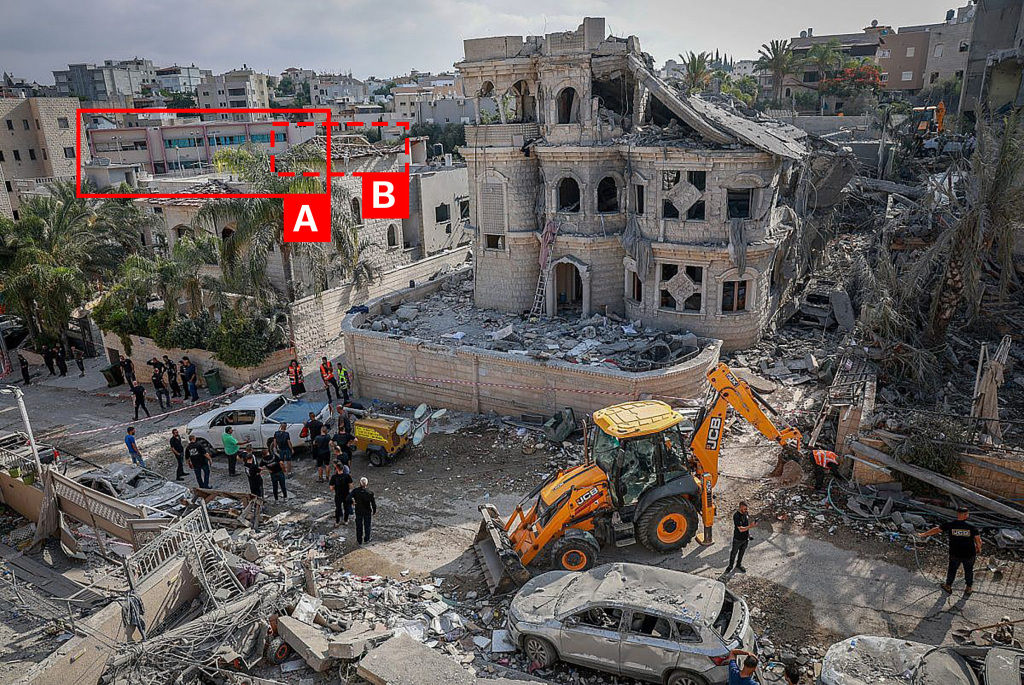
Imagery: @martoiu
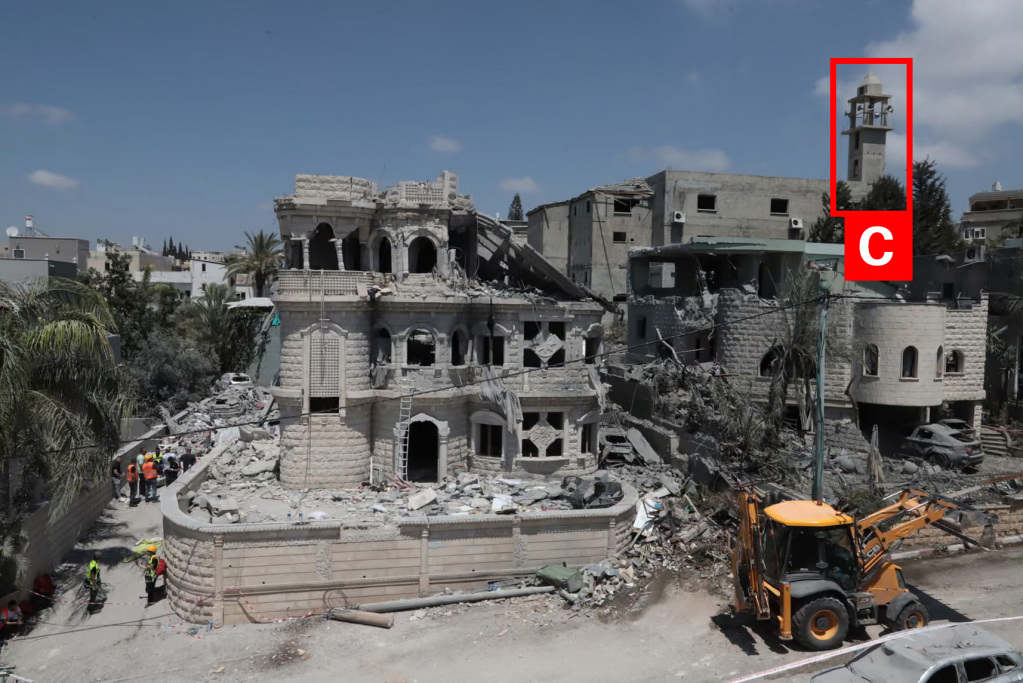
Imagery: The Guardian