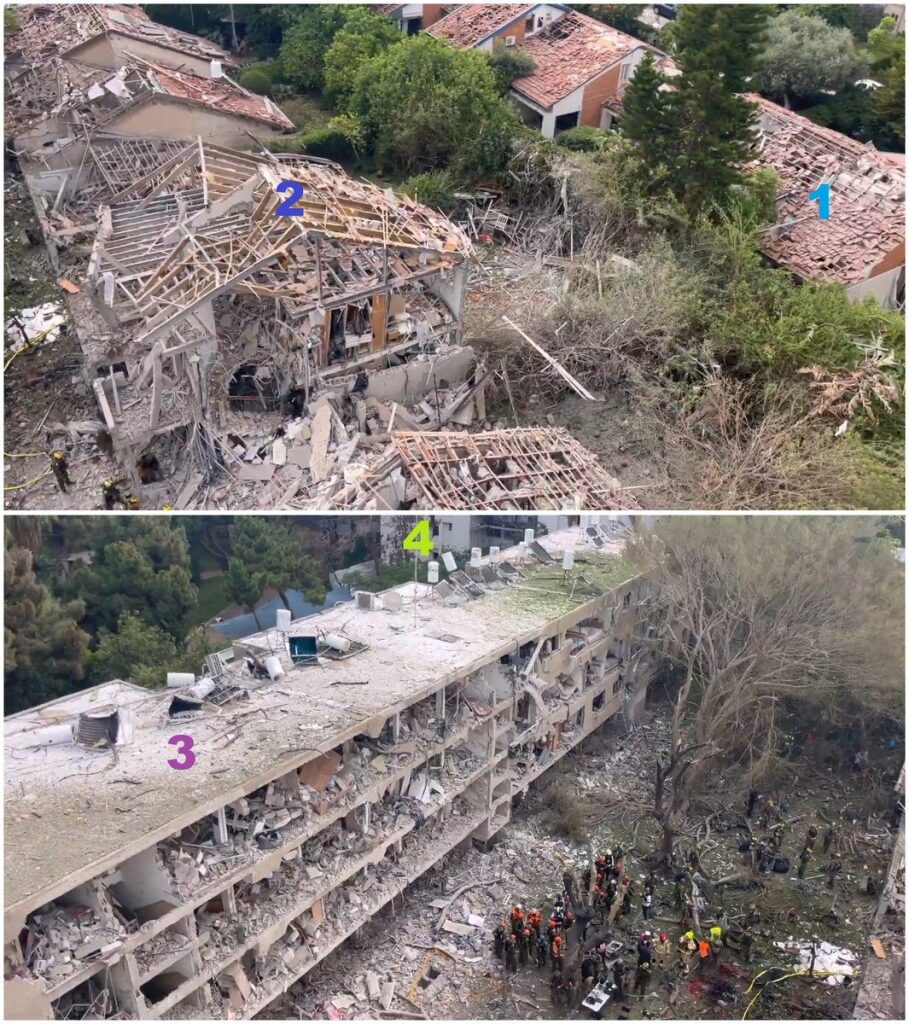
During morning of June 22 2025, between 7:30 a.m. and 8:00 a.m., between 13 and 20 civilians, including an elderly man, were reportedly injured after an alleged Iranian missile hit the residential neighborhood of Ramat Aviv in the northwest of Tel Aviv, Israel.
This was reportedly part of an attack by the Iranian military in the form of two waves of long range missiles, with the Magen David Adom emergency medical service reporting at least 10 impact sites.
Times of Israel reported that 13 people were lightly wounded when a missile hit a residential area of Tel Aviv while @France24_en stated that “around 15” were injured. The highest toll was provided by @bettapique of 20 injured.
According to news sources @France24_en and @AFP on X, there were also reports of heavy material damage. The Mayor of Tel Aviv, Ron Huldai, stated that houses were hit “very badly” and that the damage was “very extensive.” A BBC journalist at the scene of impact in Ramat Aviv described how six civilians were evacuated from a building that had been damaged, with searches continuing to find anyone who may have been trapped inside.
Residents of Ramat Aviv shared their experiences online. @ianai310757 on Twitter/X described travelling the path of Ramat Aviv every day for 40 years, noting that a former shopping mall is now crumbling, and asks what the area will be like in another 40 years. In a video posted to Twitter/X by @dailytelegraph, Hava Berger Vail, the daughter of an elderly resident of the neighborhood, guided a reporter through her mother’s destroyed house. Hava is seen visibly shaking in the video and states that she is grateful her mother survived the incident. Another resident of the neighborhood, @SachaRoytman on Twitter/X, noted that the area was mostly made up of young families and elderly residents and included images showing extensive damage to residential areas.
Journalist @emilykschrader posted a video reportedly taken at the scene of the strike in Tel Aviv which hit a nursing home, stating that nobody had been injured because they were all in shelters. However, Ynew News spoke with a paramedic named Josh who was involved in the rescue efforts at the retirement (nursing) home and stated that he rescued a 92-year-old who had to be taken to the hospital for treatment.
The Times of Israel reported that the Home Front Command investigated whether the attack also included cluster bomb warheads, however it did not find any initial evidence supporting this and did not specify in which location they suspected this of occurring. Where sources identified a belligerent, all sources attributed the strike to Iran.
Fair
Reported by two or more credible sources, with likely or confirmed near actions by a belligerent.
Causes of Death / Injury
Heavy weapons and explosive munitions
Civilians reported injured
13–20
(1 Man)
Geolocation Notes
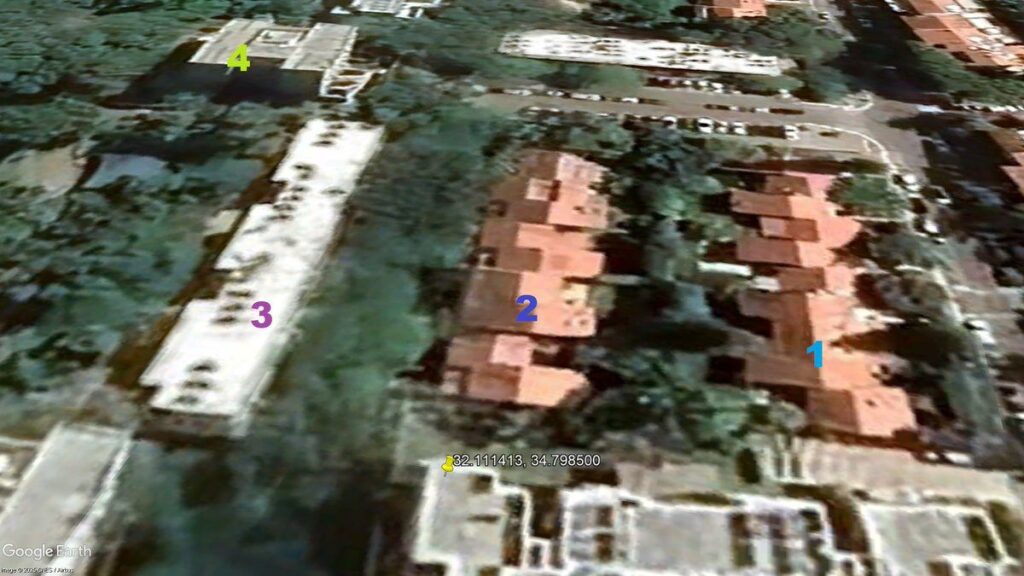
Reports of the incident mention a strike on Ramat Aviv (רָמַת אָבִיב). This incident was independently geolocated by Dominik (@99Dominik_). Satellite imagery shows the strike location at the following exact coordinates: 32.111413, 34.798500.
This is my neighborhood — a small, beautiful community in the north of Tel Aviv. It’s mostly young families with 2–4 kids and elderly residents who’ve remained here.
Today, we heard an explosion that shook our home like a massive earthquake. We knew we had been hit.
We are safe, and our home was spared — but just a block away, the damage is devastating. A missile struck, causing massive destruction.
There’s nothing here for Iran to target — just families and elderly people. And yet, this is what they chose to strike.
Media from SachaRoytman (4)
This media contains graphic content. Click to unblur.
At the scene of the ballistic missile strike in Tel Aviv that hit a nursing home.
By miracle almost no one was injured because they were all in shelters.
Following home front command instructions saves lives!
Media from emilykschrader (2)
This media contains graphic content. Click to unblur.
Iran fires large barrages on Israel; 2 injured
Magen David Adom reported receiving approximately ten reports of impact sites across Israel after 35 missiles fired. Several casualties reported, mostly with light injuries, but two were in serious condition.
by ILH Staff Published on 06-22-2025 01:37 Last modified: 06-22-2025 22:15
Israeli security forces and first responders gather at the site of an Iranian strike that hit a residential neighborhood in the Ramat Aviv area in Tel Aviv on June 22, 2025 | Photo: Jack GUEZ / AFP
Two successive volleys of more than 30 missiles targeted Israel from north to south on Sunday morning just hours after the US carried out a massive strike on Iran's largest nuclear facilities, including the underground fortified facilities Fordow.
Video: The scene of the missile strike on Tel Aviv on June 22, 2025 / Credit: Usage under Israel's intellectual property law section 27a
The site of one of the missile impacts in central Israel on June 22, 2025 (Usage under Israel's Intellectual Property Law Article 27(a))
The missile barrage from Iran caused at least 20 casualties, including two with serious casualties. The barrages included about 30 missiles in the first barrage to central Israel and the coast, followed by another five fired several minutes later to northern Israel and Samaria.
Video: The scene of the missile strike on Tel Aviv on June 22, 2025 / Credit: Usage under Israel's intellectual property law section 27a
First responders were evacuating people who were injured in Haifa, Tel Aviv, Rehovot, and Ness Ziona. At least three of the injured were children.
The site of the impact following an Iranian barrage on Israel on June 22, 2025 (Usage under Israel's Intellectual Property Law Article 27(a))
The Magen David Adom rescue service reported receiving approximately ten reports of impact sites across Israel. Several casualties reported, mostly with light injuries, but two were in serious condition.
Video: The scene of the missile strike on Haifa on June 22, 2025 / Credit: Usage under Israel's intellectual property law section 27a
The Israeli military confirmed detecting dozens of launches from Iran, triggering sirens across the country. Home Front Command issued alerts for the north and central regions as air defense systems engaged the incoming threats.
A dog being rescued in Ness Ziona on Sunday, June 22, 2025
Israelis were allowed to leave the shelter at around 8:20 p.m., some 30 minutes after the first volley.
Media from Israel Today (1)
This media contains graphic content. Click to unblur.
By Emanuel Fabian
You will receive email alerts from this author.
Manage alert preferences on your profile page
You will no longer receive email alerts from this author.
Manage alert preferences on your profile page
22 June 2025, 9:53 am
Edit
Emanuel (Mannie) Fabian is The Times of Israel's military correspondent
The IDF Home Front Command suspects that an air defense interceptor malfunctioned and crashed in Haifa amid Iran’s ballistic missile attack, which was the reason for sirens not sounding in the northern city.
An early warning was issued via the cell broadcast system in Haifa, but no sirens sounded as no ballistic missiles were heading for the city.
During the attack, an air defense interceptor likely misfired and impacted in Haifa, according to a preliminary Home Front Command investigation.
“This is not a malfunction in the warning system,” the IDF says, adding that the incident is under further investigation.
The impact wounded three people, who medics say are in good condition, and caused damage.
At least 27 missiles were launched by Iran in the attack in two salvos.
One missile hit a residential area of Tel Aviv, wounding 13 people lightly, and another hit homes in Ness Tziona, wounding six lightly.
One man was moderately hurt by shrapnel on the Route 431 highway, near Be’er Yaakov in central Israel.
The Home Front Command is also investigating whether Iran used a cluster bomb warhead in the attack this morning, as it did last week, but thus far has not found any evidence of this.
If you’d like to comment, join The Times of Israel Community.
An Iranian ballistic missile barrage injured dozens of people in Israel on Sunday morning as nearly 30 projectiles targeted the country, causing widespread destruction to residential areas in Tel Aviv and the central town of Ness Ziona.
An air defense interceptor, meanwhile, malfunctioned and impacted the northern city of Haifa, causing damage and slightly wounding three people. No sirens had sounded in the city during the incident.
The Health Ministry reported that among those who arrived at hospitals were two in moderate condition, 77 in good condition, four victims suffering from acute anxiety, and three more people who were undergoing medical evaluation and whose condition had not been immediately determined.
Ichilov Medical Center in Tel Aviv said there were two children among the five people who arrived at its emergency room with minor injuries.
The injuries were largely at the two impact sites in Tel Aviv and its Ness Ziona suburb, according to medical officials. One man was moderately hurt by shrapnel on the Route 431 highway, near Be’er Yaakov in central Israel.
Get The Times of Israel's Daily Edition
by email and never miss our top stories
By signing up, you agree to the terms
The Iranian attack came hours after the United States bombed three key nuclear sites in Iran, joining an Israeli air campaign against Iran’s nuclear and military infrastructure that began on June 13.
Israeli security and rescue forces at the scene where a ballistic missile fired from Iran hit and caused damage in Tel Aviv, June 22, 2025. (Chaim Goldberg/ Flash90)
Iran has responded to the Israeli attacks with near-daily barrages of missiles at cities, killing 24 people and wounding thousands, according to health officials and hospitals.
At least 27 missiles were launched from Iran in Sunday morning’s attack in two salvos, the military said, setting off sirens in north and central regions, as well as Jerusalem, between 7:30 and around 8 a.m.
The first salvo consisted of at least 22 missiles, and the second was made up of five, according to IDF assessments.
Firefighters, rescue workers and military work at the site of a direct missile strike launched from Iran in Tel Aviv, on June 22, 2025. (AP Photo/Oded Balilty)
Shortly after the barrage, the IDF said it struck the missile launchers used in the attack.
The military added that before the attack, the air force bombed eight other ballistic missile launchers, including six that were primed for an immediate attack on Israel, foiling a larger barrage.
According to the IDF, the strikes on the primed ballistic missile launchers eliminated several Iranian soldiers at the launch sites. The IDF released footage of the strikes.
The Home Front Command said it was investigating whether Iran used a cluster bomb warhead in the attack, as it did last week, but did not initially find evidence that this was the case.
In Tel Aviv, skeletons of homes were left standing following the barrage, with the wooden frames visible amid a sea of debris.
Rescue workers and residents react at the site where an apparently failed air defense interceptor fell in Haifa, June 22, 2025. (Baz Ratner/AP)
Emergency services were still working to evacuate residents over an hour after the barrage.
The situation was complicated by the fact that a large elder care facility was damaged in the attack.
“There was a massive explosion. Everything shook. I don’t know what happened,” a tearful witness told The Times of Israel at the site.
Dazed families walked around carrying small bags with their important possessions, as security forces moved them away from the scene, citing concerns of falling debris or a building collapse.
“Houses here were hit very, very badly,” Tel Aviv Mayor Ron Huldai said at the scene. “Those who were in the shelter are all safe and well. The damage is very, very extensive, but in terms of human life, we are okay.”
Israeli security and rescue forces at the scene where a ballistic missile fired from Iran hit and caused damage in Ness Ziona, June 22, 2025. (Yossi Aloni/Flash90)
Huldai said that a building badly damaged by the impact was empty of residents as it was in the midst of a refurbishment project.
The entire front of the broad, four-story building appeared to have been blown off.
Eran, whose home was hit in Ness Ziona, told Channel 13 that together with his family he had retreated to their home’s safe room.
“We heard a boom and the whole house shook, but the safe room remained intact,” he said.
Eran noted that the family dog was injured in the attack and taken to a veterinarian hospital for treatment.
Iran’s armed forces later said they targeted multiple sites in Israel, including Ben Gurion Airport, after the US attacked key nuclear sites in the Islamic Republic. The airport near Tel Aviv is the main international air gateway to the country.
Israeli security and rescue forces at the scene where a ballistic missile fired from Iran hit and caused damage in Ness Ziona, June 22, 2025. (Yossi Aloni/Flash90
“The twentieth wave of Operation Honest Promise 3 began using a combination of long-range liquid and solid fuel missiles with devastating warhead power,” the Iranian armed forces said in a statement quoted by Fars news agency.
The targets included the airport, a “biological research center,” logistics bases, and various layers of command and control centers, it said.
Failed interceptor explosion in Haifa
The IDF Home Front Command said it suspected that an air defense interceptor malfunctioned and crashed in Haifa during the Iranian attack, which was the reason for the warning sirens not sounding.
An early warning was issued via the cell broadcast system in Haifa, but no sirens sounded as no ballistic missiles were headed for the city, the Home Front Command said.
“This is not a malfunction in the warning system,” the IDF said, adding that the incident was under investigation.
Israeli security and rescue forces at the scene where a ballistic missile fired from Iran hit and caused damage in Tel Aviv, June 22, 2025. (Avshalom Sassoni/Flash90)
A public square in a residential area of the city was left strewn with rubble, and surrounding shops and homes were heavily damaged.
Palm trees withstood the impact in a small public garden, while storefronts were bent, shop windows shattered, and air conditioners left dangling from building facades.
The impact wounded three people, who were in good condition, according to medics, and caused some damage.
Drone attack
In addition to the missiles, two drones apparently launched from Iran at Israel were shot down by the Israeli Air Force during the morning, the IDF said. The drones had triggered sirens in the southern Arava region.
Drones take several hours to reach Israel from Iran, meaning they were likely launched before the US bombed Iran’s nuclear sites.
Overnight, the IAF and Navy intercepted some 30 drones launched from Iran at Israel, the military said.
The military said the IAF also struck dozens of drones in Iran before they were launched at Israel. The IDF released footage showing the drone interceptions and strikes on drones in Iran.
Since the start of the war with Iran, over 500 drones launched at Israel have been shot down, according to the IDF.
IDF hits Iranian jets, weapon sites, air defenses
Israel kept up its air campaign against Iran’s military overnight and Sunday, with the air force bombing two Iranian F-5 fighter jets at Dezful Airport in Iran during the morning, the military said.
The F-5 is a US fighter jet produced by the Northrop Corporation. They were sold to Iran in the 1970s.
The military said that strikes Saturday night carried out by 20 fighter jets in central Iran hit dozens of military targets.
The targets included “a military site containing components for the production of explosives, sites for the storage and production of weapons, and Iranian air defense systems,” along with military infrastructure at Isfahan Airport, to prevent the Iranian Air Force from using the site’s military facilities,” the IDF said.
A video issued by the IDF on June 22, 2025, shows strikes on Iranian F-5 fighter jets, ballistic missile launchers, and other military facilities in Iran. (Israel Defense Forces)
Israel says its sweeping assault, which began last Friday, on Iran’s top military leaders, nuclear scientists, uranium enrichment sites, and ballistic missile program is necessary to prevent the Islamic Republic from realizing its avowed plan to destroy the Jewish state.
Iran has retaliated by launching over 500 ballistic missiles and around 1,000 drones at Israel. Most of the missiles and nearly all of the drones have been intercepted by air defense systems.
Times of Israel staff and agencies contributed to this report.
An Iranian ballistic missile strike hit Ramat Aviv, suburb of #TelAviv on Sunday following US attacks on Iran. Around 15 injured and major material damage reported.
by @wdaly24, @JDungelhoeff and @cnorristrent
Media from France24_en (2)
This media contains graphic content. Click to unblur.
Emergency workers respond to the site of a missile strike in the Ramat Aviv neighborhood of Tel Aviv. Israel was hit with a wave of aerial attacks by Iran after the US entered the war overnight and bombed several Iranian nuclear sites. : Erik Marmor, Dima Vazinovich, Amir Levy
Media from GettyImagesNews (4)
This media contains graphic content. Click to unblur.
This was in 'my' Ramat Aviv @TelAviv, a path I traveled every day
in my routine forty years ago when nothing was like this.
From the vacant lot, a shopping mall rose; today it's crumbling to pieces.
What will it be like in forty years?
Content
esto fue en 'mi' Ramat-Aviv @TelAviv, derrotero que recorría cada día
en mi rutina hace cuarenta años cuando nada se parecía a esto.
del campo baldío surgió un centro comercial, hoy se hizo añicos
¿Cómo será en cuarenta años más?
Media from ianai310757 (1)
This media contains graphic content. Click to unblur.
Ramat Aviv, located northwest of Tel Aviv, is among targeted due to nearby security and military facilities. #Israel's tactic includes positioning sensitive points within residential areas and near medical and educational sites, inadvertently using civilians as shields.
Media from A7_Mirza (3)
This media contains graphic content. Click to unblur.
Israeli first responders inspect damaged buildings around the Ramat Aviv neighbourhood in Tel Aviv following the latest missile strike from Iran.
Sunday's attack follows a major US air strike on three of Iran’s key nuclear facilities, escalating tensions across the region
Media from MiddleEastEye (2)
This media contains graphic content. Click to unblur.
#DTTV - Israeli woman Hava Berger Vail has shown the apartment her mother was living in in Ramat Aviv after it was destroyed by an Iranian missile. ROLLING COVERAGE https://bit.ly/3ZKAh3r
Get the biggest stories first with The Daily Telegraph app: https://onelink.to/kysqh4
Media from dailytelegraph (2)
This media contains graphic content. Click to unblur.
Impressive damage, 20 injured, hundreds evacuated due to the retaliation for the US attack in Ramat Aviv, north of Tel Aviv
Content
Impresionantes daños, 20 heridos, centenares de evacuados provocados por la represalia de al ataque de Estados Unidos en Ramat Aviv, al norte de Tel Aviv
Media from betta fish (1)
This media contains graphic content. Click to unblur.
#UPDATE Three areas of Israel including coastal hub Tel Aviv were struck Sunday morning during waves of Iranian missiles, with at least 23 people injured, according to rescue services and police.
Several buildings were left heavily damaged in the Ramat Aviv area in Tel Aviv, where holes were torn in the facades of apartment blocs
Media from AFP (4)
This media contains graphic content. Click to unblur.
A barrage of Iranian missiles struck Israel on Sunday in the hours following a series of US strikes on nuclear facilities in Iran.Emergency workers raced to clear rubble from the site of an Iranian missile attack in the Tel Aviv neighbourhood of Ramat Aviv.Israeli police say six people with minor injuries were evacuated from a damaged building, as searches continue to find anyone trapped inside.The BBC's Middle East correspondent Hugo Bachega reports from the scene.Read more here.
Media from BBC (1)
This media contains graphic content. Click to unblur.
(Originally published in 2023)
The Israelis are all too familiar with the threat posed by rockets and missiles. Years of Katyusha rockets from Lebanon followed by Qassam rockets from the Gaza Strip provided Israel's civilian population with the best possible schooling in how to prepare and protect themselves against these threats, while the State of Israel used this time to develop counter-missile capabilities and other protection measures. Although any full-scale war would clearly introduce a completely new dimension to this type of threat due to the incomprehensibly substantial number of missiles in the enemies' arsenal, mainly Hezbollah, nonetheless, this is still a familiar challenge.
Follow Israel Hayom on Facebook, Twitter, and Instagram
At the same time, but with much less of a PR hype, in recent years another threat has been gradually developing: unmanned aerial vehicles, usually referred to by their abbreviation as UAVs. Although there were some prior indications as well as a number of operational incidents that were publicized, and the war between Russia and Ukraine also struck a chord on this issue, but it is doubtful whether anybody in Israel – apart from the relevant professionals – is aware of the scope of this issue and the extent of the threat it involves.
This is a threat that is expected to pose a significant challenge to Israel in the future, both during routine and mainly in wartime. It is the result of an Iranian decision to make a dramatic investment in the development and production of UAVs, and their serial distribution, en masse, to a broad variety of key regional players, which have themselves turned to manufacturing UAVs based on the support and knowhow provided by Iran.
In practice, this is such a significant challenge that it has forced the IDF and Israel's defense industries to invest a parallel effort in order to be able to contend with it in a variety of ways – offensively, defensively and in terms of intelligence.
"We were surprised by the speed at which things occurred," says one military source, "In the world of missiles and rockets these processes go on for 30 years. Here, everything developed extremely quickly, including the option of decentralizing the production. Though we did pay attention to it relatively quickly and began to prepare for it accordingly, this is indeed a new and extremely challenging threat."
Simple but efficient
The Iranians' involvement in UAVs is nothing new. It began back in the 90s with an attempt to manufacture initial models with a view to diversifying the force employment capabilities of the various Iranian military units. Until that point, the Iranians had been focusing on the development and production of various types of missiles and rockets to a variety of ranges, including long ranges. Those readers with a sharp memory will probably be able to recall the headlines in Israel regarding the progress in the development of the Shahab missiles and additional platforms, capable of covering the distance between Iran and Israel and of carrying heavy payloads (including a potential future nuclear device).
The Iranians came to understand that unmanned aerial vehicles provide them with additional capabilities. In contrast to missiles, which fly openly and it is clear to see from where they were launched and where they are due to impact, a UAV flies at low altitude, slowly and with stealth, and can be operated for special, low-signature missions – from intelligence collection, attacking targets by dropping munitions, to suicide missions (often referred to as 'kamikaze" missions).
The manufacturing of UAVs is also much simpler than that of long-range missiles. An SSM (Surface-to-Surface Missile) exits the earth's atmosphere and must then reenter, and is subject to immense loads and structural pressures," explains Captain L., the officer in charge of UAV research at the Enemy Firepower Capabilities Technological Research Branch in the Research & Analysis Division at IDF Military Intelligence. A UAV flies in the atmosphere, it is based on a simple piston engine, and is much easier to manufacture."
From the very outset, Iran opted for a unique method to gain progress in its UAV program. In contrast to Israel or the USA, which develop their own systems, the Iranians based their effort on the 'catch-up' approach: using others in order to bridge the technological gap. They achieved this mainly by reverse engineering of US and Israeli UAVs that either fell or were downed during various missions in the region. Any such vehicle (or even its fragments) was delivered to Iran, analyzed down to the minutest detail by local experts, and then copied perfectly. This saved the Iranians many long years of research and testing during the production process, allowing them to rapidly progress to the stage of serial production of a variety of different types of UAVs for a whole spectrum of ranges.
"All the Iranian platforms are based on a prototype that came from somewhere else," states Captain L., "The Shahed-136, which is currently in the headlines due to the ongoing war in Ukraine, is based on an Israeli UAV manufactured by Elbit. Its brothers in this series, the Shahed-141 and Shahed-197, are based on the US-made RQ-170 UAV."
Until the last decade, Iran made only relatively slow progress with its UAVs. Though it did succeed in recording certain successes, it only managed to attain capabilities that were extremely far away from what it really wanted. The dramatic technological changes undergone by the civilian world enabled it to bridge the gaps with lightning speed. Components, which until then had been developed in secret laboratories and were the property of a very limited group of technological superpowers, suddenly became widely available and could be purchased 'off the shelf' from civilian sites – from onboard computers and communication sets to navigation devices and even encryption devices.
However, over the last decade, Iran was subject to heavy international sanctions, making the task of procurement an extremely difficult one. To circumvent this obstacle, it established a series of companies and entities specializing in the procurement of various components and their shipment to Iran. Once they arrive in Iran, these components are assimilated in the various UAV programs, and above all they enable the Iranians to engage in the serial manufacture of large volumes of UAVs.
"The Iranians' ability to purchase commercially available off-the-shelf products (known as COTS) and to then integrate them in these systems was simply not an option 15 years ago," recounts a military source who specializes in this field. "This enabled them to make a highly significant leap forward that we have witnessed in recent years."
Bundles of cash mixed with diplomacy
This progress was also possible due to an additional Iranian advantage: friction. Similar to Israel, it is also in a constant state of friction with its enemies in various theaters. Some of this, mainly in the Persian Gulf, is the direct result of its actions, and some – in Lebanon, Syria, Iraq, and Yemen – via proxy, forces operating on Tehran's behalf and under its guidance and instruction. This enabled Iran to gain constant experience with the various systems it developed, to learn lessons, and implement them quickly in the development and production processes.
The technological progress and the experience accumulated also enabled it to share some of the production processes with the proxies themselves. The savings are clear: not only the proliferation of military capabilities and a significant increase of the production floor space but also the change to open up the highly challenging bottleneck of shipping arms to the various operational theaters. This is especially prominent in the northern theater, where Israel has been engaged in a permanent campaign against the Iranian arms shipments (some of which have been recently exposed here in Israel Hayom).
Over the last decade, Israel has carried out thousands of strikes and other actions designed to disrupt these Iranian efforts to smuggle a variety of weapon systems and technological capabilities – from missiles and rockets to a variety of UAVs – and one of the methods that the Iranians came across in order to overcome the intensive Israeli effort was to transfer the manufacturing capabilities to their proxies – the Houthis in Yemen, the Shi'ite militias in Iraq and Syria, and Hezbollah in Lebanon.
Although this process transformed the consumer into a manufacturer itself, it enabled the Iranians to become a key player in this field – and not only in relation to its own protégés. Iran has become a super-distributor of these advanced capabilities to a variety of countries, including superpowers. Russia is clearly the prime example of this, a global military superpower forced to seek aid from Iran in order to gain access to UAV-related capabilities. This began with procurement and has now moved on to the production process actually taking place on Russian soil. The Shahed-136, which due to the war in Ukraine has arguably become the best-known and most talked-about UAV in the world, has now been afforded the Russian title Geran (an abbreviation of the Russian name of the flower we know as a geranium).
In parallel, the Russians also operate other Iranian UAVs in Ukraine, such as the Shahed-131 and the Mohajer-6. To date, Russia has acquired some 1000 UAVs at an average price of 40 thousand dollars per unit, and in the future, it plans to produce thousands of UAVs in Russia, an issue of grave concern to the West and also to Israel, as this will be a solid connection between the global antagonist (Russia) and the regional antagonist (Iran).
Iran is also engaged in a similar process with China. Here too, a superpower was found to be lacking in this field and thus approached a much smaller and weaker nation than it to bridge the gaps. In the case of the Chinese, the Shahed-136 has been renamed, also after a flower, the Sunflower-200, and it too is due to begin serial production in China.
In both cases, with Russia and China, the Iranians are exploiting the process, not only to pump large volumes of cash into their dwindling coffers following many years of biting economic sanctions but also for a dangerous foray into the world of military and global diplomacy – increased proximity between the states and gaining support from Russia and China to obtain knowhow and various means, which until now had been well outside their reach.
A national-military project
Over the course of the last decade, the Iranian UAV industry has become a recognized global brand name, mainly due to the use to which the Russians have put the Iranian UAVs during the ongoing war in Ukraine. Iran, however, began to put the systems it has developed to use – either directly or via its proxy forces – many years previously. Even, during the Second Lebanon War way back in 2006, Iranian Ababil UAVs were operated by Hezbollah in their efforts to attack Israel. They were either intercepted by the IAF or crashed without succeeding in causing any damage or inflicting any casualties.
Later on, Hezbollah made a number of additional attempts to infiltrate various airborne vehicles into Israel – from UAVs to drones, another field in which a dramatic quantum leap has occurred in recent years in the civilian sector, enabling Iran to make significant progress in terms of the development and production of its military capabilities.
The Iranian UAV industry operates via two main channels in parallel: one takes place under the Iranian ministry of defense, or as it is officially known, the Ministry of Defense and Armed Forces Logistics (MODAFL), and the second one under the Iranian Revolutionary Guards Corps (IRGC). Within the MODAFL, there are two key industries engaged in UAV production. The first is called HESA, which was founded in 1976 and is located in Isfahan. Initially, this company was involved in the manufacture of light aircraft, but today it is also engaged in the development and manufacture of UAVs, mainly the Ababil variants, which serve the Iranian air force and also some of its proxies – from the Houthis in Yemen to Hezbollah in Lebanon. The two main variants, Ababil-2 and Ababil-3, are UAVs with a range of 100 km that are able to collect intelligence, attack targets and detonate themselves.
The other industry is called Qods. This industry was established in 1985, it employs hundreds of workers and is subject to US Department of the Treasury sanctions. Its flagship is the Mohajer. Mohajer-6 is an ISTAR (Intelligence, Surveillance, Target Acquisition & Reconnaissance) UAV with a range of thousands of kilometers and the ability to carry 4-6 guided munitions, and the Mohajer-10, which was exposed only two weeks ago, according to reports in Iran has a range of 2000 km and is capable of carrying a payload of up to 300 kg.
The other channel, run by the IRGC, is also in possession of two parallel industrial concerns. The first one is called KIPAS and is highly confidential. This industry operates under the auspices of the IRGC Qods Force, a special unit tasked with spreading the Islamic revolution outside Iran and which, among others, is responsible for leading the war against Israel.
The other industry is the Shahed Aviation Industries which was originally intended to provide the IRGC Aerospace Force with independent UAV production and operational capabilities, without the need to depend on the MODAFL or the Islamic Republic of Iran Air Force (Iran's regular air force). This was carried out as part of the process to gain power, led by the IRGC Aerospace Force Commander, Amir Ali Hajizadeh, who following the targeting of Qassem Soleimani, became the dominant figure in the IRGC in addition to becoming the bitterest and most dangerous enemy to Israel, the moderate Sunni Arab states and the West.
Shahed manufactures a broad variety of UAVs, all of which are marketed under the same name (though the model number varies). The Shahed-197 is a UAV with a 7-meter wingspan, a flight range of thousands of kilometers and a cruising speed of 200 km/h, which is capable of remaining airborne without interruption for 20 hours. The Shahed-141 is a kamikaze UAV that can be also used for transferring arms, it has a flight range of 1800 kilometers at a flight speed of 185 km/h. The Shahed-101 is a kamikaze UAV that can also be used for intelligence-gathering purposes, it weighs 10 kg and has a flight range of 700 km.
The company's flagship product is the Shahed-136. This is a suicide attack UAV with a range of 2000-2200 km, which flies at altitude and at a relatively low speed of 185 km/h, which makes it more difficult to detect and intercept. As a result of the use of the Shahed-136 in the war in Ukraine, the USA, Canada, and the EU imposed sanctions on the Shahed Aviation Industries; although, the deals concluded with Russia (and now with China) for procurement of the system, and later on for its independent production, have enabled the Shahed Aviation Industries to continue to prosper.
Sanctions circumventing UAVs
We can roughly split up the production processes as follows: the Iranians cast the wings by themselves in Iran into casts that Iran builds and then later dries and bakes, or in the country in which the UAV is manufactured (Yemen, Lebanon or in the near future in Russia); it purchases the engine (usually Chinese piston engines); the warhead is cast in Iran; and the technology it buys on the civilian market. The warheads vary according to the mission and fragmentation is often added to them in order to increase lethality and the extent of the damage.
The Russians, for example, have mainly been using 50 kg warheads in their combat in Ukraine. They purchase the UAVs in Iran and ship them to Russia mainly by air and recently by ship too across the Caspian Sea, and they pay Iran for them either in hard cash or in gold bullion in order to circumvent the sanctions.
This growing cooperation between the two states is a cause of serious concern to Israel, also as the Iranians are exploiting it to move ahead in a number of different areas – information on various fields, including the development and manufacture of hypersonic missiles and satellite launch vehicles, as well as promoting transactions (including Su-35 fighter aircraft) and culminating in intelligence and operational cooperation. According to the source, "They are trying to squeeze the lemon dry."
The first two industries, which operate under the MODAFL, focus on the domestic needs of Iran itself: they are the main suppliers of UAVs to the Iranian army, with the main objective being the defense of Iran's sovereign territory. In contrast, the two industries operating under the IRGC focus their efforts on foreign objectives: either by direct operation or via Tehran's various proxies.
The IRGC's need for instant solutions for its needs in the field is sufficient to prod the industries under its command to work at a much more rapid pace and produce results in relatively short time periods, while the industries working under the MODAFL tend to engage in more long-term projects. Just to what extent these industries share knowledge and capabilities is not fully clear, but they do share at least one common objective beyond the interests of the Islamic state itself: both of them are working full steam ahead to sell their UAVs anywhere possible around the world, both to inject cash into the system and also to increase their influence. All four of these industries are subject to a variety of different sanctions. Some of them entered the list as they were involved in attacking various elements in the region, while others have been sanctioned due to their involvement in the war in Ukraine. Though these sanctions do make the procurement processes more difficult for the Iranians, the large scale development of this field in Iran – and the growing demand for UAVs of Iranian manufacture – underscore the fact that the sanctions' effectiveness is extremely limited, especially when Russia and China top the customer list.
"As, for the most part, these are civilian components that can readily be purchased on the open market, the Iranians have little difficulty in overcoming the sanctions," says the military official. "Even if any specific procurement channel is blocked, they immediately find an alternative one."
Israel in the crosshairs
Over the years, Iran has considerably increased its use of UAVs in all theaters where it operates. The most intensive use of this type of weapon system – which in itself is perhaps the most effective test site for the Iranians – has been made by the Houthis in Yemen. Hundreds of aircraft were operated against a variety of targets, including the methodical attacking of Saudi targets, even in the capital Riyadh.
In the past, Iran itself tried to avoid the direct use of UAVs that it manufactured in order not to get involved in direct conflicts, leaving its proxies to fight with Saudi Arabia, Israel and even the USA. This Iranian hydra-like method of force employment – whose aim is to constantly challenge its adversaries while leaving Iran itself safe and off the battlefield – is all too well known, and provides its enemies, above all Israel, with a permanent predicament and a dilemma of whether to make do with an ongoing, bloody conflict with the proxies or to cause Iran to pay a heavy price itself, on its own soil.
This dilemma will probably be seriously intensified in a large-scale war such as any future Third Lebanon War, when Israel will have to deliberate the option of exercising its deterrence by striking at Iran and the concern that such a move might well draw Tehran directly into the fighting.
In recent years, Iran has begun to release some of these shackles, starting to operate UAVs also directly for its diverse objectives. The first such operational use against Israel was on February 10, 2018, when a Shahed-141 UAV was launched from the Syrian air force base of T4 towards Israel, in response to Israeli strikes on Iranian targets in Syria. Israel monitored the UAV throughout its flight and an IAF Apache combat helicopter intercepted it near the town of Beit She'an.
On September 14, 2019, Iran conducted its most famous and effective attack to date, when it launched dozens of UAVs and cruise missiles at the facilities of the Saudi Arabian national oil company, Aramco. This surprise attack caused significant damage to Saudi Arabia's oil production capability, sending shock waves across the region, mainly due to the American decision not to take action in defense of Saudi Arabia in the form of any offensive retaliation against Iran. The lessons of this incident are still echoing to this very day and form the basis, to some extent, of Saudi Arabia's lack of trust in the USA, and the extensive Saudi demands for various types of weapon systems (including unmanned systems) to enable them to defend themselves in the future.
On the verge of the threshold of escalation
The incessant hits that it suffered from the IAF strikes in Syria led Iran to look for a new medium via which it would be able to exact revenge on Israel. As part of this, commencing two years ago, a wave of attacks began in the Persian Gulf against ships, either wholly or partially owned by Israeli businessmen, but which sail under foreign flags and with foreign crews.
On March 25, 2021, Iranian UAVs hit the Lori, a partially Israeli-owned container ship that was sailing in the Arabian Sea. On April 13, 2021, a UAV hit an additional vessel under partial Israeli ownership, the Hyperion Ray, and on July 3, 2021, a third attempt was carried out, also against a ship with Israeli owners, the CSAV Tyndall.
The fourth attack in the series occurred on July 29, 2021. A Shahed-136 UAV hit a ship called the Mercer Street, killing a British and Romanian national. Britain was outraged and a severe diplomatic crisis ensued between the two states, following which the IRGC – apparently under the orders of the Supreme Leader Ali Khamenei – ceased its attacks on shipping in the Gulf region. The Iranians, who sought to remove the sanctions imposed on them due to their nuclear program, feared the intensity of the conflict with the West and thus decided to calm things down in this particular area.
But the Iranians did remain active in another theater of course – the fight against Israel. On March 15, 2021, two Shahed-197 UAVs launched from Iran to Israel were intercepted. This was the first operational interception by an IAF F-35I Adir stealth combat aircraft, and it was kept under wraps for a year until it was allowed to be made public. In another case, on April 2 this year, a Shahed-101 UAV was intercepted after crossing the border from Syria into Israel. This particular UAV was downed using electronic jamming and it crashed in the southern Golan Heights near the Sea of Galilee.
As the Iranian industries operate separately, there are a considerable number of figures involved in the development and production processes, and later on in the operation and dissemination of these systems to the various other elements. Some of them belong to the MODAFL and are responsible for HESA and Qods, others operate under the auspices of the IRGC and are responsible for KIPAS and the Shahed Aviation Industries, and some for the end users in Qods Force or the various proxy organizations.
As mentioned, Hajizadeh is the most dominant figure, mainly in view of the expedited operation and procurement processes carried out over the last year with Russia (and China). He is also responsible for the attacks on Saudi Arabia – including those against the Aramco facilities – and for the attempts to operate long-range Iranian UAVs to penetrate Israeli airspace.
Another senior figure in the IRGC who is active in this field is Abdollah Mehrabi, who is in charge of the UAV industries within the IRGC, including the Shahed Aviation Industries.
A third senior official is Sa'id Izadi, the Head of the Palestinian Branch in the IRGC-Qods Force Lebanon Corps, who is in charge of all the support provided to the Palestinian terrorist organizations and Iran's ties with them, including the transfer of funds, knowhow, and weapon systems to these various organizations (chiefly Hamas and the Palestinian Islamic Jihad). Izadi is also involved in the efforts to develop the UAV industry in the Gaza Strip, which encounters objective difficulties due to the fact that the Gaza Strip is a closed enclave and relies on independent development alone, and also as Israel tries to take advantage of every round of violence or strikes there to destroy facilities, weapons, and capabilities that these organizations try to develop.
There are two key figures working in this field in the Iranian MODAFL. The first one is Seyyed Hojjatollah Qureishi, the Head of the Logistics Branch at the MODAFL, who is in charge of arms exports and as such heads the security ties with Russia. Qureishi led the process of the UAV sales to Russia, reaping considerable praise for his success. He is also actively working to promote similar processes with additional states and is currently active in the establishment of a UAV production plant in Tajikistan, as well as the efforts to help Armenia in its war against Azerbaijan. An additional figure is Qassem Damavandian, who is in charge of the Qods Industries that manufacture the Mohajer series of UAVs.
Hundreds of workers and experts from diverse fields work under these figures – from the various engineering disciplines and technological worlds to intelligence and operations. Since this Iranian capability has made dramatic progress in recent years it has also facilitated a significant leap forward in terms of the broad variety of force employment options at its disposal. Against Israel, for example, this enables Iran to adopt offensive options using a variety of systems and ranges, beginning with its close proxies in Lebanon and Syria (and Gaza), via its more remote proxies in Iraq and Yemen, and culminating in the independent launching of UAVs from any location within Iran.
Any such attack requires meticulous planning. This starts from the selection of the appropriate aircraft (intelligence collection, attack, kamikaze), moves on to selection of the munition, and ends with planning of the flight path to limit the risk of exposure and interception. This presents Israel with a significant headache as it is then forced to adapt its defensive arrays to deal with the new threat: not only missiles arriving from a high altitude, but UAVs (and cruise missiles) that fly at a slower speed and a low altitude, thus presenting a thorny challenge to the radars that are supposed to detect them (and on the other hand, make it easier to intercept them due to their low flight speed, compared with the more complex task of intercepting missiles and rockets).
In practice, the Iranians are so taken up by this new world of UAVs, which is rife with endless opportunities, that they are currently focusing their main efforts primarily on the development of unmanned aerial vehicles. The IRGC Aerospace Force has no airplanes, and its arsenal is made up chiefly of a broad variety of missiles and rockets, UAVs and diverse air defense systems, which it also disseminates to its various proxies. "This enables it to realize its policy – force employment underneath the threshold of escalation, in other words, to attack targets without risking becoming entangled in war itself," says the military official.
The challenge: Countermeasures and interception
In relation to Israel this is an especially dramatic change. "This is not a missile launch that is a clear red line involving a breach of the threshold of escalation that would certainly lead to war. UAVs enable Iran to operate with a relative degree of clandestineness, even from a great distance, though we do currently see a clear concern among them from a potential Israeli response to such action on Iranian soil."
This has occurred, among others, following strikes in Iran that have been attributed to Israel. Such a strike, which is attributed to the Mossad, was carried out using UAVs in March 2022 leading to the destruction of dozens of Shahed UAVs on the ground at a plant in the city of Kermanshah in Iran. An additional attack, in February this year (which too was carried out using UAVs and was also credited to the Mossad), hit a plant in the vicinity of the city of Karaj at which Iran manufactured UAVs.
These attacks caused a certain degree of damage to Iran and also evidently conveyed a strong message, but they have not put an end to the process. "The Iranians now boast a sufficiently adequate level of competency," says Captain Y, the Head of the I&W (Indications & Warnings) Section in the Iran Branch in the Research & Analysis Division at IDF Military Intelligence. "They know how to manufacture, how to launch and hit the target. Even if their capability is not of a global first-rate quality, their approach is to work with quantity: to launch en masse, and then some will fall on the way be downed, but some will eventually arrive at the target. As far as they are concerned, this is a sufficient means of implementing their force employment doctrine."
As far as Israel is concerned, this is one hell of a headache. The next war might not only bring with it a downpour of missiles and rockets but also an extremely challenging multi-theater UAV threat operated by a variety of forces – from the UAV units of Hezbollah and the pro-Iranian militias in Syria, Iraq, and Yemen, to the Iranians themselves. The job of the intelligence is not only to provide advance warning in order to enable the employment of countermeasures or interception so that we are not forced to rely on a strong defensive posture alone, but also to collect intelligence designed to enable the IAF and the defense industries to become familiar with the various weapon systems and threats and their capabilities, and to develop an appropriately tailored detection and interception response using a broad variety of means.
The experts believe that the future will be no less of a challenge. "We live in a world where in no time at all we will be using drones to send deliveries, where systems are able to talk or transfer information and images from one to another," says Captain L. "At some point in the future, the endless diversity is bound to reach a point of saturation as each airborne system requires appropriate experts, technicians, logistics, and a different mode of operation, but the quantity will simply keep on growing – and consequently the challenge will not become any easier."
Subscribe to Israel Hayom's daily newsletter and never miss our top stories!
Content
(Originally published in 2023)
The Israelis are all too familiar with the threat posed by rockets and missiles. Years of Katyusha rockets from Lebanon followed by Qassam rockets from the Gaza Strip provided Israel's civilian population with the best possible schooling in how to prepare and protect themselves against these threats, while the State of Israel used this time to develop counter-missile capabilities and other protection measures. Although any full-scale war would clearly introduce a completely new dimension to this type of threat due to the incomprehensibly substantial number of missiles in the enemies' arsenal, mainly Hezbollah, nonetheless, this is still a familiar challenge.
Follow Israel Hayom on Facebook, Twitter, and Instagram
At the same time, but with much less of a PR hype, in recent years another threat has been gradually developing: unmanned aerial vehicles, usually referred to by their abbreviation as UAVs. Although there were some prior indications as well as a number of operational incidents that were publicized, and the war between Russia and Ukraine also struck a chord on this issue, but it is doubtful whether anybody in Israel – apart from the relevant professionals – is aware of the scope of this issue and the extent of the threat it involves.
This is a threat that is expected to pose a significant challenge to Israel in the future, both during routine and mainly in wartime. It is the result of an Iranian decision to make a dramatic investment in the development and production of UAVs, and their serial distribution, en masse, to a broad variety of key regional players, which have themselves turned to manufacturing UAVs based on the support and knowhow provided by Iran.
In practice, this is such a significant challenge that it has forced the IDF and Israel's defense industries to invest a parallel effort in order to be able to contend with it in a variety of ways – offensively, defensively and in terms of intelligence.
"We were surprised by the speed at which things occurred," says one military source, "In the world of missiles and rockets these processes go on for 30 years. Here, everything developed extremely quickly, including the option of decentralizing the production. Though we did pay attention to it relatively quickly and began to prepare for it accordingly, this is indeed a new and extremely challenging threat."
Simple but efficient
The Iranians' involvement in UAVs is nothing new. It began back in the 90s with an attempt to manufacture initial models with a view to diversifying the force employment capabilities of the various Iranian military units. Until that point, the Iranians had been focusing on the development and production of various types of missiles and rockets to a variety of ranges, including long ranges. Those readers with a sharp memory will probably be able to recall the headlines in Israel regarding the progress in the development of the Shahab missiles and additional platforms, capable of covering the distance between Iran and Israel and of carrying heavy payloads (including a potential future nuclear device).
The Iranians came to understand that unmanned aerial vehicles provide them with additional capabilities. In contrast to missiles, which fly openly and it is clear to see from where they were launched and where they are due to impact, a UAV flies at low altitude, slowly and with stealth, and can be operated for special, low-signature missions – from intelligence collection, attacking targets by dropping munitions, to suicide missions (often referred to as 'kamikaze" missions).
The manufacturing of UAVs is also much simpler than that of long-range missiles. An SSM (Surface-to-Surface Missile) exits the earth's atmosphere and must then reenter, and is subject to immense loads and structural pressures," explains Captain L., the officer in charge of UAV research at the Enemy Firepower Capabilities Technological Research Branch in the Research & Analysis Division at IDF Military Intelligence. A UAV flies in the atmosphere, it is based on a simple piston engine, and is much easier to manufacture."
From the very outset, Iran opted for a unique method to gain progress in its UAV program. In contrast to Israel or the USA, which develop their own systems, the Iranians based their effort on the 'catch-up' approach: using others in order to bridge the technological gap. They achieved this mainly by reverse engineering of US and Israeli UAVs that either fell or were downed during various missions in the region. Any such vehicle (or even its fragments) was delivered to Iran, analyzed down to the minutest detail by local experts, and then copied perfectly. This saved the Iranians many long years of research and testing during the production process, allowing them to rapidly progress to the stage of serial production of a variety of different types of UAVs for a whole spectrum of ranges.
"All the Iranian platforms are based on a prototype that came from somewhere else," states Captain L., "The Shahed-136, which is currently in the headlines due to the ongoing war in Ukraine, is based on an Israeli UAV manufactured by Elbit. Its brothers in this series, the Shahed-141 and Shahed-197, are based on the US-made RQ-170 UAV."
Until the last decade, Iran made only relatively slow progress with its UAVs. Though it did succeed in recording certain successes, it only managed to attain capabilities that were extremely far away from what it really wanted. The dramatic technological changes undergone by the civilian world enabled it to bridge the gaps with lightning speed. Components, which until then had been developed in secret laboratories and were the property of a very limited group of technological superpowers, suddenly became widely available and could be purchased 'off the shelf' from civilian sites – from onboard computers and communication sets to navigation devices and even encryption devices.
However, over the last decade, Iran was subject to heavy international sanctions, making the task of procurement an extremely difficult one. To circumvent this obstacle, it established a series of companies and entities specializing in the procurement of various components and their shipment to Iran. Once they arrive in Iran, these components are assimilated in the various UAV programs, and above all they enable the Iranians to engage in the serial manufacture of large volumes of UAVs.
"The Iranians' ability to purchase commercially available off-the-shelf products (known as COTS) and to then integrate them in these systems was simply not an option 15 years ago," recounts a military source who specializes in this field. "This enabled them to make a highly significant leap forward that we have witnessed in recent years."
Bundles of cash mixed with diplomacy
This progress was also possible due to an additional Iranian advantage: friction. Similar to Israel, it is also in a constant state of friction with its enemies in various theaters. Some of this, mainly in the Persian Gulf, is the direct result of its actions, and some – in Lebanon, Syria, Iraq, and Yemen – via proxy, forces operating on Tehran's behalf and under its guidance and instruction. This enabled Iran to gain constant experience with the various systems it developed, to learn lessons, and implement them quickly in the development and production processes.
The technological progress and the experience accumulated also enabled it to share some of the production processes with the proxies themselves. The savings are clear: not only the proliferation of military capabilities and a significant increase of the production floor space but also the change to open up the highly challenging bottleneck of shipping arms to the various operational theaters. This is especially prominent in the northern theater, where Israel has been engaged in a permanent campaign against the Iranian arms shipments (some of which have been recently exposed here in Israel Hayom).
Over the last decade, Israel has carried out thousands of strikes and other actions designed to disrupt these Iranian efforts to smuggle a variety of weapon systems and technological capabilities – from missiles and rockets to a variety of UAVs – and one of the methods that the Iranians came across in order to overcome the intensive Israeli effort was to transfer the manufacturing capabilities to their proxies – the Houthis in Yemen, the Shi'ite militias in Iraq and Syria, and Hezbollah in Lebanon.
Although this process transformed the consumer into a manufacturer itself, it enabled the Iranians to become a key player in this field – and not only in relation to its own protégés. Iran has become a super-distributor of these advanced capabilities to a variety of countries, including superpowers. Russia is clearly the prime example of this, a global military superpower forced to seek aid from Iran in order to gain access to UAV-related capabilities. This began with procurement and has now moved on to the production process actually taking place on Russian soil. The Shahed-136, which due to the war in Ukraine has arguably become the best-known and most talked-about UAV in the world, has now been afforded the Russian title Geran (an abbreviation of the Russian name of the flower we know as a geranium).
In parallel, the Russians also operate other Iranian UAVs in Ukraine, such as the Shahed-131 and the Mohajer-6. To date, Russia has acquired some 1000 UAVs at an average price of 40 thousand dollars per unit, and in the future, it plans to produce thousands of UAVs in Russia, an issue of grave concern to the West and also to Israel, as this will be a solid connection between the global antagonist (Russia) and the regional antagonist (Iran).
Iran is also engaged in a similar process with China. Here too, a superpower was found to be lacking in this field and thus approached a much smaller and weaker nation than it to bridge the gaps. In the case of the Chinese, the Shahed-136 has been renamed, also after a flower, the Sunflower-200, and it too is due to begin serial production in China.
In both cases, with Russia and China, the Iranians are exploiting the process, not only to pump large volumes of cash into their dwindling coffers following many years of biting economic sanctions but also for a dangerous foray into the world of military and global diplomacy – increased proximity between the states and gaining support from Russia and China to obtain knowhow and various means, which until now had been well outside their reach.
A national-military project
Over the course of the last decade, the Iranian UAV industry has become a recognized global brand name, mainly due to the use to which the Russians have put the Iranian UAVs during the ongoing war in Ukraine. Iran, however, began to put the systems it has developed to use – either directly or via its proxy forces – many years previously. Even, during the Second Lebanon War way back in 2006, Iranian Ababil UAVs were operated by Hezbollah in their efforts to attack Israel. They were either intercepted by the IAF or crashed without succeeding in causing any damage or inflicting any casualties.
Later on, Hezbollah made a number of additional attempts to infiltrate various airborne vehicles into Israel – from UAVs to drones, another field in which a dramatic quantum leap has occurred in recent years in the civilian sector, enabling Iran to make significant progress in terms of the development and production of its military capabilities.
The Iranian UAV industry operates via two main channels in parallel: one takes place under the Iranian ministry of defense, or as it is officially known, the Ministry of Defense and Armed Forces Logistics (MODAFL), and the second one under the Iranian Revolutionary Guards Corps (IRGC). Within the MODAFL, there are two key industries engaged in UAV production. The first is called HESA, which was founded in 1976 and is located in Isfahan. Initially, this company was involved in the manufacture of light aircraft, but today it is also engaged in the development and manufacture of UAVs, mainly the Ababil variants, which serve the Iranian air force and also some of its proxies – from the Houthis in Yemen to Hezbollah in Lebanon. The two main variants, Ababil-2 and Ababil-3, are UAVs with a range of 100 km that are able to collect intelligence, attack targets and detonate themselves.
The other industry is called Qods. This industry was established in 1985, it employs hundreds of workers and is subject to US Department of the Treasury sanctions. Its flagship is the Mohajer. Mohajer-6 is an ISTAR (Intelligence, Surveillance, Target Acquisition & Reconnaissance) UAV with a range of thousands of kilometers and the ability to carry 4-6 guided munitions, and the Mohajer-10, which was exposed only two weeks ago, according to reports in Iran has a range of 2000 km and is capable of carrying a payload of up to 300 kg.
The other channel, run by the IRGC, is also in possession of two parallel industrial concerns. The first one is called KIPAS and is highly confidential. This industry operates under the auspices of the IRGC Qods Force, a special unit tasked with spreading the Islamic revolution outside Iran and which, among others, is responsible for leading the war against Israel.
The other industry is the Shahed Aviation Industries which was originally intended to provide the IRGC Aerospace Force with independent UAV production and operational capabilities, without the need to depend on the MODAFL or the Islamic Republic of Iran Air Force (Iran's regular air force). This was carried out as part of the process to gain power, led by the IRGC Aerospace Force Commander, Amir Ali Hajizadeh, who following the targeting of Qassem Soleimani, became the dominant figure in the IRGC in addition to becoming the bitterest and most dangerous enemy to Israel, the moderate Sunni Arab states and the West.
Shahed manufactures a broad variety of UAVs, all of which are marketed under the same name (though the model number varies). The Shahed-197 is a UAV with a 7-meter wingspan, a flight range of thousands of kilometers and a cruising speed of 200 km/h, which is capable of remaining airborne without interruption for 20 hours. The Shahed-141 is a kamikaze UAV that can be also used for transferring arms, it has a flight range of 1800 kilometers at a flight speed of 185 km/h. The Shahed-101 is a kamikaze UAV that can also be used for intelligence-gathering purposes, it weighs 10 kg and has a flight range of 700 km.
The company's flagship product is the Shahed-136. This is a suicide attack UAV with a range of 2000-2200 km, which flies at altitude and at a relatively low speed of 185 km/h, which makes it more difficult to detect and intercept. As a result of the use of the Shahed-136 in the war in Ukraine, the USA, Canada, and the EU imposed sanctions on the Shahed Aviation Industries; although, the deals concluded with Russia (and now with China) for procurement of the system, and later on for its independent production, have enabled the Shahed Aviation Industries to continue to prosper.
Sanctions circumventing UAVs
We can roughly split up the production processes as follows: the Iranians cast the wings by themselves in Iran into casts that Iran builds and then later dries and bakes, or in the country in which the UAV is manufactured (Yemen, Lebanon or in the near future in Russia); it purchases the engine (usually Chinese piston engines); the warhead is cast in Iran; and the technology it buys on the civilian market. The warheads vary according to the mission and fragmentation is often added to them in order to increase lethality and the extent of the damage.
The Russians, for example, have mainly been using 50 kg warheads in their combat in Ukraine. They purchase the UAVs in Iran and ship them to Russia mainly by air and recently by ship too across the Caspian Sea, and they pay Iran for them either in hard cash or in gold bullion in order to circumvent the sanctions.
This growing cooperation between the two states is a cause of serious concern to Israel, also as the Iranians are exploiting it to move ahead in a number of different areas – information on various fields, including the development and manufacture of hypersonic missiles and satellite launch vehicles, as well as promoting transactions (including Su-35 fighter aircraft) and culminating in intelligence and operational cooperation. According to the source, "They are trying to squeeze the lemon dry."
The first two industries, which operate under the MODAFL, focus on the domestic needs of Iran itself: they are the main suppliers of UAVs to the Iranian army, with the main objective being the defense of Iran's sovereign territory. In contrast, the two industries operating under the IRGC focus their efforts on foreign objectives: either by direct operation or via Tehran's various proxies.
The IRGC's need for instant solutions for its needs in the field is sufficient to prod the industries under its command to work at a much more rapid pace and produce results in relatively short time periods, while the industries working under the MODAFL tend to engage in more long-term projects. Just to what extent these industries share knowledge and capabilities is not fully clear, but they do share at least one common objective beyond the interests of the Islamic state itself: both of them are working full steam ahead to sell their UAVs anywhere possible around the world, both to inject cash into the system and also to increase their influence. All four of these industries are subject to a variety of different sanctions. Some of them entered the list as they were involved in attacking various elements in the region, while others have been sanctioned due to their involvement in the war in Ukraine. Though these sanctions do make the procurement processes more difficult for the Iranians, the large scale development of this field in Iran – and the growing demand for UAVs of Iranian manufacture – underscore the fact that the sanctions' effectiveness is extremely limited, especially when Russia and China top the customer list.
"As, for the most part, these are civilian components that can readily be purchased on the open market, the Iranians have little difficulty in overcoming the sanctions," says the military official. "Even if any specific procurement channel is blocked, they immediately find an alternative one."
Israel in the crosshairs
Over the years, Iran has considerably increased its use of UAVs in all theaters where it operates. The most intensive use of this type of weapon system – which in itself is perhaps the most effective test site for the Iranians – has been made by the Houthis in Yemen. Hundreds of aircraft were operated against a variety of targets, including the methodical attacking of Saudi targets, even in the capital Riyadh.
In the past, Iran itself tried to avoid the direct use of UAVs that it manufactured in order not to get involved in direct conflicts, leaving its proxies to fight with Saudi Arabia, Israel and even the USA. This Iranian hydra-like method of force employment – whose aim is to constantly challenge its adversaries while leaving Iran itself safe and off the battlefield – is all too well known, and provides its enemies, above all Israel, with a permanent predicament and a dilemma of whether to make do with an ongoing, bloody conflict with the proxies or to cause Iran to pay a heavy price itself, on its own soil.
This dilemma will probably be seriously intensified in a large-scale war such as any future Third Lebanon War, when Israel will have to deliberate the option of exercising its deterrence by striking at Iran and the concern that such a move might well draw Tehran directly into the fighting.
In recent years, Iran has begun to release some of these shackles, starting to operate UAVs also directly for its diverse objectives. The first such operational use against Israel was on February 10, 2018, when a Shahed-141 UAV was launched from the Syrian air force base of T4 towards Israel, in response to Israeli strikes on Iranian targets in Syria. Israel monitored the UAV throughout its flight and an IAF Apache combat helicopter intercepted it near the town of Beit She'an.
On September 14, 2019, Iran conducted its most famous and effective attack to date, when it launched dozens of UAVs and cruise missiles at the facilities of the Saudi Arabian national oil company, Aramco. This surprise attack caused significant damage to Saudi Arabia's oil production capability, sending shock waves across the region, mainly due to the American decision not to take action in defense of Saudi Arabia in the form of any offensive retaliation against Iran. The lessons of this incident are still echoing to this very day and form the basis, to some extent, of Saudi Arabia's lack of trust in the USA, and the extensive Saudi demands for various types of weapon systems (including unmanned systems) to enable them to defend themselves in the future.
On the verge of the threshold of escalation
The incessant hits that it suffered from the IAF strikes in Syria led Iran to look for a new medium via which it would be able to exact revenge on Israel. As part of this, commencing two years ago, a wave of attacks began in the Persian Gulf against ships, either wholly or partially owned by Israeli businessmen, but which sail under foreign flags and with foreign crews.
On March 25, 2021, Iranian UAVs hit the Lori, a partially Israeli-owned container ship that was sailing in the Arabian Sea. On April 13, 2021, a UAV hit an additional vessel under partial Israeli ownership, the Hyperion Ray, and on July 3, 2021, a third attempt was carried out, also against a ship with Israeli owners, the CSAV Tyndall.
The fourth attack in the series occurred on July 29, 2021. A Shahed-136 UAV hit a ship called the Mercer Street, killing a British and Romanian national. Britain was outraged and a severe diplomatic crisis ensued between the two states, following which the IRGC – apparently under the orders of the Supreme Leader Ali Khamenei – ceased its attacks on shipping in the Gulf region. The Iranians, who sought to remove the sanctions imposed on them due to their nuclear program, feared the intensity of the conflict with the West and thus decided to calm things down in this particular area.
But the Iranians did remain active in another theater of course – the fight against Israel. On March 15, 2021, two Shahed-197 UAVs launched from Iran to Israel were intercepted. This was the first operational interception by an IAF F-35I Adir stealth combat aircraft, and it was kept under wraps for a year until it was allowed to be made public. In another case, on April 2 this year, a Shahed-101 UAV was intercepted after crossing the border from Syria into Israel. This particular UAV was downed using electronic jamming and it crashed in the southern Golan Heights near the Sea of Galilee.
As the Iranian industries operate separately, there are a considerable number of figures involved in the development and production processes, and later on in the operation and dissemination of these systems to the various other elements. Some of them belong to the MODAFL and are responsible for HESA and Qods, others operate under the auspices of the IRGC and are responsible for KIPAS and the Shahed Aviation Industries, and some for the end users in Qods Force or the various proxy organizations.
As mentioned, Hajizadeh is the most dominant figure, mainly in view of the expedited operation and procurement processes carried out over the last year with Russia (and China). He is also responsible for the attacks on Saudi Arabia – including those against the Aramco facilities – and for the attempts to operate long-range Iranian UAVs to penetrate Israeli airspace.
Another senior figure in the IRGC who is active in this field is Abdollah Mehrabi, who is in charge of the UAV industries within the IRGC, including the Shahed Aviation Industries.
A third senior official is Sa'id Izadi, the Head of the Palestinian Branch in the IRGC-Qods Force Lebanon Corps, who is in charge of all the support provided to the Palestinian terrorist organizations and Iran's ties with them, including the transfer of funds, knowhow, and weapon systems to these various organizations (chiefly Hamas and the Palestinian Islamic Jihad). Izadi is also involved in the efforts to develop the UAV industry in the Gaza Strip, which encounters objective difficulties due to the fact that the Gaza Strip is a closed enclave and relies on independent development alone, and also as Israel tries to take advantage of every round of violence or strikes there to destroy facilities, weapons, and capabilities that these organizations try to develop.
There are two key figures working in this field in the Iranian MODAFL. The first one is Seyyed Hojjatollah Qureishi, the Head of the Logistics Branch at the MODAFL, who is in charge of arms exports and as such heads the security ties with Russia. Qureishi led the process of the UAV sales to Russia, reaping considerable praise for his success. He is also actively working to promote similar processes with additional states and is currently active in the establishment of a UAV production plant in Tajikistan, as well as the efforts to help Armenia in its war against Azerbaijan. An additional figure is Qassem Damavandian, who is in charge of the Qods Industries that manufacture the Mohajer series of UAVs.
Hundreds of workers and experts from diverse fields work under these figures – from the various engineering disciplines and technological worlds to intelligence and operations. Since this Iranian capability has made dramatic progress in recent years it has also facilitated a significant leap forward in terms of the broad variety of force employment options at its disposal. Against Israel, for example, this enables Iran to adopt offensive options using a variety of systems and ranges, beginning with its close proxies in Lebanon and Syria (and Gaza), via its more remote proxies in Iraq and Yemen, and culminating in the independent launching of UAVs from any location within Iran.
Any such attack requires meticulous planning. This starts from the selection of the appropriate aircraft (intelligence collection, attack, kamikaze), moves on to selection of the munition, and ends with planning of the flight path to limit the risk of exposure and interception. This presents Israel with a significant headache as it is then forced to adapt its defensive arrays to deal with the new threat: not only missiles arriving from a high altitude, but UAVs (and cruise missiles) that fly at a slower speed and a low altitude, thus presenting a thorny challenge to the radars that are supposed to detect them (and on the other hand, make it easier to intercept them due to their low flight speed, compared with the more complex task of intercepting missiles and rockets).
In practice, the Iranians are so taken up by this new world of UAVs, which is rife with endless opportunities, that they are currently focusing their main efforts primarily on the development of unmanned aerial vehicles. The IRGC Aerospace Force has no airplanes, and its arsenal is made up chiefly of a broad variety of missiles and rockets, UAVs and diverse air defense systems, which it also disseminates to its various proxies. "This enables it to realize its policy – force employment underneath the threshold of escalation, in other words, to attack targets without risking becoming entangled in war itself," says the military official.
The challenge: Countermeasures and interception
In relation to Israel this is an especially dramatic change. "This is not a missile launch that is a clear red line involving a breach of the threshold of escalation that would certainly lead to war. UAVs enable Iran to operate with a relative degree of clandestineness, even from a great distance, though we do currently see a clear concern among them from a potential Israeli response to such action on Iranian soil."
This has occurred, among others, following strikes in Iran that have been attributed to Israel. Such a strike, which is attributed to the Mossad, was carried out using UAVs in March 2022 leading to the destruction of dozens of Shahed UAVs on the ground at a plant in the city of Kermanshah in Iran. An additional attack, in February this year (which too was carried out using UAVs and was also credited to the Mossad), hit a plant in the vicinity of the city of Karaj at which Iran manufactured UAVs.
These attacks caused a certain degree of damage to Iran and also evidently conveyed a strong message, but they have not put an end to the process. "The Iranians now boast a sufficiently adequate level of competency," says Captain Y, the Head of the I&W (Indications & Warnings) Section in the Iran Branch in the Research & Analysis Division at IDF Military Intelligence. "They know how to manufacture, how to launch and hit the target. Even if their capability is not of a global first-rate quality, their approach is to work with quantity: to launch en masse, and then some will fall on the way be downed, but some will eventually arrive at the target. As far as they are concerned, this is a sufficient means of implementing their force employment doctrine."
As far as Israel is concerned, this is one hell of a headache. The next war might not only bring with it a downpour of missiles and rockets but also an extremely challenging multi-theater UAV threat operated by a variety of forces – from the UAV units of Hezbollah and the pro-Iranian militias in Syria, Iraq, and Yemen, to the Iranians themselves. The job of the intelligence is not only to provide advance warning in order to enable the employment of countermeasures or interception so that we are not forced to rely on a strong defensive posture alone, but also to collect intelligence designed to enable the IAF and the defense industries to become familiar with the various weapon systems and threats and their capabilities, and to develop an appropriately tailored detection and interception response using a broad variety of means.
The experts believe that the future will be no less of a challenge. "We live in a world where in no time at all we will be using drones to send deliveries, where systems are able to talk or transfer information and images from one to another," says Captain L. "At some point in the future, the endless diversity is bound to reach a point of saturation as each airborne system requires appropriate experts, technicians, logistics, and a different mode of operation, but the quantity will simply keep on growing – and consequently the challenge will not become any easier."
Subscribe to Israel Hayom's daily newsletter and never miss our top stories!
Media from Israel Today (5)
This media contains graphic content. Click to unblur.
Sirens rang in Israeli cities, with rescue services and media reports saying at least 20 people were injured.Residents evacuate from a destroyed building in Tel Aviv. [Tomer Appelbaum/Reuters]Iran has carried out a barrage of missile attacks against Israel, hours after the United States attacked key Iranian nuclear sites.Loud explosions were heard in coastal hub Tel Aviv and Jerusalem on Sunday shortly after the Israeli military reported incoming Iranian missiles and activated air defences.Sirens rang in Israeli cities, with rescue services and media reports saying at least 20 people were injured.Israeli police reported “the fall of weapon fragments” in an area near the northern port of Haifa, where local authorities said emergency services were heading to an “accident site”.Tel Aviv, Haifa, and the southern city of Beersheba have been the three Israeli areas targeted by Iran frequently.Reporting on missile strikes is subject to strict military censorship rules in Israel, where at least 50 impacts have been officially acknowledged nationwide and 25 people have been killed since the war started on June 13, according to official figures.Iran has warned of “everlasting consequences” after President Donald Trump claimed the US attacks “obliterated” Iran’s nuclear facilities at Isfahan, Fordow and Natanz.Meanwhile, Iran’s National Nuclear Safety System Centre and the United Nations nuclear watchdog, International Atomic Energy Agency (IAEA), say there has been no increase in radiation levels following the US strikes.The Israeli army says Iran launched two volleys with a total of 27 missiles. [Tomer Appelbaum/Reuters]Initial reports from Israeli medical services say there are up to 20 injuries. [Tomer Appelbaum/Reuters]Rescue personnel evacuate residents from a building hit by a missile strike in Tel Aviv. [Tomer Appelbaum/Reuters]Medics evacuate a woman injured in a strike on Tel Aviv. [Bernat Armangue/AP Photo]Israeli emergency teams at the site of a missile strike in Tel Aviv. [Abir Sultan/EPA]Rescue workers at the site of a missile strike in Tel Aviv. [Oded Balilty/AP Photo]Israeli security forces and first responders gather at the site of a strike in the Ramat Aviv area in Tel Aviv. [Ahmad Gharabli/AFP]Israeli soldiers stand next to a destroyed house in Tel Aviv. [Jack Guez/AFP]First responders gather at the site of a missile strike in Haifa. [Florion Goga/Reuters]Residents evacuate a destroyed building in Haifa. [Baz Ratner/AP Photo]A rescue worker carries two children as residents evacuate a building destroyed by a missile strike in Haifa. [Baz Ratner/AP Photo]Firefighters and rescue workers survey a site in Haifa where an Iranian missile struck. [Baz Ratner/AP Photo]A member of the Israeli security forces rushes to the scene of an Iranian strike that hit Ness Ziona in central Israel. [Gil Cohen-Magen/AFP]Rescue workers and firefighters survey the site of a missile strike in Nes Ziona. [Ohad Zwigenberg/AP Photo]Israeli security forces and rescue teams at the scene of a missile strike that hit Ness Ziona. [Gil Cohen-Magen/AFP]Sign up for Al JazeeraBreaking News AlertGet real-time breaking news alerts and stay up-to-date with the most important headlines from around the globe.
Media from Al Jazeera (16)
This media contains graphic content. Click to unblur.