
How Airwars tracked harm in 14 countries during the 40-day Iran War
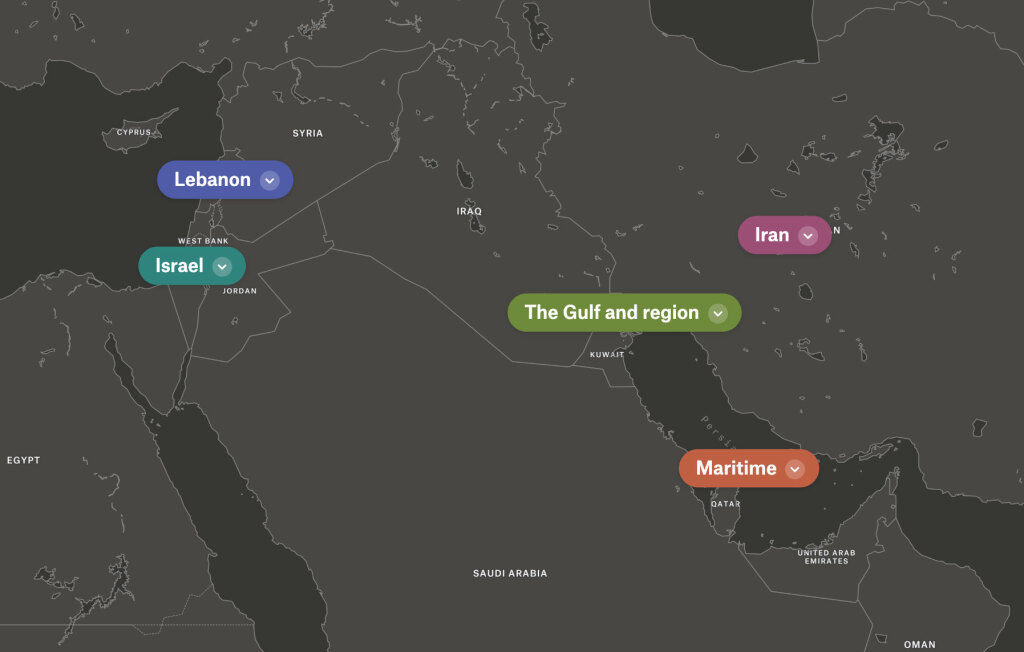
On February 28, 2026, the United States and Israel launched a large-scale attack on Iran, sparking a major war which impacted the entire Middle East, and resulted in harm to civilians across fourteen territories. A tentative ceasefire was announced 40 days later, with each side claiming victory.
In Iran, Israel, and Lebanon, accurately assessing the civilian status of those harmed can be complicated. In Iran and Israel, mandatory military service means that military affiliation extends across broad segments of the population. In Lebanon, organisations such as Hezbollah and the Amal Movement maintain armed wings while also participating in formal politics and providing, or maintaining links to, a range of civilian and social services, including civil defence and paramedic activities.
Civilians were also harmed across the Gulf, including in Bahrain, Kuwait, Oman, Qatar, Saudi Arabia, and the UAE, as well as in Iraq, Jordan, Syria, and Azerbaijan. Understanding the circumstances in which civilians were harmed in these contexts is also complex, as incidents were frequently reported as the result of missile interceptions and fallen munition debris.
This methodology note outlines how Airwars has worked to document harm to civilians across these diverse contexts in a consistent and methodical manner.
Airwars has traditionally focused on harm to civilians on land. However, in 2025 Airwars began documenting harm to those at sea, and has continued to do so over the course of this war. The methodology for documenting civilians harmed at sea can be viewed here.
Tracking vs. Research
In order to identify broad trends and patterns, Airwars’ monitoring teams track an evolving list of open sources throughout military campaigns. These might include news outlets, known journalists, Facebook pages or Telegram channels, and other fragmentary sites. As crises evolve, Airwars teams who mostly originate from the conflicts we’re monitoring conduct a continuous mapping of the open source environment to add to these monitoring lists and ensure we have as much coverage of a given conflict as possible. In order to identify a single incident, Airwars’ teams link multiple sources that contain a sufficient level of detail to pinpoint civilian harm within a particular moment in time and place. Alongside these pinpointed incidents, our researchers tag a closed set of observation fields to facilitate pattern analysis. These dataset forms the basis of any analysis that references tracking or monitoring data, which we generally are able to produce in advance of comprehensive incident-level research into each event. All analysis reflecting our tracking data should be treated as provisional, enabling a rapid birds-eye view of a given context.
Once an event has been tracked, Airwars undergoes a detailed multi-step research process, to produce each event as is found on our public archive. These more granular events enable much more detailed research, including analysis of location patterns, civilian casualty ranges, disaggregated analysis of harm by demographics such as age and professions.
How we have approached particular elements of this research is now outlined below.
Belligerent attribution
In line with Airwars’ standard methodology, while the U.S. and Israeli militaries have announced military operations in Iran (Operation Epic Fury and Operation Roaring Lion, respectively), incidents will only be categorised as ‘declared‘ if officials acknowledge incident-level events. In some cases, munitions are identified by Airwars’ specialist team that strengthen the evidence base pointing to a military’s involvement. In the absence of a corresponding military declaration, such identifications will not result in a ‘declared’ grading, but will be included as supporting information in the assessment.
Example incident
In Iran, local sources have rarely been able to differentiate between strikes carried out by U.S. Forces and the Israeli Military. This challenge is largely due to similarities in technology and munition capabilities, as well as extensive sale and purchase of military materials between the militaries. When local sources have attributed harm to both the U.S. and Israel, both U.S. Forces and the Israeli Military will be selected as belligerents and the incident will be graded as a ‘likely‘ strike, rather than a ‘contested strike’.
Example incidents
Airwars may document events in which sources are unable to attribute the incident to any particular belligerent, particularly in the Gulf where multiple belligerents are operating in close proximity. In such scenarios, the three main parties to the conflict – Iran, Israel, and U.S. Forces – will be recorded as potential belligerents, the strike status will be recorded as ‘contested‘, and the civilian harm status as ‘fair‘.
Example incident
In Israel, where sources fail to name a belligerent, strike status will be recorded as ‘contested‘, civilian harm status as ‘fair‘, and the three belligerents known to have committed harm in the area will be marked: the Israeli military, Iranian military, and Hezbollah.
Example incident
Fallen Munitions and Interceptions
In recording harm resulting from U.S., Israeli, and Iranian attacks, Airwars documented incidents in which civilians were injured or killed outside of Iran or Israel. In doing so, Airwars has documented civilian harm across the Gulf, in Bahrain, Kuwait, Oman, Qatar, and the United Arab Emirates. Airwars has also documented similar instances of harm in Iraq, Jordan, and Syria.
Interceptions outside Iran and Israel
In recording harm resulting from Israeli and Iranian attacks in June 2025, Airwars documented incidents in which civilians were injured or killed outside of Iran or Israel. In some of these incidents, local sources reported that harm resulted from falling missile debris after an interception by the local military. In these cases, strike status has been recorded as ‘contested’ as it is not possible to determine whether the harm resulted from the original missile or interception. Both the Iranian military and named local military have been recorded as belligerents, and the civilian harm status reflects the extent to which sources agree that civilian harm occurred. Where similar cases appear in Spring 2026, they are recorded accordingly.
Example incident
With most all interception incidents occurring in the Gulf states, it can be difficult to determine the relevant belligerents. In such a geography where states are very small and interceptions may extend beyond a state’s territory, local sources don’t always report the ‘relevant local military’ as the intercepting body, referring simply to an ‘interception’ or ‘air defenses’. In such instances, understanding the relevant belligerents is more complicated.
To account for this complication – in cases where sources refer to harm as a result of missile fragments from a named belligerent, and also refer to the missile being intercepted but don’t specify the intercepting party, the strike status has been recorded as ‘contested’ to account for the lack of clarity regarding the nature of the attribution of harm; the civilian harm status reflects the extent to which sources agreed that civilian harm occurred; and two belligerents have been recorded, the second one being ‘unknown’.
Example incidents
Where sources reference an interception but fail to name any belligerent – both the intercepting and original belligerent are not named – the strike status has been recorded as ‘contested‘ and the civilian harm status will reflect the extent to which sources agree that civilian harm occurred. The three main parties to the conflict – Iran, Israel, and U.S. Forces, have been recorded as possible belligerents.
Example incident
Edge case – contested
An incident reported on February 28, 2026 in Al-Suwayda, Syria, in which at least four civilians were killed has been recorded with a ‘contested’ strike status as some sources attribute the strike to an Iranian missile intercepted by Israeli air defenses, while others attribute the incident to an explosion caused by a failed attempt by Al-Hijri Guards to manufacture a missile. This is a more classic example of a ‘contested’ strike status (DEBSYR260228a)
Interceptions in Iran and Israel
In some cases, civilians in Iran and Israel are reportedly harmed by falling debris. When civilian harm occurrs in Iran or Israel and sources attribute the debris to a missile from Israel or Iran, respectively, as local sources agree that the original missiles were launched by the relevant foreign military and intercepted by the relevant local military, strike status will be recorded as ‘contested’ as it is unclear whether the resulting harm should be attributed to the original missile or interception. The civilian harm status has been recorded to reflect the extent to which sources agreed that civilian harm occurred.
Airwars is continuing to publish the 2026 archive and an example incident will be added to this section should a relevant incident be published.
Falling debris
In 2025, a number of incidents were characterised by local sources reporting that harm resulted from falling missile debris from a named belligerent and did not mention an interception. For such incidents, the strike status has been recorded as ‘likely’ to reflect source consensus in regard to the belligerent, and the civilian harm status has been recorded to reflect the extent to which sources agreed that civilian harm occurred.
Airwars is continuing to publish the 2026 archive and an example incident will be added to this section should a relevant incident be published.
Accidents related to conflict
In cases when civilians were injured out of fear (for example while running down the stairs, or from a heart attack), or died while responding to circumstances around a strike (ie. falling while running to a shelter), their injury or death has been recorded as an ‘accident related to conflict’, and the harm has not been quantified in the number of civilians killed or injured.
Example incident
Observations
Double-tap strikes
A double-tap strike denotes a second strike on an area, usually within 5 to 20 minutes of a first strike. Emergency response and medical personnel are often killed in the second strike. On March 1, 2026, Airwars researchers found that a medical clinic was hit shortly after a strike on a Basij base located about 200 meters away. Local reports indicate that a number of people injured in the first strike were killed in the second strike on the clinic. While the two strikes appear to have been about 200 meters away from each other, the strikes follow the pattern typical of double-tap strikes: having occurred in close succession, those injured in the first strike were killed in the second, and emergency/medical personnel were also among those harmed. As such, this incident has been recorded as a double-tap strike.
Example incident
Direct participation in hostilities
Under International Humanitarian Law, civilians are protected against attack ‘unless and for such time as’ they take direct participation in hostilities. As such, in line with Airwars’ methodology employed across conflicts, and including in documenting harm to civilians in Iran in June 2025, Airwars has recorded police as civilians, unless local sources reported that the individual was directly participating in hostilities, in which case Airwars has classified them as a militant.
Conscription
In Iran, while some may seek exemption, a system of compulsory military service requires men over the age of 18 to join one of the three branches of the Iranian security apparatus for a period of 14 to 24 months. The branches include the Iranian Army (Artesh), the Iranian Revolutionary Guard Corps (IRGC), or the police force (FARAJA). While inclusion in the army or IRGC make someone by definition a direct participation in hostilities, those who are conscripted into the police force are not. As such, when sources refer to someone as a “conscript” without defining their role, their civilian status will be recorded as ‘contested’ until further information is found.
When someone is referred to as a “conscript” in the IRGC or Iranian army, they will be classified as a militant. When someone is referred to as a “conscript” in the FARAJA or police force, they will be classified as a civilian unless local sources indicate that they were directly participating in hostilities.
Police / FARAJA
Airwars has documented incidents in which civilian members of the police / FARAJA were killed or injured. A number of these incidents are understood to have occurred in strikes on security infrastructure. In other incidents, police were killed or injured while in the field.
Noted above, IHL dictates that civilians are protected against attack ‘unless and for such time as’ they take direct participation in hostilities. As such, unless local sources allege that these individuals were participating in hostilities, they have been recorded as civilians. Airwars will be updated should additional information become available.
Airwars is continuing to publish the 2026 archive and an example incident will be added to this section should a relevant incident be published.
Basij
The Basij is a paramilitary volunteer militia making up one of the five branches of the Iranian Revolutionary Guard Corps (IRGC). The militia was established in 1980 in the context of the Iran-Iraq War, and officially incorporated into the IRGC in 1981.
Today, the Basij operate in a largely domestic capacity, serving as an auxiliary force engaged in maintaining regime control over society. The term ‘morality police’ generally refers to the Basij, and the group is responsible for suppressing dissent and preventing dissident gatherings.
Under the Geneva Conventions, Article 43 of Additional Protocol I, armed forces of a state include all organised armed forces, groups, or units. As the IRGC is a state armed force, and the Basij is a constituent branch, individuals cited as being members of the Basij have been recorded as militants unless sources reported a formal end to their affiliation.
Airwars is continuing to publish the 2026 archive and an example incident will be added to this section should a relevant incident be published.