
Incident Code
Incident Code
Incident Date
Location
Geolocation
Geolocation
Airwars Assessment
A declared Israeli missile attack resulted in two massive explosions in the Tajrish neighborhood and Quds Square (Bahonar Street area) in Northern Tehran, Iran, around 3:00 p.m. on Sunday, June 15, 2025, which targeted the reported location of a meeting of senior security figures. While the Minister of Health, Treatment and Medical Education officially cited 12 people killed, including a pregnant woman, and approximately 59 civilians injured, the Israeli military declined to comment on the specific Tajrish incident, despite having claimed, a day later, to have killed senior IRGC intelligence leaders in operations that included the area. Airwars was able to identify eleven civilians killed in the attack.
The IRNA Community Group reported that the Tajrish neighborhood was struck by the “missile attack and aggression”. Video evidence verified by the BBC confirmed the presence of two explosions: one directed at a building’s upper floors and another resulting from a projectile hitting the street. The target appeared to be the office of the Center for Mosque Affairs located on the upper floor of a Shahr Bank branch. Sources reported that senior IRGC security figures and the Ministry of Intelligence were said to have been holding a meeting in an informal location in Tajrish on the same day “to reduce the risk of an attack.”
Additional details on the attack were provided by the database “Civilians of Iran” which mentioned that at the time, the square was “civilians, shoppers, and passing vehicles.” In the first strike, a “guided munition” struck the upper floors of a six-story building on the square which housed in the upper floors an office of the “Regional Mosque Affairs Centre (Markaz-e Residegi be Omur-e Masajed, Shahid Bahonar district)” and on the ground floor a branch of Bank Shahr. The second munition hit the street surface of Quds Square (Meidan-e Quds), a public square, when vehicles were stopped at a red light. The munition reportedly penetrated the street and exploded underground, causing a large crater and damaging Tehran’s main water pipeline, as well as multiple cars, some of which were seen launched into the air.
Although the Israeli military declined to comment on the Tajrish explosion specifically, on June 16 the military published an article to its official website, announcing that it had killed IRGC Intelligence Chief Mohammad Kazemi, IRGC Quds Force Intelligence Chief Mohsen Bagheri, and their deputies in operations that included the Tajrish area.
The victims’ names and personal information, gathered from casualty lists and family testimonies, indicate that most were civilians engaged in daily activities.
Saleh Bayrami was a graphic designer who also worked for National Geographic. He was killed near Niyavaran in his car while returning from a work meeting. A social media source noted that he was 41 years old and an expert in graphics and advertising who had stopped for a red light near Quds Square when the missile exploded. Saleh was born in September 1983 to an Azeri family living in Tehran.
Twitter/X user @IranUnderFire shared two images of the late Saleh – he was a young man with short black hair and a trimmed black beard. In one of the images, he is seen sitting in a cafe, wearing sunglasses, a dark pullover and jeans, and smiling at a camera.
Mehrdad Kiakazemi (Khosro) was identified by the source Theninewish as a Snap driver. He was one of the 12 people killed at the red light in Quds Square. Born in 1970, he was killed at the age of 55 and resided in Pardis. He had two sons, Arshia (an electrical engineer) and Sadra (in tenth grade). Twitter/X user @theninewish shared the headshot of Mehrdad, a middle-aged man with a clean-shaven face, thick eyebrows and large brown eyes, wearing a white shirt and a white jacket.
Hooshang Naserpour was identified as a taxi driver from Borujerd, 70 years old. A relative interviewed by a Mehr News Agency reporter described him as “a quiet, unpretentious, hardworking and compassionate man” who was killed on a street of “work and life”. His body was buried in the Martyrs’ Cemetery of Borujerd. The image shared by the media showed Hooshang as an elderly man with a large forehead, thick eyebrows and a clean-shaven face, wearing a checked shirt.
Hafiz Bustani was an Afghan refugee, 45 to 47 years old, from Parwan Province. He worked as a janitor/caretaker in Tehran and had five children. A news archive (Zeinab Marzooqi report) cited his wife, Salima Bakhshandeh, who said he was hit as he was returning after visiting the building he maintained, and confirmed that “Even if we were killed, we would stay in Iran”. The family reported that the Martyrs’ Foundation had not yet issued a martyrdom certificate for him due to his nationality.
Facebook user Janitor Zahid Khirandish mourned the death of Hafiz, writing, “This bitter and unfortunate loss has saddened our hearts, and undoubtedly no words can soothe our deep sorrow. As a free and honorable man, he sacrificed his life in the path of honesty of faith, and defense of Islam for great human ideals.” Zahid added an image of Hafiz, who is seen as a middle-aged man with short hair, a thick, greying beard, wearing a white shirt and black trousers.
72-year-old Dr. Mohammad Hossein Azizi was an ENT specialist at Milan Hospital and member of the academic staff of the Academy of Medical Sciences. The Shargh Media Group reported that his colleague, Ebrahim Razmpa, said Dr. Azizi was killed while on the phone near Tajrish Square, and his body was found 500 meters away from the site of the explosion. Mohammed Azizi was born on March 15, 1953, in Fasa, Fars Province, completed his general medicine course at Shiraz University and his specialization course at Iran University of Medical Sciences. He was married and had a daughter, a veterinary specialist living in Canada.
Mohammed’s colleague Ebrahim Razmpa highly praised his achievements: “I have been practicing medicine for more than 45 years, and I can say that he was the most complete person in terms of morality, science and culture. The medical community has suffered a great loss.”
In the image shared by the media outlet, Dr. Azizi is seen as an elderly man with grey hair and a grey moustache, wearing a checkered shirt. His image was located against the backdrop of the Iranian flag.
Matin Safaian was a 16 or 17-year-old student and champion skater who studied mathematics. His dream was to open a skating school, according to his father, who also said: “Matin believed that sports were the best option for the fun, passion, and excitement of youth. He taught 6 or 7 people in the afternoons. He had his lifeguard certificate. He was fluent in English and French, and was one of the successful students of Imam Musa Sadr School in Region 1.” Matin’s mother, Azam Asaran, stated in a Hamshahri online report (Samira Babajanpour) that he had gone to Tajrish market to buy a gift for his teacher before being killed. His coach, Hamid Riahi, reported that Matin had laughed about the bombings, saying: “They won’t beat us”. He was buried next to his grandfather in Mashhad.
The report by Hamshahri contained several images of the boy – in one of them, he was running, in another one, he was standing alongside his skating coach Hamid Riahi, holding a sports award.
Fazlollah Faraji, a 60-year-old cabinetmaker and father of two daughters, was killed on June 15 while leaving his house for his daily chores on his way to work. His daughter, Delara Faraji, an operating room specialist at Imam Khomeini Hospital, confirmed that he had three years of participation in the Sacred Defense (the Iran-Iraq War).
Hamshahri online also reported on the death of accounting student 21-year-old Zahra Choubini while going to her home near the red light in Quds Square. Zahra was reportedly a student at National Skills University and was mourned by the Minister of Science, Research and Technology who expressed “condolences to the grieving family, friends, and acquaintances of this esteemed martyr, Ms. Zahra Choubini, a respected student of the Financial Accounting Department at the National University of Technology.”
Jawan online identified 34-year-old Ali Tizkar as among those killed in Tajrish, adding that he had been stopped in his car at a red light on his way to work when he was killed. Jawan online interviewed Ali’s father Nader Tizkar who said that Ali was his inly son born in Tehran. Nader described that Ali’s “kindness, purity, simplicity, compassion, and humanity were well-known. He was the fruit of my heart and the hope of my life, who sacrificed his life for the revolution and the country. My son attended elementary school at Qods School, middle school at Shahid Rajaee School in Region 8, and high school at Derakhshan School. He graduated from university with a degree in industrial engineering in Firouzkouh. He was a good, calm, and compassionate child since childhood. As he grew older, he would often visit our village of Dogol, Pol Sefid. His good deeds would reach the people of the village. At my son’s funeral in Dogol village, the villagers said that before we asked Ali Agha to take us, he would take farmers who had finished their work in the fields to Veresk or another destination. He was a very good child. He was studious and never harsh with his mother or me.” According to Nader, Ali was a “film cameraman” and had gone to work in his white Peugeot 206 car which was crushed by the explosion. He had renewed his license, and registered to be an organ donor, just three days before hw was killed.
Civilians in Iran named 42-year-old Alireza Jalalifar as one of the victims killed in the attack in Tajrish. According to IRNA, Alireza was Mazandarani, an ethnic group indigenous to the Mazandaran province on the southern shores of the Caspian Sea, and was from the town of Noor. According to a page on golzar.info which has since been deleted and was accessed on the Wayback Machine, Alireza was buried in the Martyrs’ Garden in Tehran. According to Minak News, Alireza was a “Pasdar (Guard) of Islam” – a member of the Islamic Revolutionary Guard Corps (IRGC). Therefore, Alireza has not been counted or listed among civilians. Another article by Vista News specified that Alireza was also an election observer and participated at polling places on Election Day, and included a statement from longtime friend and election observer veteran Hassan Joftpasand who was wounded in the same strike where Alireza was killed. It is unclear whether Hassan was also a member of the IRGC, as he mentions feeling Alireza’s loss at their “workplace…at their local base” possibly referencing a military base that they served at. Therefore, Joftpasand has been counted as a contested civilian until further information is found.
The incident in Tajrish documented by Civilians in Iran also included the name of 59-year-old Davoud Eyvazi Khameneh. According to @killedByIsraeli on X/Twiter, was a physician and a video since removed from Aparat but in which the description is still available referred to Dr. Davoud as a psychologist. ANA News Agency interviewed the son of Dr. Davoud who recounted that his father had been stopped at the red-light on his motorcycle in Quds Square when he was thrown from his motorcycle and died from the impact during the explosion. Based on footage that he viewed, his son believed that Dr. Davoud’s body was thrown four stories high.
Civilians in Iran also added the name of 31-year-old Mostafa Gashani to those killed. SNNTV interviewed Mostafa’s mother who said that her son had been killed on his way to class to hand in a flash drive to his professor. She told SNNTV that “when I heard the sound of the explosion, I knew from my heart that my son had been martyred.” Sedaye Iran Newspaper added that Mostafa was an only child and had been supporting his mother since his father’s death. Mostafa’s body was reportedly taken to Tajrish Martyrs’ Hospital.
Plot 42 of the Behesht Zahra Martyrs’ Garden was designated for the victims of the attacks, with 69 graves filled by July 23. The corpses, often recovered after days under rubble, included children and adults. Furthermore, the city of Borujerd, the hometown of Hooshang Naserpour, also hosted the funerals of several high-ranking military victims, including Brigadier General Meysam Moazzami Goodarzi of the IRGC.
Many eyewitnesses to the devastating attack shared their memories and impressions. In particular, the secondary, massive explosion on the street created a large, deep crater in Quds Square, causing water pipes to burst and filling the street with “mud and water”. An optical shop owner noted that the hole was so big that an SUV had fallen into it. Even the electric poles had broken and fallen to the ground. Images from the impact showed that “cars and motorcyclists waiting at a red light can be clearly seen being thrown into the air.”
While the official report indicated 12 people killed and 59 civilians injured, a juice seller working near Quds Square stated for News archive that at least 20 to 30 people were killed on the spot and more than 60 were injured. The juice seller reported seeing “only rubble and broken glass, gravel, broken trees, blood, bodies and crumpled cars,” stating that the scene was “a disaster”. The IRNA Community Group noted that the street was suddenly a scene of war with “corpses on the asphalt, the wounded being pulled out of the rubble with their bare hands”.
A janitor working at a girls’ school on Bahonar Street reported that the blast wave opened the school door and that people had brought the bodies inside the school for temporary shelter. According to her, the school was severely damaged, and the roof and windows of the classrooms were destroyed. She told IRNA journalists: “My children were crying and were shocked by fear.
An owner of an eyewear shop lamented to IRNA about its destruction, comparing the apocalyptic scenes after the explosion to footage from the Gaza Strip: “Nothing was there, everything in the shop had disappeared at once. The shop sign, the shop gate, the goods, the frames of the glasses, the lenses, everything was destroyed. It was exactly like the movies I had seen from the Gaza Strip; this street really looked like a street in Gaza.”
A resident of the Tajrish neighborhood emphasized the extensive damage to the infrastructure, noting that the blast wave had been so strong that all commercial, administrative, and residential units within a radius of several kilometers were damaged, from broken glass to the destruction of doors and walls.
The Head of the Ministry of Health’s information center, Hossein Kermanpour, provided broader casualty data, reporting that as of July 23, 610 people were killed in Israeli attacks between June 13 and July 23. The same source indicated that of the victims in the preceding ten days, 54 were women and children, five were medical personnel, and the majority of the injured and killed were civilians.
The sources emphasize the gap between official records and the lived reality, noting that narratives of fear and destruction are difficult to repair. Eyewitnesses, such as the juice seller, asserted that the “bodies, the wounded, the grieving people… these cannot be the result of imagination or rumor,” serving as “living proof that the disaster really happened”. The IRNA Community Group suggested that the attack was evidence that the enemy’s logic “made no difference between the front and the home, the soldier and the worker, or the battlefield and the Tajrish crossroads”.
Although the Israeli Defense Forces confirmed the strike, the military did not comment on resulting civilian harm. Hence, Airwars has graded the strike status of the incident as “declared”, but the civilian harm status as “fair.”
According to Civilians of Iran, quoting Tabnak, an Israeli SPICE “electro-optically guided bomb kit, a precision air-to-ground system requiring an actively identified visual target” was used for the street level strike, meaning the coordinates had been programed and was therefore a “targeted” strike.
Victims
Individuals
Geolocation Notes
Reports of the incident mention Quds Square (میدان قدس) in the Tajrish neighborhood (محله تجریش) in Tehran (تِهران). Analysing audio-visual material from sources, we have narrowed the location down to the following exact coordinates: 35.805259, 51.435901; and 35.804970, 51.434740.
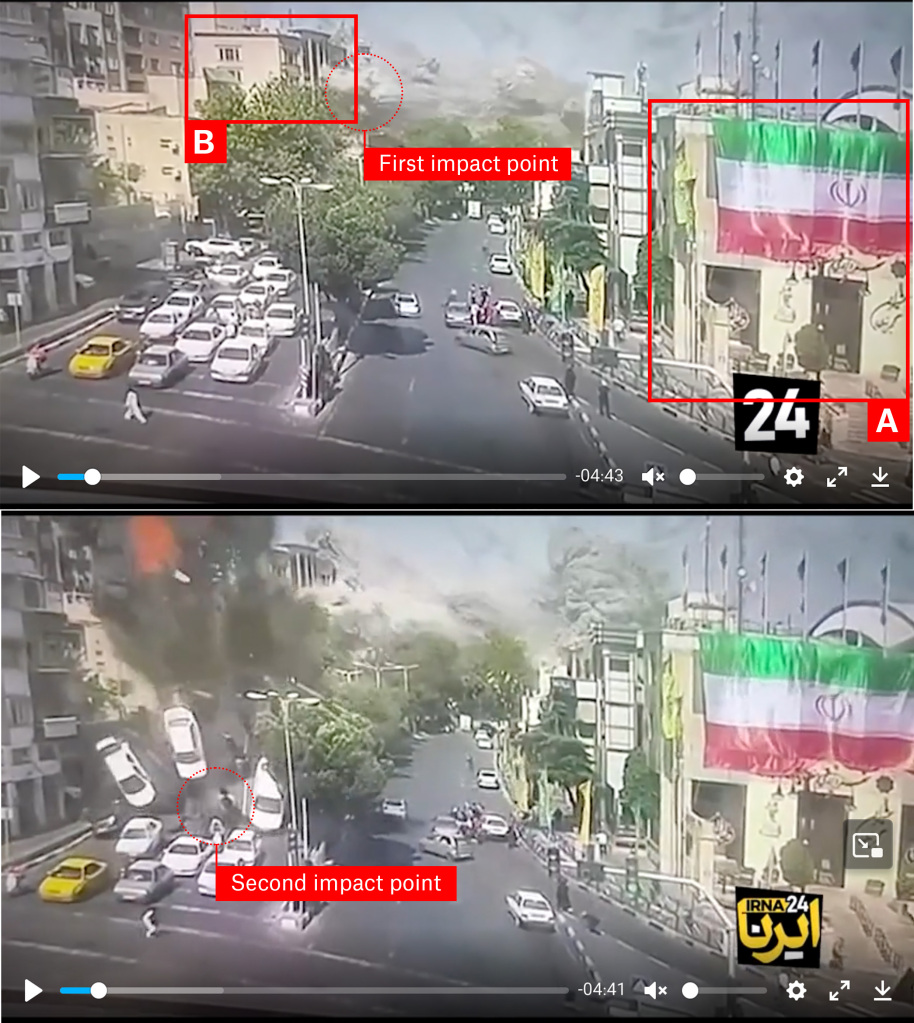
Imagery: خبرگزاری جمهوری اسلامی |صفحه اصلی | IRNA News Agency