
Incident Code
Incident Date
Location
Geolocation
Geolocation
Airwars Assessment
(Previous Incident Code: ISIR260228g )
During the morning of Saturday, February 28, 2026, Israel and the United States conducted a joint attack to assassinate the Iranian Supreme Leader Ayatollah Imam Ali Hosseini Khamenei in Tehran, as well as other senior Iranian officials and members of the Islamic Revolutionary Guard Corps (IRGC). The 86-year-old was the head of the Iranian military and therefore has been classified as a militant, but four members of his family and at least three employees (all reported to hold administrative/civilian roles) were also reported killed and have been recorded as civilians. This will be updated should additional information become available.
The Israel Defense Forces confirmed the assassination of Ali Khamenei in a public statement on Telegram and elsewhere, calling him the “Supreme Leader of the Iranian terror regime.” The statement specified that Khamenei was targeted in a precise, large-scale operation carried out by the Israeli Air Force, guided by IDF intelligence, while he was in his central leadership compound in the heart of Tehran. IDF also alleged that “Khamenei was the architect of the plan to destroy the State of Israel”.
The US military also took responsibility for the strike. US President Donald Trump wrote in a post on his Truth Social platform on the day of the attack that 86-year-old Khamenei that “one of the most evil people in History, is dead.” Trump added: “He was unable to avoid our Intelligence and Highly Sophisticated Tracking Systems and, working closely with Israel, there was not a thing he, or the other leaders that have been killed along with him, could do.”
Ayatollah Khamenei was not only the Supreme Leader of Iran, but also the commander-in-chief of the Iranian armed forces, which includes the regular artesh (army) and the IRGC. Therefore, he is not considered a civilian and as such is excluded from the list of civilian casualties below.
Harm to the Khamenei family (one injured, four killed)
At least five members of Ali Khamenei’s family were reportedly harmed in the strike. His wife, Mansoureh Khojasteh Bagherzadeh (Khamenei), was initially seriously injured and fell into a coma. Reports emerged that she had died of the injuries sustained in the attack days later, on March 2, as reported by BBC and @Nournews_ir on Telegram. However, Fars News announced on March 12th that she was still alive, correcting earlier reports, and therefore has been counted as injured. This will be updated should information to the contrary emerge. The images of Mansoureh shared on social media shows an elderly woman wearing a burqa and a black headscarf.
Among the civilians killed were Bushra Khamenei, Ali and Mansoureh’s eldest daughter; Zahra Haddad Adel, their daughter-in-law and wife of his son, Mojtaba Khamenei; Dr. Misbah al-Huda Bagheri Kani, their son-in-law and husband of their daughter, Hoda Khamenei; and Zahra Mohammadi Golpayegani, their 14-month-old granddaughter and daughter of Bushra Khamenei. Their deaths were reported by many local and international sources, including BBC, @News__Global on Twitter/X and @akhbarefori on Telegram. The deaths of Zahra and Misbah were also confirmed by Meysam Mozaffar, a member of the Tehran City Council.
Reuters reported that Mojtaba Khamenei, the second eldest son of Ali and Mansoureh, and the eventual successor as Supreme Leader, was injured in the attack. At the time of the attack, Mojtaba was in command of the Basij – a paramilitary militia making up one of the five branches of the IRGC – a position he had held since 2009. While many of the Basij’s roles involved domestic policing, based on the Basij being one of the five wings of the IRGC and the wider military structure, Mojtaba has been recorded as an injured militant, rather than civilian.
On Twitter/X, @MarianM8888 shared the images of Zahra Haddad Adel and Misbah-al-Huda Bagheri Cani. Zahra was a young woman wearing a black abaya and a black headscarf in the image. Misbah was a middle-aged man with grey hair and a greying beard, wearing a checkered shirt. The author of the post wondered why they had been killed together and alleged that they had been working together.
Misbah al-Huda Bagheri Kani was a faculty member at the Imam Sadeq University, and his death was mourned by the Imam Sadiq University Public Relations Office.
@khameneinews on Twitter/X shared the images of the young child Zahra, who had also been killed. The images showed a toddler sitting on a patterned chair, wearing a soft pink dress with a slightly sparkly skirt. The child had short light brown hair with a small decorative hair clip on the side and light-coloured eyes. In one of the images, she had a pacifier in her mouth.
The killing of civilian employees (four killed)
During Nowruz just weeks later, @Tasnimnews reported that members of the Imams’ Policy Council visited the family of Azim Dostifar, who they described as “an employee of the Municipality of District 11 of Tehran who was martyred while on duty on the first day of the attacks.” A video on Telegram by @ONNEWSMEDIA and published by @Gilin_Gilin included an interview with the wife and son of the gardener of the Supreme Leader’s house, Azim. Azad News Agency further mentioned that Azim had been killed in the vicinity of the Ayatollah’s house. Saeed Sahibdel and Akbar (Saeed) Khaji, both administrative assistants for Khamenei, were also killed. Sahibdel and Khaji were changing shifts when the strike occurred. Khaji was lauded as a “Hajj” for completing the Islamic pilgrimage to Mecca. Gholam-Ali Salehi, reportedly “one of the old servants of the house” and “served alongside the martyred leader for years”, was also among those killed in the strikes.
The killing of potential IRGC members, contested civilian status (2 killed)
Two others, one Mr. Jabbari – whose first name could not be identified – and Mohammad Hossein Maghami, were also reported killed. Both Jabbari and Maghami were members of Ali Larijani’s personal office; it is unclear whether they were also IRGC members. As such, their civilian status has been categorised as “contested.”
The killing of two bodyguards, militant status (2 killed)
The airstrike also killed two bodyguards of Ali Khamenei, Mustafa Nikouie and Mohammad Reza Saghafi Far. Mustafa Nekoei was originally from Esfarayen, and his funeral and burial ceremony were held in the presence of the people in the city of Esfarayen, North Khorasan.
Mohammad Reza Saghafi Far was one of Ali Khamenei’s oldest bodyguards and a close associate. The Tasnim news agency, affiliated with the Islamic Revolutionary Guard Corps, introduced Saghafi Far as Ali Khamenei’s old bodyguard and “special assistant”. The Mehr news agency, affiliated with the Islamic Propaganda Organization, also wrote that he was “serving the leader until the last moment of his life.” @official_rezamohammadi on Instagram shared an image of Mohammad Reza which showed a headshot of a middle-aged man with short dark hair and a greying beard.
Khamenei’s bodyguards are members of a military organisation (the IRGC), though their role is specialised in close protection rather than conventional combat. Both men are also extensively pictured in military uniforms while escorting Khamenei. Therefore, Airwars has excluded them from the civilian count and recorded them among the militant deaths.
The killing of known IRGC members, militant status (17 killed)
Others killed and associated with the IRGC were reported to be: Major General Seyyed Abdolrahim Mousavi, the Chief of the General Staff of the Armed Forces (source Mohammad Afzali); Commander Asadollah Badfar, the head of communications for the Leader’s military office (source Holy Defense News Agency); Brigadier General Mohammad Shirazi, the head of the Military Bureau of the Commander-in-Chief of the Armed Forces (source Mehdi Tolouvand); 47-year-old General Mohammad Ghanbari, IRGC member and head of Ali Shamkhani’s security team (source ISNA News Agency); Major General Akbar Ebrahimzadeh, the deputy head of the Military Office of the Supreme Commander of the Armed Forces (source Khabarfouri); Mohammad Pakpour, Commander-in-Chief of the IRGC (source Mohammad Afzali); Admiral Ali Shamkhani, an advisor to Khamenei for security affairs and Secretary of the Defense Council (source Mohammad Afzali); Major General Aziz Nasirzadeh, Minister of Defence and Armed Forces Logistics (source Mohammad Afzali); Major General Saleh Asadi, Major General of the IRGC, Deputy Intelligence of the Armed Forces General Staff and head of intelligence at Khatam al-Anbiya Emergency Command (source Iran International); Major General Mohsen Darrebaghi, pilot, Deputy Chief of Staff and deputy for “readiness, support, logistics, and industrial research” of the Armed Forces (source Borna News); Major General Gholamreza Rezaeian, head of the FARAJA Intelligence Organisation / Intelligence Directorate of Internal Security Forces (source Borna News); Major General Bahram Hosseini Motlagh, Major General of the IRGC and head of the Planning and Operations Department (source Borna News); Major General Hasan Ali Tajik, Major General of the IRGC, and head of the Preparedness / Supply Department of the Armed Forces General Staff (Borna News); Reza Mozaffarinia, former head of SPND, the Organisation of Defensive Innovation and Research (source Iran International); Mehdi Veyskarami, IRGC member in Khamenei’s guard unit (source Defa Press); and 37-year-old Mehdi Rahmani, bodyguard assigned to Abdolrahim Mousavi (source Anna News Agency). AmirReza Shiravand, IRGC member and Guard of Khamenei’s home was severely injured; he was reported killed six days later in another strike (source Asr Iran).
The Israeli military, posting to their official Telegram account (idfofficial) also reported that Seyyed Yahya Hosseini Panjaki (alias Seyyed Yahya Hamidi), Deputy Minister of Intelligence for Israeli Affairs and Jalal Pour-Hossein, Head of the Espionage Directorate in the Ministry of Intelligence were among those killed. Outside of the Israeli military’s announcement, Airwars did not find reporting naming the killing of these two military personnel in this incident. As such, their deaths, as reported by the Israeli military, have been excluded from the number of militants reportedly killed in this incident. This will be updated should additional information become available.
According to Tasnim, seven missiles hit an area near the presidential palace and the compound of Supreme Leader Khamenei. A satellite image shared by @maryam_rahmati, @trbrtc and others on Twitter/X showed several destroyed buildings on the place of his compound.
Many sources shared a video filmed by a witness who was heard saying: “They hit the Beit (Khameni’s house),” while two huge clouds of smoke are seen billowing in the skies.
Victims
Family members (5)
Individuals
Geolocation Notes
Reports of the incident mention a strike on the Iranian Supreme Leader’s residence in Tehran (اقامتگاه رهبر ایران در تهران). This incident was independently geolocated by Earth Observer, on soaratlas.com. Satellite imagery shows the strike location at the following exact coordinates: 35.692009, 51.399087.
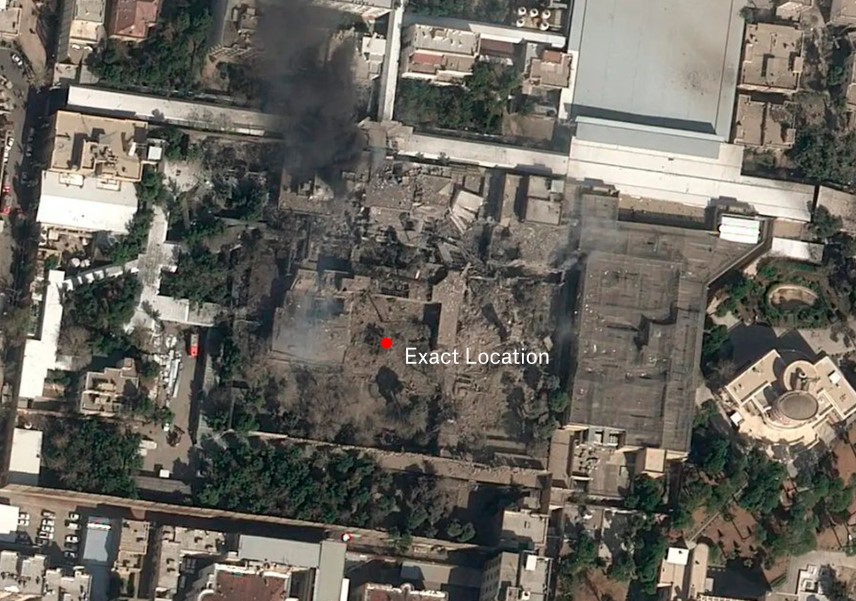
The first satellite image of Ayatollah Ali Khamenei's residence complex in Tehran after the joint Israeli-U.S. attack (Released by Airbus)
Imagery: maryam_rahmati